Philips Everflo 5 Liter Oxygen Concentrator vs Vandelay 5L (with Nebulizer)
Philips Everflo 5 Liter Oxygen Concentrator
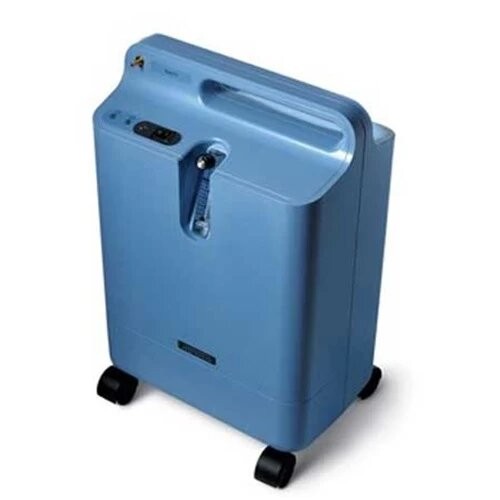
- Brand
- Philips Respironics
- Category
- 5 LPM
Discontinued
Indicative pricing based on market intelligence. Varies by dealer, city, bundle, and period — confirm with a local authorised seller before buying.
HHZ SCORE 8.2/10
Vandelay 5L (with Nebulizer)
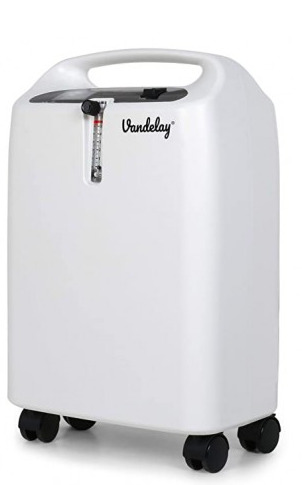
- Brand
- Vandelay
- Category
- 5 LPM
₹33,600
Indicative pricing based on market intelligence. Varies by dealer, city, bundle, and period — confirm with a local authorised seller before buying.
HHZ SCORE 5.7/10
Specifications compared
| Specification | Philips Everflo 5 Liter Oxygen Concentrator | Vandelay 5L (with Nebulizer) |
|---|---|---|
| Overview | ||
| Brand | Philips Respironics | Vandelay |
| Category | 5 LPM | 5 LPM |
| Price | — | ₹33,600.00 |
| Stock | DISCONTINUED WORLDWIDE | Out of stock |
| Key features | ||
| Purity | 90-96% | 90-95% |
| Type | Home Stationary | Home Stationary |
| Continuous Flow | 1-5LPM | 0.5-5LPM |
| Weight | 14kg | 14.5kg |
| Oxygen Purity Indicator (OPI) | Yes | No |
| Power consumption | 350watts | 300watts |
| Technical details | ||
| Purity | 90-96% | 90-95% |
| Type | Home Stationary | Home Stationary |
| Continuous Flow | 1-5LPM | 0.5-5LPM |
| Weight | 14kg | 14.5kg |
| Oxygen Purity Indicator (OPI) | Yes | — |
| Power consumption | 350watts | 300watts |
| Sound level | 45db | 45db |
| Dimensions | 23H x 15W x 9.5Dinch | 21.25H x 15.74W x 11.8Dinch |
| Operating altitude | 7500feet | — |
| Outlet pressure | 5.5psi | 8psi |
| Additional details | ||
| Loss of Power Alarm | Yes | — |
| System Malfunction Alarm | Yes | — |
| No Flow Alarm | Yes | — |
| Indian Voltage Model | Yes | Yes |
| Company Headquarters | USA | China |
| US FDA Approved | Yes | — |
| CE Certified | Yes | — |
Analysis
Editor’s note — Everflo discontinued. Philips has discontinued the Everflo worldwide; it is no longer in production and remaining units are end-of-line stock. For an in-production 5 LPM alternative available in India, consider the Home Medix HM-KV (up to 5 L/min, 93% ±3%, ≤40 dB, 3-year warranty). The comparison below is retained for reference.
Head-to-head comparisons in the Indian 5 LPM category usually come down to one question — is the cheaper imported alternative competitive enough with the Philips Respironics Everflo to displace it? The Vandelay 5L (with Nebulizer) tries to win that argument with two levers: a price roughly ₹10,099 below the Everflo and a bundled nebulizer module. For households running bronchodilator therapy alongside oxygen — post-COVID fibrosis patients, stable-phase COPD with reactive airway overlay, paediatric asthma — having the neb built into the concentrator unit saves a separate piece of equipment on the nightstand. That is an honest use case. Whether the Vandelay actually serves it well depends on how the rest of the spec sheet stacks up, and that is where the Everflo reasserts its lead.
At-a-glance
The Everflo is listed at ₹43,699 (since discontinued) and the Vandelay at ₹33,600 — a ₹10,099 gap, about 30% more for the Philips. Weight is 14 kg on the Everflo versus 14.5 kg on the Vandelay — effectively the same. Flow range is 1–5 LPM on the Everflo against 0.5–5 LPM on the Vandelay — the Vandelay’s 0.5 LPM minimum is an edge for paediatric or low-flow overnight titration. Purity is 90–96% on the Everflo and 90–95% on the Vandelay — functionally identical within PSA tolerance. Noise is 45 dB on both, a dead heat. Power draw is 350 W on the Everflo versus 300 W on the Vandelay — the Vandelay saves about ₹800–1,200 per year at typical Indian domestic tariffs and 10–12 hour daily runs.
Where the sheets diverge sharply is monitoring and certification. The Everflo carries US FDA approval, CE certification, and “Yes” on OPI plus all three alarms (loss of power, system malfunction, no flow) per manufacturer brochures. The Vandelay shows no FDA approval, no CE certification, and no OPI; the alarm rows (loss of power, system malfunction, no flow) are all empty on the Vandelay spec sheet. Outlet pressure is 5.5 psi on the Everflo and 8 psi on the Vandelay — the higher Vandelay pressure is useful for long cannula runs but is also common at this price point across Chinese-origin machines. Company HQ is USA for Philips Respironics, China for Vandelay.
Where the Everflo wins
The cleanest argument for the Everflo is the monitoring envelope. The OPI is not a nice-to-have — it is the only automatic way the machine can tell the caregiver that oxygen purity has degraded below roughly 82%. Without OPI, sieve-bed degradation is silent until the patient either notices worsening symptoms (SpO2 fall, dyspnoea) or a spot purity check is done with a separate oxygen analyser. For Indian 5 LPM ownership over a 3–5 year horizon, sieve-bed degradation is not a hypothetical failure mode; it is the single most common reason a concentrator stops meeting prescribed purity. The Everflo alarms on it. The Vandelay does not.
Beyond the OPI, the Vandelay’s spec sheet shows all three remaining alarm rows blank — loss of power, system malfunction, no flow. That means if the compressor develops a fault at 3am, if the tubing is disconnected or kinked, or if the mains supply drops and backup fails, the machine may not alert the household. For a clinical-grade home-oxygen installation — which is what a ₹30,000+ concentrator should be — that is a material gap. The Everflo’s “Yes” on all three is table stakes and the Vandelay has not cleared them.
US FDA approval and CE certification on the Everflo signal manufacturer-level design validation and electrical safety testing to defined international thresholds. The Vandelay listing shows neither mark. The practical implication is that the Philips machine has documented compliance paperwork behind every unit — useful for insurance claims, for hospital-home transition prescriptions, and for rental-supplier inventory accounting. The Vandelay does not carry that documentary layer.
Service network is the final Everflo edge. Philips Respironics has operated in India since before 2013, with service centres in all metros and most tier-2 cities, factory-trained technicians in dozens of locations, and dealer-held parts inventory that is nationally robust. Everflo sieve-bed replacement kits are stocked by multiple suppliers. Compressor replacements are a known, priced workflow. The Vandelay brand has a much thinner Indian presence — dealer visibility is limited and finding a factory-aligned service engineer outside the metros is not straightforward. Over a multi-year ownership horizon, that delta compounds. The Everflo’s published 3-year warranty sits on top of that service depth.
Where the Vandelay wins
The Vandelay’s case rests on three real advantages. First, the built-in nebulizer. For a patient on combined oxygen therapy plus inhaled bronchodilators — post-COVID fibrosis, stable-phase severe COPD with intermittent exacerbations, paediatric asthma with overlapping hypoxia — having the neb integrated into the concentrator is a genuine ergonomic win. It means one device, one power cord, one bedside footprint. A standalone Indian nebulizer retails at ₹1,500–3,500, so the Vandelay is bundling roughly that value, but the real gain is the integration, not the saving. The Everflo does not offer a neb integration.
Second, price. ₹33,600 versus ₹43,699 (since discontinued) is a ₹10,099 saving — about 23% off the Everflo. For a household with a short prescribed therapy horizon or a stretched budget, that is real money. The Everflo commands its premium for the monitoring and service-network reasons listed above; whether that premium is worth paying depends on the household’s circumstances and the patient’s clinical severity.
Third, the 0.5 LPM flow minimum. For paediatric prescriptions under 1 LPM, and for low-flow overnight titration where the patient is stable on 0.5 LPM through REM sleep, the Vandelay’s flow range is usable whereas the Everflo’s 1 LPM floor is not. This is a narrow but real advantage. Power draw is a secondary win — the Vandelay’s 300 W is 50 W below the Everflo’s 350 W, saving roughly ₹800–1,200 per year on electricity at typical Indian tariffs and use patterns.
The Vandelay’s outlet pressure of 8 psi versus the Everflo’s 5.5 psi is worth noting but not a clinical differentiator — at typical nasal-cannula lengths of 2–4 metres, both outlets deliver adequate flow at prescribed LPM settings.
Indian-market context
Stock position matters. The Everflo is listed In Stock in current e-commerce product listings. The Vandelay is listed Out of Stock — for a buyer whose prescription is today, that is a blocker. Stock availability in the Indian 5 LPM segment is meaningfully more predictable for established brands than for imported entrants whose Indian distribution is handled by third-party importers.
Indian ambient conditions — 35–42°C summer highs in plains cities, 60–80% RH in coastal belts, dust loads that are higher than the design envelopes of most OEMs assume — stress the compressor, the intake filters, and the sieve beds of every PSA concentrator. The Everflo’s decade-plus field record under these conditions is documented, with known failure modes, known parts lead times, and known service paths. The Vandelay does not have that field history; what it will look like at month 18 or month 30 of Indian residential use is an open question.
Resale: Philips Everflo units 2–3 years old sell on the Indian secondary market at ₹22,000–30,000, depending on hour meter and service history. Vandelay units rarely appear in transparent secondary listings; when they do, discounts of 60–70% off MRP within 18 months are typical. For households who may not need the concentrator for the full service life, resale is a meaningful component of effective cost of ownership, and the Everflo protects value better.
One nuance for the nebulizer question: if the bronchodilator-plus-oxygen use case is the driving factor, an alternative pairing is the Everflo plus a standalone Indian nebulizer (₹1,500–3,500). Total cost lands at ₹45,000–47,000, still ₹11,000+ above the Vandelay but with the monitoring, certification, and service depth of the Philips. Several Indian 5 LPM machines — notably the Oxymed Mini — also bundle a built-in nebulizer and ship with “Yes” on OPI and the full alarm suite. The Vandelay is not the only integrated option in the segment.
Verdict
The Philips Everflo 5 LPM wins this matchup for any buyer whose use case is chronic, clinical, or SpO2-managed home oxygen. The Everflo’s OPI and full alarm suite, US FDA and CE certifications, 3-year warranty, and Indian service-network depth together describe a machine designed to run safely unattended for years. The Vandelay’s spec sheet does not clear that bar — no OPI, no published alarms on three of four failure modes, no FDA or CE markings. For clinical home oxygen, the Everflo is the correct choice.
The Vandelay has a narrow but legitimate niche. If the household’s dominant need is combined oxygen-plus-nebulizer therapy in a single unit, if the prescribed oxygen horizon is short or intermittent (e.g., exacerbation-driven use rather than continuous), if the duty cycle will be modest, and if the ₹10,099 upfront saving meaningfully relieves budget pressure — the Vandelay can serve. We would still prefer an Oxymed Mini (also bundles a neb, also ships with OPI and full alarms) in that case, but between these two specific machines, the Vandelay has its use.
For 80% of 5 LPM buyers in India today, the answer is the Everflo. It is not the cheapest option, and it does not offer the nebulizer integration — but within the two-machine frame of this comparison, it is the one that actually meets the requirements of sustained clinical home use.