Home Medix HM-KV 5 LPM vs Philips Everflo 5 Liter Oxygen Concentrator
EDITORIAL PICK
Home Medix HM-KV 5 LPM
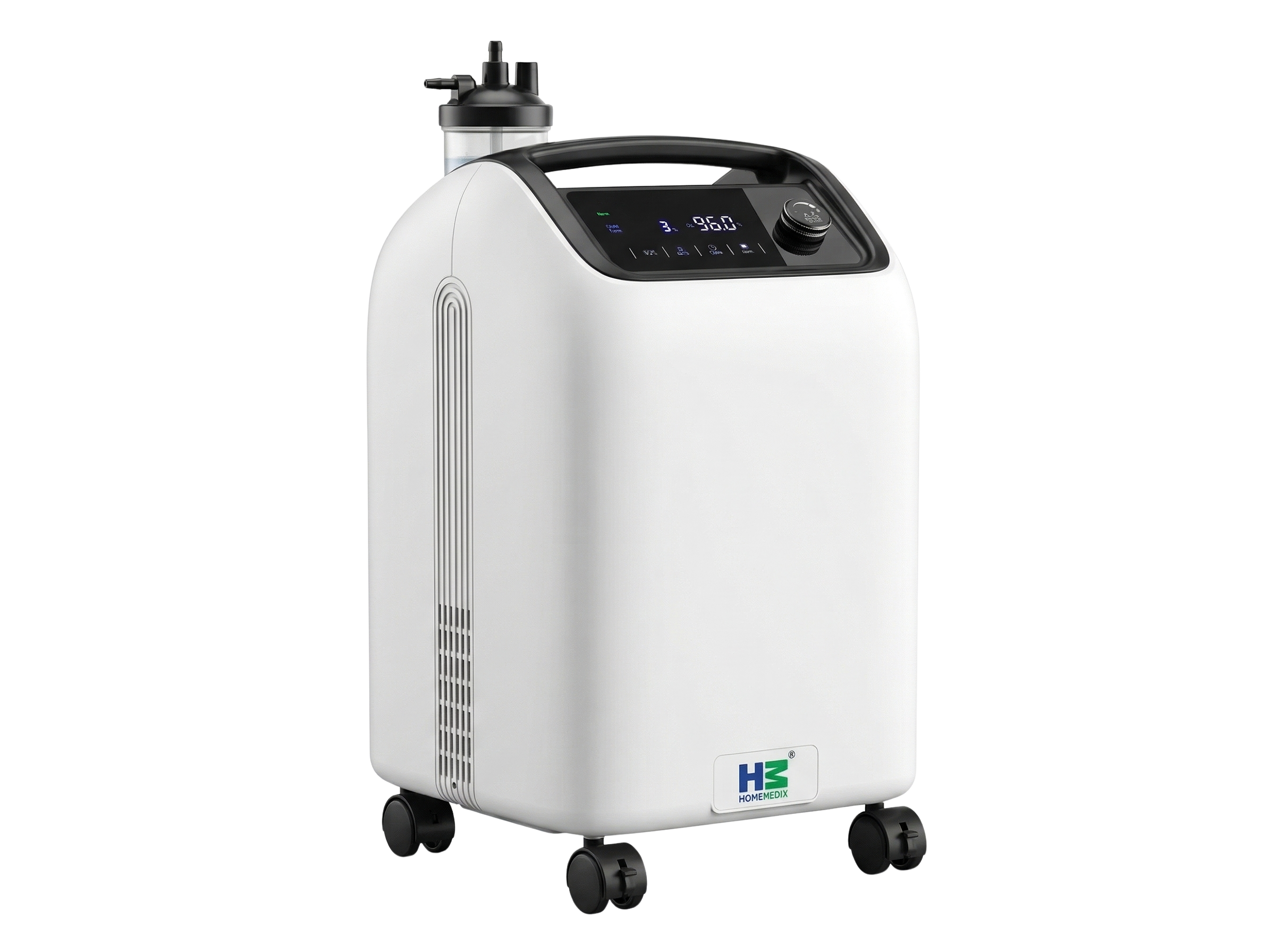
- Brand
- Home Medix
- Category
- 5 LPM
₹37,800₹54,000
Indicative pricing based on market intelligence. Varies by dealer, city, bundle, and period — confirm with a local authorised seller before buying.
HHZ SCORE 7.7/10
Philips Everflo 5 Liter Oxygen Concentrator
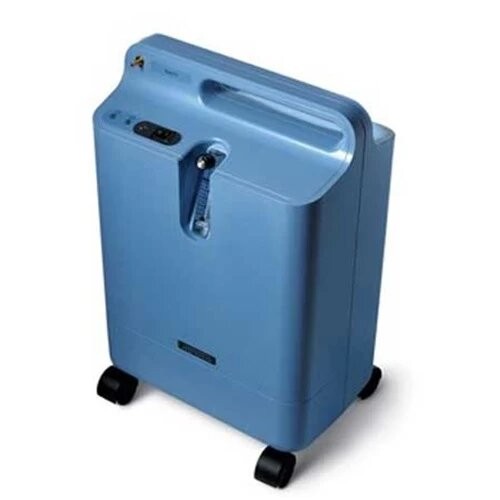
- Brand
- Philips Respironics
- Category
- 5 LPM
Discontinued
Indicative pricing based on market intelligence. Varies by dealer, city, bundle, and period — confirm with a local authorised seller before buying.
HHZ SCORE 8.2/10
Specifications compared
| Specification | Home Medix HM-KV 5 LPM | Philips Everflo 5 Liter Oxygen Concentrator |
|---|---|---|
| Overview | ||
| Brand | Home Medix | Philips Respironics |
| Category | 5 LPM | 5 LPM |
| Price | ₹37,800 | — |
| MRP | 54,000 | — |
| Stock | In Stock | DISCONTINUED WORLDWIDE |
| Key features | ||
| Purity | 93% ± 3% | 90-96% |
| Type | Home Stationary | Home Stationary |
| Continuous Flow | 0.5–5 L/min | 1-5LPM |
| Weight | 13 kg (lightest in the 5 LPM class) | 14kg |
| Oxygen Purity Indicator (OPI) | Yes | Yes |
| Power consumption | 320 VA | 350watts |
| Technical details | ||
| Purity | 93% ± 3% | 90-96% |
| Type | Home Stationary | Home Stationary |
| Continuous Flow | 0.5–5 L/min | 1-5LPM |
| Weight | 13 kg (lightest in the 5 LPM class) | 14kg |
| Oxygen Purity Indicator (OPI) | Yes | Yes |
| Power consumption | 320 VA | 350watts |
| Sound level | ≤ 40 dB (field-verified) | 45db |
| Dimensions | Compact floor-standing form factor | 23H x 15W x 9.5Dinch |
| Outlet pressure | 0.04–0.06 MPa | 5.5psi |
| Operating altitude | — | 7500feet |
| Additional details | ||
| Oxygen Purity % Analyzer | Yes | — |
| Loss of Power Alarm | Yes | Yes |
| System Malfunction Alarm | Yes (High Temperature) | Yes |
| No Flow Alarm | Yes (Low/No Flow) | Yes |
| Indian Voltage Model | Yes | Yes |
| Company Headquarters | India | USA |
| US FDA Approved | — | Yes |
| CE Certified | — | Yes |
| Home Medix differentiators | ||
| Integrated Nebulization | Yes | — |
| Precise Electronic Flowmeter | Yes | — |
| One-Touch SOS Alert | Yes — high-volume audible alarm button for summoning a nearby attendant (local siren; no mobile app or telecom channel) | — |
| Hour Counter | User-visible running-hour display | — |
| Working Voltage | AC 230V / 50Hz, ±10% tolerance (207–253 V) | — |
| Industrial-Grade Compressor | Yes | — |
| ISO 9001 | Yes | — |
| ISO 13485 | Yes | — |
| CDSCO | Approved | — |
| Warranty | 3 years or 10,000 hours of operation, whichever comes first | — |
Analysis
Editor’s note — Everflo discontinued. Philips has discontinued the Everflo worldwide; it is no longer in production and remaining units are end-of-line stock. For an in-production 5 LPM alternative available in India, consider the Home Medix HM-KV (up to 5 L/min, 93% ±3%, ≤40 dB, 3-year warranty). The comparison below is retained for reference.
The Home Medix HM-KV 5 LPM (indicative retail roughly ₹37,800 in 2026, listed MRP ₹54,000) and the Philips EverFlo 5 LPM (indicative retail roughly ₹43,699 (since discontinued) in 2026, listed MRP ₹63,228) represent the clearest value-versus-benchmark matchup in the Indian 5 LPM segment. The EverFlo is the established gold-standard import — US FDA approved, CE certified, the unit most Indian pulmonologists recognise by name, and the 5 LPM with the deepest authorised-dealer footprint in the country. The HM-KV is an Indian-manufactured unit that is, on paper, the lightest 5 LPM on the market, the quietest in its published class, and the cheapest of the three premium-spec picks we compare. Honest call: for the cost-focused LTOT buyer with reachable Home Medix service, the HM-KV is the better value. For buyers who put measurable weight on the Philips service network, on FDA/CE paperwork, or on resale-market depth, the EverFlo earns its premium.
At a glance
- Price (indicative retail, 2026). HM-KV roughly ₹37,800 vs EverFlo roughly ₹43,699 (since discontinued) — HM-KV ₹5,899 (13%) cheaper on current street pricing. MRPs: HM-KV ₹54,000; EverFlo ₹63,228.
- Weight. HM-KV 13 kg vs EverFlo 14 kg — HM-KV 1 kg lighter, the lightest 5 LPM on the Indian market.
- Sound (published). HM-KV ≤ 40 dB(A) (field-verified) vs EverFlo 45 dB — HM-KV 5 dB quieter at the bedside.
- Flow. HM-KV 0.5–5 L/min vs EverFlo 1–5 LPM — HM-KV reaches the 0.5 LPM floor.
- Purity. HM-KV 93% ± 3% vs EverFlo 90–96% — effectively equivalent bands.
- Power draw. EverFlo 350 W vs HM-KV 320 VA — HM-KV nominally lower, marginal at Indian tariffs.
- Operating voltage. HM-KV specifies AC 230V / 50Hz with ±10% tolerance (207–253 V); EverFlo ships an Indian-voltage variant without a separately-published tolerance band.
- Outlet pressure. EverFlo 5.5 psi vs HM-KV 0.04–0.06 MPa (~5.8–8.7 psi) — HM-KV at the top of its band nominally higher than EverFlo’s published figure.
- Altitude. EverFlo 7,500 ft; HM-KV not separately published.
- Alarms. Both publish Loss-of-Power, System-Malfunction, and No-Flow coverage. HM-KV additionally publishes Low-Oxygen-Concentration and High-Temperature alarms plus a one-touch SOS audible siren.
- Oxygen Purity Indicator. EverFlo has a documented OPI that trips below 82%. HM-KV publishes a Low Oxygen Concentration alarm.
- Regulatory. EverFlo US FDA + CE + Indian-voltage. HM-KV ISO 9001 + ISO 13485 + CDSCO. EverFlo has CE/FDA; HM-KV has neither.
- Warranty. Both 3 years. HM-KV caps additionally at 10,000 hours of operation.
Where the Home Medix HM-KV wins
13 kg — lightest 5 LPM on the Indian market. The HM-KV publishes 1 kg below the EverFlo’s 14 kg. The gap matters in practice: single-adult-carry up a flight of stairs, room-to-room relocation during the day, and reduced caregiver strain in multi-generational homes where the caregiver is often older or smaller-framed than the patient.
Field-verified ≤ 40 dB(A) vs EverFlo’s 45 dB published. 5 dB at the bedside is genuinely noticeable — the EverFlo at 45 dB sits at the common bedside threshold; the HM-KV at ≤ 40 dB is comfortably inside it and materially quieter for overnight use. Home Medix flags the figure as field-verified rather than a paper ceiling. For patients who sleep in the same room as the concentrator — the norm in most Indian home LTOT setups — the HM-KV is the more sleep-suitable device. The EverFlo is often sited in an adjacent room with cannula running through a door to manage the noise; the HM-KV does not force that trade-off.
0.5 LPM flow floor. The HM-KV delivers from 0.5 L/min; EverFlo publishes 1 LPM as its minimum continuous flow. For sub-1 LPM prescriptions (paediatric, very mild COPD, post-surgical tapering), the HM-KV can deliver the prescribed rate directly. The EverFlo forces the patient to either run at double the prescription or accept inexact bleeding-tube workarounds.
Documented AC ±10% voltage tolerance (207–253 V). HM-KV publishes an explicit Indian-mains tolerance band. EverFlo ships an Indian-voltage variant but does not separately publish the tolerance window. For buyers in Tier-2 and Tier-3 cities with mains routinely swinging outside the 207–253 V window, the HM-KV’s published band is the more honest design parameter. Both units need a servo stabiliser; the HM-KV’s spec tells you what the device protects itself against, which is load-bearing for warranty-claim discussions if voltage damage is disputed later.
Price — ₹5,899 cheaper at street. At roughly ₹37,800 indicative retail, the HM-KV undercuts the EverFlo by about 13%. Not a massive gap in absolute rupee terms, but it funds a decent servo stabiliser, several months of consumables, or a backup oxygen cylinder as a redundant supply.
User-visible hour counter. The HM-KV’s running-hour display on the front panel lets the patient track accumulated hours against the 10,000-hour warranty clause. The EverFlo spec sheet does not publish a user-visible counter — service-centre check may be required.
Expanded alarm suite plus one-touch SOS. Both units cover Loss-of-Power, System-Malfunction, and No-Flow. The HM-KV additionally publishes a Low Oxygen Concentration alarm and a High Temperature alarm. The EverFlo’s OPI light (trips below 82%) is the functional equivalent of the HM-KV’s Low-Oxygen alarm — both accomplish the same purpose via different mechanisms. The HM-KV’s one-touch SOS is a local high-volume audible siren button (not a telecom channel) for summoning a nearby attendant — useful for bedridden patients who cannot call out. The EverFlo does not publish an equivalent.
ISO 9001 + ISO 13485 + CDSCO. The full Indian regulatory stack is documented. That is the applicable Indian regulatory gate and the minimum credibility bar for a medical device sold in India. The EverFlo’s US FDA + CE is a superset — see the EverFlo’s column below.
Where the Philips EverFlo wins
US FDA approval and CE marking. The EverFlo carries both US FDA listing and CE certification. The HM-KV carries CDSCO — the applicable Indian regulatory gate — but neither CE nor FDA. For institutional tenders that specifically require FDA/CE paperwork, for hospital procurement audited to Western standards, or for buyers whose insurance reimbursement specifically cites Western regulatory badges, the EverFlo is the defensible pick. This is the clearest single advantage the EverFlo carries over the HM-KV on paper.
Deepest Indian authorised-dealer footprint in the 5 LPM segment. Philips Respironics has the most mature authorised-dealer network among 5 LPM imports in India — concentrated metro presence, credible Tier-1 coverage, and service-training depth accumulated over more than a decade in the market. Sieve-bed supply, compressor-part availability, and warranty-claim routing through the Philips India channel are the most established import ecosystem at this flow class. Home Medix authorised-dealer density is strongest in South and West India and thins outside Home-Medix-served cities; for non-metro buyers or buyers outside that corridor, the EverFlo is the lower-service-risk choice.
Brand recognition among Indian pulmonologists. Philips EverFlo is one of the most name-recognised 5 LPM units in Indian respiratory practice — often the unit a pulmonologist will reach for by default when specifying a home concentrator. Home Medix carries less prescription-channel pull. For patients whose pulmonologist explicitly prescribes “get a Philips”, switching to the HM-KV requires a conversation.
Installed-base advantage and technician familiarity. The EverFlo has been the benchmark Indian 5 LPM import for over a decade. Indian respiratory-equipment technicians are trained on the platform; service documentation is widely available; the sieve-bed supply pipeline is mature; third-party consumables (cannulas, humidifier bottles, dust filters) are all readily compatible. The HM-KV is a newer platform with a less-deep installed-base. For a unit that may need servicing in year 2 or 3, choosing the platform with the deeper local-knowledge base is a risk-reduction move.
Secondary-market resale. EverFlo retains the strongest secondary-market value of any 5 LPM in India — driven by brand recognition and the large installed base. Typical 12-month resale retention for a well-maintained EverFlo is meaningfully higher than for a Home Medix unit. For short-term use (post-operative oxygen, temporary respiratory episode, rental fleets), the EverFlo’s stronger resale retention narrows the upfront price gap.
Documented OPI trigger threshold. EverFlo’s Oxygen Purity Indicator is published to trigger below 82% — a specific, documented threshold. The HM-KV publishes a Low Oxygen Concentration alarm without specifying the trigger point in the spec table. Both accomplish the same purpose; the EverFlo’s documented threshold is the more transparent number.
Documented 7,500 ft altitude ceiling. EverFlo publishes a 7,500 ft operating altitude — comfortable for most Indian hill-station use (Gangtok, Darjeeling, Mussoorie, Manali, Shimla-adjacent). HM-KV does not separately publish an altitude rating. For hill-station buyers, the EverFlo’s published ceiling is the more honest design parameter to buy against.
Indian-market considerations
Both units ship Indian-voltage. HM-KV at 320 VA and EverFlo at 350 W both want a 500 VA minimum servo stabiliser (750 VA where mains routinely swings outside 207–253 V). Budget ₹3,000–6,000 for stabiliser plus ₹400–800 for a humidifier bottle, ₹80–200 per nasal cannula (monthly replacement typical), and a Y-connector or extra tubing if the concentrator sits in an adjacent room.
Altitude: EverFlo publishes 7,500 ft — safe for Shimla (~7,200 ft), Ooty (~7,300 ft), Gangtok (~5,400 ft), Darjeeling (~6,700 ft), Manali (~6,700 ft), Mussoorie (~6,500 ft), Srinagar (~5,200 ft), Munnar (~4,900 ft). HM-KV does not separately publish altitude — if the deployment is hill-station, the EverFlo’s published ceiling is the defensible choice. For setups above 7,500 ft (Leh, Tawang, higher Himalayan stations), neither of these two is the correct unit — the DeVilbiss 525 with its 13,123 ft ceiling is the right upgrade.
GST reimbursement: CGHS, ECHS, ESIC, and most private-insurance home-medical-equipment clauses reimburse against properly GST-invoiced 12% purchases. Both brands are compliant; EverFlo’s Philips India channel has the longer track record; Home Medix’s ISO + CDSCO documentation is standard and invoice-traceable.
Service-reach reality: EverFlo has broad pan-India coverage through Philips Respironics’ established distributor network and authorised dealers. Home Medix is strongest in South and West India. For buyers in Mumbai, Delhi NCR, Bengaluru, Chennai, Hyderabad, Pune, Kolkata, or Ahmedabad, both are well-served; for buyers in Guwahati, Bhubaneswar, Raipur, Patna, or smaller Tier-2 cities, EverFlo is generally the lower-service-risk pick unless a specific Home Medix authorised dealer is reachable from the pincode.
Humidity zones: Mumbai, Chennai, Kochi, Kolkata, Visakhapatnam and coastal cities stress inlet filters faster than the dry interior. Plan on quarterly filter rinses for either unit rather than the 6-month default — this is universal across PSA concentrators and not a brand difference.
Who should pick which
Pick the Home Medix HM-KV 5 LPM if: the patient is on standard plains-India LTOT, budget matters, the prescribed flow is 0.5–5 LPM, the concentrator lives in the bedroom during sleep hours (where the 5 dB noise advantage is material), authorised Home Medix service is reachable from your pincode, and FDA/CE paperwork is not a specific procurement requirement. For the cost-focused LTOT buyer in a Home-Medix-served South or West Indian city, the HM-KV is the sharper pick — lighter, quieter, with documented voltage tolerance and a one-touch SOS siren the EverFlo does not publish.
Pick the Philips EverFlo 5 LPM if: your pulmonologist has specified Philips by name, FDA or CE paperwork is required for institutional or insurance reasons, the deployment is outside the Home Medix authorised-dealer corridor (North-East, parts of Central India, non-metro Tier-2 cities), the unit will be resold within 2–3 years, the deployment is at hill-station altitude between 6,000 and 7,500 ft where EverFlo’s published ceiling is the defensible choice, or the buyer weights Philips’ mature pan-India service-network depth heavily.
Verdict
The HM-KV beats the EverFlo on the measurable spec-sheet axes that matter most for home bedroom use: weight, bedside noise, flow floor, documented voltage tolerance, explicit alarm coverage plus SOS siren, user-visible hour counter, and street price. None of those are marginal — the sound gap is genuinely noticeable, the weight difference is load-bearing for single-adult caregivers, and the voltage tolerance band is a real Indian-mains design parameter that the EverFlo does not publish as explicitly.
The EverFlo’s advantages are pan-India service-network depth, installed-base familiarity, FDA + CE paperwork, brand recognition among prescribing pulmonologists, documented altitude ceiling, and stronger resale retention. These are ecosystem advantages, not device-capability advantages. For standard Indian home LTOT buyers in Home-Medix-served cities, the HM-KV is the better pick. For buyers outside that service corridor, for FDA/CE-mandated procurement, or for resale-sensitive short-ownership horizons, the EverFlo earns its roughly ₹5,900 premium.
If you are unsure whether 5 LPM is enough headroom for the clinical trajectory, read our 5 LPM vs 10 LPM guide before buying either unit.