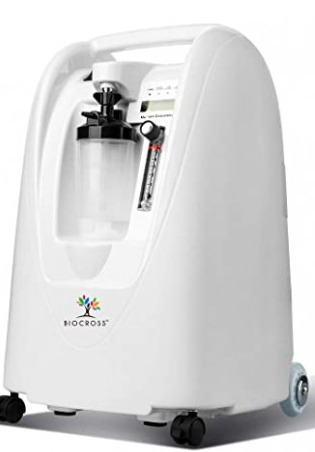
Home Medix HM-KV 5 LPM
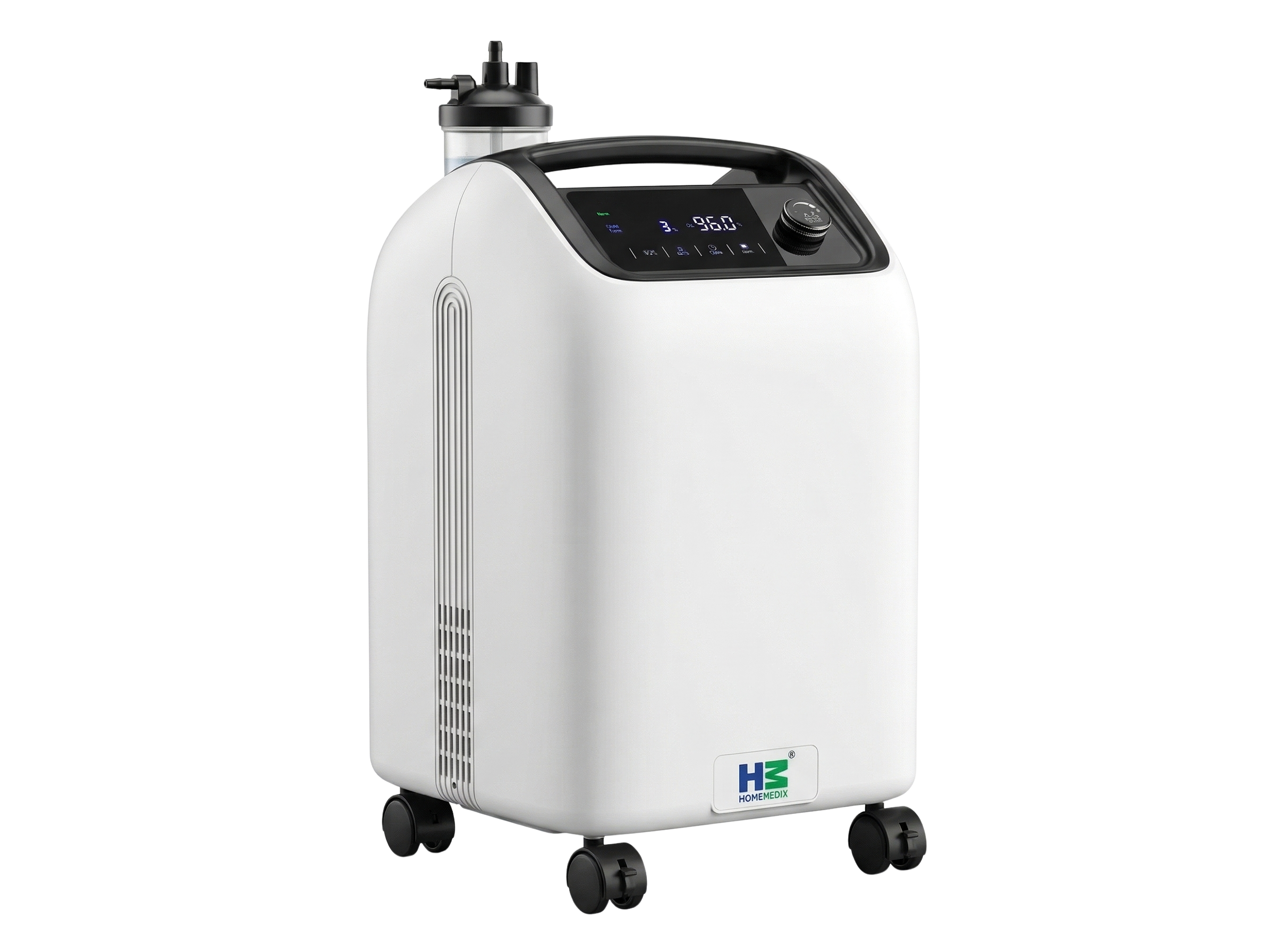
Key features
- Purity 93% ± 3%
- Type Home Stationary
- Continuous Flow 0.5–5 L/min
- Weight 13 kg (lightest in the 5 LPM class)
- Oxygen Purity Indicator (OPI) Yes
- Power consumption 320 VA
Specifications
| Purity | 93% ± 3% |
|---|---|
| Type | Home Stationary |
| Continuous Flow | 0.5–5 L/min |
| Weight | 13 kg (lightest in the 5 LPM class) |
| Oxygen Purity Indicator (OPI) | Yes |
| Power consumption | 320 VA |
| Sound level | ≤ 40 dB (field-verified) |
| Dimensions | Compact floor-standing form factor |
| Outlet pressure | 0.04–0.06 MPa |
| Oxygen Purity % Analyzer | Yes |
|---|---|
| Loss of Power Alarm | Yes |
| System Malfunction Alarm | Yes (High Temperature) |
| No Flow Alarm | Yes (Low/No Flow) |
| Indian Voltage Model | Yes |
| Company Headquarters | India |
| Integrated Nebulization | Yes |
|---|---|
| Precise Electronic Flowmeter | Yes |
| One-Touch SOS Alert | Yes — high-volume audible alarm button for summoning a nearby attendant (local siren; no mobile app or telecom channel) |
| Hour Counter | User-visible running-hour display |
| Working Voltage | AC 230V / 50Hz, ±10% tolerance (207–253 V) |
| Industrial-Grade Compressor | Yes |
| ISO 9001 | Yes |
| ISO 13485 | Yes |
| CDSCO | Approved |
| Warranty | 3 years or 10,000 hours of operation, whichever comes first |
Pros and cons
PROS
- Lightest 5 LPM on the Indian market at 13 kg — easier single-person carry and room-to-room relocation than Philips EverFlo (14 kg) or Nidek Nuvo Lite (~18 kg)
- Field-verified ≤ 40 dB(A) sound floor — class-leading at the bedside, ties Nidek Nuvo Lite and beats Philips EverFlo (~45 dB) and most mid-tier Indian competitors
- Full alarm suite: Low Oxygen Concentration, Power Failure, High Temperature, Low/No Flow — matches premium-tier coverage
- Live oxygen-purity percent display on the front panel — continuous real-time readout, not just a binary OPI threshold light. Matches the Oxymed Mini and Evox 5 LPM on this axis; one tier above the Philips EverFlo's OPI-only feedback
- Documented AC 230V ±10% tolerance (207–253 V) — voltage-surge behaviour is spec'd, not dealer-discretion
- User-visible hour counter — patient always knows how close they are to the 10,000-hour warranty clause
- 3-year / 10,000-hour warranty matches Tier-1 imports
- ISO 9001 + ISO 13485 + CDSCO approval all documented
CONS
- Service network concentrated in South and West India; authorised-dealer reach thins out in the North-East and parts of the hill belt
- Brand recognition among Indian pulmonologists sits below Philips, Nidek, and DeVilbiss — less prescription-channel pull
- Secondary-market resale value lower than the premium import tier (estimated 35–45% recovery at 12 months vs 55–65% for an EverFlo)
- No FDA approval and no published third-party bench validation; all spec numbers are manufacturer-sourced (even where field-verified)
- No clinician-facing telemetry or cloud-data platform
The Home Medix HM-KV is a 5 LPM home stationary oxygen concentrator positioned as an Indian-manufactured alternative to the Philips EverFlo / Nidek Nuvo Lite / DeVilbiss 5 LPM trio that dominates the premium tier. It is the company’s volume model, targeted at the long-term oxygen therapy (LTOT) buyer who wants a respectable spec sheet, a real Indian service address, and does not want to pay the 30–40% premium that imported units carry through the Indian distribution chain.
This review treats the HM-KV on the same rubric we apply to every 5 LPM concentrator: what the specs say, what they mean in practice, who should buy it, who shouldn’t, how it compares to real alternatives in the Indian market, and what an Indian buyer needs to verify before paying.
What the specs actually say
The published data sheet — corroborated across the v2 flyer and the current product catalogue — shows a genuinely competitive spec sheet with two class-leading numbers:
- Continuous flow: 0.5 to 5 L/min. Covers the full clinical range that a 5 LPM prescription needs. No pulse-dose mode; pure continuous flow, which is what LTOT patients are generally prescribed anyway.
- Oxygen concentration: 93% ± 3%. The standard medical-grade band for PSA home concentrators. Any manufacturer quoting purity above 96% at the outlet is either using different chemistry or stretching the truth; <= 96% is what you should actually expect.
- Sound level: ≤ 40 dB(A), field-verified. Class-leading. This is at the bedside-quiet end of the scale and materially quieter than a Philips EverFlo (~45 dB) or most mid-tier Indian competitors. It ties the Nidek Nuvo Lite, which is the traditional benchmark for quiet operation. Home Medix reports the figure is field-verified rather than a paper ceiling — a meaningful distinction in a market where quieter-sounding numbers are often unverified.
- Power consumption: 320 VA at AC 230V / 50Hz, with ±10% tolerance (207–253 V). The ±10% AC tolerance is spec’d and documented, not dealer-discretion. That matters in Tier-2 and Tier-3 Indian cities where mains can swing outside that band — the HM-KV will shut down on out-of-tolerance voltage rather than damage the compressor. Size a servo stabiliser at roughly 1.5× the VA draw; 500 VA is the minimum, 750 VA if mains regularly swings outside 207–253 V.
- Weight: 13 kg — lightest 5 LPM on the Indian market. Philips EverFlo is 14 kg, Oxymed Mini is ~14 kg, Nidek Nuvo Lite is roughly 18 kg, most Chinese OEM 5 LPMs sit at 16–21 kg. The 1–5 kg margin isn’t academic: it’s the difference between a single-person carry up a flight of stairs and a two-person job, and it materially reduces the friction of moving the unit between rooms during the day.
- Delivery pressure: 0.04–0.06 MPa. Enough headroom for nasal-cannula and mask delivery; no concerns at this flow class.
- Alarms: Low Oxygen Concentration, Power Failure, High Temperature, Low/No Flow. The full premium-tier alarm coverage — the Low/No Flow alarm is the one the budget tier most often omits, and catches tubing kinks, blocked filters, and mask disconnects that would otherwise go undetected overnight.
- Live oxygen-purity percent display. The HM-KV’s front panel shows a continuous real-time percent readout of delivered oxygen, not just the binary OPI threshold light most budget units give you. Caregivers can watch sieve-bed condition trend over weeks and months and intervene before an alarm fires. Matches the Oxymed Mini and Evox 5 LPM on this axis; one tier above the Philips EverFlo’s OPI-only feedback.
- User-visible hour counter. The running-hour display is on the control panel, so the patient can see how close they are to the 10,000-hour warranty-expiry clause without calling the service centre. A small thing, but it’s one of those tells that separates a carefully-specified medical device from a cost-engineered rebadge.
- Warranty: 3 years or 10,000 hours of operation, whichever comes first. Competitive with the import tier — Philips EverFlo commonly ships in India with a 3-year warranty, Nidek with 2 years, DeVilbiss with 3. The hour-counter clause is the honest bit: a unit running 16 hours a day hits 10,000 hours in about 20 months, so the “3-year” figure is the right planning number only for lighter-use patients.
- Certifications: ISO 9001 (quality management), ISO 13485 (medical device quality management), and CDSCO approval all documented. That combination is the minimum credibility bar for a medical device sold in India, and it is not universal at this price point — several sub-₹45k Chinese rebadges skip at least one of the three.
Who should buy the HM-KV
The honest buyer profile is narrow and specific:
- Long-term oxygen therapy patients in South or West India where the Home Medix service network is strong. Bengaluru is the company’s HQ; dealer density thins as you move out.
- Cost-conscious buyers who have been quoted ₹60k+ for a Philips EverFlo but want to stay under ₹50k without dropping to an uncertified Chinese rebadge.
- Warranty-sensitive buyers who would rather have a clean 3-year / 10,000-hour paper guarantee and an Indian service address than a Western brand name with a distribution chain that adds an extra layer between buyer and factory.
- Institutional buyers (hospitals, nursing homes, tender fulfillment) where ISO + CDSCO documentation is a procurement prerequisite and local GST-compliant invoicing matters more than brand badge.
Who should not buy the HM-KV
Equally important — the HM-KV is the wrong device for several buyer profiles:
- Patients in remote locations or the North-East. If the nearest authorised Home Medix service point is a flight away, a warranty claim turns expensive fast. Philips and Nidek have broader multi-city service footprints.
- Buyers who need >5 L/min at any point. The HM-KV caps at 5 L/min. If the clinical trajectory is deteriorating ILD or severe COPD likely to need 6–8 L/min in the next 18 months, start with the HM-KX or equivalent 10 LPM now rather than buying twice.
- Buyers planning resale after 6–12 months. Home Medix resale value is lower than Philips or Nidek in the second-hand market. A Philips EverFlo typically recovers 55–65% after a year; a Home Medix unit may recover 35–45%.
- Hospital-grade backup-unit buyers who need redundant alarms (flow-failure, low-pressure) and the data-logging that some Western units now carry.
How it compares to real alternatives
Three products the HM-KV most often gets cross-shopped against in the Indian 5 LPM market:
vs Philips EverFlo 5 LPM. The EverFlo is the gold standard: 14 kg, ≤ 45 dB(A) published, 90–96% purity, 3-year warranty. It lists at ₹55k–₹70k depending on channel and currently carries the strongest brand recognition among Indian clinicians. The HM-KV undercuts it on price by roughly 15–25% and matches it on paper warranty. The EverFlo wins on measurable reputation, service footprint, and secondary-market liquidity. The HM-KV wins on all-in landed cost and ISO/CDSCO paperwork. Pick the EverFlo if budget permits; the HM-KV if it does not and the service zone is right.
vs Oxymed Mini 5 LPM. Oxymed is the direct Indian-brand competitor and has the broadest dealer network in the country at the mid-tier price point. The Mini has similar published specs — 5 L/min, 93% ± 3%, ~45 dB(A), 14 kg. On paper, the HM-KV’s sound claim (≤ 40 dB(A)) is quieter and its flowmeter is electronic rather than mechanical, but demand a showroom listen before assuming either brand’s published dB matches your actual room. Pick the Mini for service-footprint assurance in smaller cities; the HM-KV for the warranty and feature list.
vs Nidek Nuvo Lite 5 LPM. Nidek ships a premium Japanese engineering story, FDA approval, and a ≤ 40 dB(A) bench spec that is trusted in clinical practice. The Nuvo Lite is the quietest genuine bedside unit in the class. It also lists at ₹75k+ in India. The HM-KV cannot match the Nidek’s clinical trust but also doesn’t ask for Nidek pricing. Pick the Nuvo Lite if sleep-quality-critical and budget is not the constraint; the HM-KV otherwise.
Indian-market considerations
Practical things a buyer needs to verify before committing:
- Service reach from your pincode. Home Medix publishes a dealer list; call the nearest one and ask specifically about warranty-claim turnaround and whether they stock sieve beds and compressors locally. If the answer is “we send it to Bangalore”, factor in 2–3 weeks of downtime for any major service event.
- Voltage stability at your meter. The HM-KV is rated AC 230V / 50Hz. If your local mains swing regularly outside 200–250 V — common in small-town and semi-urban India — use a servo stabiliser. Without it, a voltage surge can fry the compressor motor and most warranty fine-print excludes voltage-related damage.
- GST invoicing. Buy from an authorised dealer with proper GST invoicing. The 12% GST on medical devices is legitimate and some buyers qualify for reimbursement through CGHS / ESIC / private-insurance home-medical-equipment provisions.
- Altitude use. At hill-station altitudes (2,000 m+), published purity may drop 2–4 percentage points. Not uniquely a Home Medix issue — every PSA concentrator derates at altitude — but worth verifying in-use if the patient will be at Shimla, Gangtok, Manali, or similar.
- Humidity. Coastal India (Mumbai, Chennai, Kolkata, Kochi) stresses inlet filters faster than the dry interior. Plan for quarterly filter rinses rather than the 6-month default in the service manual.
Verdict
The HM-KV is a genuinely competitive 5 LPM home concentrator that earns a place near the top of the short list for Indian buyers. Two class-leading specs — lightest in the 5 LPM class at 13 kg and field-verified ≤ 40 dB(A) sound — are real, measurable advantages over the premium imports, not marketing rounding. Full alarm coverage (including Low/No Flow), documented AC ±10% tolerance, user-visible hour counter, and 3-year / 10,000-hour warranty all meet or match the import tier.
The remaining gap to a Philips EverFlo or Nidek Nuvo Lite is not product capability — it is brand recognition among prescribing clinicians, secondary-market resale value, and service-network breadth outside the South-and-West Indian corridor. Those are ecosystem gaps that take time and scale to close, not spec-sheet problems.
For LTOT patients in Home-Medix-served cities, the HM-KV is a sensible purchase. For patients in remote or North-East regions where authorised service is a flight away, the premium import’s broader footprint is worth the price premium. For anyone likely to escalate to >5 L/min flow in the next 18 months, look at the HM-KX instead.
If you are unsure whether 5 LPM is enough for your clinical trajectory, read our 5 LPM vs 10 LPM guide before buying either class.
Frequently asked questions
What is the HM-KV's oxygen purity?
93% ± 3% across the flow range of 0.5–5 L/min, per the published technical specification. This is the standard medical-grade purity band for PSA home concentrators.
Is the HM-KV approved for use in India?
Yes. Home Medix lists ISO 9001 and ISO 13485 certifications and CDSCO approval for the HM-KV. It is designed to run on AC 230V / 50Hz with ±10% tolerance.
How loud is the HM-KV at bedside distance?
The published specification is ≤ 40 dB (field-verified). That sits below the common 45 dB bedside threshold and ties the Nidek Nuvo Lite as the quietest 5 LPM on the Indian market.
What is the warranty?
3 years or 10,000 hours of operation, whichever comes first — a standard home-stationary concentrator warranty term.