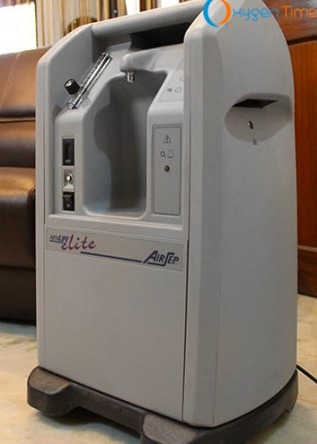
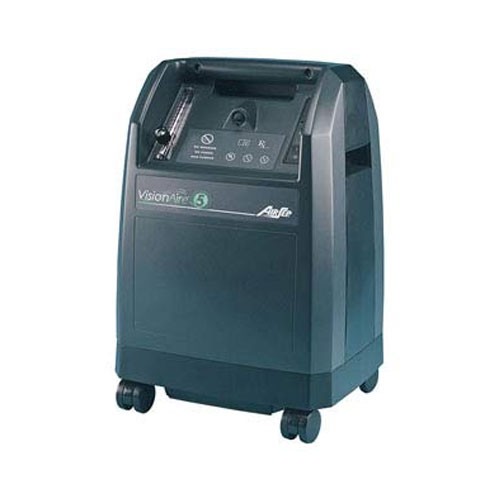
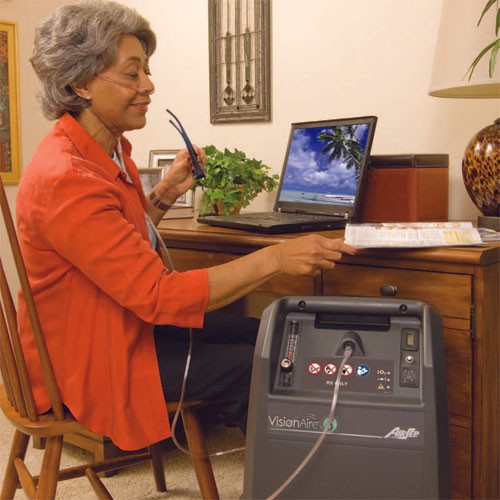
Airsep Visionaire 5
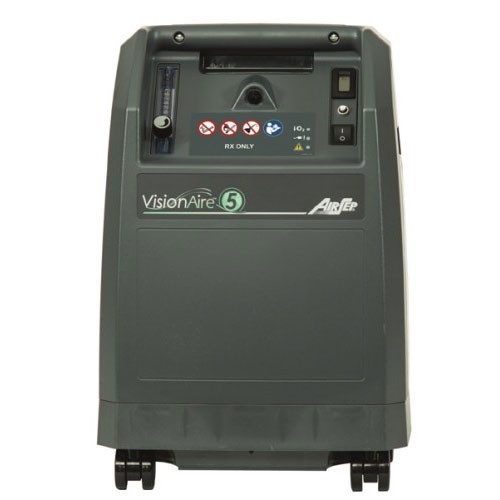
Key features
- Purity 90-96%
- Type Stationary
- Continuous Flow 0.5-5LPM
- Weight 13.6kg
- Oxygen Purity Indicator (OPI) Yes
- Power consumption 290watts
Specifications
| Purity | 90-96% |
|---|---|
| Type | Stationary |
| Continuous Flow | 0.5-5LPM |
| Weight | 13.6kg |
| Oxygen Purity Indicator (OPI) | Yes |
| Power consumption | 290watts |
| Sound level | 45db |
| Dimensions | 20.8H x 14.1W x 11.5Dinch |
| Operating altitude | 10000feet |
| Outlet pressure | 8psi |
| Loss of Power Alarm | Yes |
|---|---|
| System Malfunction Alarm | Yes |
| No Flow Alarm | Yes |
| Indian Voltage Model | Yes |
| Company Headquarters | USA |
| US FDA Approved | Yes |
| CE Certified | Yes |
Pros and cons
PROS
- 290 W published power draw is the lowest in the 5 LPM class — 17% lower than the Everflo's 350 W and 50% lower than most Indian 5 LPM units
- 13.6 kg weight is lighter than any other imported 5 LPM stationary, easing single-caregiver room moves
- 10,000 ft operating altitude opens all of Himachal, Uttarakhand, and Sikkim except the highest Leh-Spiti addresses
- Full alarm suite (loss of power, system malfunction, no flow) plus OPI — complete monitoring for unattended 24x7 operation
CONS
- Airsep/CAIRE service network in India is meaningfully thinner than Philips Respironics — dispatch times in tier-2 cities are longer
- 8 psi outlet pressure is higher than the Everflo but still modest for long cannula runs
- ₹54,999 indicative retail is 26% higher than the Everflo (₹43,699)
The Airsep Visionaire 5 is the clearest head-to-head alternative to the Philips Everflo in the Indian 5 LPM stationary segment. At indicative retail ₹54,999 (varies by region/dealer), it is priced roughly 26% above the Everflo’s ₹43,699, and it delivers tangible spec advantages in three areas that matter for Indian home-oxygen use: power efficiency (290 W vs 350 W), altitude envelope (10,000 ft vs 7,500 ft), and weight (13.6 kg vs 14 kg). Stock is In Stock, it is US FDA approved and CE certified per manufacturer brochure and e-commerce product listings, and it is shipped as an Indian Voltage Model. The single load-bearing reason it isn’t the default pick for most Indian buyers is service-network depth.
What the specs actually mean
Published purity is 90–96% — the high end of the PSA 5 LPM class and identical to the Everflo’s rating. The Visionaire 5 has an Oxygen Purity Indicator (OPI) flagged “Yes” in its technical details, which alarms below roughly 82% purity. Combined with a full alarm suite (loss of power, system malfunction, no flow all flagged “Yes” in additional details), this is a complete monitoring envelope for unattended 24x7 operation.
Flow range is 0.5–5 LPM continuous, which edges the Everflo’s 1–5 LPM — the 0.5 LPM minimum matters for paediatric prescriptions and for low-flow titration during sleep. Most adult prescriptions sit in the 2–3 LPM band where both machines are equivalent.
The 13.6 kg weight is 400 grams lighter than the Everflo. That is not a headline difference, but it puts the Visionaire in the lightest tier of imported 5 LPM stationaries. The Nidek Nuvo Lite, the Companion 5 (16.3 kg), the Invacare Platinum range — all heavier. For a caregiver moving the machine between bedroom and living room daily, 13.6 kg is closer to the ergonomic line than 16 kg.
Published power consumption of 290 W is the lowest in the 5 LPM class. On a 24x7 prescription at a 9 per kWh tariff, 290 W × 24 × 30 / 1000 × 9 = ₹1,880 a month — compared to ₹2,268 a month for the Everflo at 350 W. Over a 3-year prescription, the cumulative electricity saving is close to ₹14,000, which partially offsets the ₹11,300 retail price premium over the Everflo. For buyers on unsubsidised commercial tariffs the gap widens further.
The 45 dB published sound level matches the Everflo exactly. It sits below the 50 dB threshold that becomes disruptive at bedside placement, and above the ~40 dB floor of the premium portable segment. For a small Indian bedroom, the two machines are functionally equivalent on sound.
Operating altitude: where the Visionaire wins
10,000 ft (3,048 m) operating altitude is 2,500 ft higher than the Everflo’s 7,500 ft rating. That is a meaningful difference for Indian buyers — Shimla town (7,100 ft) is inside both envelopes, but pilgrimage routes and tourist destinations between 7,500 and 10,000 ft only work inside the Visionaire’s envelope. Darjeeling (6,700 ft), Gangtok (5,400 ft), Mussoorie (6,600 ft), Ooty (7,300 ft), Munnar (5,200 ft) — all inside both machines’ envelopes. Nainital (6,800 ft), Shimla (7,100 ft), Auli (8,530 ft), Kausani (6,250 ft) — all OK on the Visionaire, and Auli is outside the Everflo’s envelope. For a buyer planning any hill-station extended stay above 7,500 ft, the Visionaire is the safer altitude choice.
Who should buy it
The Visionaire 5 is the right buy for a long-duration 5 LPM home-oxygen prescription where the household has either higher-altitude requirements (between 7,500 and 10,000 ft) or higher electricity cost sensitivity (commercial tariff, 24x7 use) than the typical Everflo buyer. The spec delta on altitude and power are both genuine, and both translate to concrete monthly rupee savings or concrete clinical capability.
It is the right buy for a household where the machine will be moved frequently between rooms — the 400 g weight advantage over the Everflo is marginal, but the overall weight is at the low end of the class. For a single caregiver moving the machine without help, this matters.
It is also the right buy for patients on paediatric prescriptions or requiring very-low-flow titration — the 0.5 LPM floor is half the Everflo’s 1 LPM minimum, and for a 0.5–1 LPM prescription this is a real difference.
For a buyer who has an Airsep/CAIRE authorised dealer within their city with a documented service SLA in writing, the ₹54,999 indicative retail is defensible against the ₹43,699 Everflo price. The service-network qualifier is critical — most Indian buyers will find the dealer network thinner than for Philips.
Who shouldn’t
Anyone in a tier-3 Indian city or rural district without an Airsep-authorised service partner within a 48-hour dispatch radius should not buy the Visionaire. The Everflo’s biggest advantage is simply that a Philips-trained biomedical technician is easier to find, and in a service call that can mean hours to respond versus days. For a 24x7 unattended machine, that matters more than any spec advantage.
Anyone whose prescription is above 5 LPM should not buy any 5 LPM concentrator — look at 10 LPM units such as the Devilbiss 10 LPM or Nidek Nuvo 10 litre.
Anyone needing a battery-powered portable should not buy any stationary concentrator — look at the Philips SimplyGo, Inogen One G5, or SimplyGo Mini depending on prescription mode.
And anyone for whom the extra ₹11,300 retail price premium over the Everflo is a real budget constraint should just buy the Everflo. The spec advantages are genuine, but below 7,500 ft the altitude benefit is moot, and under-18-hours-a-day use blunts the electricity benefit.
How it compares to real alternatives
Visionaire 5 vs Philips Everflo 5 LPM
The fundamental head-to-head. Everflo: 14 kg, 350 W, 45 dB, 7,500 ft altitude, 3-year warranty, ₹43,699, deepest India service network. Visionaire 5: 13.6 kg, 290 W, 45 dB, 10,000 ft altitude, Indian voltage, ₹54,999, thinner India service network. Pick the Everflo if your altitude is below 7,500 ft and service-network depth matters more than electricity savings. Pick the Visionaire if you need the altitude headroom or your use is 24x7 at commercial tariffs and the ₹14,000 three-year electricity saving matters. For most buyers, the Everflo still wins on the service-network tiebreaker.
Visionaire 5 vs Companion 5 LPM
The Caire Companion 5 LPM (Out of stock at the time of our editorial review) is 16.3 kg, 285 W, 50 dB sound, 9,879 ft altitude, 4.6 psi outlet, ₹66,240. It lacks OPI, which is a real gap. The Visionaire wins on weight, sound, OPI, and price. Pick the Companion over the Visionaire only if it is in stock, the buyer has a Caire service contact with fast turnaround, and the 2.5 psi outlet pressure difference matters — it usually doesn’t. For an apples-to-apples comparison, the Visionaire is the stronger 5 LPM buy.
Visionaire 5 vs Indian-made 5 LPM (e.g., BPL Oxy 5 Neo, Nidek Nuvo Lite class)
Indian-made 5 LPM units typically sit in the ₹35,000–50,000 range with 5-year warranties, shorter service turnaround in-country, and sometimes CDSCO registration that Airsep/CAIRE lacks. The Visionaire wins on power draw (290 W vs typical 400–600 W), altitude envelope, and OPI sophistication. The Indian-made units often win on warranty length and service-call turnaround. Pick the Indian-made unit if budget is tight and 5-year warranty matters. Pick the Visionaire if power efficiency and altitude are load-bearing.
Visionaire 5 vs Inogen at Home
Inogen at Home: 8.16 kg, 100 W published, altitude not published, no OPI, ₹1,87,200, Out of stock. Visionaire 5: 13.6 kg, 290 W, 45 dB, 10,000 ft altitude, has OPI, ₹54,999, In Stock. The Inogen at Home wins on weight (40% lighter) and power (66% less) but lacks OPI and active stock. The Visionaire wins on OPI, published altitude, sound level, price (71% cheaper), and availability. For most buyers the Visionaire is the correct pick; the Inogen at Home justifies its premium only for very specific mobility-between-addresses use cases.
Clinical deployment considerations
The Visionaire’s 8 psi outlet pressure is the strongest in the peer set. Everflo is 5.5 psi; Companion is 4.6 psi; Visionaire is 8 psi. For multi-room deployments — machine in the living room, patient in the bedroom with a 30–40 ft cannula run — the 8 psi Visionaire handles the pressure drop better than the Everflo or Companion. For patients whose home layout requires the machine to live in a different room from the patient (noise isolation, space constraints), the Visionaire’s higher outlet pressure is a genuine advantage.
The 0.5 LPM continuous-flow floor is useful for nocturnal low-flow titration. Many pulmonologists prescribe 0.5–1 LPM overnight, stepping up to 2–3 LPM during waking hours, and the Visionaire’s 0.5 LPM minimum flow matches the prescription directly. The Everflo’s 1 LPM minimum means overnight titration below 1 LPM requires a different setpoint than prescribed — a small but real inconvenience for patients whose pulmonologist specifies sub-1-LPM sleep flow.
Indian-market considerations
The Visionaire is an Indian Voltage Model per additional details — tolerates 220V/50Hz directly without a step-down transformer. Indian residential supply swings 190–250V in peak load hours; a 10-amp automatic voltage stabiliser (V-Guard, Microtek, Su-Kam class, ₹2,500–4,500) ahead of any 24x7 concentrator is standard practice, and the Visionaire is not an exception.
CDSCO approval status is not stated in the published key features or additional details for this SKU in the data we reviewed (CDSCO Medical Device Registry). Check the specific SKU’s registration status with your supplier before any hospital-channel purchase. Airsep as a brand rolled up under CAIRE and the India regulatory footprint has shifted — a direct check is advisable.
Service network depth is the Visionaire’s load-bearing Indian-market weakness. Philips Respironics has a larger number of authorised service partners across tier-1 and tier-2 Indian cities than CAIRE does. In Delhi, Mumbai, Bangalore, Chennai, Hyderabad and Kolkata, both brands have coverage. In Ahmedabad, Pune, Jaipur, Lucknow, Indore, Nagpur, Coimbatore, the Philips dealer density is higher and turnaround tends to be faster. Ask any potential dealer for a written SLA before purchase.
Online-vs-hospital channel price gap is typical — 10–15%. Hospital channels generally carry the Visionaire, and the install-plus-first-PM bundle is worth 3–5% of the retail price in practical terms.
Verdict
The Airsep Visionaire 5 is the technically superior 5 LPM stationary in the Indian market on three measurable axes: power draw (290 W vs 350 W), altitude envelope (10,000 ft vs 7,500 ft), and weight (13.6 kg vs 14 kg). On one unmeasurable but load-bearing axis — service-network depth — it loses to the Philips Everflo, and that single factor tips the default pick toward Philips for most Indian buyers.
Score it 8.0 out of 10. Points off for the thinner India service footprint and the 26% retail price premium over the Everflo. Points on for the class-leading 290 W draw, the 10,000 ft altitude envelope, and the 0.5 LPM flow floor. For buyers at hill-station elevations between 7,500 and 10,000 ft, or on 24x7 commercial-tariff electricity, or with an authorised CAIRE service partner in their city, this is the better 5 LPM buy than the Everflo. For the tier-2 urban buyer without that service anchor, the Everflo is still safer.