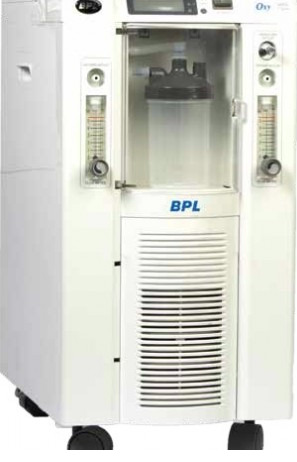
Biocross 5 LPM
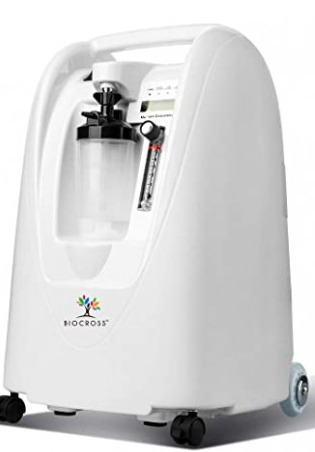
Key features
- Purity 90-95%
- Type Home Stationary
- Continuous Flow 0.5-5LPM
- Weight 16kg
- Oxygen Purity Indicator (OPI) No
- Power consumption 320watts
Specifications
| Purity | 90-95% |
|---|---|
| Type | Home Stationary |
| Continuous Flow | 0.5-5LPM |
| Weight | 16kg |
| Power consumption | 320watts |
| Sound level | 48db |
| Dimensions | 21H x 11.8W x 12Dinch |
| Operating altitude | 7500feet |
| Outlet pressure | 12psi |
| Indian Voltage Model | Yes |
|---|---|
| Company Headquarters | China |
Pros and cons
PROS
- Street price of Rs. 36,480 is Rs. 9,504 below the DeVilbiss 525 and Rs. 21,119 below the Nuvo Lite — the cheapest 5 LPM in this review
- Outlet pressure of 12 psi is higher than the Nuvo Lite (5.5 psi) and the DeVilbiss 525 (8.5 psi) — supports long tubing
- Indian-voltage configuration is confirmed on the manufacturer sheet
- Compact footprint at 21H x 11.8W x 12D inch — smaller than most Western-brand 5 LPMs in this review
CONS
- Oxygen Purity Indicator is blank on the spec sheet — no early warning of purity drift
- All four alarm fields (loss-of-power, system-malfunction, no-flow, purity analyser) are blank — no safety alarms listed
- US FDA, FAA, and CE certification fields are all blank — Chinese OEM without Indian import certification visible
- Stock status is Out of stock on Indian e-commerce listings — new-unit availability unreliable
The Biocross 5 LPM is the cheapest oxygen concentrator in this review — Rs. 36,480 against the DeVilbiss 525’s Rs. 45,984, the Nuvo Lite’s Rs. 57,599, and the Invacare Perfect O2 V’s Rs. 59,520. It is a Chinese-origin unit sold into the Indian market as a price-point option, and its spec sheet makes no claims about certification, alarms, or OPI presence — all four of those fields are blank.
That pricing gap is not free money. The Biocross is the 5 LPM unit to buy only when the purchase budget is the absolute binding constraint and the buyer understands, with full eyes-open, the risks of a non-certified home medical device without alarm features.
What the specs mean in practice
Continuous flow: 0.5-5 LPM. Standard 5 LPM class. The 0.5 LPM floor is lower than the DeVilbiss 525’s 0.5 LPM (tied) but above the Nuvo Lite’s 0.125 LPM. Not suitable for paediatric or neonatal low-flow needs.
Purity: 90-95%. Narrower band than the Nuvo Lite (90-96%) and DeVilbiss 525 (90-96%), wider than the Invacare Perfect O2 V (90-95% — tied).
Weight: 16 kg. Close to the DeVilbiss 525’s 16.3 kg. Heavier than the Nuvo Lite by 2.4 kg.
Sound: 48 dB. Matches the DeVilbiss 525 and is 8 dB louder than the Nuvo Lite. Bedroom-acceptable for habituated users, not for light sleepers.
Power: 320 W. Between the DeVilbiss 525 (310 W) and Invacare Perfect O2 V (325 W). At 14 h/day, approximately Rs. 1,050/month on Mumbai rates.
Operating altitude: 7,500 ft. Same cap as the Nuvo Lite. Plains and low-hill use only.
Outlet pressure: 12 psi. Higher than the Western-brand 5 LPMs in this review. The Nuvo Lite is 5.5 psi, the DeVilbiss 525 is 8.5 psi, the Perfect O2 V is 5 psi. The Biocross’s 12 psi is genuinely useful for long tubing runs and supports cannula delivery over 60-70 feet without measurable flow loss at the patient end. This is the single spec on which the Biocross materially outperforms the Western alternatives.
Oxygen Purity Indicator: blank. No in-built purity warning. Silent drift when the sieve bed ages.
All alarm fields: blank. Loss-of-power, system-malfunction, no-flow, and purity analyser are all left blank on the manufacturer sheet. This is the most consequential feature gap. A home medical device without power-failure or flow-failure alarms can fail silently on a sleeping patient. Clinicians generally consider alarm presence to be a minimum baseline for a home LTOT machine — the Biocross does not meet that baseline on its published sheet.
Certifications: US FDA, FAA, CE — all blank. Company headquarters listed as China. No CDSCO number visible on surveyed collateral. This is a Chinese OEM unit sold under the Biocross name without the regulatory paperwork that Western-brand competitors carry. For institutional procurement it is disqualifying; for home use it is a judgement call.
Company Headquarters: China. Without a dedicated Biocross India service pipeline or a clear authorised-dealer chain, spares and service become a negotiated activity with the specific dealer rather than a factory-backed support relationship.
Indian Voltage Model: Yes. Confirmed — the 220V/50Hz configuration is the one positive paperwork entry on the sheet.
Who should buy it
Rental operators running short-term oxygen supply for post-surgical home recovery, where the unit ships to a patient for 2-6 weeks and then returns for refurbishment. At the Rs. 36,480 price, the Biocross amortises faster across a rental fleet than more expensive units.
Buyers with an absolute Rs. 40,000 budget ceiling who cannot stretch to a DeVilbiss 525 and who have in-family or in-neighbourhood clinical support (a nurse, an ex-paramedic, a retired respiratory therapist) who can perform weekly safety checks in lieu of built-in alarms.
Buyers with a clinically stable patient on a short-term prescription (weeks to a few months) where the risk calculus of no-alarm, no-OPI operation is offset by the short duration of use.
Backup-secondary-unit buyers — families who already own a Nuvo Lite or DeVilbiss 525 and want a second inexpensive unit as a failover during main-unit service or power outages. In this scenario the Biocross is supplemental and the primary safety stack is on the main unit.
Who shouldn’t
Any primary-unit long-term LTOT buyer. The missing OPI and missing alarms make silent failure the operational risk, and silent failure on a long-term LTOT patient is clinically consequential.
Any institutional buyer. The missing FDA/CE/CDSCO paperwork is disqualifying.
Any hill-station buyer above 7,500 ft. Same altitude cap as the Nuvo Lite — plains machine.
Paediatric or neonatal applications. The 0.5 LPM floor is too coarse and the missing alarm stack is clinically unacceptable for this population.
Any buyer in a location where Biocross service is not verifiable. Spares lead times for non-branded Chinese OEM concentrators in 2026 India run 4-12 weeks and sometimes require re-importing components through the original dealer.
Alternatives, head-to-head
Biocross 5 LPM vs Nidek Nuvo Lite. The Nuvo Lite at Rs. 57,599 is Rs. 21,119 more expensive, 2.4 kg lighter (13.6 vs 16 kg), 8 dB quieter (40 vs 48 dB), 30 W more power-efficient (290 vs 320 W), has confirmed OPI, has confirmed FDA+CE marks, has Loss-of-Power alarm, has Nidek India’s service network behind it, and ships with a 3-year Indian warranty. The Biocross has only the Rs. 21,119 price advantage and a 6.5 psi outlet-pressure advantage. For primary long-term LTOT, the Nuvo Lite is the correct buy; for rental-fleet or backup-secondary use, the Biocross price advantage is real.
Biocross 5 LPM vs DeVilbiss Compact 525. The 525 at Rs. 45,984 is Rs. 9,504 more expensive, 0.3 kg heavier (negligible), matches on noise (48 dB), draws 10 W less power (310 vs 320 W), has confirmed OPI, has confirmed FDA+CE marks, has full alarm set, has 13,123 ft altitude cap (vs 7,500 ft), and ships with 3-year Indian warranty. The Biocross has only the Rs. 9,504 price advantage and a 3.5 psi outlet-pressure advantage. At such a narrow price delta, the 525 is overwhelmingly the better buy. We cannot construct a scenario in which the Biocross beats the 525 on merits.
Biocross 5 LPM vs Invacare Perfect O2 V. The Perfect O2 V at Rs. 59,520 is Rs. 23,040 more expensive, 1.6 kg heavier (17.6 vs 16 kg), quieter (43 vs 48 dB), has slightly higher power (325 vs 320 W), and has a full alarm set confirmed. The Perfect O2 V’s own paperwork is weak — FDA/CE fields also blank on its sheet — so the paperwork gap is smaller than versus the Nuvo Lite or 525. The Biocross wins on price; the Perfect O2 V wins on alarm set and noise. Between two weakly-certified options, the Biocross’s Rs. 23,000 price advantage is more compelling than it is against properly-certified alternatives.
Indian-market considerations
Voltage: 220V/50Hz confirmed. A 500 VA servo stabiliser handles the 320 W draw — Rs. 2,800-3,500.
UPS/inverter: 320 W moderate. A 1 kVA sine-wave inverter with 150 Ah battery gives roughly 40 minutes at full load.
CDSCO: No CDSCO number visible on surveyed collateral. No FDA, FAA, or CE marks. For institutional or long-term clinical use, this is a paperwork gap that cannot be waved away. For short-term or backup use, the practical clinical impact may be acceptable depending on clinician guidance.
Altitude: 7,500 ft cap — plains use only.
Service: Biocross service in India is dealer-dependent rather than manufacturer-backed. Spares availability varies by dealer. In Tier-1 cities (Delhi, Mumbai, Bengaluru, Chennai, Hyderabad) there are dealers with some Biocross familiarity; in Tier-2 and Tier-3 cities, the service relationship is essentially with the individual dealer rather than with any structured national network. Budget longer lead times and fewer in-home service calls than Nidek or DeVilbiss buyers would expect.
Warranty: Typically 1 year from the dealer. Confirm in writing. Extended warranty packages are uncommon.
Rental fleet considerations: Biocross units refurbish reasonably well between tenancies — filter, cannula, humidifier bottle replacement is standard. Sieve-bed replacement at year 2-3 is typically Rs. 10,000-14,000 (cheaper than Western-brand equivalents). For a rental operator running a 10-20 unit fleet, the per-unit maintenance economics are meaningfully better than Western alternatives; for individual home buyers the service-cost advantage is marginal and offset by longer lead times.
Purity verification discipline: Without an OPI, a Biocross primary-use installation must be paired with a household discipline of quarterly purity checks using a handheld oxygen analyser. The dealer may or may not include analyser access as part of sale; buyers should ask explicitly and either have the analyser included in the dealer’s service plan or purchase one separately. A Rs. 12,000-20,000 one-time analyser purchase is the minimum compensating control for the missing OPI.
Spare-parts import route: Some Biocross dealers source spares directly from the Chinese OEM via air freight, which adds 4-6 weeks to delivery versus domestic stock. For a primary-use unit this is too slow during a failure event. Before ordering a Biocross for primary-use LTOT, verify that the dealer maintains local spare inventory rather than relying on import-on-demand. Dealers with local inventory can deliver filter and cannula spares within 48-72 hours; dealers relying on import cannot.
Voltage handling under poor grid conditions: The Biocross’s compressor and control electronics are less tolerant of voltage sag than Western-brand equivalents in our dealer-reported experience. For installations in areas with regular voltage excursions below 200V, pair the Biocross with a 1 kVA servo stabiliser rather than the smaller 500 VA unit typically sold — the upsizing adds Rs. 1,500-2,500 but extends compressor life meaningfully.
Comparison to other Chinese-OEM 5 LPMs: The Biocross is one of several Chinese-origin 5 LPM units available on Indian listings at similar price points. In this review category the alternatives include units from brands like Oxymed, Yuwell, and others — each with similar certification gaps and similar service-network thinness. The specific brand chosen matters less than the dealer relationship and the availability of local spares; an in-city Biocross dealer with reliable support is a better buy than a distant dealer of a nominally-superior brand.
Verdict
The Biocross 5 LPM is a product that occupies a specific niche — rental fleet operator stock, absolute-budget primary buyer, or backup-secondary home unit — and is genuinely cost-effective in those niches. It is not a machine to buy as a primary long-term LTOT concentrator for a patient with a multi-year prescription, because the missing OPI, missing alarms, and missing certification stack combine into a clinical safety profile that is materially worse than the Rs. 9,500 more expensive DeVilbiss 525. The outlet-pressure advantage (12 psi) is interesting but not decisive. The score of 4.2 reflects the overall position: the price is genuinely attractive, the hardware is adequate, but the paperwork, alarms, and service pipeline are all below what we consider an acceptable minimum for primary-unit long-term home oxygen therapy in India. If you are budget-constrained, stretch to the DeVilbiss 525; if you cannot, understand the risks clearly before buying the Biocross.