Philips Everflo 5 Liter Oxygen Concentrator vs S.Cure 5 LPM
Philips Everflo 5 Liter Oxygen Concentrator
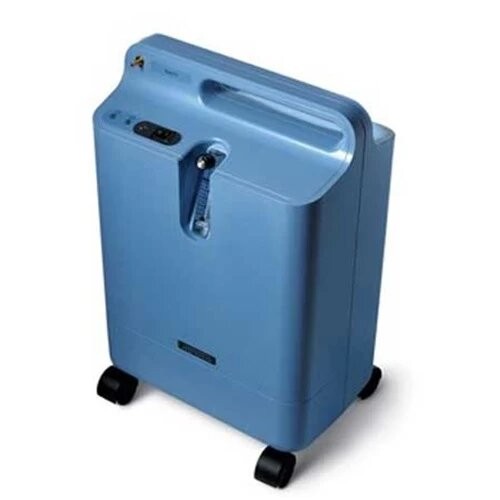
- Brand
- Philips Respironics
- Category
- 5 LPM
Discontinued
Indicative pricing based on market intelligence. Varies by dealer, city, bundle, and period — confirm with a local authorised seller before buying.
HHZ SCORE 8.2/10
S.Cure 5 LPM
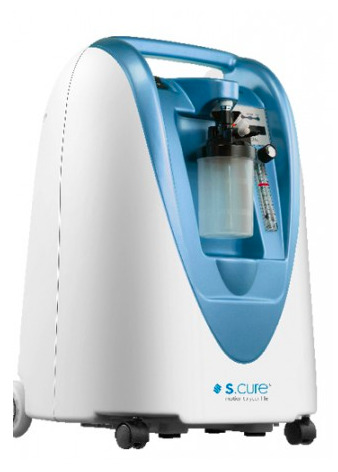
- Brand
- S. Cure
- Category
- 5 LPM
₹44,160
Indicative pricing based on market intelligence. Varies by dealer, city, bundle, and period — confirm with a local authorised seller before buying.
HHZ SCORE 6.0/10
Specifications compared
| Specification | Philips Everflo 5 Liter Oxygen Concentrator | S.Cure 5 LPM |
|---|---|---|
| Overview | ||
| Brand | Philips Respironics | S. Cure |
| Category | 5 LPM | 5 LPM |
| Price | — | ₹44,160.00 |
| Stock | DISCONTINUED WORLDWIDE | Out of stock |
| Key features | ||
| Purity | 90-96% | 90-95% |
| Type | Home Stationary | Home Stationary |
| Continuous Flow | 1-5LPM | 0.5-5LPM |
| Weight | 14kg | 16kg |
| Oxygen Purity Indicator (OPI) | Yes | No |
| Power consumption | 350watts | 285watts |
| Technical details | ||
| Purity | 90-96% | 90-95% |
| Type | Home Stationary | Home Stationary |
| Continuous Flow | 1-5LPM | 0.5-5LPM |
| Weight | 14kg | 16kg |
| Oxygen Purity Indicator (OPI) | Yes | — |
| Power consumption | 350watts | 285watts |
| Sound level | 45db | 48db |
| Dimensions | 23H x 15W x 9.5Dinch | 21H x 12W x 11.8Dinch |
| Operating altitude | 7500feet | — |
| Outlet pressure | 5.5psi | — |
| Additional details | ||
| Loss of Power Alarm | Yes | Yes |
| System Malfunction Alarm | Yes | Yes |
| No Flow Alarm | Yes | — |
| Indian Voltage Model | Yes | Yes |
| Company Headquarters | USA | China |
| US FDA Approved | Yes | — |
| CE Certified | Yes | — |
Analysis
Editor’s note — Everflo discontinued. Philips has discontinued the Everflo worldwide; it is no longer in production and remaining units are end-of-line stock. For an in-production 5 LPM alternative available in India, consider the Home Medix HM-KV (up to 5 L/min, 93% ±3%, ≤40 dB, 3-year warranty). The comparison below is retained for reference.
Most comparisons in the Indian 5 LPM segment offer a price-versus-feature trade. The buyer gives up some monitoring depth or service-network reach in exchange for a meaningfully lower unit price. That is the lever the imported low-cost brands use. What makes the S.Cure 5 LPM unusual is that it does not offer the trade — it lands at ₹44,160 against the Philips Respironics Everflo’s ₹43,699 (since discontinued), a ₹461 difference, essentially parity. At near-identical pricing, the buyer is not buying savings; they are just picking which 5 LPM machine they want. On that question, after walking through both spec sheets, the Everflo is the clearly better buy.
At-a-glance
Price is a wash — ₹44,160 for the S.Cure and ₹43,699 (since discontinued) for the Everflo, with the Everflo marginally cheaper. Weight is 14 kg on the Everflo and 16 kg on the S.Cure, a 2 kg Everflo advantage. Flow range is 1–5 LPM on the Everflo versus 0.5–5 LPM on the S.Cure; purity is 90–96% on the Everflo and 90–95% on the S.Cure; both are functionally equivalent for adult prescriptions. Noise is 45 dB on the Everflo against 48 dB on the S.Cure — the Everflo is perceptibly quieter by ~2x perceptual loudness at the 3 dB delta. Power consumption sits at 350 W for the Everflo and 285 W for the S.Cure — the S.Cure’s only material win on the technical sheet, saving roughly ₹800 per year at typical Indian tariffs and 10–12 hour daily runs.
Monitoring and certification is where the S.Cure gap widens. The Everflo ships with “Yes” on OPI and on all three alarms — loss of power, system malfunction, no flow. It carries US FDA approval and CE certification, 3-year warranty, and USA headquarters. The S.Cure shows “Yes” on only two alarms (loss of power, system malfunction), empty OPI, empty no-flow alarm, and no FDA or CE markings. Company HQ for S.Cure is China. Stock position is In Stock for the Everflo and Out of Stock for the S.Cure.
Where the Everflo wins
Start with the Oxygen Purity Indicator. Over a 3–5 year ownership horizon, sieve-bed degradation is the single most common reason a PSA concentrator falls below prescribed purity. The Everflo’s OPI alarms below roughly 82% purity, telling the caregiver the sieve beds need attention or replacement. The S.Cure does not carry an OPI per its published specs. Silent purity decline is the worst kind of failure in home oxygen — the machine keeps running, the patient keeps breathing from it, but the therapeutic benefit is quietly degrading. For any household whose patient’s SpO2 is being actively managed against the concentrator’s output, the OPI is not optional.
The alarm delta compounds this. The Everflo’s no-flow alarm catches tube kinks, disconnections, and downstream blockages — a routine failure mode during night-time use when the patient or caregiver may not immediately notice. The S.Cure shows no-flow blank on its spec sheet. A disconnected cannula at 3am means the patient simply isn’t getting oxygen until someone notices; with the Everflo, the machine itself is part of the notification loop.
US FDA approval on the Everflo matters in ways that go beyond marketing. The approval requires documented design-validation testing, electrical-safety compliance, and a manufacturer-level quality system. CE certification adds EU-specific compliance. Neither mark is on the S.Cure listing. For a ₹44,000 device that will run for years in Indian residential conditions, the absence of both is a reasonable buyer concern.
The Everflo’s 14 kg versus the S.Cure’s 16 kg is a practical 2 kg saving. Most Indian 5 LPM installations end up being moved between rooms at least occasionally — bedroom at night, living room during the day; or between ground floor and first floor in a joint-family home. For a single caregiver managing those moves, 2 kg lighter matters. The Everflo is also dimensionally more compact (23x15x9.5 inch versus 21x12x11.8 inch on the S.Cure) — the S.Cure is narrower but deeper, which affects corner-space placement.
Service network is the structural Everflo advantage. Philips Respironics has operated in India for over a decade with factory-aligned service centres in every metro and most tier-2 cities. Parts inventory for the Everflo — sieve beds, compressors, filter sets, humidifier bottles — is stocked by multiple Indian suppliers. S.Cure’s Indian distribution is much thinner; service engineer availability in Jaipur or Bhubaneswar or Coimbatore is not guaranteed and parts lead times can stretch to weeks. Warranty on the Everflo is a published 3 years; the S.Cure listing does not specify warranty length.
Noise is a smaller but real Everflo win. The 3 dB gap (45 dB vs 48 dB) translates to roughly 2x perceptual loudness — noticeable in a quiet bedroom at night. At 48 dB the S.Cure is not loud enough to wake a sleeping patient, but it sits in the range where a sleeping partner or caregiver may find it intrusive.
Where the S.Cure wins
The S.Cure’s honest wins are narrow. Power draw at 285 W against the Everflo’s 350 W is the only meaningful technical advantage — roughly 65 W saved, which over 12 hours of daily use amounts to about 0.78 kWh per day or 285 kWh per year. At typical Indian domestic slab tariffs of ₹7–10 per kWh (for slab 2 and above), that is ₹2,000–2,850 per year. Over a three-year horizon, the S.Cure saves roughly ₹6,000–8,500 in electricity. Against the ₹461 upfront price gap, that is real — but the comparison also has to set that saving against the Everflo’s superior monitoring and service, and at ₹2,000–2,850 per year the saving is small enough that most buyers will weight it below reliability and alarm coverage.
The 0.5 LPM flow minimum on the S.Cure is a legitimate advantage for paediatric or low-flow overnight titration prescriptions. The Everflo’s 1 LPM floor covers the adult mainstream but not the under-1-LPM band. This is a narrow but real S.Cure edge.
Beyond these two points, the S.Cure does not beat the Everflo on any dimension we can find in the published specs. It is heavier, louder, has less alarm coverage, no OPI, no FDA or CE markings, weaker Indian service footprint, and unspecified warranty length — all at effectively the same price.
Indian-market context
The pricing is the deciding context. In the Indian 5 LPM segment, the imported low-cost brands compete on a price-for-features trade. The S.Cure is not offering that trade — it is priced at Everflo parity. For comparison, the Oxymed Mini at ₹35,400 offers OPI, a live purity analyser, full alarm suite, Indian HQ, CDSCO registration, a 3-year warranty and a built-in nebulizer at ₹8,800 below the Everflo. The GVS Oxypure at ₹33,599 offers CE certification at ₹10,100 below the Everflo. The BPL Oxy 5 Neo at ₹31,966 offers OPI and Indian HQ at ₹11,700 below the Everflo. Any of those is a more coherent trade than the S.Cure’s near-parity pricing against a thinner feature set.
Stock position also matters. The Everflo is listed In Stock while the S.Cure is Out of Stock in current listings. For a buyer with an immediate prescription, this alone settles it.
Indian ambient conditions — summer highs above 40°C in many plains cities, monsoon humidity above 80% along coasts, dust loads that exceed design envelopes of many OEMs — are punishing for PSA concentrators. Failure rates in years 2–3 are real, particularly on compressor and sieve-bed components. The Everflo’s long Indian field history means these failure modes are priced, parts-stocked, and serviceable through known channels. The S.Cure’s Indian field history is shorter and shallower, and parts availability over a 5-year ownership horizon is not something we can confidently assume.
Resale value is a further Everflo advantage. 2–3 year old Everflo units hold ₹22,000–30,000 on the Indian secondary market. S.Cure resale is essentially unobservable — there is no active secondary market for the brand at Indian scale, which means a household wanting to exit the machine after 18 months has no price-discovery mechanism.
Verdict
The Philips Everflo 5 LPM wins this matchup without qualification. The S.Cure’s positioning — priced within ₹500 of the Everflo while offering meaningfully less monitoring (no OPI, blank no-flow alarm), no FDA or CE markings, a thinner Indian service footprint, unspecified warranty length, and 2 kg more weight — does not make sense to us as a buyer proposition. The only dimension on which the S.Cure beats the Everflo is power consumption (65 W lower), and that saving is too small to offset the gaps.
For any Indian buyer comparing these two specific machines: pick the Everflo. Pay the ₹461 more, get the OPI, the no-flow alarm, the FDA and CE approvals, the decade-deep Indian service network, the 3-year published warranty, and the 2 kg lighter form factor. Every axis except power draw points to the Philips.
A broader point: if the S.Cure’s ₹44,160 price has pushed a buyer to consider the Everflo more seriously, they should also look at the alternatives the segment actually offers at real discounts — the Oxymed Mini, the GVS Oxypure, the BPL Oxy 5 Neo. These are the machines that offer legitimate price-for-features trade-offs against the Everflo. Among those, the Oxymed Mini is the one we would point most Indian buyers toward if they want a meaningful saving without giving up the monitoring envelope. The S.Cure at ₹44,160 sits in an uncomfortable middle that no buyer should choose over the Everflo.