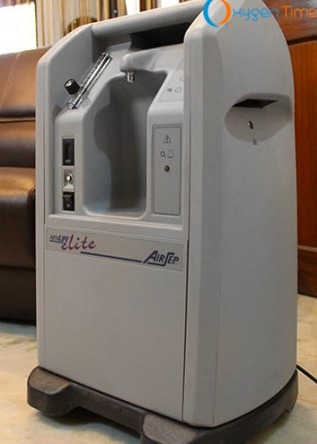
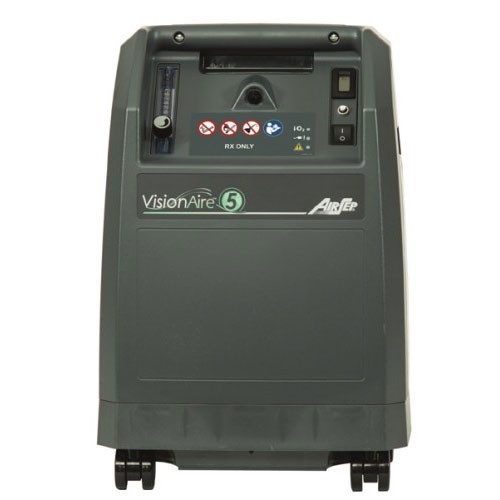
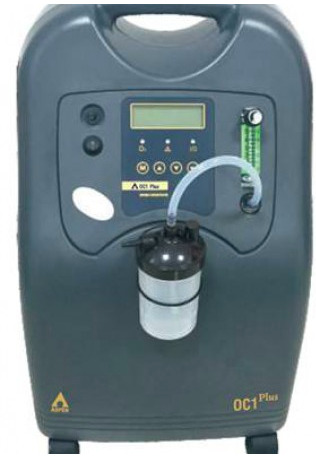
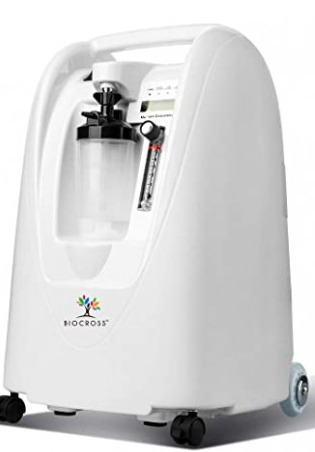
S.Cure 5 LPM
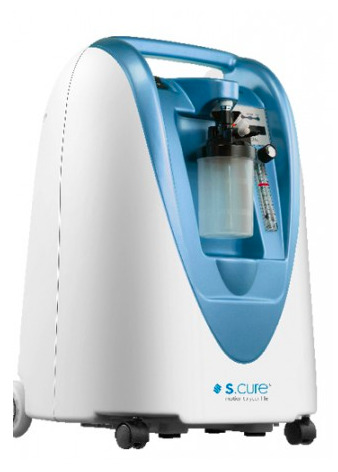
Key features
- Purity 90-95%
- Type Home Stationary
- Continuous Flow 0.5-5LPM
- Weight 16kg
- Oxygen Purity Indicator (OPI) No
- Power consumption 285watts
Specifications
| Purity | 90-95% |
|---|---|
| Type | Home Stationary |
| Continuous Flow | 0.5-5LPM |
| Weight | 16kg |
| Power consumption | 285watts |
| Sound level | 48db |
| Dimensions | 21H x 12W x 11.8Dinch |
| Loss of Power Alarm | Yes |
|---|---|
| System Malfunction Alarm | Yes |
| Indian Voltage Model | Yes |
| Company Headquarters | China |
Pros and cons
PROS
- 285 W power draw is among the most efficient 5 LPM units in the market
- Dual alarms confirmed — loss-of-power and system-malfunction
- Compact 21H x 12W x 11.8D inch chassis is easy to place in small rooms
- Indian voltage confirmed
CONS
- No OPI on the spec sheet — the single most important patient-safety gap
- ₹44,160 price puts it uncomfortably close to Nidek Nuvo Lite and Philips EverFlo territory
- 48 dB sound level is above Nidek and Philips equivalents
- No CE, FDA, or CDSCO markers; China-headquartered
S.Cure’s 5 LPM stationary concentrator is listed at ₹44,160 on Indian channels. The brand’s positioning is roughly identical to Dr Diaz 5 LPM on the spec sheet — same 285 W power draw, same 16 kg chassis, same 48 dB sound, same 21H x 12W x 11.8D inch dimensions. The critical differences are that S.Cure (a) does not confirm an OPI on the brochure, (b) confirms only two alarms vs Dr Diaz’s three, and (c) lists China as headquarters rather than Dr Diaz’s India HQ. At ₹44,160 S.Cure is ₹14,400 more expensive than Dr Diaz 5 LPM while offering less — an awkward positioning that makes it hard to recommend.
What the specs mean
The 0.5–5 LPM flow range at 90–95% purity is the standard 5 LPM envelope. The 0.5 LPM minimum supports paediatric and low-flow adult prescriptions.
The 285 W power draw is genuinely low — matches Dr Diaz, beats most Chinese-OEM 5 LPM competitors, close to Nidek’s 290 W. Over a year of 16-hour daily use at ₹9/kWh this works out to roughly ₹1,250/month — one of the lower electricity bills achievable on a 5 LPM stationary. This is the product’s real strength.
The 16 kg chassis is mid-pack. Moveable by one adult, appropriate for a stationary unit.
The 48 dB sound is class-average. Louder than Philips EverFlo (45 dB), Nidek Nuvo Lite (40 dB), Vandelay (45 dB), and GVS Oxypure (43 dB). Comparable to Dr Diaz and Keyhub. Not bedroom-quiet.
Dimensions at 21H x 12W x 11.8D inches are relatively compact. Depth of less than 12 inches allows placement against a wall without significant footprint. This is useful in small Indian flats.
Alarm suite: loss-of-power and system-malfunction confirmed. No no-flow alarm. This is a two-alarm configuration, which is above the one-alarm floor of most budget Chinese-OEM units but below the three-alarm standard of Philips, Nidek, and Dr Diaz.
The critical gap: no OPI confirmed. For a machine at ₹44,160 this is the fundamental issue — the price point is high enough that the buyer has reasonable alternatives with OPI, and S.Cure’s decision (or brochure omission) to leave this field blank is the single most important reason to look elsewhere.
No outlet pressure published. Most 5 LPM units run 5-8 psi; assume this and verify with dealer.
No altitude rating.
Certifications: no CE, no FDA, no CDSCO. Indian voltage confirmed. China HQ.
Who should buy it
An edge case. The only circumstance where S.Cure 5 LPM at ₹44,160 is a defensible purchase over the more completely-specced Dr Diaz 5 LPM at ₹29,759 is if S.Cure is available at significant discount from list price (say, ₹30,000-35,000 through a dealer promotion) and Dr Diaz is not available at the buyer’s specific dealer.
Short-term post-discharge users (3-6 months) where the machine sees moderate daily load and the OPI gap is less consequential.
Buyers who specifically value the compact 21H x 12W x 11.8D depth-under-12-inches footprint for small-room placement.
Who shouldn’t
Long-term LTOT patients. At ₹44,160, the comparison is against Nidek Nuvo Lite at ₹55,000 — a ₹11,000 premium that buys OPI, full alarms, 40 dB sound, 14 kg chassis, and Japanese-build reliability. For any multi-year use, paying the delta for Nidek is the right call.
Buyers who want CDSCO paperwork, a verified service network, or regulatory markers.
Patients in hill stations — no altitude rating.
Bedroom-use patients — 48 dB is too loud for same-room overnight.
Head-to-head alternatives
Dr Diaz 5 LPM (₹29,759 current / ₹40,320 MRP). Identical dimensions, identical weight, identical power draw, identical sound level — but with confirmed OPI, three alarms (vs S.Cure’s two), Indian HQ (vs China), and 12,000 ft altitude rating (vs none published for S.Cure). At ₹14,401 cheaper than S.Cure, Dr Diaz wins on every comparable axis. Unless Dr Diaz is unavailable at your dealer, it is straightforwardly the better buy.
Nidek Nuvo Lite 5 LPM (₹55,000-65,000). Japanese. 40 dB, 290 W, OPI, full alarms, 14 kg. Against S.Cure, Nidek is 25-50% more expensive but dramatically better on noise (40 dB vs 48 dB), OPI presence, alarm suite, and build quality. The cost delta of ₹11,000-21,000 is earned back on patient comfort and long-term reliability.
Oxymed Mini 5 LPM (₹32,000-38,000). Indian-brand peer at lower price. Chennai-based manufacturing, OPI typically included, basic alarm suite, stronger service network in South/West India. Against S.Cure, Oxymed is ₹6,000-12,000 cheaper and materially better on service-network reality.
Indian-market considerations
S.Cure has thin visible presence in the Indian home-oxygen market. No documented authorised-service-centre list, no dealer network directory, no toll-free warranty line we can verify. Warranty-claim reality is entirely dealer-dependent.
For a Chinese-OEM brand at ₹44,160 — a price point where several better-established alternatives exist — the weak service footprint is the biggest practical concern. If the machine fails in month 10, the buyer’s recourse is whatever the specific seller offers.
Spare parts: no publicly documented Indian distribution. Compressor, sieve beds, valves, and filters are all Chinese-OEM sourced with unknown lead times for individual replacement.
Warranty: not explicitly documented on the source listing. Category standard of 1 year from seller applies; confirm in writing.
Voltage: Indian voltage confirmed. 500 VA stabiliser minimum at 285 W continuous draw.
Altitude: not listed.
CDSCO: not indicated. Verify for insurance claims.
Stock: out of stock on source listing. Availability is inconsistent.
Additional S.Cure-specific considerations
The shared-chassis pattern. S.Cure’s spec sheet is near-identical to Dr Diaz 5 LPM on dimensions (21H x 12W x 11.8D inches), weight (16 kg), power draw (285 W), and sound level (48 dB). This is not coincidence. The underlying hardware almost certainly originates from the same Chinese OEM — quite possibly Longfian, which manufactures a 5 LPM chassis matching these specs and supplies several rebadge customers globally. Dr Diaz and S.Cure are plausibly the same physical machine with different label stickers and different alarm-configuration SKUs from the factory. If true, S.Cure’s extra ₹14,400 premium buys nothing material beyond the brand label.
Alarm configuration as differentiator. The two-alarm configuration (loss-of-power + system-malfunction) versus Dr Diaz’s three-alarm (adds no-flow) is likely a factory SKU selection — the same underlying machine with different alarm modules enabled. This means that if you buy S.Cure, the third alarm may or may not be physically absent; it may just not be enabled in the firmware. Asking the dealer whether the no-flow alarm can be field-enabled is worth trying.
Service-network caveat. S.Cure-specific service centres are not publicly documented in the Indian market. However, because the underlying chassis is the same shared Chinese-OEM unit, any technician who services Dr Diaz or Longfian-family 5 LPM units can typically service an S.Cure with the same spare parts. This is a pragmatic benefit — your ₹44,160 S.Cure is not stranded if the brand’s local distribution collapses, because the physical machine is supportable through other channels.
Why the brand exists at all. S.Cure occupies a legitimate but narrow commercial niche: buyers who have a relationship with a specific dealer who stocks S.Cure but not Dr Diaz, or buyers who specifically prefer a non-Hemodiaz label for reasons unrelated to product fit. For most buyers comparing on spec and price, the brand adds no value.
Operating cost assumptions. At 285 W continuous draw and 16 hours daily use, Indian electricity cost at ₹9/kWh works out to ₹1,250/month. Over a 3-year typical ownership, this is ₹45,000 in electricity — more than the capital cost of the machine itself. For LTOT patients, electricity is the dominant total-cost-of-ownership factor once the capital-cost decision is made. S.Cure’s 285 W is competitive here; the decision should be driven by safety-feature completeness and service-network depth rather than electricity economics.
Real-world S.Cure ownership expectations
For a buyer who has specifically committed to S.Cure — perhaps through an existing dealer relationship, or because the brand is the only available option at a specific retail outlet — understanding the ownership experience helps set expectations.
Week 1-4 (commissioning): The machine should arrive with a complete set of filters installed, a humidifier bottle (empty), power cord, cannula, and user manual. Set up typically takes 15-30 minutes. Run the machine for 10-15 minutes in a well-ventilated space before connecting to the patient to burn off any residual packaging odors and verify compressor operation. Check flow rate at multiple settings (1, 3, 5 LPM) against a flow meter to confirm delivered flow matches the indicator setting.
Month 1-6 (acclimation): Monitor sound level, vibration, and basic alarm functionality. The S.Cure two-alarm suite (loss-of-power + system-malfunction) should fire correctly when tested — deliberately pull the power plug and verify the alarm buzzer sounds; this is your main patient-safety feature. The system-malfunction alarm is harder to test without inducing actual malfunction, which you should not do. Note any unusual sounds from the compressor, any drop in delivered flow at max setting, or any persistent warm-to-hot chassis temperature.
Month 6-18 (steady state): Replace the inlet gross filter every 2-3 months (budget ₹400-600 per replacement, available through general medical-equipment dealers as the filter is a generic size). The HEPA or bacterial filter should last 6-12 months. Expect sound level to remain stable; any increase in compressor noise indicates bearing wear and should trigger a service call.
Month 18-36 (degradation): Without an OPI, this is the blind-spot period. Plan to have delivered oxygen purity verified with a handheld oxygen analyser (₹3,500-7,500 for a basic unit) every 4-6 months. If delivered purity drops below 90% at 5 LPM setting, the molecular sieves need service — either refurbishment (if parts available) or replacement. Typical sieve-bed replacement on a shared-chassis Longfian-family 5 LPM unit costs ₹8,000-14,000 in India, including labour.
Month 36+ (replacement decision): If the compressor is still running quietly, the machine has survived its main reliability test. If compressor noise has increased or flow stability has degraded, the machine is approaching end-of-useful-life and replacement should be planned rather than repaired.
For this 36-month ownership cycle, S.Cure’s total cost of ownership is approximately:
- Capital: ₹44,160
- Electricity at 285 W × 16 hrs/day × ₹9/kWh × 3 years = ₹45,000
- Filters and consumables: ₹8,000-12,000
- One sieve bed service event: ₹8,000-14,000 (probable but not certain)
- Total: ₹105,000-115,000 over 3 years
Compared to Nidek Nuvo Lite at ₹55,000 capital cost:
- Capital: ₹55,000
- Electricity at 290 W × 16 hrs/day × ₹9/kWh × 3 years = ₹45,700
- Filters and consumables: ₹8,000-12,000
- Sieve bed service probability much lower with Nidek’s build quality: ₹0-10,000
- Total: ₹108,000-122,000 over 3 years
The 3-year total cost of ownership is roughly comparable. The difference is Nidek provides better OPI, better alarms, better noise, better service network, and lower service-event probability. For multi-year use, Nidek wins on everything except day-zero capital outlay.
The ₹44,160 problem dissected
At ₹44,160, S.Cure sits in an awkward zone. Below ₹40,000 the category shifts to Chinese-OEM budget units with acknowledged compromises (Home Medix, Jumao, Biocross) and Indian-brand peers (Dr Diaz, Oxymed Mini, Nareena) where the buyer is picking a specific feature trade-off. Above ₹50,000 the category shifts to Tier-1 imports (Nidek Nuvo Lite, DeVilbiss 525, Yuwell 7F) where the buyer is paying for genuine Japanese / Western manufacturing, service networks, and 3-5 year reliability track records. S.Cure at ₹44,160 is neither — not the cheapest Chinese-OEM, not a Tier 1 import, not an established Indian brand with dealer depth. The pricing positions the product as a mid-tier premium pick for features that the spec sheet does not actually deliver. Either the list price needs to drop to ₹32-35K to be competitive against Chinese-OEM peers, or the spec sheet needs an OPI and a third alarm to justify the premium.
Verdict
S.Cure 5 LPM is priced out of its competitive position. At ₹44,160 it is more expensive than the comparably-specced Dr Diaz 5 LPM by ₹14,401, while offering less on OPI, alarms, country of origin, and altitude rating. Against Nidek Nuvo Lite at ₹55,000, S.Cure is only ₹11,000 cheaper while being materially worse on noise, OPI, and reliability. Against Oxymed Mini at ₹32-38K, S.Cure is more expensive without corresponding spec benefits. There is no price point at which S.Cure is the correct first-choice 5 LPM. If the specific dealer stocks only S.Cure and has the unit at a meaningful discount — say under ₹32,000 — it becomes acceptable. At list price it is not. Score: 6.0/10.