Yuwell 9F Touchscreen 5LPM
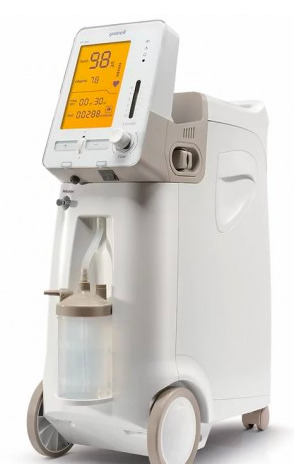
Key features
- Purity 90-95%
- Type Home Stationary
- Continuous Flow 0.5-5LPM
- Weight 18kg
- Oxygen Purity Indicator (OPI) No
- Power consumption 400watts
Specifications
| Purity | 90-95% |
|---|---|
| Type | Home Stationary |
| Continuous Flow | 0.5-5LPM |
| Weight | 18kg |
| Power consumption | 400watts |
| Sound level | 52db |
| Dimensions | 19.6H x 15.35W x 24.5Dinch |
| Outlet pressure | 10psi |
| Loss of Power Alarm | Yes |
|---|---|
| System Malfunction Alarm | Yes |
| No Flow Alarm | Yes |
| Indian Voltage Model | Yes |
| Company Headquarters | China |
Pros and cons
PROS
- Touchscreen control interface with remote option, rare at this price band
- Established brand with identifiable Indian service footprint in metros
- Full three-alarm set (power loss, system malfunction, no-flow) on the brochure
- Operates on Indian 230 V mains with declared Indian-voltage model
CONS
- 18 kg weight and no top handle — physically awkward to reposition
- 400 W continuous draw is 30–40 % higher than the Nidek Nuvo Lite and Philips Everflo
- 52 dB noise floor is loud for a bedroom by Indian bedroom standards
- Brochure shows no US FDA, FAA or CE entry filled in — certification status unclear
- Listed at ₹45,120 but stock status on major Indian listings is intermittent
The 9F is Yuwell trying to modernise an old chassis
Yuwell’s 9F arrived in India as the premium trim of the 7F/8F/9F family — a 5 LPM home stationary with a touchscreen fascia and, depending on batch, a remote control. On paper it targets the same buyer the Philips Everflo and Nidek Nuvo Lite already serve: the long-term home-oxygen user who wants a quiet, reliable unit that does not need to leave the house. In practice the 9F sits a tier below both of those machines. It is heavier, thirstier, louder and — according to the manufacturer brochure and e-commerce product listings HHZ pulled — missing explicit FDA, FAA and CE entries. Against Chinese OEM peers sold in India at ₹35,000–45,000 it is competitive, but buyers drawn by the brand name need to understand what they are getting: a mature design with a premium front panel bolted on.
The 9F’s listed price of ₹45,120 is in the same bracket as the Philips Everflo’s typical street price, which is where the value argument gets hard to sustain. Yuwell has a bigger Indian retail presence than most of the rebadged Chinese OEMs, but the service network is still thinner than what Philips and BPL can field pan-India.
What the specs actually mean
The 9F carries six load-bearing specs you should read before anything else.
Continuous flow 0.5–5 LPM, purity 90–95 %. Standard PSA-zeolite behaviour in this class. 90 % is the lower guaranteed purity at the top of the flow range; the brochure does not publish a per-flow purity table, so you should assume purity degrades near 5 LPM like on every other budget OEM. For a patient titrated at 2–3 LPM this is operationally fine. For a COPD patient who sometimes touches 5 LPM during exertion the margin is thinner, and there is no oxygen purity indicator (OPI) on the front panel to warn you if it drifts — which is a meaningful omission in this price band.
Weight 18 kg, no top handle. This is where the 9F shows its age. An Everflo is 14 kg with a proper top handle. A Nidek Nuvo Lite is 13.6 kg. The 9F is 18 kg and, as the original Indian listings note, the front wheels are oversized — the machine is hard to lift, hard to tilt, and awkward to shift from bedroom to drawing room. For an elderly patient who moves the unit themselves this matters more than any touchscreen.
Power 400 W. On a 16-hour-per-day prescription at ₹7/unit that is roughly ₹750/month of electricity. The Nidek Nuvo Lite pulls 290 W, the Everflo 350 W. The 9F is not catastrophic but it is measurably above the class average, which over three years of LTOT use runs into real money.
Noise 52 dB. Yuwell’s published figure. The Philips Everflo’s brochure value is 45 dB and the Nidek Nuvo Lite’s is 40 dB. 52 dB is the level of a quiet conversation — usable in a living room, noticeable in a bedroom, and genuinely intrusive in a small-room set-up. If the patient sleeps with the concentrator running, 52 dB is the spec most likely to drive post-purchase regret.
Three-alarm set, no OPI. The brochure confirms loss-of-power, system-malfunction and no-flow alarms. What it does not list is an oxygen purity indicator or analyzer. For a unit pitched at the premium end of the Chinese lineup this is the most striking gap — every Tier-1 5 LPM in the same price band (Philips, Nidek, DeVilbiss) ships with an OPI light or an on-screen purity readout.
Certifications: blank. The brochure and product listings show the FDA, FAA and CE fields all empty. Yuwell does hold CE marks on other models in other markets, but the published spec sheet for the Indian 9F does not assert any of them. Treat as uncertified unless you can get a written statement from the importer.
Outlet pressure is 10 psi, dimensions are 19.6 × 15.35 × 24.5 inches (H×W×D) — a mid-tower form factor slightly smaller than a BPL Oxy 5 Neo but still substantial.
Who should buy it
Three buyer profiles make sense for the 9F:
Cost-conscious short-term users in metro cities. If the patient needs six to nine months of 2–3 LPM support post-surgery, post-ICU step-down, or during a flare-up, and you can find the 9F priced well under ₹40,000 from a Yuwell-authorised dealer with real service access in your metro, it is a defensible buy. Short horizon limits how much the electricity premium and noise profile matter.
Backup-unit buyers in households where the primary is a Tier-1. If your primary concentrator is a Philips or Nidek and you want a second unit for redundancy during monsoon power issues or service downtime, a mid-priced Yuwell with a working touchscreen is a reasonable secondary. You get the brand-recognition argument without staking LTOT on it.
Nursing-home operators in Tier-1 cities. Facilities running 10–20 units with their own biomed maintenance can absorb the weight, noise and power penalties more easily than a single household. The 9F is serviceable by any Chinese-pattern concentrator technician — sieve beds, compressor and valve blocks are generic parts.
Who should not buy it
Long-term LTOT patients. If the prescription is for 15+ hours a day over three or more years, the 9F’s power draw and noise floor and the brochure’s silence on FDA/CE will compound into a worse ownership experience than a Philips Everflo or Nidek Nuvo Lite at similar or modestly higher price. For LTOT, choose the Tier-1 every time.
Remote and Tier-2/Tier-3 buyers. Yuwell’s Indian service presence is concentrated in metros. If you are in a district town a full day’s drive from the nearest authorised service centre, a 9F going into a sieve-bed fault is dead weight until a technician visits or the machine makes the return trip — neither of which happens quickly. Philips’s service footprint, while imperfect, is broader.
Buyers who need the patient to move the unit themselves. An 18 kg chassis with no top handle is a physical problem for the 65-year-old patient who lives alone. A 14 kg Everflo with a handle is a different device entirely.
Pediatric or high-titration users. No OPI + unclear certification + only 5 LPM top flow + no low-flow meter option in most Indian batches means the 9F is not the machine for a child on finely titrated therapy.
Alternatives that beat the 9F on specific axes
Philips Respironics EverFlo, ~₹43,700–50,000 street. On every load-bearing spec the Everflo wins: 14 kg versus 18 kg, 350 W versus 400 W, 45 dB versus 52 dB, FDA-approved and CE-marked versus blank certification fields, published OPI versus none. The 9F has one nominal advantage — the touchscreen — and the Everflo has a three-year Indian warranty through Philips Home Healthcare. If the budget allows ₹45,000, the Everflo is the default. There is almost no clinical argument for the 9F over the Everflo.
Nidek Nuvo Lite 5 LPM, ~₹57,000 street. The Nidek is 13.6 kg, 290 W and 40 dB — the cleanest spec sheet in the 5 LPM home class and FDA-approved, CE-certified. You pay roughly ₹12,000 more than the 9F. For an LTOT patient that premium pays itself back in electricity and replacement avoidance inside 24 months. The Nidek also ships with 12 flow settings from 0.125 LPM, which matters for pediatric and low-flow adult titration. Again, no real case for the 9F here.
Oxymed Mini 5 LPM, ~₹35,000–45,000 street. The Indian-made Oxymed Mini is the most obvious head-to-head. On weight (13.9 kg), noise (45 dB) and OPI (present, with a live digital purity readout), the Oxymed Mini is measurably better than the 9F. Oxymed claims roughly 50 Indian service cities, which is the widest domestic network of any India-headquartered brand in this price band. Regulatory-wise the Oxymed is CDSCO registered under the domestic-manufacturer route but carries neither CE nor US FDA on record — CDSCO is the gate that matters for Indian domestic sale. Against the 9F the Oxymed Mini wins on almost every practical axis except pure “foreign brand” recognition — and in 2026 that has worn thin. If you are specifically choosing between the Yuwell 9F and the Oxymed Mini at the same price, the Oxymed Mini is the better buy.
BPL Oxy 5 Neo 5 LPM, ~₹32,000 street. Indian-brand, much wider service network than Yuwell in Tier-2 cities, OPI present on the brochure, warranty through BPL Medical’s service centres. The BPL is heavier (25 kg) and louder (55 dB), so for bedroom use the 9F is slightly quieter. But for anything other than bedroom placement the BPL’s service story beats Yuwell’s.
Indian-market considerations
Yuwell is one of the three Chinese respiratory brands (alongside Longfian and Dedakj) that genuinely built retail distribution in India during and after the 2020–2021 oxygen demand cycle. The 9F was positioned as the “flagship” — touchscreen, nebuliser compatibility, and optional remote — and priced accordingly. That positioning has eroded as Indian-assembled units (Oxymed, BPL, Evox, Nareena, Home Medix) caught up on feature set while undercutting on price and offering proper domestic warranty and service.
CDSCO import registration for Class-B medical devices like oxygen concentrators is now required under the 2022 medical-devices framework. Yuwell’s India importer status should be confirmed on a per-batch basis — ask the seller for the CDSCO import licence number and the importer’s address before you buy. (CDSCO)
Spare-parts lead times for the 9F specifically — sieve beds, compressor, flowmeter, touchscreen assembly — are typically 2–4 weeks from the importer. That is fine for a backup unit; it is a problem for an LTOT patient running the 9F as their only machine. Compressor replacement costs in Indian service centres for a Yuwell-class 5 LPM are in the ₹6,000–10,000 range depending on city. Sieve-bed service (dry them, replace the zeolite if worn) runs ₹4,000–7,000. These are not trivial numbers against a ₹45,000 purchase price if the unit goes out of warranty in year two.
Warranty claims on Chinese OEMs in India remain the weakest part of the ownership story across the entire category, and Yuwell is no exception — if the importer does not have a CDSCO-registered service agreement and the dealer is a one-man e-commerce operation, the warranty card is a decorative object. Buy through a dealer who can give you the service contract in writing, not just a box with a QR code.
Verdict
The Yuwell 9F is an identifiable, mid-tier Chinese 5 LPM with a touchscreen fascia and a familiar name. At its ₹45,120 list price it is priced against machines that comprehensively outclass it — the Philips Everflo and the Oxymed Mini — on weight, noise, power, regulatory paperwork and OPI. The touchscreen alone does not justify choosing the 9F over those two. If you can find it ₹8,000–10,000 below list, and you specifically want a Yuwell for short-term or secondary use in a metro city with service access, it is a defensible purchase. For anything resembling long-term LTOT, pick the Everflo, the Nidek Nuvo Lite, or the Oxymed Mini instead. The 9F is not the worst machine in this review cycle, but it is not the best deployment of ₹45,000 either.