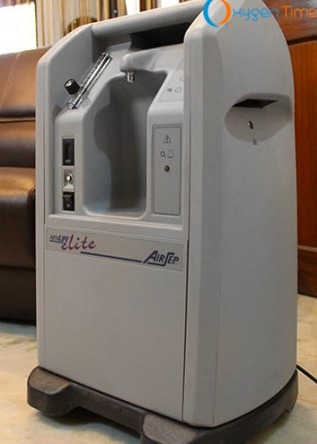
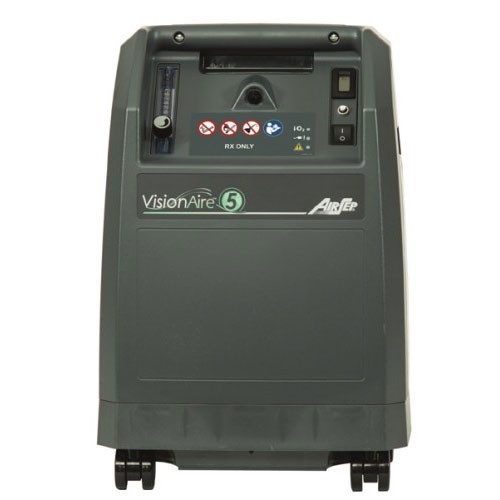
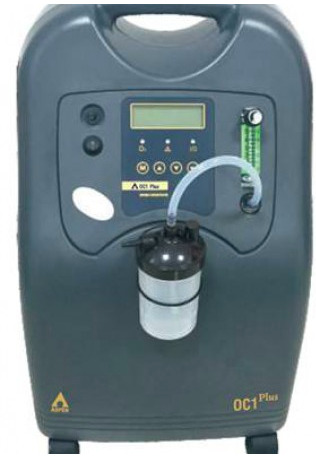
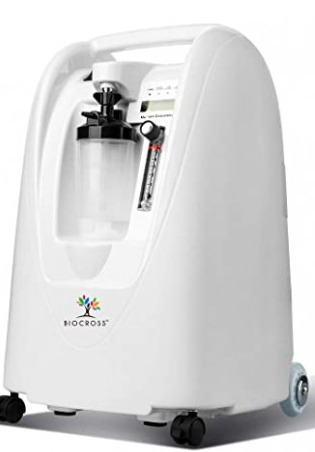
Veayva 5 litre
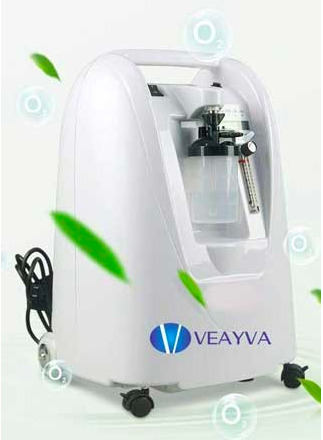
Key features
- Purity 90-95%%
- Type Home Stationary
- Continuous Flow 0.5-5LPM
- Weight 16kg
- Oxygen Purity Indicator (OPI) No
- Power consumption 285watts
Specifications
| Purity | 90-95%% |
|---|---|
| Type | Home Stationary |
| Continuous Flow | 0.5-5LPM |
| Weight | 16kg |
| Power consumption | 285watts |
| Sound level | 48db |
| Dimensions | 21H x 12W x 11.8Dinch |
| No Flow Alarm | Yes |
|---|---|
| Indian Voltage Model | Yes |
| Company Headquarters | China |
Pros and cons
PROS
- ₹27,840 is the lowest price in our sub-₹30K Indian-market 5 LPM tier
- 285 W power draw is class-leading efficient
- 48 dB sound is moderate, similar to Dr Diaz at much higher price
- 16 kg chassis matches class average for home stationary
CONS
- No OPI — patient-safety gap at any duration of use
- Only a no-flow alarm is confirmed — no loss-of-power, no system-malfunction
- No CE, FDA, or CDSCO; China-headquartered
- Brochure purity spec shows typo ('90-95%%'), documentation quality is poor
The Veayva 5 Litre is the cheapest Chinese-OEM 5 LPM oxygen concentrator we review on the Indian market at ₹27,840. Positioned below Dr Diaz’s ₹29,759 discounted price, below the ₹32K+ Indian-brand alternatives, and well below any Tier 1 import, Veayva’s proposition is pure price. The spec sheet reads: 0.5–5 LPM continuous, 90–95% purity (reported with a typo as “90-95%%” in the source document), 16 kg chassis, 285 W power draw, 48 dB sound, no OPI, only a no-flow alarm confirmed. The machine is functional as a 5 LPM oxygen delivery device. It is not appropriate as a primary LTOT machine.
What the specs mean
The 0.5–5 LPM flow range is standard. Purity at 90–95% is the category baseline; the brochure typo (“90-95%%”) reflects poor documentation quality rather than a real spec issue, but it is worth noting because documentation discipline often correlates with manufacturing discipline. A manufacturer that cannot catch a typo on its headline spec may also be missing other quality-control steps.
The 285 W power draw is genuinely efficient. Matches Dr Diaz and S.Cure at the low end of the Chinese-OEM 5 LPM category, close to Nidek Nuvo Lite’s 290 W. Over 16 hours/day of daily use at ₹9/kWh, 285 W works out to ₹1,250/month — one of the lowest electricity burns achievable. For a long-hours use case this is a real economic benefit.
The 16 kg chassis is class-average. 48 dB sound is moderate — comparable to Dr Diaz and S.Cure, louder than Nidek (40 dB) or Philips (45 dB), quieter than Jumao (52 dB) or Healthgenie (55 dB). Dimensions at 21H x 12W x 11.8D inches — identical to Dr Diaz and S.Cure, suggesting a shared OEM chassis. This is a common pattern in Chinese-OEM Indian-market concentrators: several brands buy the same base unit and apply their own label.
The critical gaps are on the safety and monitoring side. No OPI. No loss-of-power alarm confirmed. No system-malfunction alarm confirmed. Only a no-flow alarm is listed. This is an unusual configuration — most Chinese-OEM units include loss-of-power (because it is the simplest alarm to implement) but Veayva’s brochure shows that field blank. Either this is a brochure omission or the machine genuinely lacks the basic power-failure notification.
Outlet pressure is not published.
No altitude rating.
Certifications: no CE, no FDA, no CDSCO. Indian voltage confirmed. China HQ.
Who should buy it
A narrow buyer with a strict price ceiling. The Veayva 5 Litre at ₹27,840 is the cheapest credible entry into the Indian home-oxygen market. For a patient with:
- A short-term (3-6 months) oxygen requirement
- Home with adult supervision during active hours
- No immediate need for CDSCO/insurance paperwork
- A specific local dealer with documented service capacity
- Budget hard-capped at ₹28,000-30,000
Veayva becomes defensible. The 285 W power draw keeps running costs low, and the basic 5 LPM capability is delivered.
Bridge-use cases between hospital discharge and clinical follow-up where the machine runs 8-12 hours daily in supervised home settings are also acceptable.
Who shouldn’t
Anyone on LTOT — the combination of no OPI, no confirmed loss-of-power alarm, and thin service network is not safe for multi-year use.
Overnight unattended operation — without a confirmed loss-of-power alarm, a power failure at 3 AM may go undetected until the patient wakes with hypoxia.
Insurance-reimbursement cases requiring CDSCO registration.
Buyers in hill stations — no altitude rating.
Bedroom-use where patient-facing alarms matter.
Head-to-head alternatives
Dr Diaz 5 LPM (₹29,759 current). Identical chassis architecture (same dimensions, same weight, same power draw), but confirmed OPI, three alarms including loss-of-power, 12,000 ft altitude rating, and India HQ. Against Veayva at ₹27,840, Dr Diaz is only ₹1,919 more and dramatically better on every safety-relevant spec. Unless Dr Diaz is specifically unavailable at the buyer’s dealer, it is the better choice at this price tier.
Oxymed Mini 5 LPM (₹32,000-38,000). Indian-brand peer at higher price. Chennai-based manufacturing, usually OPI-equipped, stronger service network in South/West India. Against Veayva, Oxymed is ₹4,000-10,000 more expensive and materially better on service reality.
Nidek Nuvo Lite 5 LPM (₹55,000-65,000). The reference. 40 dB, 290 W, OPI, full alarms, 14 kg. Against Veayva, Nidek is 2x the price but buys a dramatically better machine on every axis. For long-term LTOT, Nidek is correct and Veayva is wrong.
Indian-market considerations
Veayva is a minimal-presence brand in the Indian market. No documented authorised-service-centre list, no dealer network directory, no warranty toll-free line. The source listing shows out of stock status. Availability is inconsistent; the brand appears to ship batches rather than maintain continuous inventory.
Warranty-claim reality: dealer-dependent entirely. For a ₹27,840 machine, the warranty is nominal and the practical recourse if the machine fails is whatever the specific seller offers in the first few weeks, or the buyer paying for independent repair thereafter.
Spare parts: no publicly documented Indian distribution. Compressor, sieve beds, valves, filters are all sourced through unclear channels. Post-warranty repair is high-uncertainty.
The brochure quality is also a signal. The purity typo (“90-95%%”) reflects a brand that either does not proofread its product documentation or is using an auto-generated listing from a Chinese OEM supplier with minimal localisation effort. Neither suggests strong Indian market commitment.
Warranty: not explicitly documented. 1 year from dealer is the category standard.
Voltage: Indian voltage confirmed.
Altitude: not listed.
CDSCO: not indicated.
Stock: out of stock. Availability is unreliable.
Additional Veayva-specific considerations
The shared-chassis signal. Veayva’s spec sheet is character-for-character identical to Dr Diaz 5 LPM and S.Cure 5 LPM on the core physical specs: 16 kg chassis, 21H x 12W x 11.8D inch dimensions, 285 W power draw, 48 dB sound, 0.5–5 LPM flow. The only material differences across the three brands are (a) purity spec (Dr Diaz: 90-96%, Veayva: 90-95%, S.Cure: 90-95%), (b) alarm configuration (Dr Diaz: 3 alarms including OPI, Veayva: 1 alarm only, S.Cure: 2 alarms no OPI), and (c) listed headquarters (Dr Diaz: India, Veayva: China, S.Cure: China). This is strong evidence of a shared Chinese OEM base unit with brand-level SKU differentiation on alarms and label.
Implications:
- The physical compressor, sieve beds, and plumbing are substantially identical across Dr Diaz, Veayva, and S.Cure. Reliability in year 2-3 should be similar across all three — the factor driving differences is build-QC at the OEM level, not brand-level engineering.
- Spare parts sourced for any of the three brands will likely fit the others. This gives buyers of Veayva a practical fallback: any technician who services Dr Diaz 5 LPM can likely service Veayva with the same spare parts, even if the Veayva brand itself disappears from the Indian market.
- The ₹1,919 premium for Dr Diaz over Veayva buys the OPI and two extra alarms, plus India-HQ warranty accountability. This is excellent value.
The typo as quality signal. The “90-95%%” typo in the purity spec is minor in isolation but represents a broader pattern. The entire Veayva listing shows signs of auto-generation from a Chinese OEM template with minimal localisation review. This is common in the ₹25-35K Chinese-OEM-in-India segment but is not acceptable quality control for a medical device. A brand that cannot proofread its own product brochure is a brand whose claims about alarm functionality, voltage rating, and warranty coverage should be independently verified by the dealer.
The no-flow-only alarm configuration. Veayva’s spec sheet confirms only the no-flow alarm, leaving loss-of-power and system-malfunction blank. This is an unusual configuration — most Chinese-OEM units at minimum confirm a loss-of-power alarm (the simplest to implement: a capacitor and buzzer on the input side that beeps when mains power drops). The inverted configuration — no-flow present but loss-of-power absent — may reflect a specific SKU choice or a brochure documentation error. For a patient who sleeps connected to the machine, this matters: a power failure at 3 AM produces 0 LPM flow, which should trigger both a loss-of-power and a no-flow alarm in theory. If only the no-flow alarm is present, it does fire — but the cause (power failure) is not immediately communicated to the household.
The accessory bundle is not documented. The source listing shows an empty description_text field. Most competitors at this price point document a basic shipping list (humidifier bottle, cannula, power cord, manual). Veayva does not. Buyers should confirm with the dealer what is actually included before purchase.
Post-warranty repair economics. At ₹27,840 capital cost, a major compressor replacement in year 3 (plausible for budget Chinese-OEM units) costing ₹6,000-10,000 is 22-36% of the purchase price. Running the same analysis on a Philips EverFlo at ₹70,000 with the same ₹6-10K repair cost is 9-14% of purchase price. The economics of budget units favour replacement over repair — and on the Veayva’s fragile service story, replacement may be the only viable path.
Stock-status and transit time. The source listing shows out-of-stock, which is common for Veayva and for many Chinese-OEM emerging brands. For a buyer who needs a machine urgently (post-discharge patient, acute respiratory flare-up), Veayva’s availability is unreliable. Factor in 7-21 days of waiting for stock if the brand is currently unavailable at your dealer.
Practical decision criteria for Veayva buyers
For a buyer seriously considering Veayva at ₹27,840, here is a decision framework:
Buy Veayva if all of the following are true:
- Total budget is hard-capped at ₹28,000 and cannot flex by even ₹2,000
- Intended use duration is under 12 months (post-discharge recovery, seasonal exacerbation, bridge-use during hospitalisation)
- An adult will be present in the home during all hours of machine operation (no overnight unattended use)
- A specific local medical-equipment dealer is selling the unit with a written 1-year warranty and spare-parts-availability commitment
- The prescription is 1-3 LPM continuous (not high-flow) — this aligns with the machine’s likely reliable output range despite specification claims
- Insurance reimbursement is not a requirement
- The patient or caregiver is medically literate enough to catch problems that the machine’s thin alarm suite will miss
Do NOT buy Veayva if any of the following are true:
- Budget can stretch to ₹30,000 or more — Dr Diaz 5 LPM at ₹29,759 is dramatically better
- LTOT horizon exceeds 12 months
- Overnight unattended operation is anticipated
- The patient is medically fragile and cannot self-report oxygenation changes
- The prescription requires high flow (4-5 LPM continuous)
- The buyer wants any regulatory marker (CDSCO, CE) for insurance or documentation
- The local dealer cannot provide specific written warranty terms
The ₹1,919 between Veayva and Dr Diaz 5 LPM is the smallest capital-cost delta we track in this review set. It buys: an OPI (critical), two additional alarms (critical), 12,000 ft altitude rating (useful), 13 psi outlet pressure (useful), India HQ accountability (useful), and a 0.5-5 LPM flow range vs Veayva’s 0.5-5 LPM (identical). There is essentially no scenario where Veayva is the right choice over Dr Diaz unless Dr Diaz is specifically unavailable at the buyer’s dealer.
When the shared-chassis reality helps Veayva buyers
Because Veayva appears to share the same underlying OEM chassis as Dr Diaz 5 LPM and S.Cure 5 LPM — same dimensions, same weight, same power draw, same sound level — a practical positive emerges for post-warranty service. Any medical-equipment technician who can service a Dr Diaz 5 LPM can service a Veayva with essentially the same spare parts. This means that even if Veayva the brand disappears from the Indian market in 18 months, the physical machine remains serviceable through the same technician network that supports the broader Longfian-family 5 LPM ecosystem.
For a buyer committed to Veayva at ₹27,840 — perhaps because it is the only unit available at their local dealer, or because the specific discount makes it economically rational — this chassis-level cross-compatibility is useful insurance against brand-level disappearance. It does not change the day-one spec gaps (no OPI, thin alarms), but it does change the long-tail post-warranty story from “potentially stranded” to “serviceable through standard channels.”
Verdict
The Veayva 5 Litre is a price-first product for a price-first buyer. At ₹27,840 it is the lowest cost of entry into the Indian home-oxygen market for a 5 LPM stationary. The 285 W power efficiency and the 48 dB sound level are genuinely positive specs. The missing OPI, missing loss-of-power alarm (critical for overnight use), typo-riddled brochure, and invisible service network are all real concerns that rule out the machine for any long-term or unattended use. For a three-month post-discharge requirement with strict budget constraints and adult home supervision, it is acceptable. For everything else, Dr Diaz 5 LPM at ₹1,919 more money is a dramatically better purchase. Score: 5.6/10.