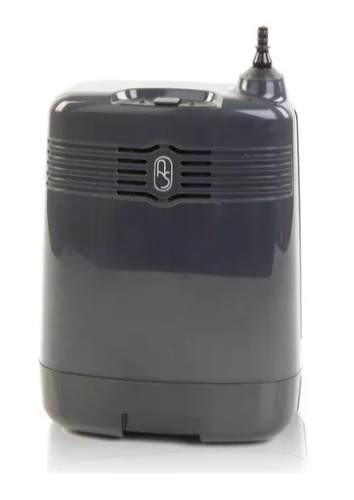
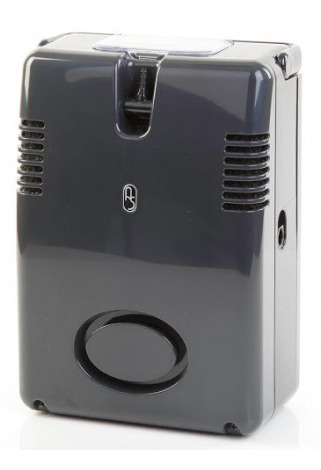
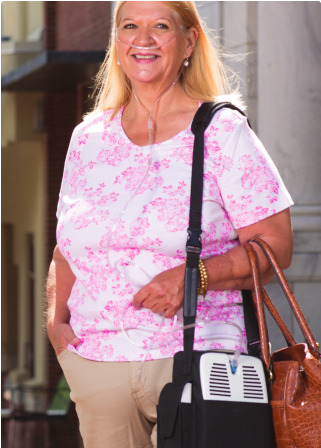
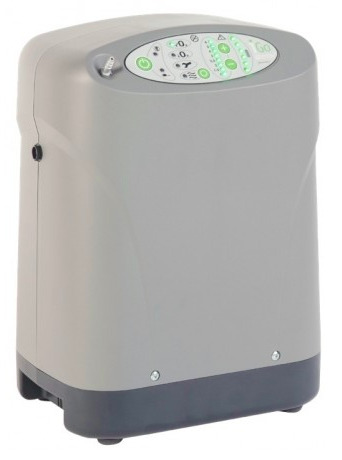
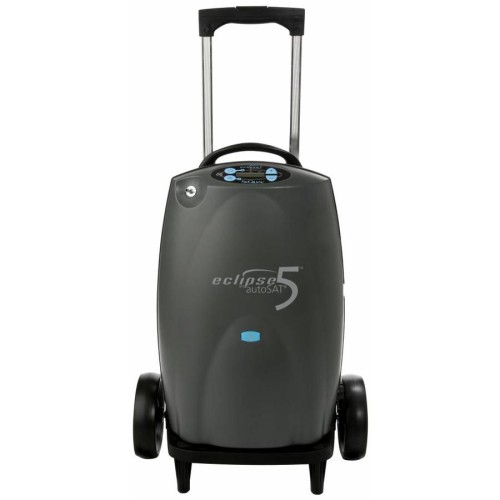
SeQual Eclipse 5 Portable Oxygen Concentrator
Key features
- Purity 90-96%
- Temperature Range 40Celcius
- Type Portable (Battery powered)
- Continuous Flow 0.5-3LPM
- Pulse Flow 1-9Pulse setting
- mL dose 16-192mL
Specifications
| Purity | 90-96% |
|---|---|
| Temperature Range | 40Celcius |
| Type | Portable (Battery powered) |
| Continuous Flow | 0.5-3LPM |
| Pulse Flow | 1-9Pulse setting |
| mL dose | 16-192mL |
| Weight | 8.3kg |
| Oxygen Purity Indicator (OPI) | Yes |
| Battery backup (at 2 pulse setting) | 5.4hours |
| Recharge time | 5hours |
| Sound level | 40db |
| Dimensions | 19.3H x 12.3W x 7.1Dinch |
|---|---|
| Operating altitude | 13123feet |
| Loss of Power Alarm | Yes |
| System Malfunction Alarm | Yes |
| Indian Voltage Model | Yes |
| Company Headquarters | USA |
| US FDA Approved | Yes |
| FAA Approved | Yes |
| CE Certified | Yes |
Pros and cons
PROS
- 13,123 ft published operating altitude is the highest in the active-SKU portable segment — covers Leh, Spiti and Leh-Manali road approaches
- Dual-mode delivery: 0.5–3 LPM continuous plus 1–9 pulse settings, the broadest range in any single portable
- 16–192 mL per-dose range covers clinical prescriptions that no pulse-only portable can service
- 40 dB published sound level competitive with the quietest premium pulse portables
CONS
- 8.3 kg published weight is 2.6x the Inogen G5 and 3.6x the Focus — genuinely heavy as a 'portable'
- ₹2,87,040 indicative retail is 34% above the Philips SimplyGo at comparable dual-mode capability
- Non-touchscreen interface — older UX than the active Inogen and Caire active SKUs
The SeQual Eclipse 5 is the high-capability outlier in the Indian portable market — a dual-mode unit delivering 0.5–3 LPM continuous or 1–9 pulse settings from a single chassis, at a published 13,123 ft operating altitude and 40 dB sound level. Indicative retail is ₹2,87,040 (varies by region/dealer), In Stock per manufacturer brochure and e-commerce product listings. It is US FDA approved, FAA approved and CE certified, shipped as an Indian Voltage Model, and at 8.3 kg it occupies a category of one — genuinely heavier than all other portables but genuinely capable of prescriptions they cannot service.
What the specs actually mean
Published purity is 90–96% — high end of the PSA class for portables. The Eclipse 5 has an Oxygen Purity Indicator (OPI) flagged “Yes” in technical details. The description confirms the OPI activates “in case the oxygen purity level falls below 86%” — a slightly more conservative threshold than the typical 82% used by other manufacturers.
The flow architecture is the defining spec. 0.5–3 LPM continuous flow delivery is the standout — no pulse-only portable can deliver continuous flow, and the SimplyGo’s continuous mode tops out at 2 LPM. At 3 LPM continuous, the Eclipse 5 covers the majority of home-oxygen prescriptions on battery power, which is structurally different from what other portables offer. On the pulse side, 1–9 settings is wider than any competing portable (G5: 1–6; SimplyGo Mini: 1–5). The 16–192 mL per-dose range covers clinical prescriptions that no 1–5 pulse unit can meet.
Battery backup depends on mode. At pulse setting 2, the published figure is 5.4 hours; at pulse 5, 3.7 hours; at pulse 9, 1.7 hours. At continuous 0.5 LPM, 4.4 hours; at 1 LPM, 3.7 hours; at 2 LPM, 2.0 hours; at 3 LPM, 1.3 hours. Recharge time is 5 hours — the longest among premium portables, a function of the larger battery pack. For continuous-flow use above 1 LPM on battery, the Eclipse 5 is clearly a short-trip tool; pulse-mode battery endurance is competitive with the segment.
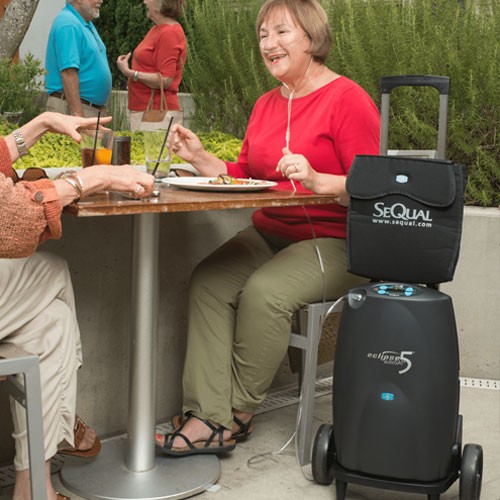
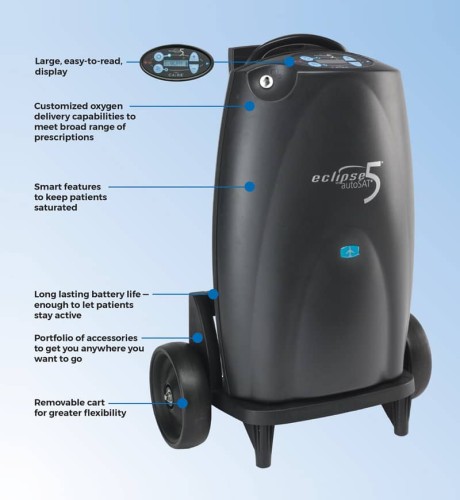
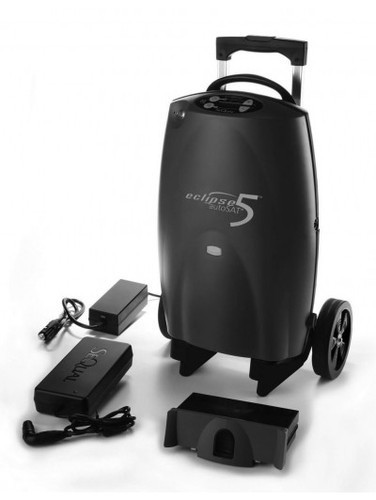
The 8.3 kg weight is the main compromise. Inogen G5: 2.6 kg; SimplyGo Mini: 2.3 kg; Eclipse 5: 8.3 kg. The Eclipse 5 ships with a removable roller cart, and the description notes “could be easily dragged and carried despite its heavyweight.” In practice, 8.3 kg is not shoulder-strap wearable for extended periods — this is a cart or trolley portable, not a side-bag portable. For airports, train stations, and hotel-to-taxi transitions, the cart works; for unplanned stairs or crowded Indian railway platforms, it is a genuine burden.
Altitude: 13,123 ft, the unique selling point
13,123 ft (4,000 m) operating altitude is the highest in any active-SKU Indian-market portable. It covers Leh (11,500 ft), Spiti’s villages (10–12,000 ft), Rohtang Pass (13,000 ft in its open season), Nathu La Pass (14,140 ft — just outside), and the entire Leh-Manali road approach. For pilgrimage routes, high-altitude tourism, and deployments to Ladakh region military or civilian patients, this is the only portable that fits the altitude envelope.
40 dB sound and 30+ psi outlet
The 40 dB published sound level is in the same range as the premium pulse portables — 38 dB (G5), 39.9 dB (Freestyle Comfort 5), 40 dB (Eclipse 5, Inogen G4), 43 dB (SimplyGo), 52 dB (SimplyGo Mini). At bedside the Eclipse 5 is audibly distinguishable from the 38 dB G5 by roughly 25% perceived loudness (logarithmic scale) but functionally the same — it is a quiet machine.
Who should buy it
The Eclipse 5 is the right buy for three specific profiles. First, any patient on a continuous-flow prescription above 2 LPM who needs portable delivery — the Eclipse 5 is the only active-SKU Indian-market portable that delivers 2.5–3 LPM continuous on battery. For post-hospital-discharge patients on 2.5 LPM or 3 LPM continuous whose travel cannot wait for titration, this is it.
Second, any patient travelling to destinations above 10,000 ft — specifically Leh, Spiti, and Leh-Manali road journeys. The next-best altitude-rated portable (Freestyle 3/5 at 12,000 ft, both Discontinued) does not reach the Eclipse 5’s 13,123 ft envelope, and every other active-SKU portable caps at 10,000 ft. For pilgrimage or tourism to Ladakh on home oxygen, this is the only defensible option.
Third, any patient who needs pulse settings 6–9 for effective oxygen delivery. Most 1–5 and 1–6 portables cannot reach the higher pulse-equivalent flow that the Eclipse 5’s settings 7–9 deliver. For patients with higher effective oxygen demand on pulse flow, the 192 mL peak per-dose capability is unmatched.
For a household that already owns a home stationary unit (Philips Everflo) and wants to add a portable that covers any plausible travel scenario — flights, high-altitude tourism, long-distance train, international travel — the Eclipse 5’s spec breadth justifies the 8.3 kg weight and ₹2,87,040 retail for a one-time capability buy.
Who shouldn’t
Anyone whose portable requirement is strictly daily urban mobility below 10,000 ft altitude with mild-to-moderate pulse prescriptions should not buy the Eclipse 5. The 8.3 kg weight is overspecced for that use case — the Inogen G5 (2.6 kg, ₹2,14,999) or SimplyGo Mini (2.3 kg, ₹2,10,700) serve better.
Anyone whose patient profile includes mobility limitations that make cart-wheeling impractical should not buy the Eclipse 5. Stairs, crowded Indian railway platforms, uneven pavement, and narrow hospital corridors all stress the cart-based portability model.
Anyone on a tight budget should not consider the Eclipse 5 — ₹2,87,040 is 34% above the SimplyGo and 30% above the SimplyGo Mini / G5. The spec-sheet value is real but only for buyers whose prescription genuinely uses the additional capabilities.
Anyone who primarily values touchscreen or modern UX should be aware that the Eclipse 5 uses a non-touchscreen interface per the manufacturer’s own description. Active-SKU competitors have moved to touchscreen; the Eclipse 5 platform is older. For older or less technology-comfortable patients, this may actually be an advantage (fewer failure modes, physical buttons are unambiguous) — but for UX-oriented buyers it is a regression.
How it compares to real alternatives
Eclipse 5 vs Philips SimplyGo
The closest dual-mode competitor. SimplyGo: 4.5 kg, 0.5–2 LPM continuous + 1–6 pulse, 3 hours at pulse 2, 43 dB, OPI, 10,000 ft altitude, ₹2,10,700, In Stock. Eclipse 5: 8.3 kg, 0.5–3 LPM continuous + 1–9 pulse, 5.4 hours at pulse 2, 40 dB, OPI, 13,123 ft altitude, ₹2,87,040, In Stock. Pick the SimplyGo if continuous 2 LPM and 10,000 ft cover the use case — lighter, cheaper, Philips service depth. Pick the Eclipse 5 if continuous flow above 2 LPM, altitude above 10,000 ft, or pulse settings above 6 are clinically needed.
Eclipse 5 vs Inogen One G5
G5: 2.6 kg, pulse 1–6, 6.5 hours at pulse 2, 38 dB, 90–93% purity, 10,000 ft altitude, ₹2,14,999. Eclipse 5: 8.3 kg, dual mode (pulse 1–9 + continuous 0.5–3 LPM), 5.4 hours at pulse 2, 40 dB, 90–96% purity, 13,123 ft altitude, ₹2,87,040. Pick the G5 for lightweight urban mobility; pick the Eclipse 5 for altitude, continuous flow, or high-setting pulse needs.
Eclipse 5 vs Caire Freestyle Comfort 5
Same manufacturer family (Caire/Chart Industries). Freestyle Comfort 5: 2.3 kg, pulse 1–5, 4 hours / 16 hours extended at pulse 2, 39.9 dB, 10,000 ft altitude, ₹2,48,640, Out of stock. Eclipse 5: 8.3 kg, dual mode, 5.4 hours at pulse 2, 40 dB, 13,123 ft altitude, ₹2,87,040, In Stock. Pick the Freestyle Comfort 5 if lightweight and long extended-battery are the priorities and 10,000 ft altitude is sufficient. Pick the Eclipse 5 for altitude/continuous-flow/high-pulse needs and immediate availability.
Clinical workflow considerations
The Eclipse 5’s continuous-flow capability up to 3 LPM changes the clinical workflow for patients transitioning between home stationary and travel. A patient on a 2.5 LPM continuous prescription at home — say on an Everflo or Visionaire 5 — can travel on the Eclipse 5 at the same prescribed setting without requiring a pulse-setting titration visit with the pulmonologist. The continuity of dose is clinically meaningful: pulse settings do not translate linearly to LPM equivalents, and a titration visit typically involves a walk-test on the new portable to verify adequate SpO2 maintenance. For patients whose travel schedules cannot accommodate titration, the Eclipse 5’s continuous-mode capability is a real workflow advantage.
On the battery-rotation workflow: the published 5.4-hour base battery at pulse 2 means a single-battery Eclipse 5 covers most non-flight outings without needing a swap, and the 5-hour recharge time means an overnight AC charge returns a fully charged unit for the next day. For patients with multiple batteries, the rotation approach (charge one while using the other) is the standard playbook.
Indian-market considerations
The Eclipse 5 is Indian Voltage Model per published additional details. 220V/50Hz compatible without a step-down transformer. A small inline stabiliser for home charging in tier-2 cities with voltage variability is optional rather than required.
CDSCO approval status is not stated in the published key features or additional details for this SKU in the data we reviewed (CDSCO Medical Device Registry). Verify with the dealer before hospital-channel purchase.
Caire/Chart Industries India service network is thinner than Philips Respironics — fewer authorised service partners in tier-2 Indian cities. For the Eclipse 5 specifically, the larger battery pack is the most common service item, and replacement batteries have historically had 2–4 week lead times in India. Given the specialised nature of the platform and the premium price, written parts-availability and service-SLA assurances from the dealer at the time of purchase are strongly advisable.
For international travel use, the FAA approval is published in the additional details. Indian airport ground staff are generally familiar with Eclipse 5 paperwork requirements — it has been on the Indian market for a decade. Allow extra time at check-in for oxygen documentation, and carry the FAA approval letter printout.
Online-vs-hospital channel price gap is narrow on premium portables — typically sub-10%. The Eclipse 5 is generally a direct-to-dealer online purchase, and the hospital channel does not add meaningful value on portables beyond the box.
Verdict
The SeQual Eclipse 5 is a category-of-one portable oxygen concentrator for the Indian market — the only active-SKU unit that combines 3 LPM continuous flow, 1–9 pulse settings, and a 13,123 ft operating altitude. For patients who need those capabilities, nothing competes; for patients who don’t, the 8.3 kg weight and ₹2,87,040 retail are both substantial penalties.
Score it 8.4 out of 10. Points off for the heavy weight (a genuine portability penalty), the 1.3-hour battery life at 3 LPM continuous (limits continuous-mode trip duration), the older non-touchscreen UX, and the thinner Caire India service network versus Philips. Points on for the uniquely broad delivery envelope, the 13,123 ft altitude rating, and the 40 dB sound. For Leh-class travel, post-discharge high-continuous-flow prescriptions, or high-pulse-setting requirements, this is the portable to buy in India.