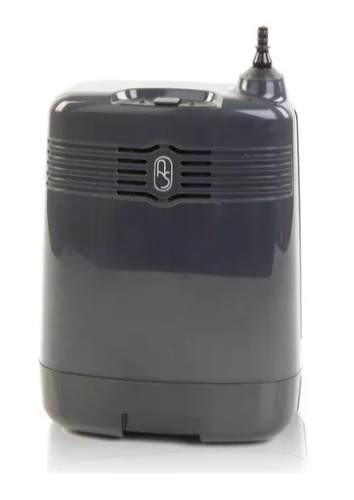
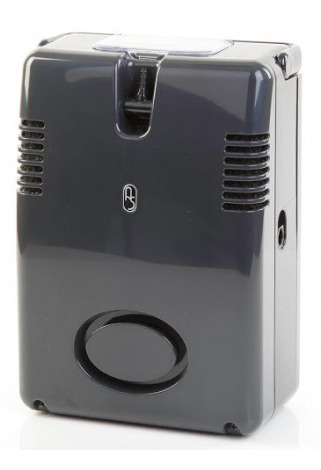
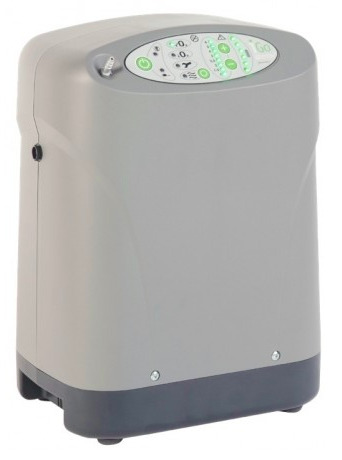
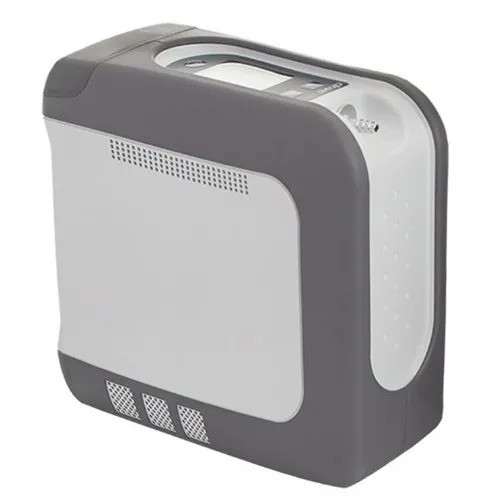
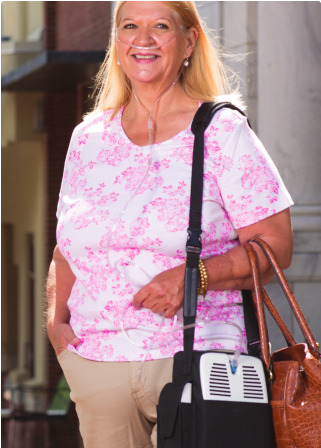
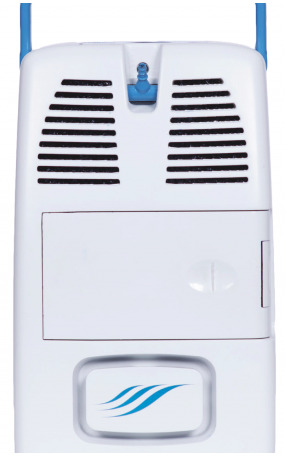
Airsep Freestyle 5
Key features
- Purity 90-95%
- Type Portable (Battery-powered)
- Pulse Flow 1-5Pulse setting
- mL dose 8.75mL
- Weight 2.8kg
- Oxygen Purity Indicator (OPI) No
Specifications
| Purity | 90-95% |
|---|---|
| Type | Portable (Battery-powered) |
| Pulse Flow | 1-5Pulse setting |
| mL dose | 8.75mL |
| Weight | 2.8kg |
| Battery backup (at 2 pulse setting) | 2hours |
| Recharge time | 3hours |
| Backup with external battery pack | 7hours |
| Sound level | 41db |
| Dimensions | 10.7H x 6.6W x 4.4Dinch |
| Operating altitude | 12000feet |
|---|---|
| System Malfunction Alarm | Yes |
| No Flow Alarm | Yes |
| Indian Voltage Model | Yes |
| Company Headquarters | USA |
| US FDA Approved | Yes |
| FAA Approved | Yes |
| CE Certified | Yes |
Pros and cons
PROS
- 12,000 ft operating altitude covers Indian hill destinations that 10,000 ft-rated portables cannot
- 1–5 pulse setting range covers mid-range prescriptions that the Freestyle 3 (1–3) cannot
- 41 dB published sound level is among the quietest POCs in any generation, including active SKUs
- 2.8 kg is within the all-day-wearable range for most adult caregiver profiles
CONS
- Stock: Discontinued per manufacturer brochure and e-commerce product listings
- 2 hours battery life at pulse setting 2 is the shortest among comparable pulse portables
- No Oxygen Purity Indicator (OPI) and no loss-of-power alarm — the alarm package is weakest in its class
The Airsep Freestyle 5 is the Freestyle 3’s bigger sibling — same brand, same chassis family, extended pulse-setting range from 1–3 to 1–5. At indicative retail ₹1,72,800 (varies by region/dealer), it is listed as Discontinued per manufacturer brochure and e-commerce product listings, and like the Freestyle 3, its clinical fit in 2026 has narrowed considerably. It retains the 12,000 ft operating altitude and the 41 dB sound level — strong specs — but adds weight (2.8 kg vs 2 kg), loses battery life (2 hours at pulse 2 vs 2.5 hours), and carries the same gap in Oxygen Purity Indicator (OPI).
What the specs actually mean
Published purity is 90–95% — standard for a PSA pulse-flow portable. The Freestyle 5 does not have an OPI per the published technical details. Its alarm package is weaker than the Freestyle 3’s: loss-of-power alarm is empty in additional details (not confirmed “Yes”), system malfunction and no-flow are “Yes.” The missing loss-of-power alarm is unusual — most portables in this class include it, and its absence means a battery-depleted or AC-drop event may go unannounced until the patient notices reduced flow. This is a real safety consideration for unattended overnight use.
The 1–5 pulse setting range is the main distinction from the Freestyle 3. Setting 5 delivers the largest pulse volume, which at a patient’s resting breath rate approaches an LPM-equivalent of ~1.5 LPM. For patients whose prescription reads “pulse setting 4–5” — not uncommon for COPD patients with moderate hypoxaemia — the Freestyle 3 is under-specced and the Freestyle 5 is the right member of the line.
Battery backup at pulse setting 2 is published at 2 hours from the internal battery and 7 hours with the external battery pack. 2 hours is the shortest base-battery duration among comparable pulse portables — G5 is 6.5 hours, SimplyGo Mini is 4.5 hours, Freestyle Comfort 5 is 4 hours, Eclipse 5 is 5.4 hours. For a patient planning more than a short outing, the external battery pack is effectively mandatory. Recharge time is 3 hours.
The 2.8 kg weight is heavier than the Freestyle 3 (2 kg) but still inside the all-day-wearable envelope for most adults. The SimplyGo Mini (2.3 kg) and Freestyle Comfort 5 (2.3 kg) are lighter; the Inogen One G5 (2.6 kg) is close to the Freestyle 5.
The 41 dB published sound level is among the quietest in any portable generation. It is quieter than the SimplyGo Mini (52 dB), the SimplyGo (43 dB), the Eclipse 5 (40 dB — tie, effectively), and the G5 (38 dB, slightly quieter). For bedside or shared-space use, 41 dB is well under the threshold where portable noise becomes intrusive.
Altitude envelope and certifications
12,000 ft (3,658 m) operating altitude matches the Freestyle 3 and beats most active-SKU portables except the SeQual Eclipse 5 (13,123 ft). FAA, FDA and CE certifications are all confirmed “Yes” in published additional details. The Indian Voltage Model flag is “Yes” — no step-down transformer for AC charging.
Who should buy it
The narrow fit is a residual-stock buyer on a pulse setting 3–5 prescription who needs to travel to altitudes above 10,000 ft and has secured parts and service commitments in writing. That combination is uncommon. Above 10,000 ft with a mid-to-higher pulse setting is the only zone where the Freestyle 5 is doing something an active-SKU alternative cannot — and even that zone has the SeQual Eclipse 5 competing at 13,123 ft with better battery life and full OPI, albeit at 8.3 kg and much higher price.
For a household where cost is a real constraint and there is residual Freestyle 5 inventory on offer below ₹1,50,000, it can be defensible — the 41 dB sound and 12,000 ft altitude are genuine. But the missing OPI and loss-of-power alarm are clinical gaps that do not go away at any price.
For a caregiver who values sound-level above all else — patients in small bedrooms with very light sleep — the 41 dB is better than the SimplyGo Mini (52 dB) and on par with the quietest portables ever made. That alone is not enough to recommend the Freestyle 5 over an active-SKU alternative, but it is a genuine advantage.
Who shouldn’t
Anyone on a pulse setting 1–3 prescription should buy the Freestyle 3 (same chassis, lighter, cheaper) or the active-SKU Inogen One G5 (fuller alarm package, longer battery). The Freestyle 5’s 1–5 range is not useful if only 1–3 are prescribed.
Anyone for whom loss-of-power alarm is clinically important — and this includes most overnight or unattended users — should not buy the Freestyle 5. A portable that runs out of battery silently during sleep is a real safety issue, and most buyers simply assume their portable will alarm on AC drop. The Freestyle 5 does not, per the empty loss-of-power field in the published additional details.
Anyone whose out-of-home use routinely exceeds 2 hours without AC access should not buy the Freestyle 5 unless they are committing to the external battery pack as mandatory equipment. The base-battery duration is the shortest in its peer group.
Anyone who values OPI, full alarm coverage, and active-SKU warranty should look at the G5 (₹2,14,999) or SimplyGo Mini (₹2,10,700) instead. The 20–25% price premium buys a meaningfully more complete machine.
How it compares to real alternatives
Freestyle 5 vs Airsep Freestyle 3
Same family. Freestyle 3: 2 kg, 1–3 pulse, 2.5 hours at pulse 2 base, ₹1,58,400. Freestyle 5: 2.8 kg, 1–5 pulse, 2 hours at pulse 2 base, ₹1,72,800. Pick the Freestyle 3 if 1–3 covers the prescription; pick the Freestyle 5 only if 4–5 are genuinely needed. The Freestyle 5 loses battery life and gains weight to buy the broader setting range.
Freestyle 5 vs Inogen One G5
The G5 (active SKU, ₹2,14,999) is the head-to-head comparison any residual-stock Freestyle 5 buyer should make. G5: 2.6 kg, 1–6 pulse, 6.5 hours at pulse 2, 38 dB, has OPI, full alarm suite including loss-of-power, 10,000 ft altitude, 2-year manufacturer warranty. Freestyle 5: 2.8 kg, 1–5 pulse, 2 hours at pulse 2, 41 dB, no OPI, no loss-of-power alarm, 12,000 ft altitude, no active warranty. Pick the G5 unless you genuinely need the 12,000 ft altitude — and even then, the SeQual Eclipse 5 at 13,123 ft is the altitude-optimised answer.
Freestyle 5 vs SeQual Eclipse 5
The Eclipse 5 (In Stock, ₹2,87,040) is the high-altitude portable benchmark. Eclipse 5: 8.3 kg, 1–9 pulse plus 0.5–3 LPM continuous, 5.4 hours battery at pulse 2, 40 dB, OPI, 13,123 ft altitude. Freestyle 5: 2.8 kg, 1–5 pulse only, 2 hours at pulse 2, 41 dB, no OPI, 12,000 ft altitude. Pick the Eclipse 5 if altitude above 10,000 ft is load-bearing and the weight premium is acceptable. Pick the Freestyle 5 only if residual-stock pricing is very favourable and a weight advantage of 5.5 kg matters more than OPI, battery life, and continuous-flow capability.
Freestyle 5 vs Philips SimplyGo Mini
Active-SKU premium alternative. SimplyGo Mini: 2.3 kg, 1–5 pulse, 4.5 hours at pulse 2, 52 dB, has OPI, 10,000 ft altitude, ₹2,10,700, In Stock. Freestyle 5: 2.8 kg, 1–5 pulse, 2 hours at pulse 2, 41 dB, no OPI, 12,000 ft altitude, ₹1,72,800, Discontinued. SimplyGo Mini wins on weight (500 g less), battery life (125% longer base), OPI presence, active warranty, and Philips India service. Freestyle 5 wins on sound (11 dB lower) and altitude (2,000 ft more). The SimplyGo Mini is the stronger buy for almost every profile; Freestyle 5 residual-stock only makes sense if sound below 50 dB and altitude above 10,000 ft are both clinically required.
Clinical fit considerations
For patients titrated at pulse setting 4 or 5 — not an uncommon prescription for stable COPD patients with moderate hypoxaemia — the Freestyle 5’s delivery envelope is adequate. The concern is that at settings 4–5, the 2-hour base battery becomes a significant constraint. A 90-minute urban outing at setting 5 leaves no reserve; any plan above 90 minutes at those settings requires the external battery pack as mandatory equipment. The Freestyle 5 is therefore best suited to the patient on a stable setting 3–4 prescription who uses the portable for short-to-medium outings and has AC access for charging between trips.
For higher-altitude use (Auli, Kedarnath approach, Leh-Manali road), the Freestyle 5’s 12,000 ft rating is genuinely useful, but the 2-hour battery is a practical problem: at higher altitudes, vehicle AC outlets become less reliable, and the external battery pack becomes essential. Plan for at least one spare battery per full day of travel, and verify that the dealer can source replacement batteries before trip planning commits.
Indian-market considerations
The Freestyle 5 is Indian Voltage Model per published additional details — direct 220V/50Hz compatible without a step-down transformer. A small inline stabiliser for home charging in tier-2 cities with voltage variability is optional rather than mandatory.
CDSCO approval status is not stated in the published key features or additional details for this SKU in the data we reviewed (CDSCO Medical Device Registry). Discontinued SKUs frequently have lapsed Indian registration; verify with the dealer before any hospital-channel transaction.
Airsep/CAIRE India service network is thinner than Philips or Inogen. For discontinued SKUs, the service situation is worse — common complaint across Indian dealers is 6–8 week parts turnaround for Freestyle-line batteries and sieve cartridges. Before purchase, verify in writing: (1) spare battery availability and price, (2) sieve cartridge availability, (3) service turnaround commitment. Without these, a ₹1,72,800 residual-stock purchase is an open-ended risk.
Online-vs-hospital channel gap: hospital channels generally do not stock discontinued portables. The Freestyle 5, like the Focus and Freestyle 3, is almost exclusively an online-dealer purchase at this point. Verify the dealer’s return policy and service network before committing.
For international air travel, the FAA approval is published in the additional details. Indian airline ground staff are generally familiar with FAA-approved POCs but will want to see the original paperwork at check-in. For a discontinued SKU, the original FAA approval letter may need to be sourced from the dealer at time of purchase; verify this is included. A generic printout of FAA-approved device lists is not always accepted by airline ground staff — the manufacturer’s named approval letter carries more weight.
Verdict
The Airsep Freestyle 5 extends the Freestyle line’s altitude envelope to pulse settings 1–5, but it pays for that range with weight, battery life, and — critically — a weaker alarm package than the Freestyle 3 itself. The discontinued status, the absent OPI, and the missing loss-of-power alarm make this a narrow residual-stock buy for 2026.
Score it 6.1 out of 10. Points off for the discontinued status, the missing OPI and loss-of-power alarm, and the 2-hour base battery. Points on for the 12,000 ft altitude and the 41 dB sound level. For almost every buyer in 2026, an active-SKU alternative (Inogen One G5, SimplyGo Mini, Freestyle Comfort 5) is the safer choice. The only defensible residual-stock purchase is for a patient who specifically needs pulse settings 4–5 at altitudes above 10,000 ft, has written parts and service commitments, and understands the alarm-package gap.