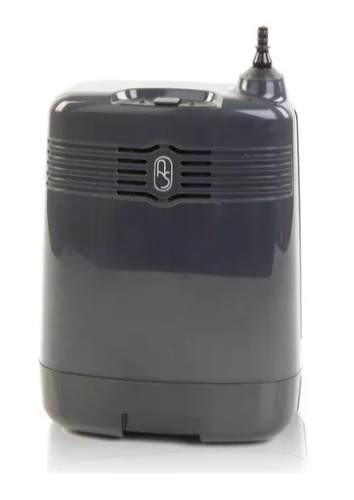
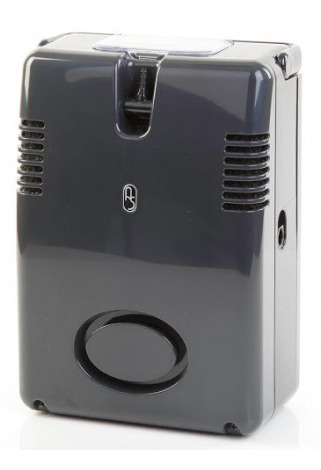
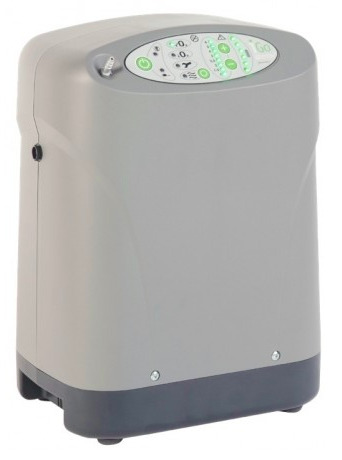
Devilbiss iGo2 Portable Oxygen Concentrator
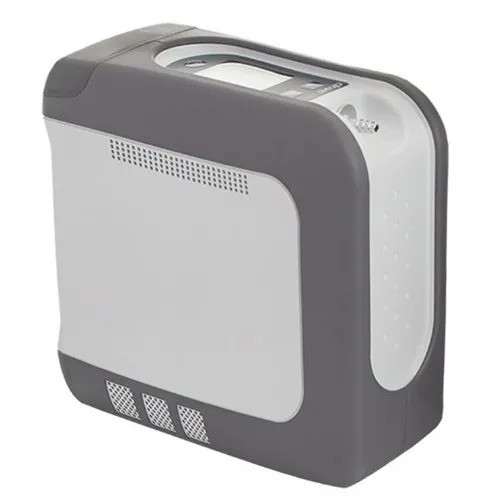
Key features
- Purity 90%
- Temperature Range 35Celcius
- Battery Duration 3.5hours
- Transportation Humidity 93%
- Type Portable
- Pulse Flow 1-5Pulse setting
Specifications
| Purity | 90% |
|---|---|
| Battery Duration | 3.5hours |
| Transportation Humidity | 93% |
| Temperature Range | 35Celcius |
| Type | Portable |
| Pulse Flow | 1-5Pulse setting |
| Weight | 2.2kg |
| Battery backup (at 2 pulse setting) | 3.5hours |
| Recharge time | 5hours |
| Sound level | 37.5db |
| Dimensions | 8.4x 3.9x 8.4inch |
|---|---|
| Operating altitude | 10000feet |
| Loss of Power Alarm | Yes |
| System Malfunction Alarm | Yes |
| No Flow Alarm | Yes |
| Indian Voltage Model | Yes |
| Company Headquarters | Germany |
| US FDA Approved | Yes |
| FAA Approved | Yes |
| CE Certified | Yes |
Pros and cons
PROS
- Weight of 2.2 kg is shoulder-strap practical — a genuine ambulatory portable, not a wheeled cart
- Sound level of 37.5 dB is the quietest portable in this review — 2.5 dB below the Platinum Mobile
- FAA, US FDA, and CE certifications all confirmed — full regulatory stack for airline use
- Indian-voltage configuration and 2-year warranty per the manufacturer sheet — the longest portable warranty here
CONS
- Battery backup of 3.5 hours at pulse setting 2 is the lowest among current-production portables reviewed — 1.5 hours less than the Platinum Mobile's 5 hours
- Pulse-only operation with no continuous-flow mode — unsuitable for CPAP integration or continuous-flow prescriptions
- Street price of Rs. 172,781 is Rs. 37,459 below the Platinum Mobile but still a premium buy — not a budget portable
The DeVilbiss iGo2 is the portable we recommend to Indian buyers who are choosing a current-production, fully-supported pulse-dose concentrator in 2026 and do not want to pay the Invacare Platinum Mobile premium. At 2.2 kg and 37.5 dB it is the lightest and quietest active-stock portable in this review, and its FAA certification makes it one of the safer travel-grade options for Indian patients who fly.
Street pricing sits around Rs. 172,781 against a list of Rs. 225,600, a 23% discount that reflects normal dealer margins in the portable category. For a portable with 2-year warranty and genuine airline-usable FAA paperwork, this is a fair price in the Indian market — not cheap, but competitive.
What the specs mean in practice
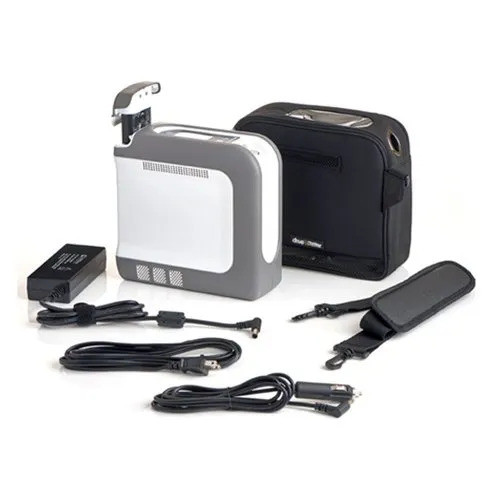
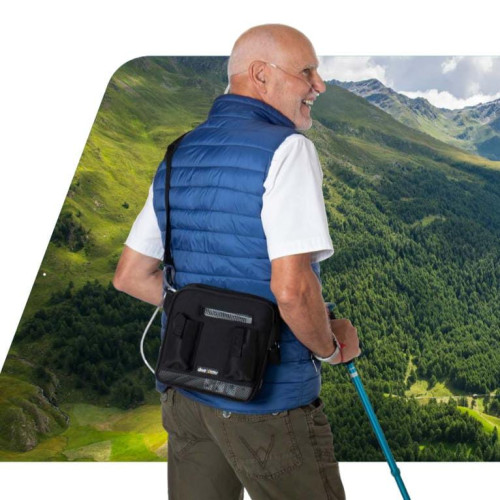
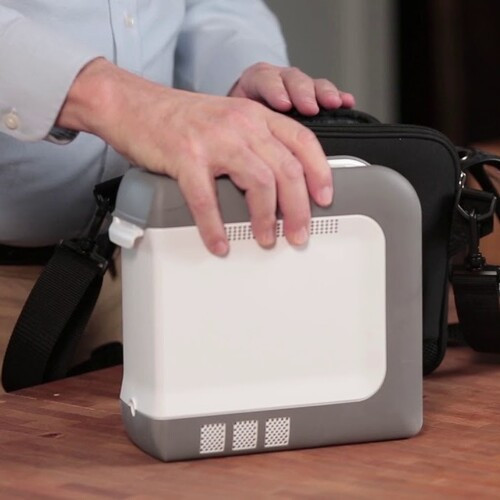
Weight: 2.2 kg. Identical to the Platinum Mobile’s 2.18 kg. Both are genuinely shoulder-strap portables — unlike the 8.6 kg iGo, which is a wheeled cart. For airport use, for hour-long outings, for day trips with car transport and walking phases, 2.2 kg over the shoulder is comfortable for most adults.
Pulse flow: 1-5 settings. One fewer than the iGo’s 1-6 and matching the Platinum Mobile and XPO2’s 1-5. Pulse settings are not directly convertible to continuous LPM equivalents, but as a rough guide setting 3 on the iGo2 is appropriate for resting supplementation in most moderate-hypoxaemia patients, setting 4-5 for exertional need.
Sound: 37.5 dB. Quietest portable in this review. 2.5 dB below the Platinum Mobile’s 40 dB, 7.5 dB below the XPO2’s 45 dB. For restaurant or conference-room use this margin matters.
Battery backup: 3.5 hours at pulse setting 2. This is the weakest spec on the sheet. The Platinum Mobile with its standard battery delivers 5 hours at the same setting, and 10 hours with the optional external pack. The iGo2 ships with a single battery pack per the box contents list — external or dual-battery options are not stocked by Indian dealers as widely as for the Platinum Mobile. For a Delhi-to-Bengaluru flight plus 2 hours of ground time, 3.5 hours is cutting it close; for a full-day outing without mains access, inadequate.
Recharge time: 5 hours. Same as the iGo. Overnight recharge assumed.
Operating altitude: 10,000 ft. Matches the Platinum Mobile and XPO2. This is the current-generation portable altitude envelope. For Leh at 11,500 ft, the iGo2 is nominally over-spec; in practice, altitude margins on portables are often verified at installation rather than relied on absolutely.
Outlet pressure: not stated on the sheet for pulse-only delivery. The iGo2’s bolus delivery is via pulse — outlet pressure in the stationary sense is not a meaningful spec for this class.
Purity: 90%. Single-point purity rather than a band, suggesting the iGo2’s sieve bed is tuned for a narrower delivery spec than the dual-mode iGo. This is fine for pulse-dose where the bolus volume and oxygen concentration of that bolus are what matters, not the continuous 90-96% band of a stationary.
Dimensions: 8.4 x 3.9 x 8.4 in. Small enough to fit in a cabin-bag side pocket or a small backpack.
Who should buy it
Ambulatory oxygen patients who want a current-generation, fully-certified, shoulder-carry portable for occasional outings, medical appointments, family travel. The iGo2 is the modern answer. For a patient who leaves the house 3-4 times a week for pulmonary rehabilitation sessions, medical follow-ups, temple visits, and family functions, the 2.2 kg unit in a small crossbody bag handles the use case without drawing attention.
Patients who fly occasionally — 2-4 times a year — and need FAA-certified portable oxygen with airline-acceptable paperwork. The iGo2 ships with the FAA compliance letter in the Indian consumer configuration. For typical domestic flights of 1.5-3 hours (Delhi-Mumbai, Bengaluru-Chennai, Mumbai-Kochi), the single-battery 3.5-hour runtime covers the flight plus modest ground-time buffer without needing dual packs.
Buyers who want a Drive DeVilbiss service pipeline and 2-year warranty for their portable — the longest warranty term among active-stock portables in this review. The DeVilbiss India dealer network is denser than Invacare’s, with service centres in most Tier-1 and several Tier-2 cities, and battery replacement lead times are typically under three weeks.
Patients who were previously using a continuous-flow machine for room-to-room mobility and are stepping down to pulse-dose for genuine out-of-home activity. The transition usually requires a clinician to confirm pulse-setting equivalence to prior continuous-flow prescription — in practice, pulse setting 2-3 maps to approximately 1-2 LPM continuous flow for most adult patients with normal inspiratory effort.
Family caregivers who want a backup portable to supplement a stationary machine during power outages or planned outings with an elderly patient. In this use case, the iGo2’s 3.5 hour battery covers typical urban outage duration and the lower price versus the Platinum Mobile reduces the opportunity cost of occasional-use equipment.
Who shouldn’t
Patients on continuous-flow-only prescriptions who integrate oxygen with CPAP at night. Pulse-dose does not work with CPAP because the CPAP machine’s continuous-pressure airflow is not synchronised with the patient’s inspiratory trigger. For these patients the discontinued iGo’s dual-mode capability was the fit; the iGo2 is not. The appropriate path is a stationary concentrator (Nuvo Lite or DeVilbiss 525) for nocturnal CPAP-oxygen integration and, if portability is also needed, a separate pulse-dose unit.
Buyers needing a full day of battery-backed portable use without mains access. The 3.5 hour battery and single-pack default is inadequate — upgrade to the Platinum Mobile and its dual-battery 10-hour capability. Indian dealers sometimes advertise “optional extended battery” for the iGo2; verify in writing before purchase because the availability of the extended pack in Indian retail has been inconsistent.
Cost-sensitive buyers. Rs. 172,781 is a premium that only makes sense when genuine portability is a requirement. For a patient who only leaves the house once a month for a doctor’s visit, cylinder oxygen is cheaper and adequate — a DA-type steel cylinder plus 5 refills a year costs roughly Rs. 15,000-20,000 versus the iGo2’s capital cost.
High-altitude travellers above 10,000 feet. The iGo2 caps at 10,000 ft; Leh (11,500 ft) and Spiti’s Kaza (11,980 ft) exceed the rating. Purity performance at altitude above rating is not guaranteed. For high-altitude portable oxygen, the discontinued iGo’s 13,123 ft rating was the only option in this set — 2026 buyers with genuine Leh/Spiti requirements may need to consider cylinder-based portable oxygen instead.
Alternatives, head-to-head
DeVilbiss iGo2 vs Invacare Platinum Mobile. The Platinum Mobile at Rs. 210,240 is Rs. 37,459 more expensive. It carries an OPI where the iGo2 does not. Battery backup is 5 hours single / 10 hours dual against the iGo2’s 3.5 hours single. Outlet pressure is 28.5 psi (meaningful if paired with continuous-flow ancillaries — the Platinum Mobile is technically pulse-only but the rated outlet pressure suggests richer accessory compatibility). Weight and altitude are essentially identical. Purity band 87-95.6% vs the iGo2’s flat 90%. The Platinum Mobile is the better portable if budget allows — the 10-hour dual-battery capability alone is worth the premium for frequent travelers. For occasional use, the iGo2 is adequate and Rs. 37,000 cheaper.
DeVilbiss iGo2 vs DeVilbiss iGo (original). The iGo is discontinued — see the separate review. For current-market purchases, the iGo2 is obligatory unless a refurbished iGo at half the price and dual-mode capability fits a specific narrow requirement.
DeVilbiss iGo2 vs Invacare XPO2. The XPO2 is discontinued — listed at Rs. 153,600 when available. 2.7 kg, 45 dB, 2.5 hour battery, 15 mL pulse dose. Against the iGo2 it is heavier, louder, shorter-battery, and out of production. No reason to choose the XPO2 over the iGo2 in 2026.
Indian-market considerations
Voltage: 220V/50Hz AC adapter bundled, DC car adapter bundled. Both tolerate Indian voltage variation.
Stabiliser/UPS: Not relevant to battery use. Wall charger has internal voltage regulation; external stabilisers are unnecessary for charging.
CDSCO: FAA, US FDA, CE all confirmed on the manufacturer sheet. CDSCO import registration should be verifiable via the Drive India dealer network.
Altitude: 10,000 ft cap. Suitable for most Indian destinations including Darjeeling, Mussoorie, Shimla, Ooty, Munnar. Marginal for Leh (11,500 ft) and off-brief for Spiti’s Kaza (11,980 ft) — verify with dealer before high-altitude travel.
Service: Drive DeVilbiss India supports the iGo2 through its standard regional dealer network. Battery replacement, when needed, runs Rs. 14,000-18,000 for an original-spec pack. Sieve-bed servicing at year 3-4 is Rs. 18,000-22,000.
Warranty: 2 years Indian — confirm with dealer’s warranty card. Longest among active-stock portables in this review.
Airline use: FAA certification is on the manufacturer sheet. Indian carriers accept the iGo2 with standard 48-72 hour notice plus physician letter. Keep the iGo2’s FAA compliance letter (from the Drive regulatory archive) in the travel kit.
Spares: Batteries and cannulas widely stocked. Dealer network is denser than the Invacare network. For Tier-1 cities expect 1-2 week spare delivery; for Tier-2 cities 2-3 weeks; for Tier-3 cities and smaller hill stations, courier-based service from the nearest Tier-1 DeVilbiss centre with 3-4 week turnaround.
Pulse-delivery clinical calibration: The iGo2 uses Drive DeVilbiss’s inspiratory-trigger bolus algorithm which is responsive to normal adult breathing mechanics. For patients with shallow or rapid breathing patterns — certain post-stroke, neuromuscular, or severe ILD cases — a trial of the pulse setting at rest and during walking should be performed under clinician supervision before committing to daily use. The Platinum Mobile’s alternative algorithm may be better suited to edge-case patients, which is a clinical differentiation that warrants testing rather than spec-sheet comparison.
Temperature handling in Indian summer: The iGo2’s 35°C operating ceiling is potentially marginal for car-based transport during peak summer in Rajasthan, Tamil Nadu coastal areas, and parts of Maharashtra and Gujarat. Cabin temperatures in parked cars can reach 50-60°C within minutes. The Platinum Mobile’s 40°C ceiling provides more thermal margin. For buyers who will frequently transport the unit by car in summer without air conditioning, this is a genuine consideration — though in practice most iGo2 users keep the unit cabin-conditioned or in a thermally-insulated carry bag during transit.
Verdict
The iGo2 is the right ambulatory portable for an Indian buyer in 2026 who wants a current-production, fully-certified, lightweight unit without paying the Platinum Mobile premium. The 3.5 hour battery is its clear weakness — anyone traveling long distances without mains access needs to verify if dual-battery configurations are available from their dealer, and if not, accept that this is not a full-day-out portable without a planned recharge. Against the Platinum Mobile the iGo2 saves Rs. 37,000 at the cost of battery life and OPI; against the discontinued iGo it gains supportability at the cost of continuous-flow capability. For the common-case ambulatory patient on pulse-dose therapy with occasional air travel, the iGo2 scores 7.5 and is the sensible buy.