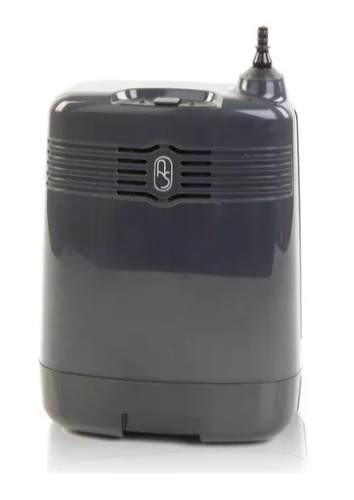
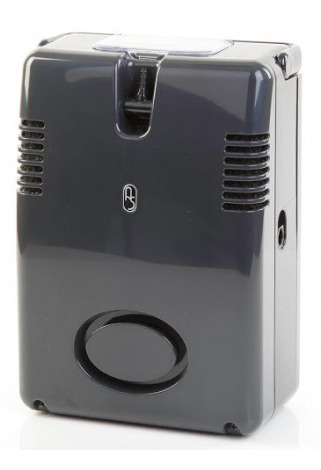
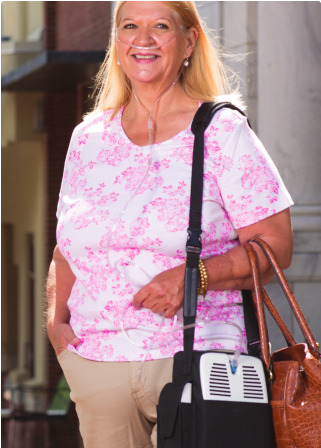
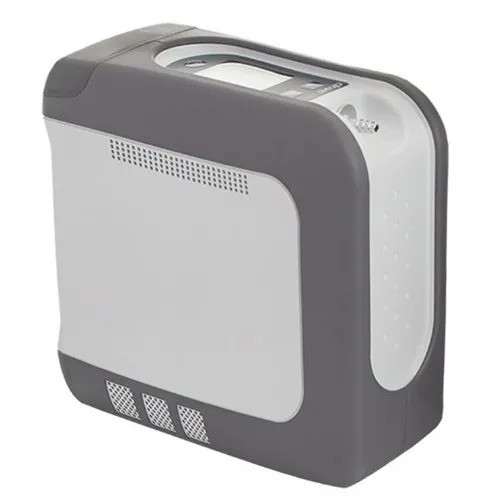
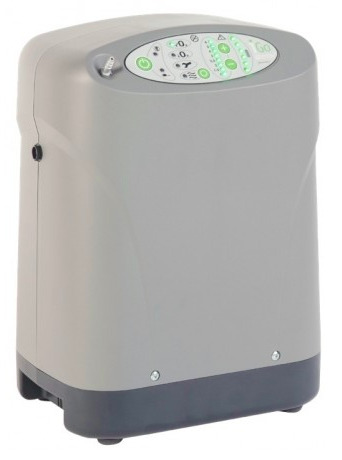
Devilbiss iGo
Key features
- Purity 90-95%
- Type Portable (Battery-powered)
- Continuous Flow 1-3LPM
- Pulse Flow 1-6Pulse setting
- mL dose 14mL
- Weight 8.6kg
Specifications
| Purity | 90-95% |
|---|---|
| Type | Portable (Battery-powered) |
| Continuous Flow | 1-3LPM |
| Pulse Flow | 1-6Pulse setting |
| mL dose | 14mL |
| Weight | 8.6kg |
| Battery backup (at 2 pulse setting) | 4.7hours |
| Recharge time | 5hours |
| Sound level | 40db |
| Dimensions | 15H x 11W x 8Dinch |
| Operating altitude | 13123feet |
|---|---|
| Loss of Power Alarm | Yes |
| System Malfunction Alarm | Yes |
| No Flow Alarm | Yes |
| Indian Voltage Model | Yes |
| Company Headquarters | USA |
| US FDA Approved | Yes |
| FAA Approved | Yes |
| CE Certified | Yes |
Pros and cons
PROS
- Dual-mode delivery — 1-3 LPM continuous flow plus 1-6 pulse settings — unique in this portable set
- Operating altitude of 13,123 ft matches the DeVilbiss 525 stationary — the widest altitude envelope in the portable category
- FAA, FDA, and CE certifications all listed — the most complete regulatory stack among portables here
- Sound level of 40 dB is the quietest stationary-replacement portable in the Indian market
CONS
- Stock status is Discontinued — new-unit warranty pipeline from Drive India is no longer guaranteed
- Weight of 8.6 kg is 4-6x heavier than pulse-only portables like the Platinum Mobile (2.18 kg) and iGo2 (2.2 kg)
- Battery backup of 4.7 hours at pulse setting 2 is below the Platinum Mobile's 5 hours and less practical for a full-day outing
- Recharge time of 5 hours is long enough that a same-day round-trip outing cannot be double-charged without two batteries
The DeVilbiss iGo occupies an odd place in the Indian portable concentrator market — it is the only unit in this review that delivers both continuous flow and pulse dose, its FAA certification is still honoured on airlines that accept the device identifier, and its altitude envelope matches a full stationary concentrator. Against that, its stock status is listed as Discontinued on Indian e-commerce product listings and the official Drive DeVilbiss India service pipeline for it has been wound down in favour of the iGo2 replacement.
This means the only iGo units you should consider are refurbished stock from a dealer offering an explicit one-year minimum refurbishment warranty covering the compressor, sieve bed, and battery pack. A private second-hand purchase without that warranty is a gamble — sieve-bed replacement costs for the iGo now exceed Rs. 25,000 and battery replacement runs Rs. 12,000-18,000 if you can source an original pack at all.
What the specs mean in practice
Dual-mode delivery: 1-3 LPM continuous + 1-6 pulse. This is the iGo’s genuine differentiator. Every other portable in this review — Platinum Mobile, XPO2, iGo2 — is pulse-only. Continuous flow on a portable matters for patients whose CPAP or BiPAP integration requires continuous-flow oxygen bleed during sleep, and for patients on pure continuous-flow prescriptions who still want to be able to leave the house. Pulse-dose works well for ambulatory outings but does not integrate with most CPAP units. The iGo covers both.
Weight: 8.6 kg. Four times heavier than the Platinum Mobile (2.18 kg) and the iGo2 (2.2 kg). This is not a shoulder-strap portable — it is a wheeled unit that rolls like a small cabin bag. For airport use it is at the upper end of carry-on practicality. For genuine walking-around use, the Platinum Mobile or iGo2 are dramatically more practical.
mL dose: 14 mL. Single-breath pulse dose volume at maximum setting. This is comparable to the XPO2’s 15 mL and slightly lower than some newer pulse-only units. For clinical adequacy it is generally sufficient for patients on exertional prescriptions up to the 4-5 pulse equivalent.
Battery backup: 4.7 hours at pulse setting 2. With a single battery pack, at a low pulse setting, the iGo runs for about 4 hours 42 minutes. At higher pulse settings or in continuous-flow mode, runtime drops sharply — continuous 2 LPM on battery typically lasts 90-120 minutes. For a Delhi-to-Mumbai flight with ground-time allowance, this is borderline; for a full day out with a single battery, it is inadequate.
Recharge time: 5 hours. Essentially an overnight recharge. A same-day use-discharge-recharge-use cycle is not practical on a single battery. Two-battery configurations were shipped in the original box for some markets but confirming this for Indian refurbished units is often impossible after ten years of post-sale service.
Altitude: 13,123 ft. Unique in the portable category in this review — the iGo2 caps at 10,000 ft, the Platinum Mobile at 10,000 ft, the XPO2 at 10,000 ft. For a patient traveling to Leh or visiting higher Himalayan destinations, the iGo is the only portable that maintains rated purity at destination altitude.
Sound: 40 dB. Matches the Nuvo Lite stationary. The quietest portable in this review alongside the Platinum Mobile.
FAA approval: Yes. Confirmed on the manufacturer sheet. Indian airlines generally accept FAA-certified portable oxygen concentrators with 48-hour pre-boarding clearance and a letter from the treating physician. Air India, IndiGo, and Vistara have historically accepted the iGo — always confirm the airline’s current POC list before booking.
Who should buy it
Patients on continuous-flow prescriptions (1-3 LPM) who want some portability — occasional trips, medical appointments, family visits — and do not need a shoulder-carry unit. The dual-mode capability at 8.6 kg is unique. For a post-surgical or post-exacerbation patient who needs to leave the house 2-3 times a month for follow-up appointments and wants to use continuous-flow delivery during transit (rather than switching between a home stationary and a walkabout cylinder), the iGo is the one-unit-fits-both answer.
Travelers to high-altitude Indian destinations (Leh, Spiti, Tawang) who need a portable that maintains rated performance above 10,000 ft. The iGo is the only portable in this review that does. For a family member on LTOT accompanying a pilgrimage to Ladakh or a wedding in Tawang, the 13,123 ft altitude envelope is a genuine clinical differentiator that current-stock portables cannot match.
Buyers who can locate refurbished stock from an authorised Drive DeVilbiss India refurbisher with a written warranty, and who understand the constraint that parts will become progressively harder to source. Refurbished iGo pricing typically falls in the Rs. 55,000-85,000 band depending on condition grade and battery pack condition — well below the Rs. 120,000 list price of new-old-stock.
Patients using home CPAP or BiPAP therapy with oxygen bleed integration who need occasional out-of-home portable oxygen. The iGo’s continuous-flow mode can integrate with travel CPAP setups where the iGo2, Platinum Mobile, and XPO2 (all pulse-only) cannot. This is a narrow but specific clinical niche that the dual-mode iGo uniquely serves.
Who shouldn’t
Anyone buying a new portable in 2026. The iGo2 is the direct replacement and is the current-production answer.
Patients needing ambulatory portability (long walks, shopping outings, active daily use). The 8.6 kg unit is too heavy for shoulder carry; a Platinum Mobile or iGo2 at 2.2 kg is the right choice.
Buyers without access to an authorised refurbisher. Non-authorised second-hand stock in India is risky — sieve-bed age and battery condition cannot be assessed without specialist tools.
Alternatives, head-to-head
DeVilbiss iGo vs DeVilbiss iGo2. The iGo2 at Rs. 172,781 is the current production unit — 6.4 kg lighter (2.2 vs 8.6 kg), slightly lower altitude cap (10,000 vs 13,123 ft), slightly quieter (37.5 vs 40 dB), pulse-only (1-5 settings) with no continuous-flow mode, 3.5 hour battery at pulse 2. For a current-market purchase the iGo2 is obligatory — it is supported, stocked, and warrantied. The only reasons to take the iGo over the iGo2 are (a) continuous-flow requirement, (b) 13,123 ft altitude requirement, (c) heavily-discounted refurbished price.
DeVilbiss iGo vs Invacare Platinum Mobile. The Platinum Mobile at Rs. 210,240 is the pulse-only premium portable — 2.18 kg, pulse 1-5 settings, 28.5 psi outlet, 10,000 ft altitude, 5 hour battery at pulse 2 with a single pack and 10 hours on dual. It has an OPI where the iGo does not. It is FDA and FAA approved. The Platinum Mobile is a genuinely better pulse-only portable; the iGo is the only option if continuous-flow is required.
DeVilbiss iGo vs Invacare XPO2. The XPO2 is also discontinued stock on Indian listings — 2.7 kg, pulse-only 1-5, 10,000 ft altitude, 2.5 hour battery at pulse 2, 15 mL dose. Between two discontinued units, the iGo’s dual-mode capability and altitude advantage are the better combination if you can find equivalent-condition refurbished stock.
Indian-market considerations
Voltage: 220V/50Hz AC charging stated. The unit also has a DC car-adapter input for in-car charging. Both rails tolerate normal Indian voltage variation.
Stabiliser/UPS: Not practical for portable use. During AC charging at home a 500 VA stabiliser can be used but is typically unnecessary.
CDSCO: FDA, FAA, CE all listed on the manufacturer sheet. CDSCO import registration should be verified via the dealer’s importer if procuring for institutional fleet.
Altitude: 13,123 ft cap — suitable for Leh, Spiti, upper Kinnaur, Tawang, and the high-altitude Himalayan belt.
Service: Drive DeVilbiss India has quietly transitioned the iGo service network to the iGo2. Refurbished iGo units from authorised dealers typically come with a 1-year warranty that covers the compressor and bundled original-pack battery. Non-warranty battery replacement, if original-spec packs are available, is Rs. 12,000-18,000.
Airline use: Always confirm with the airline 48-72 hours before boarding. Carry the manufacturer’s FAA compliance letter (downloadable from Drive’s regulatory docs archive) and a physician’s letter on letterhead specifying flow requirement. Indian carriers that have accepted the iGo historically include Air India, IndiGo, and Vistara, but policies change.
Spares availability: Filters and cannulas are generic and widely available. Batteries are the critical-spares concern. The sieve bed, once it degrades past the OPI trigger, is a full-service-centre job with lead times of 2-4 weeks in 2026. Drive DeVilbiss India maintains a partial legacy-parts inventory for the iGo specifically to support existing-user refurbishment cycles — ask the dealer to confirm part numbers and lead times in writing before committing to a refurbished purchase.
Home charging and car charging: The iGo ships with both AC and DC adapters in the original packaging. For Indian buyers who use the unit during road travel — typical for Ladakh or Himachal journeys where flights are not an option — the DC car adapter is essential. Verify that the specific refurbished unit includes the DC adapter, as some second-hand stock has been stripped of accessories.
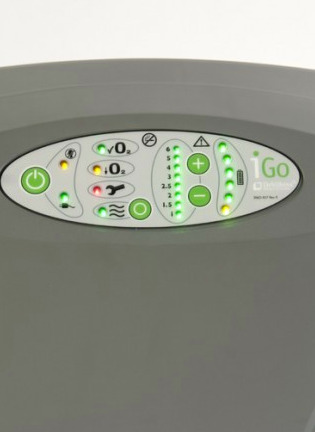
Pulse-vs-continuous mode switching: The iGo’s control panel allows switching between continuous and pulse modes mid-use. This is operationally useful — continuous mode during sleep or rest (higher oxygen delivery), pulse mode during ambulatory activity (longer battery life). Patients should be trained by the dealer on the mode-switch procedure, because unintentional mode switching during sleep can cause clinically significant under- or over-delivery.
Clinical context: For Indian patients with cor pulmonale, severe pulmonary fibrosis, or end-stage COPD where continuous flow at 2-3 LPM is the prescribed delivery mode, the iGo’s unique capability to maintain that prescription outside the home is genuinely valuable. The closest alternative in current-stock units is pairing a stationary concentrator with a walkabout continuous-flow cylinder — heavier, less convenient, and requires cylinder refill logistics. For the specific narrow clinical niche the iGo addresses, the trade-off against discontinued status may still favour the iGo if refurbished stock is available with warranty.
Verdict
The DeVilbiss iGo is a technically excellent machine from a product-engineering point of view — the dual-mode capability, the 13,123 ft altitude envelope, the full certification stack — but it is a machine at the end of its supported life. The score of 6.5 reflects that reality: the unit itself deserves higher, the supportability discount pulls it down. For patients who genuinely need dual-mode portable oxygen or altitude-rated portable oxygen and can find refurbished stock with an authorised-dealer warranty, the iGo is still the right answer for a specific, narrow use case. For everyone else, the iGo2 (for ambulatory pulse) or the DeVilbiss 525 plus a separate cylinder (for occasional portability of continuous-flow) is the better-positioned combination in the 2026 Indian market. Treat this review as a diagnostic tool for a niche need, not a general recommendation.