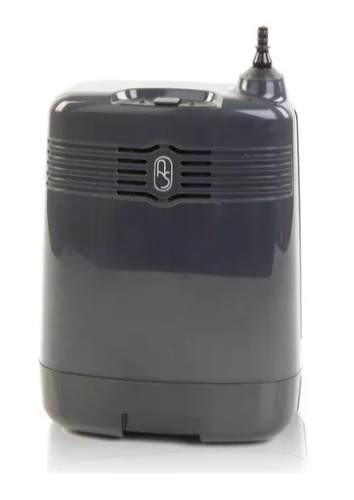
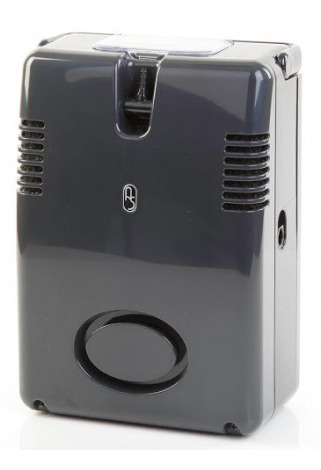
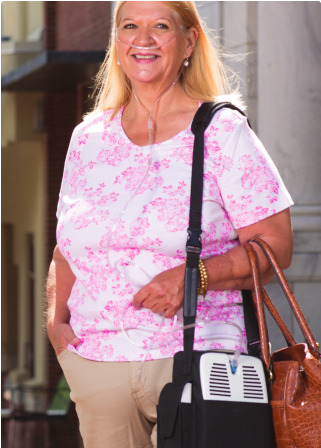
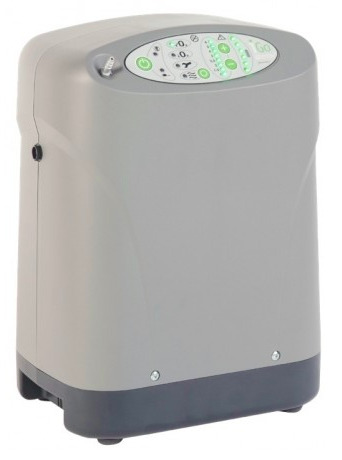
Philips SimplyGo Portable Oxygen Concentrator
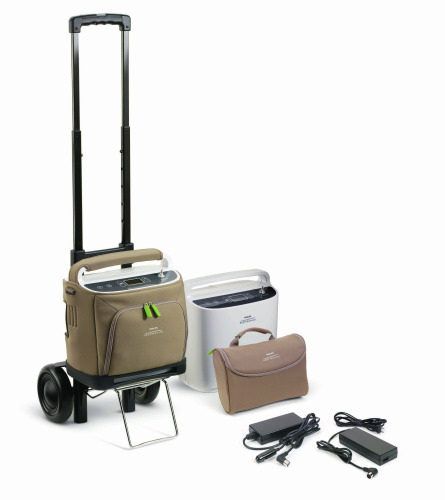
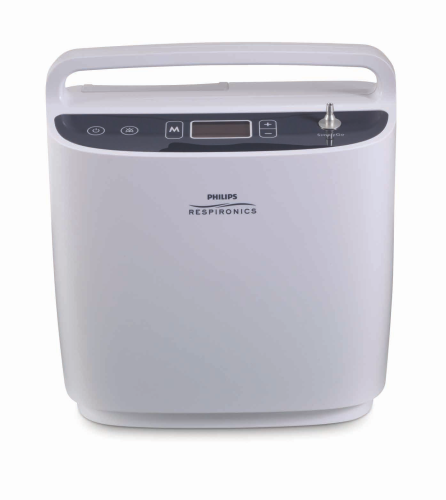
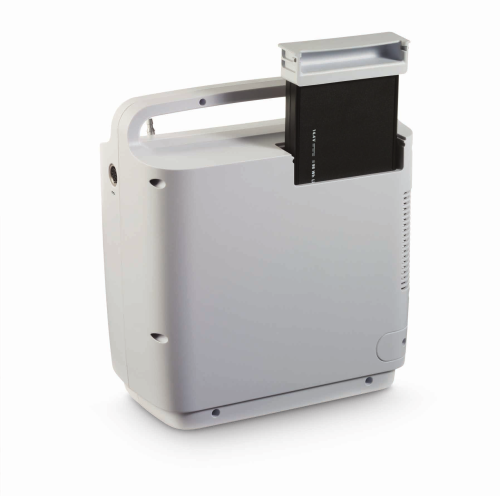
Key features
- Purity 90-96%
- Type Portable (Battery powered)
- Continuous Flow 0.5-2LPM
- Pulse Flow 1-6Pulse setting
- Weight 4.5kg
- Oxygen Purity Indicator (OPI) Yes
Specifications
| Purity | 90-96% |
|---|---|
| Type | Portable (Battery powered) |
| Continuous Flow | 0.5-2LPM |
| Pulse Flow | 1-6Pulse setting |
| Weight | 4.5kg |
| Oxygen Purity Indicator (OPI) | Yes |
| Battery backup (at 2 pulse setting) | 3hours |
| Recharge time | 3hours |
| Sound level | 43db |
| Dimensions | 11.5H x 10W x 6Dinch |
| Operating altitude | 10000feet |
| Outlet pressure | 5.5psi |
|---|---|
| Loss of Power Alarm | Yes |
| Indian Voltage Model | Yes |
| Company Headquarters | USA |
| US FDA Approved | Yes |
| FAA Approved | Yes |
| CE Certified | Yes |
Pros and cons
PROS
- Dual-mode 0.5–2 LPM continuous plus 1–6 pulse settings — the only portable in India that covers both delivery modes in one unit
- 10,000 ft operating altitude makes Leh, Manali, Gangtok and high-altitude pilgrimage travel clinically feasible
- 43 dB published sound level is low enough for in-cabin use on long-distance trains and in shared hotel rooms
- FAA approved per manufacturer brochure and e-commerce product listings — legal for carry-on on most international airlines
CONS
- 4.5 kg is heavy for a portable — 2x the SimplyGo Mini's 2.3 kg — and feels it after 10 minutes on a shoulder strap
- Continuous flow capped at 2 LPM — if the prescription exceeds that on the move, the SimplyGo cannot deliver it
- ₹2,10,700 indicative retail is 5x a 5 LPM home unit and 1.5x a high-end Indian portable
The Philips SimplyGo Portable Oxygen Concentrator is the outlier in the portable category — the only currently-distributed pulse-flow portable in India that also delivers continuous-flow oxygen up to 2 LPM. At 4.5 kg (unit plus battery), indicative retail ₹2,10,700 (varies by region/dealer), the SimplyGo targets patients who need oxygen on the move but whose prescription specifies continuous flow rather than pulse. It carries a published 43 dB sound level, 10,000 ft operating altitude, and both FDA and FAA approval per the manufacturer brochure and e-commerce product listings — the FAA stamp is the one that matters for any Indian buyer planning air travel domestic or international.
| Buying question | Philips SimplyGo answer |
|---|---|
| Indicative India price | ₹2,10,700; verify current dealer bundle |
| Delivery modes | 0.5–2 LPM continuous plus pulse settings 1–6 |
| Published battery runtime | About 3 hours at pulse 2; about 0.9 hour at 2 LPM continuous |
| Carry weight | 4.5 kg with battery |
| Best buyer | Traveller who specifically needs continuous flow on the move |
| Better alternative when pulse-only | SimplyGo Mini or another lighter FAA-listed pulse POC |
Compare the full market in the portable oxygen concentrator ranking and check current bands in the oxygen concentrator price guide.
What the specs actually mean
The 90–96% published oxygen purity range is standard for PSA portables in this class. The SimplyGo’s Oxygen Purity Indicator (OPI) — flagged “Yes” in the technical details — activates below roughly 82% purity, which for a battery-powered travel unit that sees temperature and humidity shocks is essential protection.
The flow architecture is the defining spec. The SimplyGo delivers 0.5–2 LPM continuous and 1–6 pulse setting modes from the same unit. That combination is unusual — most portables in this class are pulse-only. For a patient on a 2 LPM continuous prescription who wants to move around, the SimplyGo is the only currently-distributed portable in India that delivers that prescription mode on battery. At pulse setting 2, the published battery duration is 3 hours from the internal battery; at 0.5 LPM continuous it is 2.9 hours; at 2 LPM continuous it is 0.9 hours. Continuous mode is therefore a short-trip tool — train stations, hospital visits — not an all-day expedition tool.
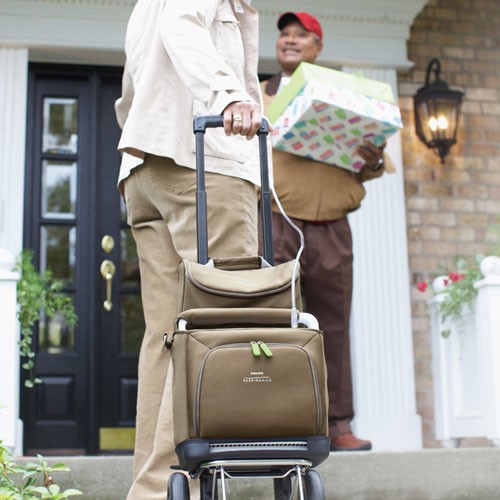
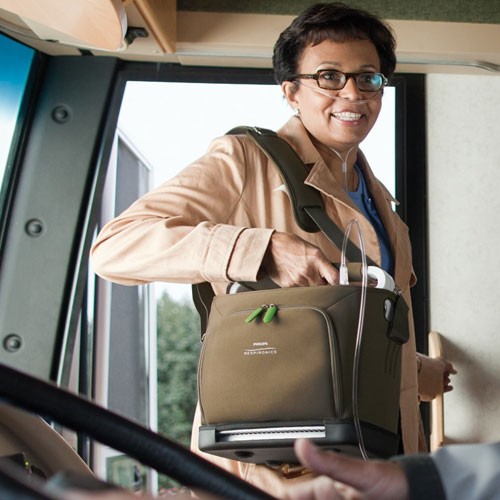
The 4.5 kg weight (unit plus battery) is the main reason this is not the SimplyGo Mini. The Mini is 2.3 kg, and the difference shows within 10 minutes of strap wear. On a rolling cart the 4.5 kg is fine; slung on a shoulder for extended walks, it is tiring. The SimplyGo is usable as a travel unit but not as a long-walk unit.
Recharge time is published at 3 hours from empty to full — fast enough to turn around a battery between a morning and afternoon outing from a hotel room in Udaipur or Srinagar. The AC power supply is Indian voltage compatible per the “Indian Voltage Model: Yes” entry in the additional details, so no step-down transformer is required.
The 43 dB published sound level is low — lower than the SimplyGo Mini’s 52 dB — and inside the threshold for shared-space use. On a long-distance train in Tier 2 AC, the 43 dB is below the cabin ambient noise and functionally inaudible to neighbours.
The 5.5 psi outlet pressure is modest. It is enough for a standard nasal cannula on a short tube run; it is not enough to drive a humidifier bottle or a long tubing run reliably.
The altitude win
10,000 ft operating altitude is the single most useful spec for Indian travel. Leh sits around 11,500 ft, Spiti’s villages around 10–12,000 ft, Nathu La pass at 14,140 ft, and Rohtang at 13,000 ft — all outside the spec. But the approaches to these destinations — Shimla (7,100 ft), Manali (6,700 ft), Gangtok (5,400 ft), Darjeeling (6,700 ft), Ooty (7,300 ft) — are all within the 10,000 ft envelope, as is the entire Leh-Manali road approach below the final pass. For a pilgrimage or holiday traveller on home oxygen, 10,000 ft is the line that gates most Indian hill destinations.
Who should buy it
The SimplyGo is the right buy for a home-oxygen patient whose primary use case is travel — long-distance trains, domestic and international flights, hotel-to-hotel hill-station tours, multi-day pilgrimage routes — and whose prescription is either 0.5–2 LPM continuous or pulse-equivalent at settings 1–6. The dual-mode delivery is useless if you never touch the continuous flow setting; it is irreplaceable if you use it.
It is the right buy for patients travelling to elevations between 6,000 and 10,000 ft who want to stay in the rated envelope — the SimplyGo’s altitude rating is higher than the Caire Freestyle Comfort 5 (also 10,000 ft) but matches the Inogen One G5 (10,000 ft) and falls below the SeQual Eclipse 5 (13,123 ft). For the travel envelope below 10,000 ft, its dual-mode capability makes it the stronger buy.
It is also the right buy for caregivers who value FAA approval documentation — airlines in India and globally are still inconsistent about which specific POCs they allow on board, but the FAA list is the reference most airlines check. The SimplyGo is on it. FAA-approved portables with active Indian distribution is a small set — SimplyGo, SimplyGo Mini, SeQual Eclipse 5, Inogen One G5, and Caire Freestyle Comfort 5 (FAA POC acceptance list).
For a household where the patient is at home on a 5 LPM Everflo for most of the year and needs a portable specifically for 3–4 planned trips a year, the SimplyGo is defensible. The ₹2,10,700 is a travel-enablement expense, not a replacement for the home machine.
Who shouldn’t
Anyone who only needs a pulse-flow portable should buy the SimplyGo Mini (2.3 kg) or the Inogen One G5 (2.6 kg) instead. The SimplyGo’s 4.5 kg weight is entirely driven by the continuous-flow capability — if you don’t need it, the Mini is the better buy at a similar price point.
Anyone whose continuous-flow prescription is above 2 LPM should not buy the SimplyGo. At above 2 LPM the SimplyGo cannot deliver it — period. The SeQual Eclipse 5 delivers continuous up to 3 LPM (at a considerable weight penalty at 8.3 kg and ₹2,87,040). Above 3 LPM, there is no portable — you need to plan travel around a home unit.
Anyone who intends to use a portable as the primary supply for more than 6–8 hours a day should not buy any single-battery portable, including the SimplyGo. These are hour-scale batteries, not day-scale — plan for AC outlet access or multiple batteries.
And anyone whose travel budget allows only ₹2,10,700 for the entire machine (not just the portable) should reconsider. The SimplyGo is additional-capacity over a home machine, not a replacement. The ₹2,10,700 can buy a 5 LPM Everflo (₹43,699) plus a solid Indian-made pulse-flow portable, and the combination is more flexible than a single dual-mode portable.
How it compares to real alternatives
SimplyGo vs SimplyGo Mini
Same family, different target. The Mini is 2.3 kg vs 4.5 kg, pulse-only vs dual-mode, 4.5 hour battery at pulse 2 vs 3 hours, 52 dB vs 43 dB. They share price (both ₹2,10,700 indicative retail), 10,000 ft altitude, FAA approval, and Indian voltage model. Pick the Mini if you only need pulse and want lightweight comfort. Pick the SimplyGo if you need continuous flow mode on the move — that is its unique advantage in the Philips line-up.
SimplyGo vs Inogen One G5
The G5 is 2.6 kg, pulse-only (1–6 settings), 6.5 hours battery at pulse 2, 38 dB published sound, ₹2,14,999 indicative. The SimplyGo is 4.5 kg, dual-mode, 3 hours at pulse 2, 43 dB, ₹2,10,700. Pick the G5 over this if you are pulse-only and want the longer battery life and lower weight. Pick the SimplyGo if the continuous-flow capability is clinically required.
SimplyGo vs SeQual Eclipse 5
The Eclipse 5 is 8.3 kg, dual-mode (0.5–3 LPM continuous, 1–9 pulse), 13,123 ft altitude, 40 dB published sound, ₹2,87,040 indicative. The SimplyGo is 4.5 kg, dual-mode (0.5–2 LPM continuous, 1–6 pulse), 10,000 ft altitude, 43 dB, ₹2,10,700. Pick the Eclipse 5 if the continuous-flow prescription is 2.5–3 LPM on the move or the destination altitude is above 10,000 ft — its higher flow cap and altitude envelope justify the weight and price premium. Pick the SimplyGo if 2 LPM continuous and 10,000 ft cover the use case, because at 4.5 kg vs 8.3 kg it is genuinely more portable.
Indian-market considerations
The SimplyGo is Indian Voltage Model per the additional details in the published spec — it runs on 220V/50Hz directly without a step-down transformer. On the move this matters for the AC power brick: most Indian hotels and home outlets deliver adequate voltage, but a small automatic voltage stabiliser is still advisable if the unit will run 8+ hours continuously on AC at a single destination.
CDSCO approval status is not stated in the published key features or additional details for this SKU in the data we reviewed (CDSCO Medical Device Registry). Philips Respironics as a manufacturer has an established India regulatory footprint; check the specific SKU’s registration with your supplier before hospital-channel purchase.
Service network: the SimplyGo shares service coverage with the Everflo through Philips Respironics India. That said, portable concentrator service is noticeably worse than stationary — most service centres keep inventory for the most-common stationary spares (sieve beds, filters, pressure switches) but not for battery packs, which have to be ordered in from Singapore or the US. Budget a 2–4 week turnaround for any battery replacement outside the 1-year warranty.
Online-vs-hospital price gap is narrow on imported portables — typically under 10%, because the hospital channel does not offer meaningful value-add on a portable unit beyond the box. Most portable buys in India are direct-to-dealer, often with a warranty extension offered as an add-on purchase. The 1-year standard warranty is short; a 2-year extension at 6–10% of machine cost is worth considering on a ₹2,10,700 machine.
Verdict
The Philips SimplyGo is a narrow-use-case but well-executed portable for the Indian buyer who specifically needs continuous-flow oxygen delivery on the move. Its dual-mode capability is unique in the currently-distributed Indian portable market, and the 10,000 ft altitude envelope plus FAA approval make it the strongest travel fit for most domestic and international journeys below Leh-class altitude.
Score it 7.6 out of 10. Points off for the 4.5 kg weight that makes it heavy among portables, the 2 LPM continuous flow ceiling, the 3-hour battery at pulse 2 that is shorter than the G5, and the ₹2,10,700 price that puts it in the top tier of portable oxygen spending. If your prescription needs continuous-flow oxygen on the move, this is the machine to buy in India. If it doesn’t, the SimplyGo Mini or the Inogen One G5 are the better buys.