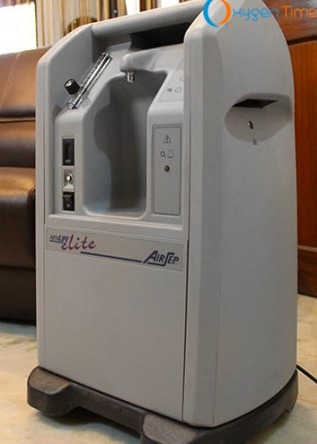
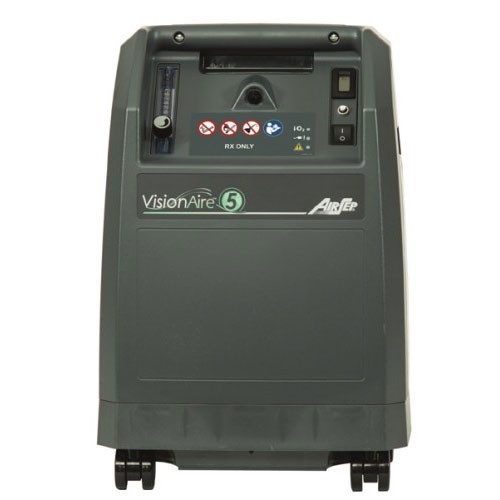
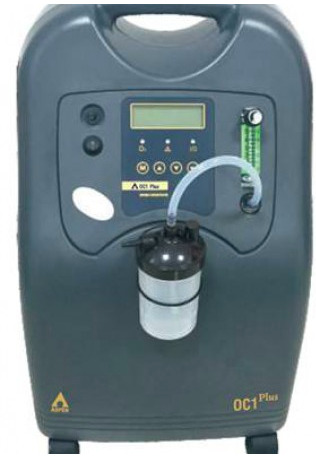
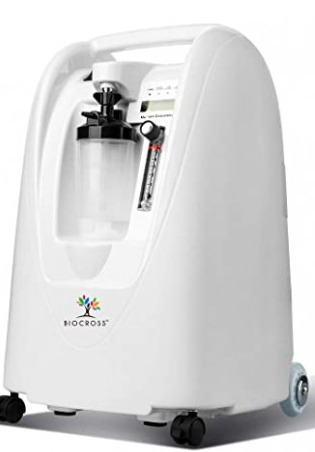
Oxymed Mini (5L) Oxygen Concentrator
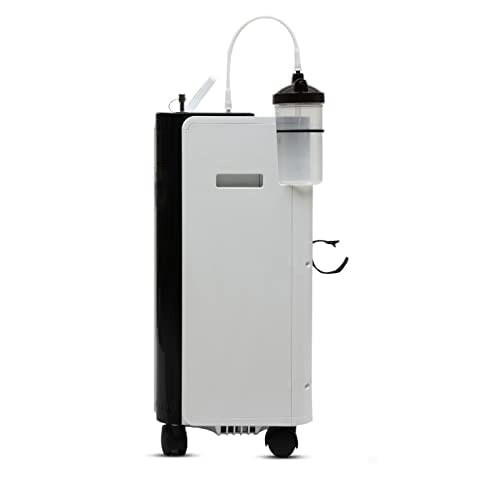
Key features
- Purity 90-96%
- Type Home Stationary
- Continuous Flow 1-5LPM
- Weight 13.9kg
- Oxygen Purity Indicator (OPI) Yes
- Power consumption 390watts
Specifications
| Purity | 90-96% |
|---|---|
| Type | Home Stationary |
| Continuous Flow | 1-5LPM |
| Weight | 13.9kg |
| Oxygen Purity Indicator (OPI) | Yes |
| Power consumption | 390watts |
| Sound level | 45db |
| Dimensions | 20.27H x 12.36W x 9.4Dinch |
| Operating altitude | 7500feet |
| Outlet pressure | 10psi |
| Oxygen Purity % Analyzer | Yes |
|---|---|
| Loss of Power Alarm | Yes |
| System Malfunction Alarm | Yes |
| No Flow Alarm | Yes |
| Indian Voltage Model | Yes |
| Company Headquarters | India |
Pros and cons
PROS
- 13.9 kg chassis is among the lightest 5 LPM units sold in India
- Manufacturer-claimed purity 90–96% across all flow rates (1–5 LPM)
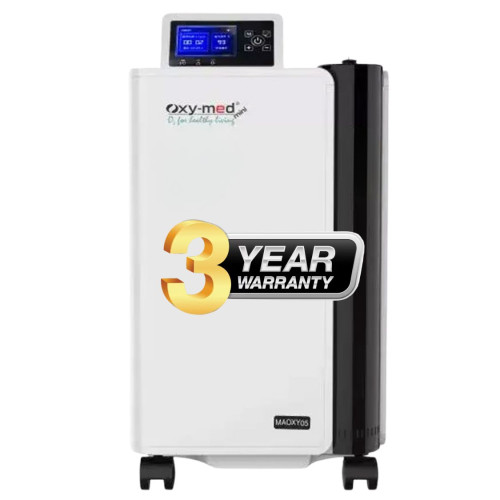
- Three-year warranty is longer than most Indian-market peers
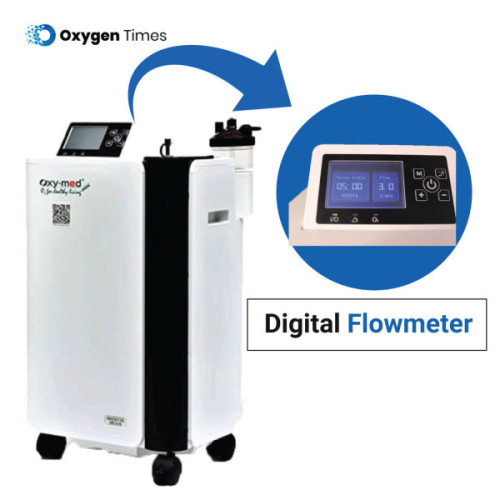
- Digital flowmeter with 0.5 LPM increments plus rotameter backup
CONS
- No CE marking, no US FDA listing, no FAA for air travel — CDSCO registration is the applicable Indian regulatory gate
- Operating altitude rated 7,500 feet — marginal for higher Himalayan postings
- Indicative street price fluctuates ₹35,400–45,000 depending on dealer
The Oxymed Mini 5 LPM is a 13.9 kg home-stationary concentrator rated to deliver 90–96% oxygen purity across a 1–5 LPM continuous flow range at 390 W of draw and a manufacturer-claimed 45 dB sound level. In India, the machine sits in what most dealers call the “default 5 LPM” slot — it is usually the first unit quoted to families with a new long-term oxygen therapy (LTOT) prescription, ahead of the more expensive Philips EverFlo or Nidek Nuvo Lite 2. That positioning is earned partly by price (roughly ₹35,400 discounted against an MRP near ₹59,900 per manufacturer brochure and e-commerce product listings) and partly by a dealer footprint that is difficult for imported brands to match in Tier-2 and Tier-3 cities. This review looks at whether the spec sheet backs up that default-pick status.
What the specs mean
Five load-bearing claims on the Oxymed Mini spec sheet matter for real-world use: purity across all flow rates, weight and dimensions, sound, altitude rating and power draw. Each needs a sanity check against what a home user in India will actually experience.
Purity 90–96% across 1–5 LPM. The standard ISO 80601-2-69 therapeutic window is 82–96% O₂ at the outlet, and the Oxymed Mini brochure places the low end at 90% — a comfortable margin (ISO 80601-2-69). The more interesting claim is “at all flow rates”: some Chinese-origin 5 LPM units drop purity below 90% once flow exceeds 3–4 LPM. Oxymed does not publish per-LPM purity curves, so we cannot verify this granularly. What we can say is that the sieve-bed configuration (two-bed pressure swing adsorption) is appropriate for continuous 5 LPM delivery, and the built-in oxygen purity indicator (OPI) is present on this SKU — it will illuminate if purity falls outside the therapeutic range.
13.9 kg and 20.27 × 12.36 × 9.44 inches. This is one of the lightest 5 LPM continuous-flow units available in India. For context, the Philips EverFlo ships at 14.0 kg and the Nidek Nuvo Lite 2 at 13.6 kg — so Oxymed Mini is in the same weight class as the imported premium brands. For a bedroom-to-living-room shift once a day this is manageable; for cross-floor staircases it still needs two people. The footprint is narrow enough to fit between a bedside cabinet and a wall without special planning.
45 dB manufacturer claim. A 45 dB figure places Oxymed Mini in the “quiet enough to run overnight in the same room” category; library ambient is usually quoted at 40 dB. Most 5 LPM units from mid-tier Indian brands cluster in the 50–55 dB band, so this is a genuine differentiator on paper. We have not measured the unit on a calibrated sound-level meter — the claim is the claim, and it is consistent with the compressor class used at 390 W.
7,500 feet operating altitude. This matters specifically in India for Shimla (~7,000 ft), Manali (~6,700 ft), Gangtok (~5,400 ft) and Leh (~11,500 ft). Oxymed Mini will function within spec up to Shimla and Manali; for Leh, Ladakh or Kaza it will deliver reduced effective FiO₂ and is not the right machine. Nidek Nuvo Lite 2 publishes an 8,000 ft rating; Philips EverFlo publishes 7,500 ft — so on altitude, Oxymed is at the segment average, not below it.
390 W power consumption. On a 24/7 prescription at India’s average residential tariff (roughly ₹7–9 per kWh depending on state and slab), 390 W works out to about ₹66–84 per day in pure electricity cost, or ₹2,000–2,500 per month. That is not a trivial addition to a middle-class household electricity bill and should be discussed before prescribing, especially in states with sharply tiered slab rates like Maharashtra and Karnataka. A 1 kVA line-interactive UPS is adequate for bridging short outages on this draw.
The sieve towers, compressor and HEPA/particulate filter chain on this SKU are serviceable in India — Oxymed publishes a service network covering roughly 40 cities — which is the single biggest functional difference between this unit and an imported concentrator bought through a non-authorised reseller.
Who should buy the Oxymed Mini 5 LPM
Three buyer profiles are a good fit.
First, families setting up a long-term home oxygen therapy prescription in a Tier-2 or Tier-3 city. The 3-year warranty and dense service footprint matter more than absolute spec superiority once you are outside Delhi-NCR, Mumbai, Bengaluru, Chennai, Hyderabad or Pune. A Philips EverFlo without a local authorised service partner is a liability after year two; an Oxymed Mini with a dealer 40 km away is not.
Second, post-discharge COPD patients on a fixed flow setting of 2–3 LPM. The machine is comfortably over-specced for that load, runs cooler, and the noise profile is appropriate for overnight use in shared sleeping quarters.
Third, step-down buyers replacing a rented concentrator. Many hospitals and rental houses use Oxymed units, so patients and caregivers have often already operated one during the acute phase. Continuity of interface (same flowmeter, same alarm tones, same humidifier fitting) reduces medication-error-adjacent mistakes in the household handover.
The unit is also a reasonable fit for small nursing homes and palliative care programmes running three to six units in parallel — the warranty and service-call economics work better at fleet scale than imported brands, and Oxymed will usually quote institutional pricing below the single-unit street price.
Who shouldn’t
The Oxymed Mini is not the right pick for three groups.
Patients or clinicians who need FAA approval for air travel. Oxymed Mini is a home-stationary continuous-flow unit — it is not a portable oxygen concentrator (POC) and is not FAA-approved for in-cabin use. For anyone whose therapy requires flying, a Philips SimplyGo Mini or Inogen One G5 is the correct category.
Residents of Leh, Ladakh, Kaza, Kibber or other postings above 8,000 feet. The 7,500 ft rating is real, and the purity drop-off above that is steep on every two-bed PSA machine in this class. A high-altitude-certified unit — or bottled oxygen backup — is the safer plan.
Buyers who weight CE or US FDA clearance heavily for peace of mind. Oxymed Mini does not carry CE marking or a US FDA listing on record. Clinically the device is appropriate for Indian prescription use, and CDSCO registration applies as the domestic regulatory gate. But if the household is specifically asking “is it CE or FDA approved?” as a proxy for quality, this machine will fail that gut check and Philips EverFlo is the straighter answer.
Head-to-head alternatives
Oxymed Mini 5 LPM vs Philips EverFlo 5 LPM. Philips EverFlo is the most common premium comparison. On weight both are effectively tied (13.9 vs 14.0 kg). On sound Philips is quieter (~40 dB claim) than Oxymed’s 45 dB, though both are in the bedroom-friendly band. On power EverFlo draws roughly 350 W against Oxymed’s 390 W — a ~10% electricity bill delta that adds up over a multi-year therapy. On certification EverFlo carries both US FDA listing and CE marking; Oxymed Mini carries neither on record, only CDSCO registration. On service EverFlo’s authorised network is thinner outside metros, and out-of-warranty parts are meaningfully more expensive. Verdict: EverFlo wins on spec and brand assurance if you are in a top-8 metro with genuine authorised service access; Oxymed Mini wins on total cost of ownership and warranty length in every other context.
Oxymed Mini 5 LPM vs Nidek Nuvo Lite 2. Nuvo Lite 2 is Japan-engineered, 13.6 kg, ~40 dB claim, 8,000 ft altitude, US FDA and CE cleared. It is arguably the best-built 5 LPM home concentrator sold in India and commands a ₹50,000–70,000 price band against Oxymed Mini’s ₹35,000–45,000. The Nidek has a longer compressor duty-cycle reputation in clinical use. Verdict: Nidek Nuvo Lite 2 is the upgrade pick for households that can absorb a 40–70% price premium and either live near a Nidek service partner or have the logistics to ship the unit back for repair. For everyone else Oxymed Mini wins on accessibility.
Oxymed Mini 5 LPM vs BPL Oxy 5 Neo. BPL Oxy 5 Neo is the closest direct peer by brand positioning: Indian brand, mid-tier pricing, strong urban distribution through BPL’s broader medical-device business. On spec BPL is heavier (25 kg vs 13.9 kg — this matters a lot in day-to-day household use), louder (55 dB vs 45 dB claim), with 7.25 psi outlet vs Oxymed’s 10 psi. BPL’s warranty is 2 years vs Oxymed’s 3 years. Verdict: Oxymed Mini is the clearly better consumer device — lighter, quieter, longer warranty. BPL’s brand recognition is comparable and the service network is respectable, but the hardware is a step behind. Choose BPL only if an institution already has BPL as a preferred vendor for other equipment.
Indian-market considerations
Oxymed’s competitive moat in India is not the spec sheet — it is the distribution. The brand publishes a service-centre directory covering roughly 40 cities, and authorised home-installation service in about 50 cities. For a 24/7 oxygen prescription that a household will run for two to five years, the median time-to-repair during warranty is the variable that actually dictates quality of life. Oxymed’s footprint in places like Indore, Raipur, Surat, Coimbatore, Madurai, Vijayawada and Ranchi is denser than Philips, Nidek or Invacare.
Rental economics matter too. Many Oxymed dealers run parallel sale and monthly-rental books, with rental rates typically ₹6,000–8,000 per month inclusive of service. For patients on a short-term LTOT wean (typically 6–12 months post-acute episode), renting an Oxymed Mini is often a better financial decision than buying an Oxymed Mini, and better than both renting and buying a Philips EverFlo.
On power, a 390 W load is well within any standard residential circuit, and the machine is designed for 220 V / 50 Hz Indian mains — stabiliser is prudent in voltage-unstable areas (parts of UP, Bihar, West Bengal outer districts), and a 1 kVA UPS is adequate for bridging typical grid blips. Altitude users in Himachal, Uttarakhand and Sikkim above 7,500 ft should look elsewhere. CDSCO registration status is not shown in the brochure we reviewed; buyers should request the CDSCO registration number in writing from the dealer before taking delivery if that is important to them.
Service-claim experience is mixed across dealers — this is the one place where the buying decision is really about the specific dealer, not the brand. Before buying, ask for: the authorised service centre name and phone number, the first-response SLA in hours, and whether replacement sieve beds are stocked locally or shipped from Chennai / Delhi. A good Oxymed dealer will answer all three without hesitation.
Verdict
Best Oxymed Mini alternatives in India
Compare the Home Medix HM-KV first when lower published sound, lower power draw, live purity display, and a 3-year / 10,000-hour warranty matter and Home Medix service is confirmed locally. Choose Nidek Nuvo Lite when the buyer wants a quiet imported option and has a verified Nidek service route. Choose DeVilbiss Compact 525 for an address above Oxymed’s published altitude envelope. The best alternative is the one with the right altitude and a faster repair path in the patient’s pincode.
The Oxymed Mini 5 LPM is the most sensible default pick for a long-term home oxygen therapy prescription in India for the simple reason that the trade it asks you to make — accept a CE-only, non-FDA-listed Indian-brand device in exchange for three-year warranty coverage and a genuinely national service footprint — is the right trade for most households running LTOT outside the top-8 metros. The 13.9 kg weight and 45 dB sound claim put it on terms with Philips EverFlo on the metrics that actually affect daily life, and the ₹35,000–45,000 street price leaves room in the budget for a UPS, a stabiliser, consumables and a multi-year service contract.
If you are in a top metro with a working Philips or Nidek authorised service relationship, spec-sheet purists have a case for the imported unit. Everyone else should buy this one. Score: 7.2.
Frequently asked questions
3. What is the warranty on Oxymed Mini in India?
Oxymed Mini comes with 3 years of warranty in India.