Oxypure 5L Oxygen Concentrator
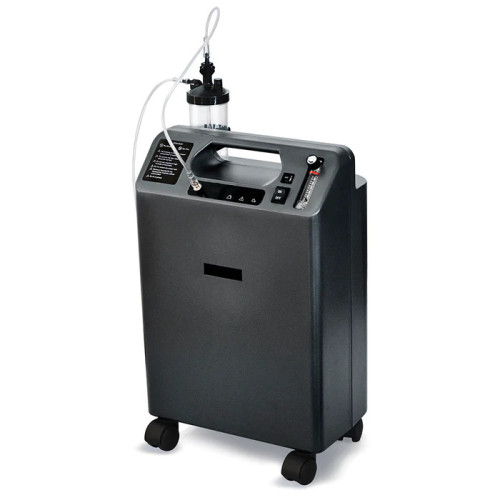
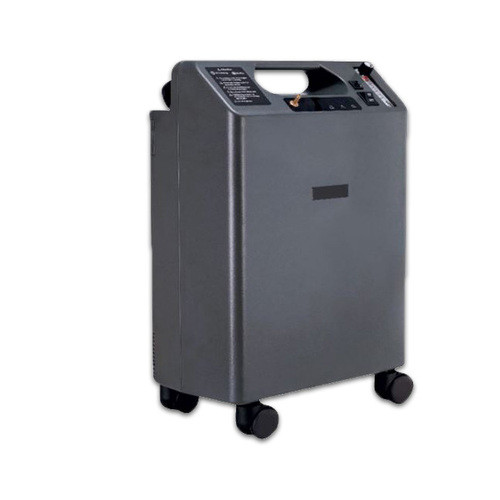
Key features
- Purity 90-96%
- Type Home Stationary
- Continuous Flow 1-5LPM
- Weight 16kg
- Oxygen Purity Indicator (OPI) Yes
- Power consumption 300watts
Specifications
| Purity | 90-96% |
|---|---|
| Type | Home Stationary |
| Continuous Flow | 1-5LPM |
| Weight | 16kg |
| Oxygen Purity Indicator (OPI) | Yes |
| Power consumption | 300watts |
| Sound level | 50db |
| Dimensions | 26H x 17.7W x 13.4Dinch |
| Outlet pressure | 7.3psi |
| Loss of Power Alarm | Yes |
|---|---|
| Indian Voltage Model | Yes |
| Company Headquarters | India |
| US FDA Approved | Yes |
| CE Certified | Yes |
Pros and cons
PROS
- US FDA approved and CE certified declared on spec sheet
- 16 kg chassis weight is competitive for class
- India-assembled — Sanrai has declared Indian headquarters and local service
- 90-96% oxygen purity claim (higher ceiling than the typical 90-95%)
- 300 W power draw is efficient for a 5 LPM continuous unit
CONS
- No FAA approval — not a portable unit
- System-malfunction and no-flow alarm rows blank on brochure
- 50 dB noise is middle-of-pack, not class-leading
- ₹57,600 price is above Yuwell 7F and reconditioned Philips units
- 1 LPM flow floor excludes paediatric 0.5 LPM prescriptions
The Oxyflow 5 LPM is distinctive in the Indian market because it is one of the few locally-assembled oxygen concentrators that declare both US FDA approval and CE certification on the public spec sheet. Sold under the Sanrai brand, the unit is listed at ₹57,600 per the manufacturer brochure and e-commerce product listings (with an MRP of ₹52,800, making the current price actually above MRP — possibly a listing error). Sanrai is headquartered in India, which places it in a different category from Chinese imports (Eloxy, Fitmate, Niscomed) and from Taiwan imports (Oxybliss). For Indian buyers who prioritise an India-made product with declared regulatory compliance, the Oxyflow is a rational choice that deserves honest evaluation.
What the specs actually mean in Indian homes
The Oxyflow 5 LPM delivers 90-96% oxygen purity at a continuous flow range of 1 to 5 LPM. The 96% purity ceiling (versus 95% on most competitors) is worth pausing on. A higher ceiling means the PSA zeolite bed and valve-switching timing are tuned for slightly tighter performance. In clinical practice the difference between 95% and 96% purity is negligible for typical supplemental oxygen prescriptions — the FiO2 (fraction of inspired oxygen) delivered to the patient depends on flow rate and cannula interface more than on source purity within the 90-99% range. Still, a 96% ceiling suggests the machine has slightly better design headroom than a 95% unit, and the spec sheet claim holds across the full flow range of 1-5 LPM rather than only at low flows.
The 1 LPM floor excludes paediatric 0.5 LPM prescriptions and the lowest adult nocturnal-only prescriptions. For adult patients above 1 LPM the flow range is fully covered.
Weight is 16 kg. This matches the Keyhub 5 LPM at 16 kg and is lighter than the Fitmate 5 (18 kg), Eloxy (19 kg), Equinox (19 kg), Healthgenie (21 kg), and Niscomed (25 kg). One-person moves on flat surfaces are manageable, which is a quality-of-life improvement for Indian homes where the machine may shift between rooms.
Power consumption of 300 W is efficient. This matches Oxybliss 5 LPM and OxyPure 5 LPM at 300 W — the leaders in the class. Against 350 W units (Fitmate 5, Healthgenie, Yuwell 7F) the Oxyflow saves roughly 14% on electricity. At Indian domestic tariff of ₹8-10 per kWh, 300 W continuous is ₹58-72 per day or ₹17,500-22,000 per year at 12 hours/day. Over a 3-year service life this is ₹52,000-65,000 in electricity — still meaningful but lower than 350 W competitors by ₹7,500-10,000 over the same period.
Noise at 50 dB is middle-of-the-pack. Quieter than Fitmate 5 and Healthgenie at 55 dB; louder than Eloxy, Equinox, Oxybliss, OxyPure at 40 dB; close to Keyhub at 48 dB. 50 dB is borderline acceptable for bedroom placement at night — lighter sleepers will notice; deeper sleepers will adapt. For daytime living-room use 50 dB is a non-issue.
Dimensions of 26 × 17.7 × 13.4 inches make the Oxyflow taller than most 5 LPM competitors (23-24 inches typical). This is due to a slightly different internal layout that stacks the compressor, sieve bed, and regulator in a more vertical arrangement. For placement beside a hospital bed this height is fine; for placement under a table or desk it may not fit in some configurations.
Outlet pressure of 7.3 psi (brochure notes 7.9 psi in the description text, a minor internal inconsistency in the manufacturer’s published materials) is adequate for standard cannula and humidifier use. Lower than the Keyhub at 13 psi; comparable to Philips EverFlo at 5-7 psi; lower than Niscomed and Fitmate 10 at 10 psi. For standard 7-foot cannula runs this is fully adequate.
Compliance: US FDA declared Yes. CE declared Yes. Indian Voltage Model declared Yes. Company Headquarters: India. Loss of Power Alarm declared Yes. System Malfunction Alarm blank. No Flow Alarm blank. FAA blank. The US FDA declaration is the important one — for an India-assembled unit to carry US FDA 510(k) clearance, the manufacturer must have gone through the FDA pre-market notification process and maintain quality system regulation compliance. This places the Oxyflow in a distinctly different credibility tier from the uncertified Chinese imports. The CE mark adds European IEC 60601 electrical safety and IEC 80601-2-69 oxygen-concentrator-specific compliance.
The gap is the alarm coverage. Loss-of-power is declared, but system-malfunction and no-flow are blank. For a unit that claims FDA clearance, the absence of declared malfunction and no-flow alarms is unusual — the 510(k) submission typically includes these alarm capabilities as standard. Buyers should verify with the dealer whether these alarms are actually present in the unit (potentially just omitted from the spec sheet) or genuinely absent.
Who should buy the Oxyflow 5 LPM
The Oxyflow 5 LPM suits a buyer who prioritises an India-assembled product with declared FDA and CE certifications, who needs standard 1-5 LPM adult oxygen flows, and who places the unit in a daytime living-room or lounge location where 50 dB noise is acceptable. It fits an Indian family who wants the reassurance of local manufacturer presence for service (Sanrai has declared Indian headquarters, which should translate to more responsive local service than overseas importers), who values the FDA-plus-CE compliance stamp over the marginal noise penalty, and who has a budget around ₹55,000-60,000. For patients stepping down from hospital care to 6-12 months of home oxygen therapy, the Oxyflow is a defensible mid-tier choice.
Who should not buy the Oxyflow 5 LPM
Paediatric patients with 0.5 LPM prescriptions — the 1 LPM floor does not serve this. Light-sleeping patients with bedroom-placement requirements — the 50 dB noise is borderline. Buyers who specifically need the declared no-flow alarm for unsupervised or sleeping patients — the Oxyflow’s brochure blank on this alarm is a concern until verified. Buyers who can access reconditioned Philips EverFlo or Nidek Nuvo Lite at ₹40,000-50,000 — those branded reconditioned units typically have full alarm coverage and Indian service networks. High-altitude users (above 6,000 feet) should verify operating altitude with Sanrai before purchase.
How it compares: Oxyflow vs OxyPure vs Yuwell 7F vs Philips EverFlo
Oxyflow 5 vs OxyPure 5 LPM (Sanrai) — Interestingly, both are Sanrai-brand units listed at nearly identical prices (Oxyflow ₹57,600, OxyPure ₹57,590). Specs are very similar — both 90-96% purity, both 300-350 W depending on spec sheet, both 15-16 kg. OxyPure is 15.2 kg (slightly lighter), 40 dB (10 dB quieter), 350 W (higher draw than Oxyflow’s 300 W), and has US FDA and CE rows blank on its own brochure. Oxyflow has US FDA and CE declared Yes. These appear to be sibling products from the same manufacturer with different variants — Oxyflow is marketed with FDA/CE, OxyPure as a slightly lighter/quieter variant. Verdict: Oxyflow wins if FDA/CE is required; OxyPure wins if noise is the priority.
Oxyflow 5 vs Yuwell 7F 5 LPM — Yuwell 7F at ₹45,000-55,000 (₹2,600-12,600 cheaper). Yuwell has full alarm coverage, Chinese national medical device registration, 14-15 kg weight (1-2 kg lighter), 43 dB noise (7 dB quieter), 300-350 W power, Indian service network in 40+ cities. Yuwell does not declare US FDA; it has CE and its own Chinese national equivalent. For buyers who specifically value US FDA, Oxyflow wins. For buyers who value alarm coverage and lower price, Yuwell 7F wins. Verdict: close call — Yuwell 7F wins for most buyers on price and alarm coverage; Oxyflow wins for FDA-preferring buyers.
Oxyflow 5 vs Philips EverFlo 5 LPM — Philips EverFlo at ₹80,000-90,000 new, ₹35,000-50,000 reconditioned. New Philips is ₹22,000-32,000 more expensive; reconditioned Philips is ₹7,600-22,600 cheaper than Oxyflow. Philips has US FDA, CE, full alarm coverage, Indian service network through Philips partners, 14 kg weight, 43-45 dB noise, 350 W power. Against new Philips the Oxyflow is cheaper; against reconditioned Philips the Oxyflow costs more. Verdict: reconditioned Philips wins for price-and-compliance buyers; Oxyflow wins for new-unit-preference buyers.
Indian-market considerations
Sanrai’s Indian headquarters is a meaningful advantage in service network terms. Sanrai products are distributed through a network that includes major Indian cities and has a declared service contact infrastructure. This does not reach the scale of Philips India or Nidek India service partnerships, but it is more substantial than the dealer-dependent networks of most Chinese imports. Spare parts (sieve beds, compressors, solenoid valves) for Sanrai products are typically available in-country, reducing service turnaround to 1-2 weeks for most issues rather than 4-8 weeks for imported-parts-dependent competitors.
Power infrastructure: 300 W is compatible with a 1 kVA AVR stabiliser (₹3,000-4,500). A 1 kVA inverter UPS with 30-minute backup at 300 W load is ₹10,000-15,000 and recommended for metros with frequent cuts.
CDSCO notification: not explicitly declared on the public Oxyflow listing, though Sanrai as an India-based manufacturer-importer typically holds medical device registrations. Buyers should request the notification number from the dealer (CDSCO).
US FDA 510(k) status: buyers who want to verify the declared FDA approval should request the 510(k) clearance number from Sanrai and cross-check against the FDA 510(k) database. A credible Indian manufacturer will provide this number on request.
Warranty is typically 1 year standard, with extended warranty options from Sanrai and its dealers. Given the Indian manufacturing presence, extended warranty offers (2-3 years) are more credible here than on Chinese-import products where dealer tenure is uncertain.
GST is 12% on oxygen concentrators, typically inclusive in listed prices.
Verdict
The Oxyflow 5 LPM is a meaningful option in the Indian 5 LPM segment because it combines India-assembly credibility with declared US FDA and CE compliance — a combination that is rare in the sub-₹60,000 price bracket. Its 16 kg chassis, 300 W power draw, and 90-96% purity claim position it competitively on core specs. The alarm coverage gap (malfunction and no-flow blank) is the main concern, and the 50 dB noise is borderline for sensitive sleepers. Against Yuwell 7F at similar price the choice depends on whether FDA declaration or alarm coverage matters more to the buyer. Against reconditioned Philips EverFlo it loses on price and compliance. Against new Chinese imports it wins decisively on compliance and service network. For Indian buyers prioritising local manufacturing and FDA declaration at ₹55,000-60,000, the Oxyflow is a legitimate pick. Score: 6.6 out of 10.