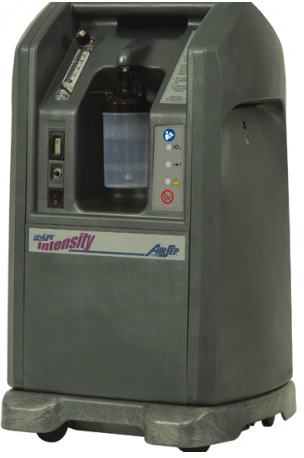
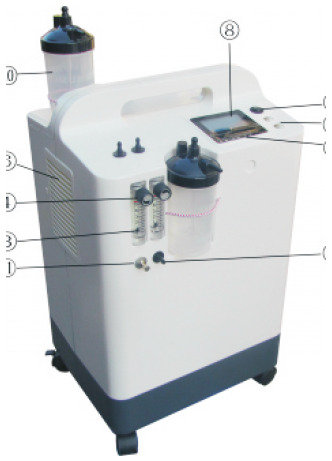
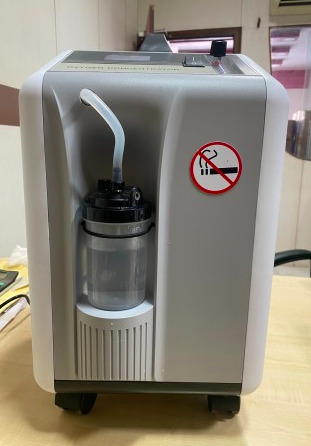
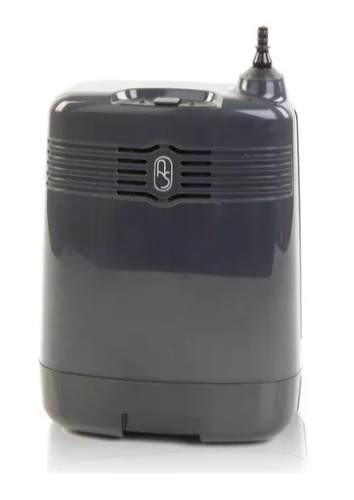
Nidek Nuvo 8
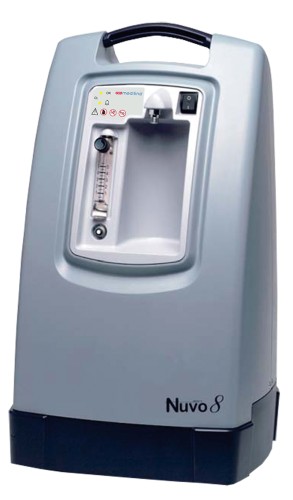
Key features
- Purity 90-96%
- Type High Flow Stationary
- Continuous Flow 1-8LPM
- Weight 25.2kg
- Oxygen Purity Indicator (OPI) Yes
- Power consumption 500watts
Specifications
| Purity | 90-96% |
|---|---|
| Type | High Flow Stationary |
| Continuous Flow | 1-8LPM |
| Weight | 25.2kg |
| Oxygen Purity Indicator (OPI) | Yes |
| Power consumption | 500watts |
| Sound level | 47db |
| Dimensions | 27.8H x 15.6W x 15.5Dinch |
| Operating altitude | 7500feet |
| Outlet pressure | 15psi |
| Loss of Power Alarm | Yes |
|---|---|
| Indian Voltage Model | Yes |
| Company Headquarters | USA |
| US FDA Approved | Yes |
| CE Certified | Yes |
Pros and cons
PROS
- 8 LPM continuous ceiling at stated 90-96% purity — covers 95% of home oxygen prescriptions without running at top-end
- Sound of 47 dB is 11 dB quieter than the Nuvo 10's 58 dB and 20 dB quieter than the DeVilbiss 10 LPM's 67 dB
- Outlet pressure of 15 psi supports transfill rigs and long tubing runs — meaningful for patients who want to fill portable cylinders at home
- Power draw of 500 W is 100 W below the Nuvo 10 and 164 W below the DeVilbiss 10 LPM — Rs. 350-500/month saving at 14 h/day
CONS
- Indian warranty of 1 year per the manufacturer sheet — one-third of the Nuvo Lite's 3 years
- Altitude cap of 7,500 ft — same as the Nuvo Lite; off-brief for Leh, Spiti, Tawang, upper Himachal
- OPI is present but there is no system-malfunction alarm or no-flow alarm listed on the spec sheet, unlike the Nuvo 10
The Nuvo 8 is the unit we recommend most often when a pulmonologist’s prescription reads “up to 6 LPM continuous, titrate as needed” and the family asks whether they should buy a 5 LPM or a 10 LPM. The 8 LPM spec is almost a Goldilocks category in Indian home oxygen — enough headroom to cover prescriptions that spike during exertion, without the noise, weight, and electricity penalties of the 10 LPM class. At a street price of Rs. 97,920, it is only Rs. 3,800 more than the Nuvo 10 and roughly Rs. 40,000 more than a 5 LPM, which for the right patient is easily worth the difference.
It is also the machine that gets under-sold in India, partly because most dealer catalogues jump from 5 LPM to 10 LPM and skip the 8 LPM category in their featured listings. If you have been quoted only on 5 and 10 LPM options, ask for the Nuvo 8 by name.
What the specs mean in practice
Continuous flow: 1-8 LPM. This is the central number. A patient whose resting prescription is 2-3 LPM and who desaturates to SpO2 88% on a flight of stairs requiring 5-6 LPM short-term support fits neatly inside the Nuvo 8’s band. Running a 5 LPM at its 5 LPM ceiling for 6-8 hours a night is fine; running it at the ceiling continuously for months, as can happen for late-stage ILD or cor pulmonale, is how you age the zeolite bed prematurely. The Nuvo 8 in the same home, running at 4-5 LPM most of the time with spikes to 7 LPM, is being operated in the middle of its capability band — the machine lasts longer and purity drift is slower.
Purity: 90-96%. The same band as the Nuvo Lite and higher than the Nuvo 10’s 87-95%. At 8 LPM the -3% tolerance brings worst-case delivery to 87%, which is still above the clinical floor of 85% used as the OPI trigger point.
Sound: 47 dB. This is an underrated number. The DeVilbiss 10 LPM at 67 dB is loud — conversationally loud, “I can hear it from the kitchen” loud. The Nuvo 10 at 58 dB is in the loud-refrigerator band. The Nuvo 8 at 47 dB is quieter than the Invacare Platinum 9 (58 dB) and comparable to most 5 LPM stationary units. For a high-flow machine running in a bedroom this is the single biggest reason to prefer the Nuvo 8 over a 10 LPM class machine.
Power: 500 W. At 14 h/day that is 7 kWh daily or roughly Rs. 1,640/month on a Mumbai domestic tariff of Rs. 7.80. The Nuvo 10 at 600 W adds about Rs. 325/month; the DeVilbiss 10 LPM at 664 W adds another Rs. 210 on top of that. Over a four-year horizon the Nuvo 8’s power savings against a DeVilbiss 10 LPM are roughly Rs. 25,000-30,000 — meaningful money against the Rs. 11,000 price gap between them.
Outlet pressure: 15 psi. Matches the Nuvo 10, meaningfully above the 5 LPM class. Supports transfill rigs that operate at 12-14 psi intake, supports long tubing runs in larger houses, and provides margin for nebuliser integration if a physician orders concurrent bronchodilator therapy.
Operating altitude: 7,500 ft. The one real weak point. Same cap as the Nuvo Lite. Leh, Spiti, Tawang off-brief. For a hill-station buyer needing 8 LPM of flow at altitude, the option is either a DeVilbiss 10 LPM (5,000 ft cap — worse) or the DeVilbiss 5 LPM/525 (13,123 ft — but only 5 LPM). There is no clean 8 LPM high-altitude machine in this roundup.
Who should buy it
The high-flow home LTOT patient whose prescription tops out at 6-7 LPM exertion and 2-4 LPM rest. Fibrotic lung disease post-COVID, advanced COPD with chronic hypercapnia, pulmonary hypertension cases requiring continuous supplemental oxygen to hold SpO2 above 88% at rest.
Patients whose household runs the machine 16-20 hours a day. The Nuvo 8’s 500 W power draw versus the Nuvo 10’s 600 W or the DeVilbiss 10’s 664 W is a direct, measurable saving on the electricity bill, particularly in Maharashtra, Karnataka, and Tamil Nadu where domestic slab rates above 500 units/month jump sharply.
Buyers who plan to pair the machine with a portable cylinder transfill rig for outings. The Nuvo 8’s 15 psi outlet is enough; a 5 LPM’s 5.5-8.5 psi is not.
Who shouldn’t
Patients with a clinician-written prescription of 9-10 LPM continuous. Running an 8 LPM at its ceiling for months is the same failure mode as running a 5 LPM at 5 LPM — you buy the next category up.
Hill-station buyers above 7,500 ft. The altitude cap is the cap. Choose differently.
Cost-sensitive buyers on a stable 1-3 LPM prescription. At Rs. 97,920 versus a Nuvo Lite’s Rs. 57,600, you are paying Rs. 40,000 for headroom you will never use. If the pulmonologist expects the prescription to be stable, buy the 5 LPM and upgrade if clinical need changes.
Buyers relying on 3-year warranty. The Nuvo 8’s published warranty in India is 1 year; the Nuvo Lite’s is 3. If warranty horizon matters, factor that in.
Alternatives, head-to-head
Nidek Nuvo 8 vs Nidek Nuvo 10 LPM. The Nuvo 10 delivers 2 extra LPM of ceiling, the same 15 psi outlet, higher power (600 vs 500 W), and a 10 dB louder sound profile (58 vs 47 dB). It carries a system-malfunction and no-flow alarm spec that the Nuvo 8 sheet omits. The Nuvo 10’s 87-95% purity floor is lower than the Nuvo 8’s 90-96%. Price-wise the Nuvo 10 at Rs. 94,079 is actually slightly cheaper than the Nuvo 8’s Rs. 97,920, which is an odd Indian pricing quirk — the 10 sits under the 8 because its list price was set earlier and the 8 is a newer mid-tier SKU priced as a premium. For any patient whose prescription is under 8 LPM, the Nuvo 8 is the right buy despite the slight price premium, because of noise and power. For patients with 9-10 LPM prescriptions, the Nuvo 10 is obligatory.
Nidek Nuvo 8 vs DeVilbiss 10 LPM. The DeVilbiss 10 at Rs. 109,584 is 6 kg lighter than the Nuvo 8 (19 vs 25.2 kg), has a 20 psi outlet (versus 15 psi), and extends to 10 LPM. Against the Nuvo 8 it is 20 dB louder (67 vs 47 dB), 33% more power-hungry (664 vs 500 W), and 12% more expensive. For a hospital-to-home transition case where a 10 LPM ceiling has already been validated clinically and the family can afford the noise and electricity, the DeVilbiss 10 is a fair pick. For anyone else, the Nuvo 8 is quieter, cheaper to run, and covers 95% of non-institutional prescriptions.
Nidek Nuvo 8 vs Invacare Platinum 9. The Platinum 9 at Rs. 110,400 gives 9 LPM versus the Nuvo 8’s 8 LPM, with the same 58 dB noise as the Nuvo 10 (11 dB louder than the Nuvo 8), a 475 W power draw (25 W less than the Nuvo 8), a 9 psi outlet (below the Nuvo 8’s 15 psi), and no stated Indian-voltage configuration on its spec sheet. Invacare India’s service footprint is thinner than Nidek’s post-2023. The Nuvo 8 wins on noise, on outlet pressure, on Indian-voltage compatibility, and on dealer density. The only reason to pick the Platinum 9 is the 1 LPM of extra ceiling, which is not clinically meaningful for most LTOT cases.
Indian-market considerations
Voltage: 220V/50Hz configuration stated. A 500 W continuous draw warrants a 1.5 kVA servo stabiliser for Tier-2 and Tier-3 grid quality — budget Rs. 4,500-6,500. UPS options get expensive fast at this power draw. A 2 kVA sine-wave inverter with a 200 Ah battery bank will give roughly 40 minutes of full-load runtime. For households with reliable power the cost-benefit is marginal; for households with multi-hour daily outages, a 3 kVA/300 Ah system is the correct spec and lands at Rs. 45,000-60,000 installed.
CDSCO: The sheet shows US FDA and CE; no CDSCO number on Indian-facing collateral surveyed. Ask the dealer’s importer.
Altitude: 7,500 ft cap — plains machine only. Upper Himalayan buyers should not order this.
Service: Nidek’s India network handles Nuvo 8 spares at broadly the same density as Nuvo Lite spares. Compressor service at year 3-4 is typically Rs. 22,000-28,000 plus labour.
Warranty: 1 year published. Confirm with the dealer whether extended warranty packages are offered — some Tier-1 Nidek dealers offer a paid 3-year extension at roughly Rs. 7,000-10,000. For the Nuvo 8 specifically, the extended warranty is worth taking given that any compressor service in years 2-3 can cost Rs. 20,000-25,000 without warranty coverage.
Pricing anomaly explanation: The Nuvo 8’s Rs. 97,920 street price being slightly higher than the Nuvo 10’s Rs. 94,079 is an artefact of Nidek India’s price-list revisions through 2022-2024. The 10 LPM’s list price was set when 10 LPM units were a smaller segment of the market; the 8 LPM was introduced later as a mid-upper option and priced at a slight premium reflecting its newer positioning. This is an odd pricing dynamic that buyers should be aware of — it does not change the recommendation that the Nuvo 8 is the right machine for most high-flow Indian home cases, but it means the “cheaper machine” argument for the Nuvo 10 is technically accurate on capital cost while being reversed on operating cost.
Flow-rate adequacy for most prescriptions: Indian clinical practice for home LTOT prescriptions in 2026 skews toward “up to 5 LPM” for stable cases, “up to 8 LPM” for moderate-severity LTOT, and “10+ LPM” for end-stage cases. The Nuvo 8’s 8 LPM ceiling fits the middle category cleanly and also covers the upper end of the lower category — a prescription written “2-6 LPM” sits comfortably inside the Nuvo 8’s capability band with headroom for exertional spikes.
Humidification considerations: At sustained 6-8 LPM output, cold-dry oxygen delivery via standard nasal cannula can cause nasal mucosal drying, epistaxis, and patient discomfort over multi-hour wear. A heated humidifier sized for 8 LPM is recommended for continuous high-flow use — Fisher & Paykel HC150 or equivalent, approximately Rs. 12,000-18,000. Running the Nuvo 8 with an unheated bubble humidifier at the 6-8 LPM end of its capability is functional but produces patient discomfort that a heated humidifier solves.
Noise behaviour versus spec: Field reports suggest the Nuvo 8 maintains its 47 dB spec reasonably well over the first 18-24 months of operation, drifting upward by 1-2 dB by year 3. This is better behaviour than the Nuvo Standard and comparable to the Nuvo Lite. Running the unit in its rated operating temperature range (15-35°C ambient) extends acoustic-stability lifespan.
Alarm-set gap note: The Nuvo 8’s published spec sheet lists loss-of-power alarm but leaves system-malfunction and no-flow alarm fields blank. The physical machine may have these alarms as buried-in-spec features — dealers report that the Nuvo 8 does audibly alert on most failure modes — but the published documentation leaves the certainty gap. Buyers committed to clinical reliability should ask the dealer to demonstrate alarm behaviour during sale walkthrough.
Dealer-network service tier distinctions: Nidek India classifies its dealer network into authorised-service and authorised-sales tiers. For the Nuvo 8 in Tier-2 cities, buyers should confirm whether the local dealer is service-authorised or sales-only; service-only dealers in adjacent Tier-1 cities may be the actual service provider with longer in-home service lead times.
Verdict
The Nuvo 8 is the mid-upper high-flow concentrator that should be the default recommendation for any Indian home patient with a prescription between 5 and 8 LPM. At 47 dB it solves the single biggest problem of the high-flow category — noise — and its 500 W power draw keeps monthly electricity costs in the same band as most 5 LPM stationary units. The 7,500 ft altitude cap and 1-year warranty are the two real weaknesses; the altitude constraint is absolute, the warranty is negotiable with a paid extension. Against the Nuvo 10 and the DeVilbiss 10 LPM, the Nuvo 8 gives up only 2 LPM of ceiling that most home users never need — and it gives that up in exchange for meaningful improvements in every other column a home family cares about. Score 7.6, and this is the 8 LPM we would buy today.