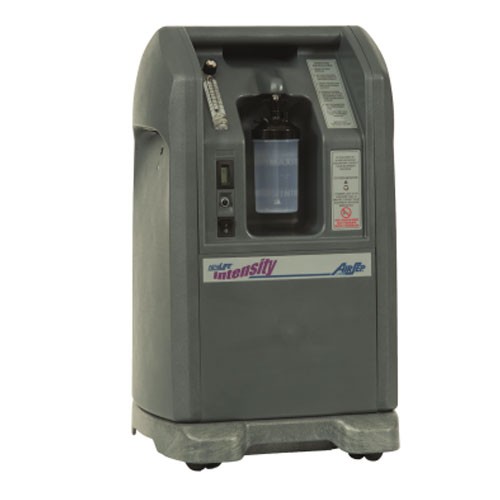
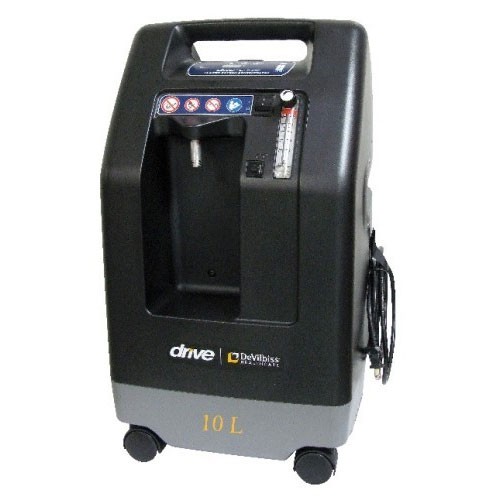
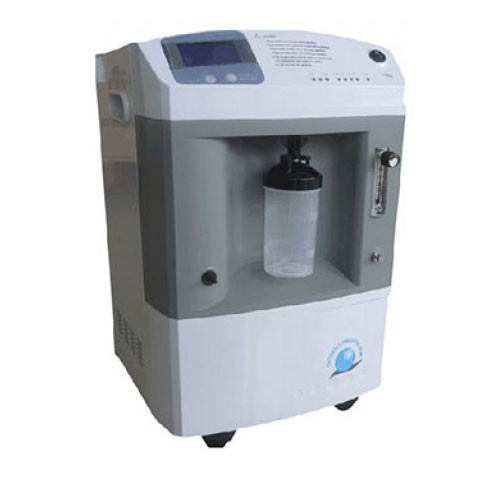
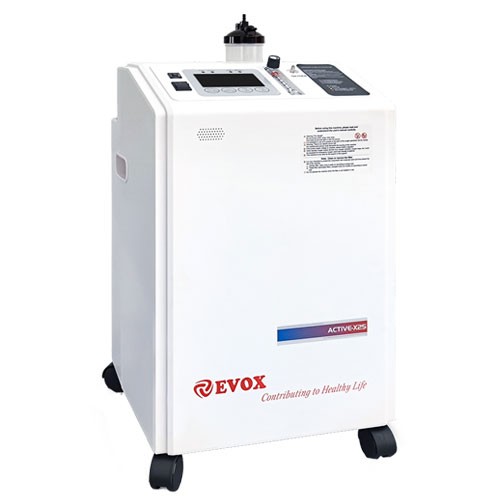
AAYOU 10L
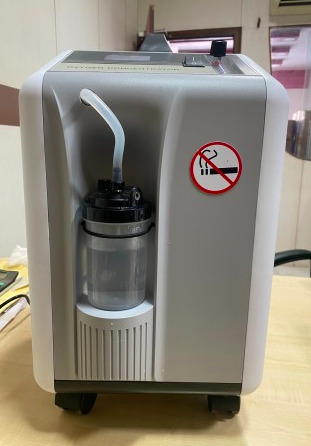
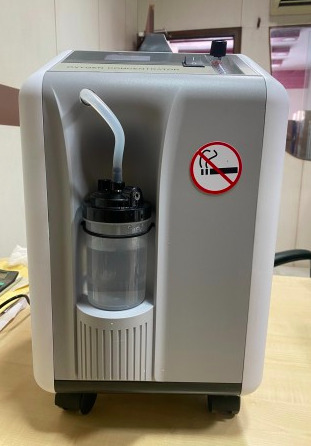
Key features
- Purity 90-95%
- Type High Flow Stationary
- Continuous Flow 1-10LPM
- Weight 21kg
- Oxygen Purity Indicator (OPI) No
- Power consumption 650watts
Specifications
| Purity | 90-95% |
|---|---|
| Type | High Flow Stationary |
| Continuous Flow | 1-10LPM |
| Weight | 21kg |
| Power consumption | 650watts |
| Sound level | 52db |
| Dimensions | 16H x 12W x 21Dinch |
| Operating altitude | 10000feet |
| Outlet pressure | 11.6psi |
| Loss of Power Alarm | Yes |
|---|---|
| System Malfunction Alarm | Yes |
| Indian Voltage Model | Yes |
| Company Headquarters | China |
| CE Certified | Yes |
Pros and cons
PROS
- Lighter 10 LPM chassis at 21 kg — easier to position than many 10 LPM peers
- 10,000 ft operating altitude — the highest in this Chinese OEM cohort
- CE certification published on the Indian brochure
- 52 dB noise — quieter than most 10 LPM high-flow units in this class
- Outlet pressure 11.6 psi supports long tubing runs for bedside placement
CONS
- ₹1,34,400 list price overlaps directly with Philips 10 LPM — a vastly better-supported unit
- AAYOU brand has near-zero independent Indian service network
- Stock listed Out of stock on the source listing — supply is discontinuous
- No FDA or FAA certification on the Indian brochure
- 650 W power draw acceptable for class but unremarkable
AAYOU is a Chinese import brand whose Indian presence never scaled
AAYOU is one of the smaller Chinese concentrator brands that appeared in Indian e-commerce during the 2020–2021 oxygen demand cycle. The 10L model is the only AAYOU unit in this review cycle’s catalogue. The manufacturer brochure and e-commerce product listings HHZ reviewed show a relatively well-specified 10 LPM unit — 21 kg, 650 W, 52 dB, 10,000 ft altitude, CE certification published — at a list price of ₹1,34,400 that places it squarely in Tier-1 territory. The stock status on the source listing is “Out of stock,” which tracks with the brand’s limited ongoing Indian distribution.
The problem is not the machine. The specifications are honest and the CE mark is a positive differentiator against most of the Chinese-OEM 10 LPM cohort. The problem is the price-and-support equation. At ₹1,34,400 you are paying Philips 10 LPM money without the Philips service network, Philips spare-parts pipeline, or Philips warranty infrastructure. AAYOU’s Indian service footprint is a handful of importers, not a structured authorised-service-centre network. For a 10 LPM clinical-grade machine that is the wrong tradeoff at that price.
What the specs actually mean
Continuous flow 1–10 LPM, purity 90–95 %. The range starts at 1 LPM rather than 0.5 LPM (as on the Yuwell 10 LPM), which is marginally less useful for low-flow titration but acceptable for any buyer actually needing a 10 LPM. Purity is standard PSA spec. Per-flow purity table not published; assume 90 % floor at peak flow.
Weight 21 kg. Genuinely good for a 10 LPM. Lighter than the Niscomed 10 LPM (30 kg), Fitmate 10 LPM (25.5 kg) and Yuwell 10 LPM (33 kg). Against the Oxybliss 10 LPM’s 18.8 kg it is 2 kg heavier but still in the tractable-for-one-person class. For institutional deployment that is a meaningful operational benefit.
Power 650 W. Mid-pack for the 10 LPM category. Philips 10 LPM runs 580 W, DeVilbiss 1025 runs 600 W, Yuwell 10 LPM 850 W. The AAYOU’s 650 W is closer to Tier-1 efficiency than most Chinese OEMs manage, which is a positive. At 16 hours of daily LTOT and ₹7/unit that is ~₹1,250/month electricity.
Noise 52 dB. Below most 10 LPM peers (Yuwell 60, Niscomed 50, Oxybliss 50, Fitmate 55). For a 10 LPM unit in a home setting 52 dB is on the acceptable edge — still not bedroom-friendly but usable in an adjacent room with a tubing run.
Operating altitude 10,000 ft. This is a standout spec. 10,000 ft is higher than any other 10 LPM in this review cycle. Philips 10 LPM runs 7,500 ft, DeVilbiss similar. For a buyer in Leh (11,500 ft) or similar high-altitude deployment the AAYOU’s rating is genuinely useful — though verify in writing with the seller that purity is maintained at your specific altitude.
CE certified: Yes. This is one of the few Chinese OEM 10 LPMs in this review cycle with a published CE mark. FDA and FAA fields are blank. CE is the European conformity mark and indicates the unit has passed EU-harmonised medical device standards. For Indian regulatory purposes CDSCO Class B registration is still required separately, but CE improves procurement-team comfort for institutional buyers.
Outlet pressure 11.6 psi. Higher than most, which supports long tubing runs (for bedroom-to-utility-room installations) and dual-patient split operation without excessive pressure drop.
Dimensions 16 × 12 × 21 inches (H×W×D), vertical compact form.
Who should buy it
High-altitude clinical deployment. The 10,000 ft altitude rating is the single most defensible reason to choose the AAYOU over a cheaper Indian-branded 10 LPM. Buyers in Leh, Kargil, upper Himachal, North Sikkim and similar should prioritise the altitude spec and this is the unit that publishes the best figure in this cohort.
Institutional buyers who specifically need CE documentation. Some private hospitals and medical tourism facilities require CE-marked equipment for accreditation purposes. The AAYOU delivers on that line item.
Facilities with existing AAYOU service relationships. If a hospital or clinic already operates AAYOU units and has an importer relationship the marginal unit is rational.
Space-constrained 10 LPM needs. The 21 kg and 16-inch-wide dimensions make the AAYOU the most apartment-deployable 10 LPM in the Chinese-OEM category.
Who should not buy it
Home buyers paying list price. At ₹1,34,400 the AAYOU is head-to-head with Philips 10 LPM (₹95,000–1,10,000 street in better-discounted channels) and DeVilbiss 10 LPM at similar pricing. For a home LTOT 10 LPM there is no case.
Remote buyers without service access. AAYOU’s Indian service network is thin. A 10 LPM failure in a remote location is a multi-week outage without local service.
Buyers on budget constraints. The AAYOU is not cheap. If the budget is constrained, Indian-brand alternatives (Oxymed 10 LPM at ~₹60,000–70,000 street, Nareena 10 LPM at ~₹55,000) deliver similar specs at less than half the price.
Buyers who need FDA documentation. Not published on the Indian brochure.
Alternatives that beat the AAYOU on specific axes
Philips Respironics 10 LPM (EverFlo Q), ~₹95,000–1,10,000 street. At lower street price the Philips delivers 24 kg / 580 W / 50 dB with FDA, CE and OPI present, plus Philips Home Healthcare’s 3-year Indian warranty and 15+ city authorised-service-centre network. For home LTOT at the AAYOU’s price bracket the Philips is the default.
DeVilbiss 10 LPM, ~₹85,000–1,00,000 street. 27 kg, 600 W, 48 dB, FDA-approved, DeVilbiss service in major metros. Again, better-specified and better-supported at a lower price than the AAYOU list.
Oxymed 10 LPM, ~₹60,000–70,000 street. Indian-brand 10 LPM with 40+ city service footprint. Against the AAYOU it loses on altitude rating and on CE paperwork (AAYOU carries CE; Oxymed does not). For any non-altitude home use where CE isn’t mandatory for the buyer, Oxymed is the clearer buy at half the AAYOU’s price.
Invacare Platinum 10, ~₹90,000–1,10,000 street. 24 kg, 600 W, FDA-approved, Invacare’s institutional service network. A strong alternative for facility buyers.
Indian-market considerations
AAYOU’s Indian distribution was always a smaller operation than Yuwell, Longfian or Dedakj. After 2022 the brand’s retail visibility declined and most listings now show intermittent stock. For a 2026 buyer, availability is a primary risk — ensure the dealer has physical stock and a clear import-documentation trail before purchase.
CDSCO MD-14 importer licensing for AAYOU in India is held by a small number of importers, some of whom may have exited the category. Before purchase, confirm the importer is currently active, holds a valid MD-14, and commits in writing to spare-parts supply for the unit lifetime. Without that commitment a ₹1,34,000 purchase is a multi-week outage away from becoming an expensive paperweight. (CDSCO)
Spare-parts cross-compatibility is the one mitigation. The AAYOU 10L chassis shares tooling and components with several other Chinese-OEM 10 LPM platforms. A competent independent biomed technician can source sieve beds, compressors and valves from cross-compatible stock. Compressor replacement on a 10 LPM is ₹15,000–22,000 in independent Indian service; sieve-bed service is ₹8,000–12,000. Out-of-warranty exposure on a 10 LPM unit used in LTOT is meaningful — budget for one major service in years 3–5.
Warranty claim cycle time for a smaller-importer brand like AAYOU in India is typically 4–8 weeks including parts shipping from China. Clinical-use buyers should maintain a backup oxygen source — either a second concentrator or a cylinder bank — to cover that window.
The 650 W power draw with typical Indian voltage fluctuation means an AVR (automatic voltage regulator) is a recommended ₹3,500–5,000 accessory for any deployment. Compressor damage from voltage spikes is the most common failure mode on 10 LPM units in Indian field conditions.
Verdict
The AAYOU 10L is a well-specified 10 LPM Chinese OEM unit with a genuinely useful altitude rating and a CE mark, priced at a level that puts it in direct competition with Philips and DeVilbiss Tier-1 alternatives. At that price point the Tier-1 alternatives win because the service network, parts pipeline and warranty infrastructure are fundamentally better. The AAYOU earns its 5.7 score by being a technically credible machine in a competitive category where it is not the correct buy for most scenarios. The narrow cases where the AAYOU makes sense are: high-altitude clinical deployment where the 10,000 ft rating is load-bearing, institutional buyers with existing AAYOU relationships, or deeply discounted liquidated stock. For ordinary home or facility buyers at list price, pick the Philips, the Oxymed, or the Nareena instead.