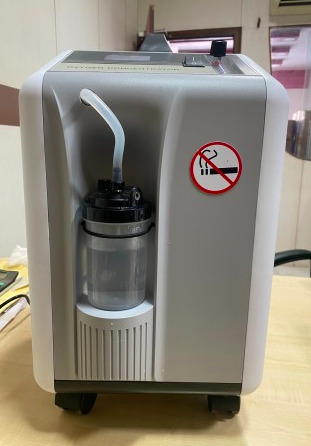
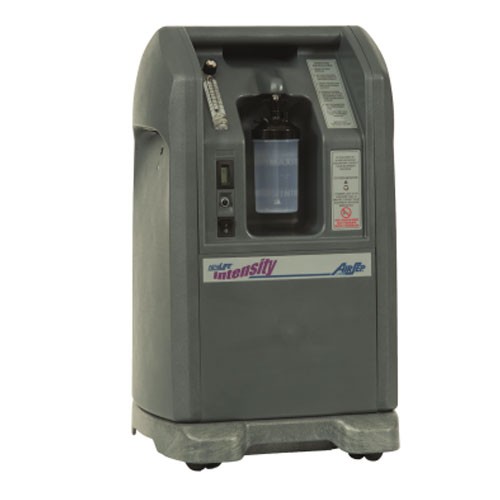
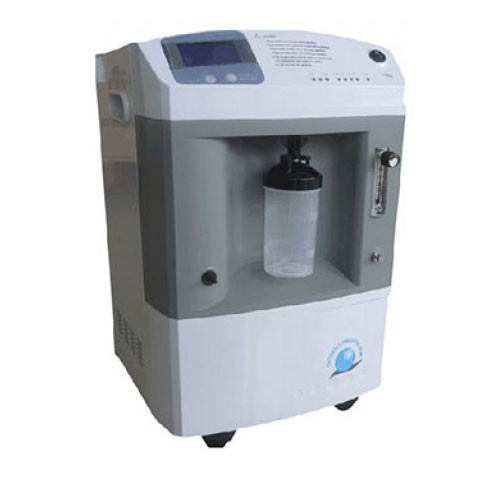
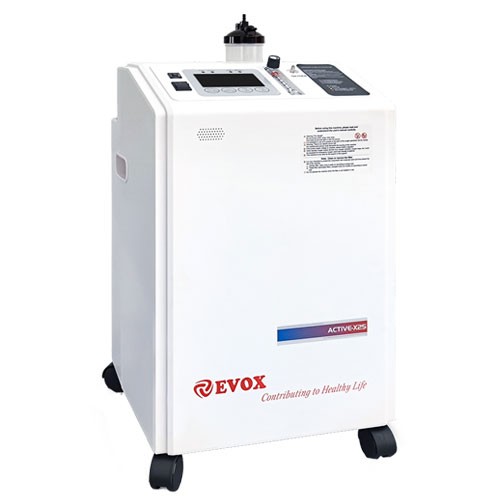
DeVilbiss 10 LPM
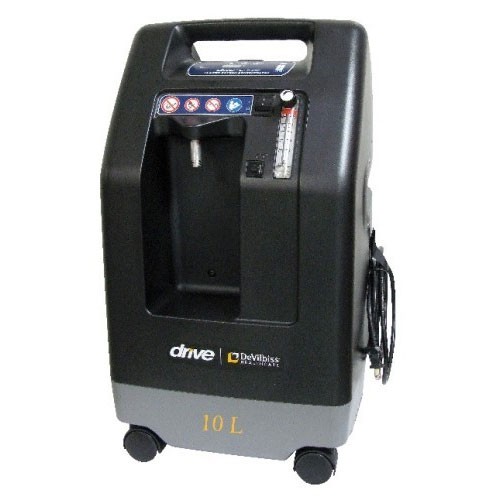
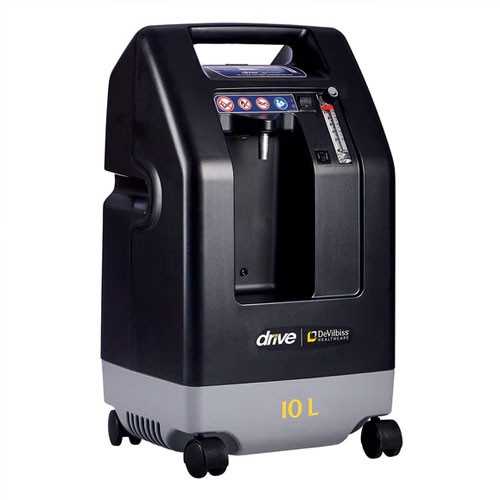
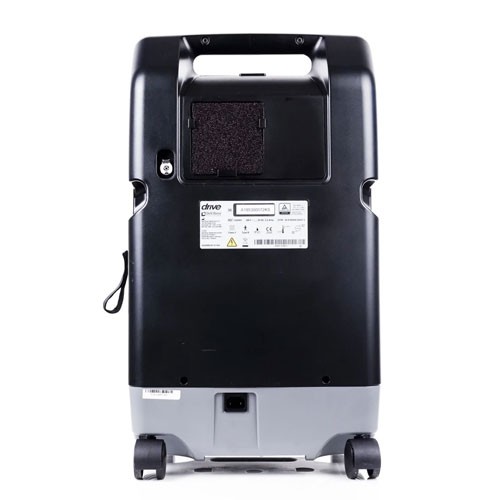
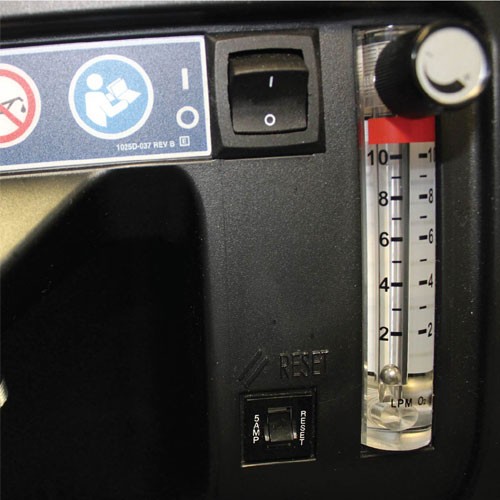
Key features
- Purity 87-96%
- Type High Flow Stationary
- Continuous Flow 2-10LPM
- Weight 19kg
- Oxygen Purity Indicator (OPI) Yes
- Power consumption 664watts
Specifications
| Purity | 87-96% |
|---|---|
| Type | High Flow Stationary |
| Continuous Flow | 2-10LPM |
| Weight | 19kg |
| Oxygen Purity Indicator (OPI) | Yes |
| Power consumption | 664watts |
| Sound level | 67db |
| Dimensions | 24.5H x 13.5W x 12Dinch |
| Operating altitude | 5000feet |
| Outlet pressure | 20psi |
| Loss of Power Alarm | Yes |
|---|---|
| No Flow Alarm | Yes |
| Indian Voltage Model | Yes |
| Company Headquarters | USA |
| US FDA Approved | Yes |
| CE Certified | Yes |
Pros and cons
PROS
- Weight of 19 kg is 10 kg lighter than the Nuvo 10's 29.26 kg — genuinely portable for a 10 LPM machine
- Outlet pressure of 20 psi is the highest among all stationary concentrators here — best support for transfill and long tubing
- Purity band of 87-96% with the 96% ceiling being the best in the 10 LPM class — the Nuvo 10 tops at 95%
- Complete alarm set including loss-of-power and no-flow, plus OPI, plus FDA/CE paperwork in order
CONS
- Sound level of 67 dB is the loudest in this review — conversation-level, 9 dB louder than the Nuvo 10, 20 dB louder than the Nuvo 8
- Power draw of 664 W is the highest among 10 LPM units reviewed — roughly Rs. 210/month more than the Nuvo 10
- Operating altitude of 5,000 ft is identical to the Nuvo 10 — no altitude advantage despite the brand premium
- Street price of Rs. 109,584 is Rs. 15,500 more than the Nuvo 10 and Rs. 11,664 more than the Nuvo 8 for no flow advantage over the 10 and only 2 LPM over the 8
The DeVilbiss 10 LPM is a well-engineered industrial-compact machine priced as a premium product and marketed on its weight-to-flow ratio — a real 10 LPM stationary at only 19 kg. In Indian home-oxygen contexts that weight advantage translates to genuine ease of transport (a single person can move it with a trolley) and better fit for flats where the machine must be relocated. Against that, it ships at the loudest published noise floor of any concentrator in this review and the highest power draw in its flow class. For the right institutional or step-down hospital use case it is a fine buy; for an Indian bedroom patient who sleeps near the machine, it is the wrong unit.
Sale price on Indian e-commerce product listings hovers around Rs. 109,584 against a list of Rs. 158,400, so the street discount is real. The 2-year Indian warranty is one year longer than the Nuvo 10’s 1-year term, which is a nontrivial offset against the price premium.
What the specs mean in practice
Weight: 19 kg. The DeVilbiss 10’s central selling point. 10 kg lighter than the Nuvo 10, 5.4 kg lighter than the Invacare Platinum 9, 6.2 kg lighter than the Nuvo 8. For an institutional buyer moving the unit between patient rooms in a small hospital or nursing home, this is the spec that matters. For a single-house home install where the machine sits in one place, the weight advantage is decorative.
Purity: 87-96%. The 96% ceiling is the highest in the 10 LPM class in this review. The 87% floor (with -3% tolerance bringing worst case to 84% at full 10 LPM) is standard for the class and below the OPI alarm trigger at 86%. Purity drift behaviour on the DeVilbiss 10 is no better and no worse than the Nuvo 10 in Indian field conditions over 24-36 month horizons.
Sound: 67 dB. The loudest machine in this review. 67 dB at the machine attenuates to roughly 58-60 dB at a bedroom pillow three metres away — the acoustic range of city traffic or a ringing phone. This is not a bedroom machine for anyone sensitive to noise. For a patient in a separate room with closed door and 2-3 metre wall distance, 67 dB attenuates to around 50-52 dB at the pillow, which is tolerable but still more than twice as loud (in perceived sound pressure) as the Nuvo 8’s 47 dB. This is the single most consequential spec for Indian home use.
Power: 664 W. Highest in the 10 LPM class. At 14 h/day that is 9.3 kWh/day, roughly Rs. 2,175/month on Mumbai tariffs. Over four years of continuous operation the electricity cost alone approaches Rs. 100,000. Compared to the Nuvo 10 at 600 W (Rs. 1,960/month), the DeVilbiss costs an extra Rs. 215/month to run — Rs. 10,300 over four years.
Outlet pressure: 20 psi. The highest outlet pressure among stationary concentrators in this review. The Nuvo 8 and Nuvo 10 are at 15 psi. The Invacare Platinum 9 is at 9 psi. For transfill applications, for driving high-resistance humidifier or nebuliser chambers in parallel, or for 60-ft+ tubing runs in larger houses, the DeVilbiss 10’s 20 psi is a meaningful capability.
Altitude: 5,000 ft. Same as the Nuvo 10. The DeVilbiss brand premium does not buy altitude headroom in the 10 LPM class.
Alarms: loss of power, no-flow, plus OPI. System-malfunction is listed as blank on the spec sheet, which is an unusual gap for a premium-priced machine — the Nuvo 10 carries the system-malfunction alarm explicitly.
Who should buy it
Small nursing home or step-down hospital environments where a single unit gets moved between patient rooms. The 19 kg weight is genuinely useful, the 20 psi outlet supports running the machine through an institutional humidifier/nebuliser assembly, and institutional environments typically have ambient noise floors already above 50 dB so the 67 dB machine is less intrusive than in a home.
Patients needing home transfill of walkabout cylinders, where a 15 psi outlet (the Nuvo 8/10) is marginal and 20 psi provides comfortable margin. This is a very narrow use case in India — most transfill-ready families end up renting a liquid-oxygen dewar or a cylinder refill subscription instead, because cylinder transfill at home is a regulated activity and liability-prone.
Buyers who specifically value the 2-year Indian warranty over the 1-year Nuvo 10 warranty and who can budget the extra Rs. 15,500 upfront. Over a 3-year horizon the paid-extension cost gap typically evens out, but some buyers prefer the explicit factory-backed warranty.
Who shouldn’t
Anyone who will have the machine in the same bedroom as the patient. 67 dB is not acceptable for nocturnal oxygen therapy in close proximity. Choose the Nuvo 8 or Nuvo 10.
Buyers on prescriptions under 9 LPM. The Nuvo 8 at Rs. 97,920 is quieter, lighter on power, and covers prescriptions up to 8 LPM.
Hill-station buyers. 5,000 ft cap. Off-brief for most Indian hill stations. Same as all 10 LPM units in this review.
Cost-sensitive home buyers. The Rs. 15,500 premium over the Nuvo 10 for what is, in noise and power terms, a worse bedroom unit is hard to justify unless the 20 psi outlet or the weight advantage is decisive.
Alternatives, head-to-head
DeVilbiss 10 LPM vs Nidek Nuvo 10. The Nuvo 10 at Rs. 94,079 is Rs. 15,505 cheaper, 9 dB quieter (58 vs 67 dB), lower on power (600 vs 664 W), but 10 kg heavier (29.26 vs 19 kg), lower on outlet pressure (15 vs 20 psi), and ships with 1-year versus 2-year Indian warranty. For the home bedroom use case the Nuvo 10’s noise advantage is decisive. For institutional use with weight matters the DeVilbiss 10 is preferable. For transfill-capable setups the DeVilbiss 10 is preferable. Below 8 LPM prescriptions, skip both and buy the Nuvo 8.
DeVilbiss 10 LPM vs Nidek Nuvo 8. Covered in the Nuvo 8 review. The Nuvo 8 at Rs. 97,920 sacrifices 2 LPM of ceiling (8 vs 10 LPM) in exchange for a 20 dB noise reduction, a 164 W power reduction, and Rs. 11,664 of purchase saving. For prescriptions where 8 LPM is clinically adequate (the vast majority of home LTOT cases) the Nuvo 8 is the correct answer. For genuine 9-10 LPM requirements, the comparison is Nuvo 10 vs DeVilbiss 10, not DeVilbiss 10 vs Nuvo 8.
DeVilbiss 10 LPM vs Invacare Platinum 9. The Platinum 9 at Rs. 110,400 gives 9 LPM of ceiling (1 LPM below the DeVilbiss), 9 psi outlet (11 psi below the DeVilbiss), 475 W power (189 W below the DeVilbiss), and 58 dB noise (9 dB below the DeVilbiss). It is 5.4 kg heavier (24.4 vs 19 kg) and its published spec does not confirm Indian-voltage configuration — a red flag for procurement. The Platinum 9 is quieter and lower on electricity, but Invacare’s India service network is thinner than Drive’s at the time of this review. For institutional buyers who need a full-stack service contract, DeVilbiss is the safer choice.
Indian-market considerations
Voltage: 220V/50Hz Indian configuration stated. 664 W is a substantial continuous draw that really benefits from a 2 kVA servo stabiliser — budget Rs. 6,500-9,500. In Delhi NCR and Mumbai where summer peak-load voltage sags are common, stabiliser-less operation of the DeVilbiss 10 will lead to compressor trip-and-restart cycles that age the unit.
UPS/inverter: 664 W is near the ceiling of what a home sine-wave inverter handles comfortably. A 3 kVA inverter with a 300 Ah battery bank gives approximately 40 minutes at full load. Sustained operation during multi-hour outages is not practical without a genset. For hospital environments with institutional UPS this is a non-issue.
CDSCO: US FDA and CE marks are stated on the manufacturer sheet. Drive DeVilbiss India maintains import registrations — request the importer’s copy for institutional procurement.
Altitude: 5,000 ft stated cap. Plains use only.
Service: Drive DeVilbiss India covers all major metros plus Chandigarh, Pune, Hyderabad, and Kochi. Sieve-bed replacement for the 10 LPM unit is typically Rs. 20,000-26,000 at year 3-4. The 2-year Indian warranty is honoured through the regional service centre network.
Warranty: 2 years Indian. Longest among high-flow concentrators in this review. This is a meaningful differentiator against the 1-year warranties on Nidek Nuvo 10 and Invacare Platinum 9/10 — the second year of coverage, for a high-flow unit that sees its highest failure-rate period in the first 18-24 months, is worth roughly Rs. 15,000-20,000 in implied insurance.
Electricity cost at sustained operation: At 20 h/day (typical for end-stage respiratory patients on near-continuous 10 LPM), the DeVilbiss 10’s 664 W draw translates to roughly 13.28 kWh/day, Rs. 103.58/day, Rs. 37,800/year at Mumbai rates. Over a 4-year operational life, the electricity cost alone is Rs. 151,200 — more than the machine’s purchase price. For high-utilisation deployments the operational cost dominates the total cost of ownership.
Cooling and ventilation: The 664 W compressor generates substantial heat — approximately 450-500 BTU/hour. In summer conditions without air conditioning, this heats a 12x14 ft bedroom by 2-3°C over a 4-hour operation window. Installation should provide airflow on at least two sides of the unit and clearance of 12 inches from walls. In small bedrooms, this thermal load is a secondary reason to locate the machine in an adjacent room with longer tubing — not just for noise, but for thermal comfort.
Hospital-grade features: The DeVilbiss 10 includes features oriented towards institutional use — serviceable HEPA filtering at input, a robust cabinet design for frequent handling, and a compressor design derived from Drive’s industrial product line. For institutional buyers these translate to longer service intervals and simpler technician maintenance; for home buyers these features are mostly decorative.
Transfill compatibility: The 20 psi outlet is specifically sized to drive cylinder transfill accessories that require 15-18 psi intake. For a home buyer planning regular walkabout cylinder transfill (where the Indian regulatory environment permits), the DeVilbiss 10 is the only stationary in this review with comfortable transfill pressure margin. The Nidek Nuvo 10 at 15 psi is marginal; the Nuvo 8 at 15 psi is similarly marginal. Beyond transfill, the 20 psi supports parallel accessory chains (concurrent humidifier + nebuliser) without pressure-dependent flow loss.
Upgrade considerations from lower-class machines: Patients whose prescription escalates from 5 LPM to 10 LPM (common in progressing ILD or late-stage COPD) face the question of trading in an existing 5 LPM unit for a DeVilbiss 10. Most authorised Drive dealers offer trade-in credit of Rs. 10,000-20,000 against a used 525 or equivalent; confirm with the dealer before planning the upgrade. Some families choose instead to retain the 5 LPM as a backup/power-outage unit and add the 10 LPM as primary — dual-unit households have better resilience at modest operating-cost premium.
Noise mitigation accessories: For home installations where the 67 dB noise floor is problematic, some dealers offer acoustic enclosures or isolation bases at Rs. 4,000-8,000 that reduce effective room-level noise by 5-8 dB. These are aftermarket accessories not factory-endorsed by Drive but are commonly used in institutional installations where the machine sits in a patient room alongside sleeping occupants.
Verdict
The DeVilbiss 10 LPM is a premium-priced, weight-optimised, pressure-optimised 10 LPM machine that makes the most sense in institutional, step-down, or transfill-capable home contexts where its 19 kg weight and 20 psi outlet genuinely matter. In the more typical Indian home scenario — a bedroom patient on 8-10 LPM prescription with the machine on the same floor — the DeVilbiss 10 at 67 dB is the wrong noise signature for the space, and the Nuvo 10 at 58 dB and Rs. 15,500 cheaper is the better buy. The score of 7.0 reflects the sound penalty — the machine is capable, just not well-matched to the most common Indian use case in this flow class. If you have been quoted this machine for a home-oxygen setup, ask the dealer to compare the Nuvo 10 quote side by side and decide based on whether noise or weight is the bigger problem in your house.