Jumao 5LPM
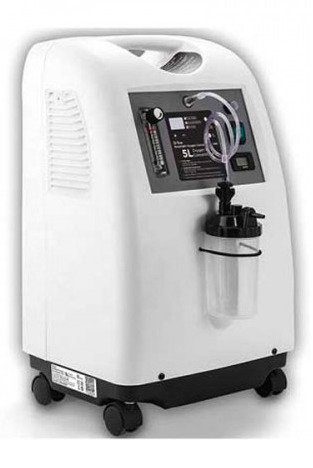
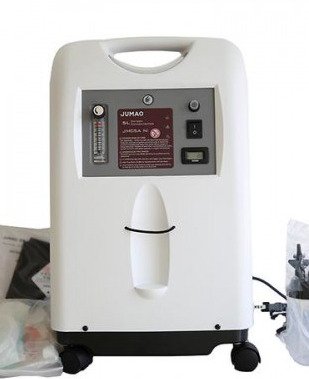
Key features
- Purity 90-95%
- Type Home Stationary
- Continuous Flow 0.5-5LPM
- Weight 16kg
- Oxygen Purity Indicator (OPI) No
- Power consumption 390watts
Specifications
| Purity | 90-95% |
|---|---|
| Type | Home Stationary |
| Continuous Flow | 0.5-5LPM |
| Weight | 16kg |
| Power consumption | 390watts |
| Sound level | 52db |
| Dimensions | 22.8H x 12.2W x 16.1Dinch |
| Outlet pressure | 8.4psi |
| Indian Voltage Model | Yes |
|---|---|
| Company Headquarters | China |
Pros and cons
PROS
- Full accessory bundle — nebulizer kit, humidifier bottle, cannula, connector tube
- 16 kg chassis is portable between rooms
- 0.5-5 LPM flow range covers paediatric and low-flow adult prescriptions
- 8.4 psi outlet pressure is competitive for the class
CONS
- 52 dB published sound — highest in its class, unsuitable for bedroom use
- No OPI, no alarms of any kind confirmed on brochure
- No CE, FDA, or CDSCO certifications
- Out of stock on source listing; no documented Indian dealer network
The Jumao 5 LPM is a Chinese-OEM-under-its-own-brand 5 LPM stationary concentrator sold on Indian e-commerce channels at ₹40,320. The brand has minimal Indian market presence — no documented authorised-service-centre list, no visible dealer network, out of stock on the source listing. The spec sheet reports 0.5–5 LPM continuous flow, 90–95% purity, 16 kg chassis, 390 W power draw, 52 dB sound, 8.4 psi outlet pressure, and a full accessory bundle. At ₹40,320 it costs the same as a Home Medix 5 LPM and 35% more than a Veayva, but is louder, less-specified on safety features, and less-supported on service. There are better choices at this price point.
What the specs mean
The 0.5–5 LPM flow range with 90–95% purity is the category baseline. The 0.5 LPM minimum allows for paediatric or very low-flow adult prescriptions, which is useful. The 95% upper purity is typical — one percentage point below best-in-class (Dr Diaz, Nareena, Oxyflow at 96%).
The 16 kg chassis is mid-pack for the 5 LPM class. Lighter than Philips EverFlo-class legacy shells or Aspen (21 kg); heavier than Home Medix HM-KV (13 kg), Nareena (15 kg), or Vandelay (14.5 kg). Two-hand lift for one adult, manageable.
The 390 W power draw is mid-pack. Matches Dr Trust, less efficient than Home Medix HM-KV (320 VA), GVS/Vandelay (300 W), or Dr Diaz (285 W), more efficient than Nareena (550 W). At 16 hours/day × ₹9/kWh this is roughly ₹1,700/month in electricity — a reasonable cost but not the best available at this flow rate.
The 52 dB sound level is where Jumao falls hardest. This is among the loudest in the 5 LPM class. For reference: Nidek Nuvo Lite 40 dB, Philips EverFlo 45 dB, Vandelay 45 dB, GVS Oxypure 43 dB, Dr Diaz 48 dB, Home Medix claims 36 dB (optimistic). At 52 dB, Jumao is louder than normal conversation and borders on dishwasher-level noise. For bedroom-use at night this is a real problem. Even adjacent-room installation with a 2 m cannula extension will be audible through closed doors in most Indian flat layouts.
8.4 psi outlet pressure is competitive — adequate for standard nasal cannula delivery.
Dimensions at 22.8H x 12.2W x 16.1D inches are deeper than most competitors (16.1 inches is a 41 cm depth), which can be inconvenient in narrow corridors or small rooms.
The critical gaps: no OPI confirmed. No loss-of-power alarm, no system-malfunction alarm, no no-flow alarm — all blank. Even entry-level Chinese-OEM concentrators usually confirm a loss-of-power alarm; Jumao’s brochure does not, which is either an absence or a documentation gap. Either way it is a red flag.
No CE, no FDA, no FAA, no CDSCO. The Chinese headquarters is listed; no Indian regulatory marker is claimed.
No altitude rating published.
The accessory bundle is competitive — humidifier, humidifier connector, cannula, nebulizer kit. This is the only clear product-positive.
Who should buy it
A narrow buyer, if any. The Jumao 5 LPM at ₹40,320 competes directly against the Home Medix 5 LPM at the same price — and the Home Medix is quieter (36 dB claimed vs 52 dB), CE certified, and at least lists a loss-of-power alarm. If you are buying in this price bracket from a dealer who stocks Jumao and not Home Medix, and the specific patient’s noise tolerance is high (ground-floor installation, noisy urban environment, basement or hallway placement), Jumao may be acceptable.
Very short-term use (4-8 weeks) where the machine runs during clinical visits and is not expected to see heavy daily load.
Buyers who specifically value the bundled nebulizer kit and prefer not to buy a separate unit — though Vandelay 5L at ₹33,600 is better-specced for this use case.
Frankly, for most buyers there is no strong argument for Jumao over alternatives at equal or lower price.
Who shouldn’t
Bedroom-use patients — the 52 dB is too loud.
Any long-term LTOT patient — the missing OPI, missing alarms, unclear certification status makes this unsuitable for multi-year daily use.
Patients in hill stations — no altitude rating.
Buyers who need CDSCO paperwork for insurance.
Buyers who want a verifiable Indian service network and spare-parts availability.
Head-to-head alternatives
Home Medix 5 LPM (₹40,320). Same price. Quieter (36 dB claimed), CE certified, Indian-voltage confirmed, lists a loss-of-power alarm. Full accessory bundle including nebulizer. Against Jumao, Home Medix wins on every documented spec except possibly outlet pressure (where Jumao has marginally higher 8.4 psi vs Home Medix 6.5 psi). At identical price, Home Medix is the better buy.
Oxymed Mini 5 LPM (₹32,000-38,000). Indian-manufactured, Chennai-based assembly, dealer network in South/West India, usually includes OPI and basic alarms. Against Jumao, Oxymed is ₹2,000-8,000 cheaper, better-supported for warranty claims in most Indian metros, and materially better-specced on safety features. For buyers who want the most practical sub-₹40,000 5 LPM for Indian urban use, Oxymed Mini wins over Jumao.
Nidek Nuvo Lite 5 LPM (₹55,000-65,000). Japanese reference. 40 dB, 290 W, OPI, full alarms, 14 kg. Against Jumao, Nidek is 35-60% more expensive but buys a dramatically quieter, more efficient, safer, and better-supported machine. For any buyer whose budget can stretch to ₹55,000, Nidek is the correct pick over Jumao.
Indian-market considerations
Jumao has minimal visible presence in the Indian home-oxygen market. No published dealer network, no documented service depots, out of stock on the source listing. The warranty story depends entirely on the specific e-commerce seller.
Practical implications: if a Jumao unit fails in month 8, the buyer’s only recourse is the seller’s return policy and whatever independent technician in India has spare parts for a Chinese-OEM unit that doesn’t ship regularly. This is a high-risk ownership profile for a medical device.
Spare parts: zeolite sieve beds, compressor capacitors, flow meters, solenoids. For Jumao specifically, none of these are documented as locally-stocked by any Indian distributor we can verify. Compressor failure on a Jumao unit in month 14 may mean waiting 3-6 weeks for replacement parts from China, during which the machine is unusable.
Warranty: not explicitly documented on the source listing. 1-year from seller is the category expectation; confirm in writing before purchase.
Voltage: Indian voltage confirmed. Use a stabiliser at 500 VA minimum.
Altitude: not published. Do not use above ~1,500 m.
CDSCO: not indicated. For insurance reimbursement, confirm with dealer or choose an alternative brand.
Stock: out of stock on source listing. Availability is inconsistent. For an urgent purchase, this is not a reliable option.
Additional Jumao-specific considerations
The 52 dB noise in context. 52 dB is louder than the typical range for 5 LPM concentrators (44-50 dB) and approaches the lower end of 10 LPM machines. For reference, a quiet dishwasher runs 50-55 dB, a normal conversation at 1 m distance runs 55-65 dB. At 52 dB, the Jumao is audible through a closed standard interior door and definitely audible through a half-open one. For adjacent-room overnight use the noise is moderately intrusive; for same-room use it is disruptive to sleep for most adults.
The underlying cause is likely a combination of a less-efficient compressor (higher piston-speed for the 390 W draw) and reduced acoustic damping in the chassis. Both are cost-reduction choices by the manufacturer. No amount of user-side mitigation — anti-vibration pads, acoustic isolation — will bring a 52 dB machine down to 45 dB performance.
The 22.8H x 12.2W x 16.1D form factor. Worth examining closely. The 16.1-inch depth is substantial — most 5 LPM units run 10-14 inches deep. A 16.1-inch depth machine needs 41 cm of clearance from the wall, which in Indian flat layouts with narrow corridors or small bedrooms can be a real placement constraint. Measure the intended location before purchase.
The accessory bundle. Jumao ships with 1 unit concentrator, 1 humidifier bottle, 1 humidifier bottle connector, 1 oxygen cannula (1.5 m), and 1 nebulizer kit. This is more generous than some competitors at the same price, and the bundled nebulizer is a genuine value-add worth ₹1,500-2,500 if purchased separately. The 1.5 m cannula is shorter than the 2 m standard — check whether this is adequate for your intended patient-to-machine distance.
Shared-OEM-chassis positioning. The Jumao spec sheet does not cleanly match any of the Dr Diaz / Veayva / S.Cure shared-chassis family (different dimensions, different weight, different outlet pressure). This suggests Jumao is sourced from a different Chinese OEM than the Dr Diaz family — which means spare parts may not be cross-compatible with the more widely-distributed Longfian-family 5 LPM units. For practical post-warranty service in India, this is a mild negative.
The 8.4 psi outlet pressure. Higher than Aspen (5.5 psi), lower than Biocross (12 psi) or Dr Diaz (13 psi). Adequate for standard 2 m nasal cannula delivery. Not enough headroom for long tubing runs, mask delivery, or downstream equipment.
Warranty-claim reality for Jumao specifically. In the Indian market, Jumao appears primarily through second-tier e-commerce sellers rather than through established medical-equipment dealers. This means warranty-claim resolution is highly dependent on the specific seller’s policies. Reputable e-commerce platforms (Amazon, Flipkart) offer buyer-protection windows of 7-30 days for defect-on-arrival claims but do not extend to structural warranty. Beyond the initial return window, the buyer is dependent on Jumao’s Indian distributor relationship, which is not publicly documented.
Price-matching considerations. At ₹40,320, Jumao is priced at the same level as Home Medix 5 LPM and Dr Trust 5L — both of which offer better spec-sheet completeness (Home Medix has CE + one alarm confirmed; Dr Trust has a recognisable consumer-brand name). Unless the specific seller is offering Jumao at a meaningful discount (₹32-35K range), the product does not compete on value at the ₹40,320 list price.
Paired-patient use caveat
Some buyers consider Jumao for paired-patient use — two patients on low-flow cannulas (1-2 LPM each) sharing the single 5 LPM machine via Y-connector. This is technically feasible at the flow-rate level (2 × 2 LPM = 4 LPM aggregate, within the 5 LPM capacity) but produces additional concerns:
- Sound exposure doubles — if one machine serves two patients, the 52 dB sound is present in both locations if the Y-split uses short tubing.
- Failure impact doubles — a machine failure leaves both patients without oxygen simultaneously.
- Cross-contamination risk — without bacterial filters on each branch, respiratory pathogens can transfer between patients via shared tubing.
For paired-patient use, a proper dual-flow machine (Nareena 10 LPM Dual Flow) is architecturally correct. Using a single-outlet 5 LPM like Jumao with a Y-connector is a cost-cutting improvisation, not a clinically defensible setup.
Verdict
The Jumao 5 LPM is one of the weakest picks at its ₹40,320 price point. The 52 dB noise is class-loudest, the missing OPI and blank alarm sheet put it below even the lowest-tier Indian-brand competitors, and the service-network absence makes warranty-claim reality uncertain. At the same price, Home Medix 5 LPM is clearly better. At slightly less money, Oxymed Mini is clearly better. At ₹15,000 more, Nidek Nuvo Lite is dramatically better. There is no compelling use case for Jumao over these alternatives. If the dealer strongly prefers stocking Jumao for reasons unrelated to product quality, negotiate the price down or walk. Score: 5.5/10.