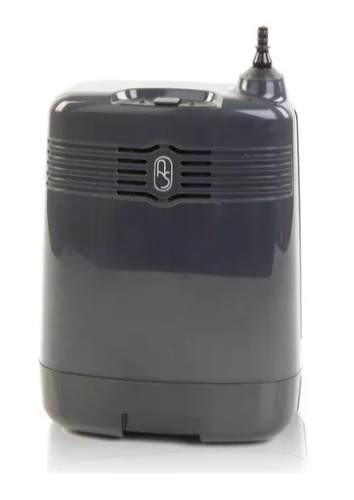
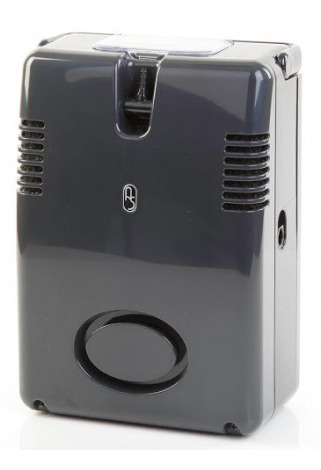
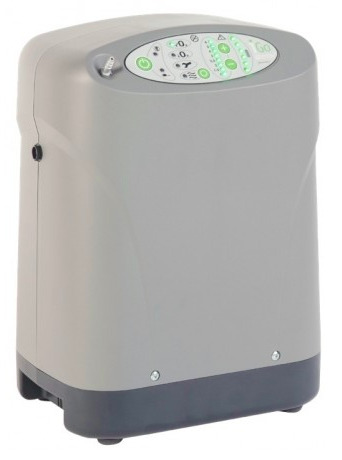
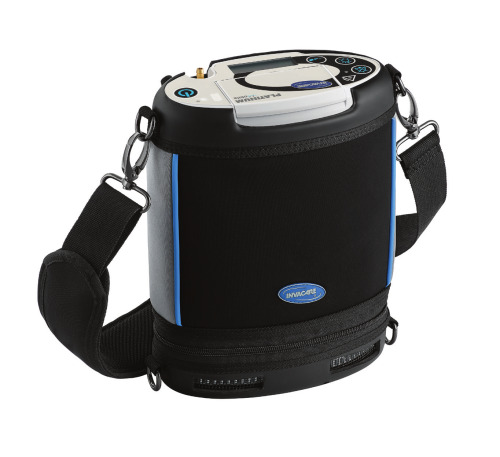
Invacare Platinum Mobile
Key features
- Purity 87-95.6%
- Temperature Range 40Celcius
- Battery Duration 5hours
- Transportation Humidity 90%
- Type Portable (Battery powered)
- Pulse Flow 1-5Pulse setting
Specifications
| Purity | 87-95.6% |
|---|---|
| Temperature Range | 40Celcius |
| Transportation Humidity | 90% |
| Battery Duration | 5hours |
| Type | Portable (Battery powered) |
| Pulse Flow | 1-5Pulse setting |
| Weight | 2.18kg |
| Oxygen Purity Indicator (OPI) | Yes |
| Battery backup (at 2 pulse setting) | 3.5hours |
| Recharge time | 2hours |
| Backup with external battery pack | 10hours |
| Sound level | 40db |
| Dimensions | 9.45H x 7.5W x 3.88Dinch |
|---|---|
| Operating altitude | 10000feet |
| Outlet pressure | 28.5psi |
| System Malfunction Alarm | Yes |
| Indian Voltage Model | Yes |
| Company Headquarters | USA |
| US FDA Approved | Yes |
| FAA Approved | Yes |
Pros and cons
PROS
- Weight of 2.18 kg is the lightest in this review — genuinely shoulder-strap portable for daily ambulatory use
- Battery backup of 5 hours single / 10 hours dual-pack at pulse 2 is the longest in the portable category — true full-day-out capability
- Recharge time of 2 hours is the shortest among portables here — less than half the iGo and iGo2's 5 hours
- Outlet pressure of 28.5 psi is the highest among all concentrators in this review — widest accessory compatibility
CONS
- Street price of Rs. 210,240 is Rs. 37,000 above the iGo2 and Rs. 56,000 above the XPO2 — a clear premium position
- CE certification field is blank on the manufacturer sheet — a gap for buyers travelling to EU destinations
- Loss-of-power alarm and no-flow alarm are blank on the sheet, though system-malfunction alarm is listed
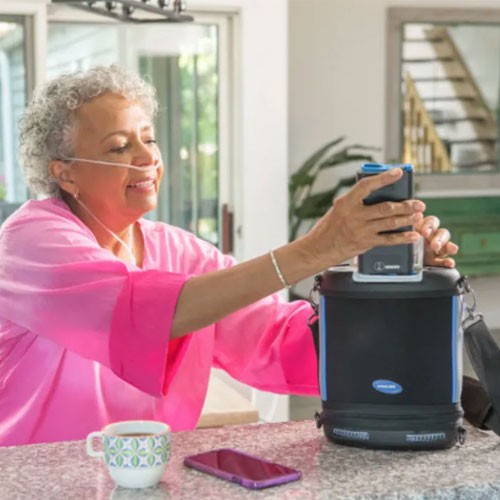
The Invacare Platinum Mobile is the premium pulse-dose portable concentrator in the Indian market and the unit we recommend for frequent air travelers, for patients with active daily lifestyles, and for LTOT users who refuse to accept the battery anxiety that comes with single-pack-only portables. At Rs. 210,240 it sits at a clear premium above the DeVilbiss iGo2 (Rs. 172,781) and the discontinued Invacare XPO2 (Rs. 153,600), and the premium is justified specifically by the dual-battery 10-hour capability, the 2-hour fast recharge, and the OPI.
The Platinum Mobile is also an example of Invacare’s Indian positioning working — this is a current-stock unit with confirmed Indian-voltage configuration, FDA and FAA certification, and a published dealer network. The stationary Invacare line has structural problems in India; the portable line is cleaner.
What the specs mean in practice
Weight: 2.18 kg. The lightest current-stock concentrator in this review. Matches the iGo2’s 2.2 kg essentially exactly. For shoulder-strap or backpack-pocket carry, 2.18 kg is comfortable for a typical 60-80 kg adult for 2-4 hour continuous wear.
Pulse flow: 1-5 settings. Matches the iGo2 and XPO2. Pulse 3 is typical for resting supplementation, pulse 4-5 for exertion. The Platinum Mobile’s pulse delivery algorithm is different from the DeVilbiss — Invacare’s implementation uses a demand-sensitive bolus delivery timed to the early inspiratory phase for optimised oxygen uptake.
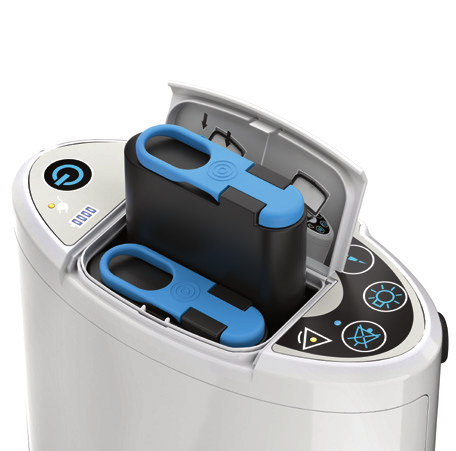
Battery backup: 5 hours single / 10 hours dual at pulse 2. This is the central spec. A patient flying Delhi-Singapore (5.5 hours) with dual batteries is covered with margin. A patient going to an all-day family wedding with dual packs is covered. The iGo2 at 3.5 hours single is cutting close on both; the XPO2 at 2.5 hours single is inadequate. At higher pulse settings the runtime drops — pulse 4-5 gives roughly 1 hr 45 min single, 3 hr 30 min dual.
Recharge time: 2 hours. Half the time of the iGo2 (5 hours) and iGo (5 hours). Enables same-day discharge-recharge-use cycles that neither DeVilbiss portable supports.
Oxygen Purity Indicator: confirmed. This is rare among pulse-only portables — the iGo2 and XPO2 ship without an OPI. For long-term portable use, OPI matters because pulse-dose users rely on adequate bolus purity for clinical effect, and sieve-bed aging can silently degrade that.
Operating altitude: 10,000 ft. Same as the iGo2 and XPO2. Adequate for most Indian hill destinations, marginal for Leh, off-brief for Spiti’s Kaza.
Outlet pressure: 28.5 psi. The highest outlet pressure among all concentrators in this review, stationary or portable. Pulse-dose portables don’t use outlet pressure in the same way as stationary units, but the 28.5 psi rating indicates the Platinum Mobile can drive higher-resistance accessory chains if needed — a mostly-academic advantage for typical pulse-only use.
Sound: 40 dB. Quietest among current-stock portables after the iGo2 (37.5 dB). Acceptable for restaurant or conference-room use without drawing attention.
Temperature range: operates to 40°C. Useful specification for Indian summer transit — the iGo2’s 35°C rating is nominally tighter and in practice may trigger over-temp protection during long car journeys in Rajasthan or coastal Tamil Nadu summer. The Platinum Mobile’s wider thermal envelope is a meaningful Indian-market advantage.
Certifications: US FDA Yes, FAA Yes, CE blank. FDA and FAA are the material certifications for Indian air travel and home clinical use. The blank CE field is relevant for buyers who travel into EU destinations where CE compliance is checked at some airports — verify with the dealer before committing to EU travel.
Who should buy it
Frequent air travelers on pulse-dose oxygen — patients who fly domestic 6-12 times a year or international 2-4 times a year. The dual-battery 10-hour capability and 2-hour recharge are the features that make this practical. For a business traveller who commutes between Indian metros weekly or a family member visiting children abroad 2-3 times a year, the Platinum Mobile is the only unit in this review that comfortably handles long-haul flights with ground-time buffer.
Active ambulatory patients with prescriptions in the pulse 2-4 range who want a full-day out capability without mid-day mains charging. Workday patients who commute, attend meetings, run errands. For a patient in active retirement lifestyle — club memberships, temple visits, family outings — the full-day battery with OPI monitoring is what transforms portable oxygen from an occasional-use accessory into everyday infrastructure.
Buyers who value the OPI in a portable — the only pulse-dose portable in this review with confirmed OPI — and the paperwork stack (FDA, FAA, Indian-voltage) that makes airline pre-clearance straightforward. For a patient whose travel is important enough that a failed pre-clearance is a Rs. 20,000-50,000 disruption (rebooked flights, hotel, care coordination), the paperwork robustness pays for itself.
LTOT patients transitioning off a stationary for home-and-travel dual use, where the Platinum Mobile’s battery life and premium build quality justify the capital cost. For patients clinically improving from severe to moderate hypoxaemia whose oxygen need is shifting from near-continuous to episodic, the Platinum Mobile can serve as a bridge — heavy enough daily use to justify the premium, portable enough for recovery of active lifestyle.
Parents of paediatric oxygen-dependent patients who need to maintain the child’s normal school, therapy, and social schedule. For these patients the reliability and battery-life margin of the Platinum Mobile matters more than the price — a mid-day battery failure during a school day is a clinical emergency that the Platinum Mobile’s dual-pack capability is specifically designed to prevent.
Who shouldn’t
Occasional users — patients who leave the house twice a month for medical appointments and otherwise use a stationary. The iGo2 at Rs. 37,000 less covers that use case.
Patients on continuous-flow-only prescriptions (including those with CPAP integration at night). The Platinum Mobile is pulse-only; the discontinued DeVilbiss iGo was the continuous+pulse unit.
Cost-sensitive buyers. Rs. 210,240 is a premium that only makes sense when the capability is used.
Buyers planning regular EU travel. The blank CE field may be problematic at some European airports — confirm before booking.
Alternatives, head-to-head
Invacare Platinum Mobile vs DeVilbiss iGo2. The iGo2 at Rs. 172,781 is Rs. 37,459 cheaper, 2.5 dB quieter (37.5 vs 40 dB), matches on weight and altitude, ships with 2-year warranty vs typically 1-year on the Platinum Mobile. The Platinum Mobile wins on battery (5/10 hr vs 3.5 hr), on recharge (2 hr vs 5 hr), on OPI (present vs absent), on temperature range (40°C vs 35°C), and on outlet pressure. For a frequent-traveler use case, the Platinum Mobile is worth the Rs. 37,000 premium. For occasional-use cases, the iGo2 is the smarter buy.
Invacare Platinum Mobile vs Invacare XPO2. The XPO2 is discontinued — listed at Rs. 153,600 when available. 2.7 kg vs 2.18 kg, 45 dB vs 40 dB, 2.5 hr battery vs 5 hr, no OPI vs OPI, CE Yes vs CE blank (the one certification where the older XPO2 actually beats the newer Platinum Mobile on the spec sheet). For a current-market purchase decision the XPO2 is not an option; for existing-stock comparison, the Platinum Mobile is the better machine on essentially every axis except CE marking.
Invacare Platinum Mobile vs DeVilbiss iGo (original). The iGo offers continuous-flow capability (1-3 LPM) plus pulse (1-6) at 8.6 kg. The Platinum Mobile is pulse-only at 2.18 kg. For pure portability the Platinum Mobile is far more practical; for dual-mode delivery the iGo is unique. Both occupy distinct niches; for the ambulatory pulse-only use case the Platinum Mobile is dominant.
Indian-market considerations
Voltage: AC adapter 220V/50Hz, DC adapter for car use. Both tolerate Indian variation.
Stabiliser/UPS: Not relevant to battery use. AC charging uses internal voltage regulation.
CDSCO: FDA and FAA confirmed; CE blank. CDSCO import registration should be verified through Invacare India. The overall paperwork stack is adequate for Indian air travel and home use.
Altitude: 10,000 ft cap. Covers most Indian hill destinations. Verify with dealer for Leh and Spiti use — altitude performance margins on portables may be narrower in practice than on the spec sheet.
Service: Invacare India’s portable line has held its service footprint better than the stationary line through the parent-company restructuring. Battery replacement, when needed, runs Rs. 14,000-20,000 for original-spec packs. Sieve-bed service at year 3-4 is Rs. 20,000-26,000. Authorised service points are present in Delhi, Mumbai, Bengaluru, Chennai, Hyderabad, Pune, Kolkata.
Warranty: 1 year typically quoted — shorter than the iGo2’s 2 years. Some dealers offer paid extensions.
Spares availability: Batteries are the high-wear item. Stocking dual-pack accessory kits through the dealer network is essential for travel-frequent buyers — order the secondary battery pack at time of unit purchase rather than separately, which typically saves 10-15% on the pack price. Battery packs have a useful life of approximately 2-3 years of daily charge cycles before capacity degrades below 70% of original; plan replacement accordingly.
Carrying accessories: The Platinum Mobile ships with a carry backpack and desktop battery charger. The carry backpack is functional but not stylish — frequent travellers often buy a third-party padded shoulder bag for daily use and reserve the original backpack for air travel where the manufacturer’s carry case is sometimes expected by airline ground staff.
Pulse-setting clinical mapping: The Platinum Mobile’s pulse algorithm delivers on early inspiratory phase, which for most adult patients maps approximately to pulse setting 2 = 1-1.5 LPM continuous equivalent, setting 3 = 2 LPM equivalent, setting 4 = 3 LPM equivalent, setting 5 = 4+ LPM equivalent. These are rough mappings and do not substitute for a clinician titration — the first-time user should have the pulse setting confirmed against target SpO2 during a walk test before committing to a prescribed setting for daily use.
Lifecycle cost: At Rs. 210,240 capital cost plus roughly Rs. 8,000-12,000 per year in battery amortisation and consumables, the Platinum Mobile’s 5-year lifecycle cost is approximately Rs. 250,000. For an occasional-use patient this is expensive; for a frequent-use patient who would otherwise be paying Rs. 3,000-5,000 per month for cylinder rental and courier logistics (Rs. 180,000-300,000 over 5 years), the Platinum Mobile is cost-competitive.
Insurance and reimbursement: Indian private medical insurance rarely reimburses portable oxygen concentrators but does sometimes reimburse rental of stationary units. For ESI or CGHS-covered patients, the prescription pathway for portable oxygen is distinct from stationary and typically requires documentation of activity-based hypoxaemia — the Platinum Mobile’s paperwork supports this pathway where cheaper alternatives with thinner paperwork do not.
Airline use: FAA confirmed. Indian airlines accept the Platinum Mobile with 48-72 hour notice plus physician letter. Keep the manufacturer’s FAA compliance letter in the travel kit. International carriers (Singapore Airlines, Emirates, Lufthansa) have generally accepted the Platinum Mobile — always verify with the specific carrier.
Verdict
The Platinum Mobile is the best pulse-dose portable currently sold in India and the correct buy for any patient whose use case genuinely requires the full-day or full-flight battery capability, the OPI, and the premium paperwork stack. The Rs. 210,240 price is a clear premium over the DeVilbiss iGo2 but is justified by specific capability gaps — the iGo2 is inadequate for a frequent traveler. For the occasional-use patient, the iGo2 is the right and cheaper buy; the Platinum Mobile is overkill. The score of 7.9 reflects the Platinum Mobile’s clear competence in its premium niche, pulled back slightly by the blank CE marking and the 1-year warranty versus the iGo2’s 2-year term. If you fly often, if you want full-day battery, if you want the OPI — buy this. If none of those apply, buy the iGo2 and save Rs. 37,000.