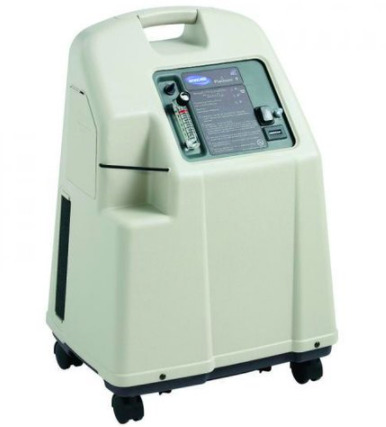
Invacare Platinum 9
Key features
- Purity 90-96%
- Type High Flow Stationary
- Continuous Flow 1-9LPM
- Weight 24.4kg
- Oxygen Purity Indicator (OPI) Yes
- Power consumption 475watts
Specifications
| Purity | 90-96% |
|---|---|
| Type | High Flow Stationary |
| Continuous Flow | 1-9LPM |
| Weight | 24.4kg |
| Oxygen Purity Indicator (OPI) | Yes |
| Power consumption | 475watts |
| Sound level | 58db |
| Outlet pressure | 9psi |
| Loss of Power Alarm | Yes |
|---|---|
| System Malfunction Alarm | Yes |
| No Flow Alarm | Yes |
| Company Headquarters | USA |
| US FDA Approved | Yes |
| CE Certified | Yes |
Pros and cons
PROS
- Power draw of 475 W is the lowest among high-flow units in this review — 25 W below the Nuvo 8 and 125 W below the Nuvo 10
- Full alarm set confirmed — loss-of-power, system-malfunction, and no-flow
- US FDA and CE certification marks are confirmed on the spec sheet
- Oxygen Purity Indicator is present — confirmed on the manufacturer sheet
CONS
- Indian-voltage configuration field is blank on the manufacturer sheet — buyers must verify transformer compatibility before order
- Sound level of 58 dB is 11 dB louder than the Nuvo 8 — not a bedroom-adjacent machine for light sleepers
- Outlet pressure of 9 psi is well below the Nuvo 8/10 at 15 psi and the DeVilbiss 10 at 20 psi — limits transfill and tubing flexibility
- Flow ceiling of 9 LPM is an awkward step between 8 LPM and 10 LPM classes — rarely prescribed as a target
The Invacare Platinum 9 is a puzzling unit to find in the Indian market — a 9 LPM flow ceiling that does not map cleanly to any standard Indian LTOT prescription, and a spec sheet on which the Indian-voltage configuration field is conspicuously blank. At Rs. 110,400 it is priced above both the Nuvo 10 (Rs. 94,079) and the Nuvo 8 (Rs. 97,920), and the buyer gets an extra 1 LPM of ceiling over the Nuvo 8 in exchange for a substantially louder acoustic signature and an unconfirmed voltage compatibility.
This review therefore has two jobs: evaluate the machine on its on-paper merits, and flag the procurement risks that make it hard to recommend for Indian home use even when those on-paper merits stack up reasonably well.
What the specs mean in practice
Continuous flow: 1-9 LPM. The 9 LPM ceiling is unusual. Most clinician prescriptions for high-flow home LTOT call for either 8 LPM or 10 LPM as the ceiling, not 9. The 9 LPM number is a legacy of Invacare’s North American model coding and does not reflect a distinct Indian clinical use case. For buyers with a prescription written as “up to 9 LPM” (rare), this unit fits; for buyers with “up to 8 LPM” the Nuvo 8 is the right machine, and for “up to 10 LPM” the Nuvo 10 is the right machine. The awkward 9 LPM middle exists for North American reimbursement-code reasons.
Purity: 90-96%. Matches the Nuvo 8 and DeVilbiss 10 LPM’s purity band, better than the Nuvo 10’s 87-95%. The Platinum 9 OPI triggers at 86% as standard.
Weight: 24.4 kg. Lighter than the Nuvo 8 (25.2 kg) and the Nuvo 10 (29.26 kg), heavier than the DeVilbiss 10 LPM (19 kg). At the middle of the high-flow class.
Sound: 58 dB. Matches the Nuvo 10 and is 11 dB louder than the Nuvo 8. Same bedroom considerations as the Nuvo 10 — not a machine for a shared sleeping space.
Power: 475 W. The lowest power draw in the high-flow class in this review. Below the Nuvo 8 (500 W), Nuvo 10 (600 W), and DeVilbiss 10 (664 W). At 14 h/day this is roughly Rs. 1,555/month — a genuine Rs. 85-405/month saving versus the Nidek and DeVilbiss high-flow alternatives.
Outlet pressure: 9 psi. Below the Nuvo 8/10’s 15 psi and well below the DeVilbiss 10’s 20 psi. Adequate for normal cannula tubing, marginal for transfill, inadequate for long tubing runs or high-resistance accessory chains.
Alarms: loss-of-power, system-malfunction, no-flow — all confirmed. Plus OPI. Full safety loadout.
Certifications: US FDA, CE — confirmed. FAA — blank (not relevant for stationary anyway). CDSCO: not visible on the Indian-facing material.
Indian Voltage Model: blank on the spec sheet. This is the red flag. Nidek and Drive DeVilbiss units in this review all confirm “Indian Voltage Model: Yes” on their respective sheets. The Platinum 9’s blank field suggests the unit may be a 110V/60Hz North American variant requiring a step-up transformer for Indian use, or may be a 220V variant that the dealer has not confirmed to Invacare India’s voltage configuration. Either way, the buyer must verify before order — a step-up transformer adds Rs. 6,000-12,000 to effective purchase cost and a long-term reliability concern.
Who should buy it
Patients with a clinician prescription explicitly written as “9 LPM continuous” who have the budget for the Rs. 110,400 price and a local Invacare dealer with confirmed Indian-voltage stock on hand. This is a narrow population — the 9 LPM prescription ceiling is rarely written in Indian clinical practice, where prescriptions more commonly specify 8 LPM or 10 LPM as the upper limit.
Institutional buyers who already have an Invacare fleet and are adding one unit — the common service and spare pool reduces incremental operational complexity. Small nursing homes or respiratory-care providers with 3-5 Invacare units already deployed have a genuine operational argument for fleet continuity that can offset the certification and voltage concerns at the incremental margin.
Patients who prioritise power efficiency over noise and outlet pressure — the 475 W draw is the lowest in the class and over multi-year operation this is worth roughly Rs. 20,000-30,000 versus the DeVilbiss 10. For a patient in Maharashtra or Karnataka where domestic electricity tariffs above 500 units/month jump sharply, the power efficiency can matter enough to override other considerations, assuming voltage compatibility is confirmed.
Buyers running multiple concentrators from a shared UPS or inverter bank — the lower per-unit power draw enables tighter inverter sizing and longer cumulative backup duration. For a small dispensary running 3-4 Platinum 9 units off a 5 kVA UPS, the 475 W individual draw translates to meaningful total-load reduction versus Nidek or Drive alternatives.
Who shouldn’t
Any buyer who has not confirmed in writing that the specific unit they are purchasing is 220V/50Hz Indian-configured. Running a 110V Invacare unit via step-up transformer in India is a recipe for compressor thermal stress and early failure.
Patients on 8 LPM or 10 LPM prescriptions. The Nuvo 8 or Nuvo 10 are the right-sized machines.
Buyers needing transfill capability. The 9 psi outlet is inadequate.
Buyers sensitive to bedroom noise. 58 dB is not quiet.
Alternatives, head-to-head
Invacare Platinum 9 vs Nidek Nuvo 8. The Nuvo 8 at Rs. 97,920 is Rs. 12,480 cheaper, 11 dB quieter (47 vs 58 dB), 0.8 kg heavier (25.2 vs 24.4 kg — negligible), draws 25 W more (500 vs 475 W — also negligible), has a 15 psi outlet (vs 9 psi), and has confirmed Indian-voltage configuration. The Platinum 9’s only wins are the 1 LPM of extra ceiling and a nominal 25 W of power saving. For prescriptions up to 8 LPM, the Nuvo 8 is clearly better. For a 9 LPM prescription, the Platinum 9’s niche exists but is narrow.
Invacare Platinum 9 vs Nidek Nuvo 10. The Nuvo 10 at Rs. 94,079 is Rs. 16,321 cheaper, has 10 LPM ceiling (vs 9), matches on noise (58 dB), draws 125 W more (600 vs 475 W), has a 15 psi outlet (vs 9 psi), and has confirmed Indian-voltage. The Platinum 9’s only wins over the Nuvo 10 are power draw and a slightly lighter weight. For a genuine 9 LPM prescription, the Platinum 9 technically fits better than a 10 LPM running slightly below ceiling — but in practice the Nuvo 10 at Rs. 16,000 less is the economic buy.
Invacare Platinum 9 vs DeVilbiss 10 LPM. The DeVilbiss 10 at Rs. 109,584 is marginally cheaper (Rs. 816), 5.4 kg lighter (19 vs 24.4 kg), 9 dB louder (67 vs 58 dB), draws 189 W more (664 vs 475 W), has a 20 psi outlet (vs 9 psi), 10 LPM vs 9 LPM ceiling. The Platinum 9 is quieter and lower on power; the DeVilbiss 10 is lighter, higher-ceiling, and has a confirmed Indian-voltage configuration. For weight-critical institutional use the DeVilbiss 10 is preferable. For power-efficient home stationary use the Platinum 9 would be preferable if voltage configuration is confirmed.
Indian-market considerations
Voltage: The critical concern. The spec sheet does not confirm 220V/50Hz Indian configuration. A step-up transformer path (buying the 110V North American variant and adding a 2 kVA transformer) is technically possible but operationally inferior to buying a native-220V machine. Ask the dealer in writing for a commercial invoice specifying voltage and a factory spec sheet confirming the unit shipped as 220V. If the dealer cannot produce this, walk.
Stabiliser: Assuming confirmed 220V configuration, a 1 kVA servo stabiliser handles the 475 W draw comfortably — budget Rs. 4,500-6,500. For Tier-2 grid quality, upsize to 1.5 kVA.
UPS/inverter: 475 W is moderate. A 1.5 kVA sine-wave inverter with 200 Ah battery gives approximately 60 minutes at full load.
CDSCO: US FDA and CE confirmed; CDSCO status to be verified through Invacare India importer.
Altitude: Not stated on the spec sheet. Practical operating altitude for Platinum-class Invacare units has historically been quoted at 8,000 ft in global markets — verify with the Indian dealer before hill-station use.
Service: Invacare India’s service network has thinned since 2023. Platinum-class spares lead times in 2026 are running 4-8 weeks. This is the second red flag after voltage, and it compounds.
Warranty: 1 year typically quoted. Some dealers offer paid extensions at Rs. 8,000-12,000 for an additional 2 years, though availability varies by region and dealer.
Compressor service scheduling: Invacare Platinum-class compressors have a typical service interval of 6,000-8,000 operating hours for filter replacement and 15,000-20,000 hours for sieve-bed renewal. At 14 h/day home use, this maps to roughly annual filter service and 3-4 year sieve-bed renewal. Factor this into the total cost of ownership alongside the lower power draw — the service cost offset may or may not recover the power efficiency saving depending on individual usage patterns.
Ambient temperature operation: Indian summer conditions in Rajasthan, Gujarat, Andhra Pradesh, and Tamil Nadu regularly exceed 40°C ambient. Platinum-class units are typically rated for 35°C continuous operation. For installations in non-air-conditioned rooms during summer, thermal trip-and-restart cycles may occur, aging the compressor faster than rated. Air-conditioned installation rooms materially extend Platinum-class compressor life, and this should be factored into the household infrastructure planning.
Voltage stability testing: Before committing to a Platinum 9 purchase, Indian buyers should have the dealer perform a voltage-stability demonstration using the specific unit — running at continuous 9 LPM for 30-45 minutes with voltage-meter verification at the mains socket. This tests both the voltage configuration of the specific unit and the compressor’s behaviour under sustained load, and provides a baseline for post-sale comparison if performance drifts.
Verdict
The Invacare Platinum 9 has a power-efficiency lead and a full alarm+certification stack that would make it genuinely competitive in the high-flow category if Invacare’s India service network were healthier and if the spec sheet confirmed Indian-voltage configuration. Neither is the case in 2026. For Indian buyers the honest recommendation is: buy a Nuvo 8 for prescriptions up to 8 LPM, buy a Nuvo 10 for prescriptions of 9-10 LPM, and treat the Platinum 9 as an option only when a local Invacare dealer can provide written voltage confirmation, in-stock spares, and a committed service response time. The score of 6.2 reflects a machine that is functionally sound but poorly positioned for the current Indian market — a number that would move up 1-1.5 points if Invacare’s India footprint returns to its pre-2023 levels.