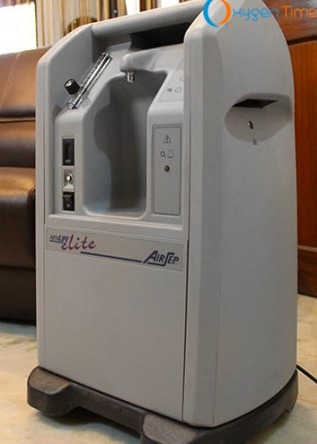
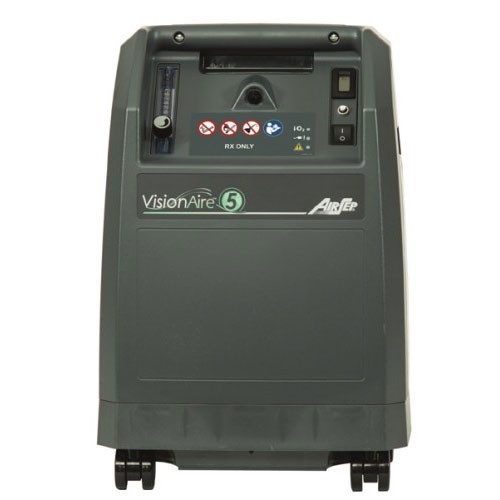
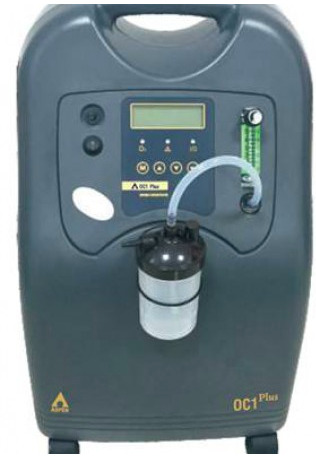
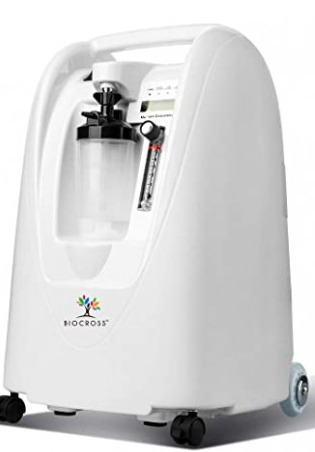
Inogen at Home
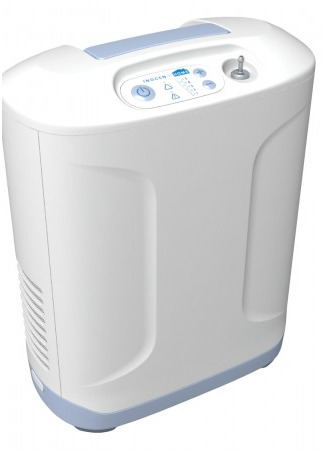
Key features
- Purity 90-95%
- Type Home Stationary
- Continuous Flow 1-5LPM
- Weight 8.16kg
- Oxygen Purity Indicator (OPI) No
- Power consumption 100watts
Specifications
| Purity | 90-95% |
|---|---|
| Type | Home Stationary |
| Continuous Flow | 1-5LPM |
| Weight | 8.16kg |
| Power consumption | 100watts |
| Dimensions | 16.5H x 13W x 7Dinch |
| Loss of Power Alarm | Yes |
|---|---|
| System Malfunction Alarm | Yes |
| No Flow Alarm | Yes |
| Indian Voltage Model | Yes |
| Company Headquarters | USA |
| US FDA Approved | Yes |
| CE Certified | Yes |
Pros and cons
PROS
- 100 W published power consumption is one-third of the Everflo's 350 W — cuts monthly electricity cost dramatically
- 8.16 kg weight is the lightest 5 LPM stationary in the Indian market — 40% lighter than the Everflo's 14 kg
- Indian Voltage Model per manufacturer brochure and e-commerce product listings
- Full alarm suite (loss of power, system malfunction, no flow) for unattended 24x7 operation
CONS
- Stock: Out of stock per manufacturer brochure and e-commerce product listings
- No Oxygen Purity Indicator (OPI) — gap for unattended long-duration home use
- Inogen India service network is weaker for stationaries than portables — limited tier-2 city coverage
The Inogen at Home 5 LPM is, on its published specs, one of the most interesting home stationaries in the Indian market — an 8.16 kg continuous-flow unit at indicative retail ₹1,87,200 (varies by region/dealer) with a 100 W power consumption that is a fraction of every peer 5 LPM stationary. It is currently Out of stock per manufacturer brochure and e-commerce product listings. It carries US FDA approval and CE certification, is shipped as an Indian Voltage Model, and has a full alarm suite — but does not include an Oxygen Purity Indicator (OPI), and the price premium over the Everflo (₹1,43,501 higher) is substantial for a machine that must compete primarily on efficiency.
What the specs actually mean
Published oxygen purity is 90–95% — standard PSA envelope. The Inogen at Home does not have an OPI per the published technical details — the field is empty. The “Oxygen Purity % Analyzer” field is also empty, meaning no purity monitoring of any kind is present on the unit. For an unattended 24x7 home machine, this is a real gap — purity drop from sieve-bed contamination (a common degradation mode in Indian high-humidity coastal environments) will not be flagged automatically, and the first warning will be the patient’s SpO2 drop.
The alarm suite is more complete than on several peers: loss of power, system malfunction, and no flow are all flagged “Yes” in additional details. These catch the major non-purity failure modes — AC dropout, compressor issues, cannula blockage — but do not substitute for OPI on sieve-bed degradation.
Flow range is 1–5 LPM continuous, matching the Philips Everflo exactly. This covers the standard home-oxygen prescribing range.
The 8.16 kg weight is the defining spec. It is 5.84 kg lighter than the Everflo (14 kg), 5.44 kg lighter than the Visionaire (13.6 kg), and 8.14 kg lighter than the Companion (16.3 kg). At 8.16 kg, the Inogen at Home is in “easily carryable by one person” territory — a single caregiver can lift it in and out of a car without help, can carry it up a flight of stairs without struggle. For rental-home deployments or patients who move between two addresses, this matters.
100 W power consumption — remarkable on paper
Published power consumption is 100 W — one-third of the Everflo’s 350 W, roughly one-third of the Visionaire’s 290 W and Companion’s 285 W. At 9 per kWh tariff on 24x7 operation, 100 W works out to ₹648 a month — compared to ₹2,268 for the Everflo, or ₹1,848 for the Visionaire. Over a 3-year prescription, the electricity saving versus the Everflo is close to ₹58,000. If the 100 W spec is realistic in actual operation, it fundamentally changes the total-cost-of-ownership math for long-duration home oxygen. The figure is unusually low for a 5 LPM continuous-flow concentrator, and our editorial review treats it as a manufacturer claim to verify in practical use.
Dimensions are 16.5H x 13W x 7D inches — a smaller footprint than the Everflo’s 23H x 15W x 9.5D inches. The Inogen at Home is genuinely a compact home unit, intended to sit on a counter or shelf rather than standing on wheels.
Absent altitude spec
The published technical details for the Inogen at Home do not include an operating altitude figure — the field is not populated in the reviewed JSON. For a home stationary, altitude matters when the address is at elevation. Without a published altitude spec, buyers at hill-station addresses should request the specification in writing from the dealer before purchase. We would not deploy this at altitudes above 5,000 ft without dealer confirmation of altitude rating.
Who should buy it
The Inogen at Home is the right buy for specific profiles that align with its published strengths. First, buyers on long-duration 24x7 prescriptions at commercial electricity tariffs where the 100 W figure — if it holds in practice — delivers a genuine ₹50,000+ three-year electricity saving over the Everflo. For hospitals, hospice-at-home services, or patients on unsubsidised tariffs, this math is meaningful.
Second, buyers whose household moves the machine frequently between rooms or addresses. The 8.16 kg weight is categorically different from 14 kg — it is actually carry-able, not just wheel-able. For patients who split time between two homes, or for caregivers who move the machine daily between bedroom and living room, this matters.
Third, buyers with verified Inogen service coverage in their city who accept the OPI gap and can monitor SpO2 adequately as a backstop. The alarm suite is otherwise complete; the OPI is the specific missing piece.
For an alternative view: the combination of 8.16 kg weight, 100 W power, and compact 16.5x13x7 inch dimensions makes this the closest thing to a “portable stationary” in the Indian market. If a buyer’s use case is home-based but genuinely mobile between addresses, the Inogen at Home is the one unit that can be treated both as a home machine and as a frequent-travel companion without requiring battery support.
Who shouldn’t
Anyone who needs immediate availability should not wait on the Inogen at Home — its Out of stock status means indefinite delays. The Everflo (In Stock, Philips service network) or Visionaire 5 (In Stock) are the right buys.
Anyone for whom OPI is clinically important — most long-duration home oxygen patients, especially in Indian coastal cities with high humidity — should not buy the Inogen at Home. Both the Everflo and Visionaire 5 have OPI; this is the clearest trade-off.
Anyone whose budget anchors near ₹40,000–55,000 cannot justify the Inogen at Home’s ₹1,87,200 retail. That price point is 4.3x the Everflo’s ₹43,699 and 3.4x the Visionaire 5’s ₹54,999. The electricity savings do not close that gap even over a 5-year prescription — the machine has to be justified primarily on weight and form factor, and that justification requires a specific use case.
Anyone at hill-station elevations without a verified altitude rating should not buy this unit. Without a published operating altitude spec, deployment above ~5,000 ft is an open risk.
Anyone relying on a strong stationary-unit service network should buy a Philips Everflo or an Airsep Visionaire 5 instead. Inogen’s India service presence is historically stronger for portables than for stationaries — the at Home unit is a less-commonly-stocked spare-parts platform in India.
How it compares to real alternatives
Inogen at Home vs Philips Everflo 5 LPM
The primary comparison. Everflo: 14 kg, 350 W, 45 dB, 7,500 ft altitude, has OPI, 3-year warranty, ₹43,699, In Stock, deepest India service network. Inogen at Home: 8.16 kg, 100 W, sound level not published, altitude not published, no OPI, ₹1,87,200, Out of stock, thinner stationary service. The Everflo wins on availability, OPI, price, and service depth. The Inogen at Home wins on weight (42% lighter) and power (71% less). For a tier-2 urban buyer on standard prescription, pick the Everflo — it is genuinely the better buy on every axis that has an apples-to-apples comparison. Pick the Inogen at Home only if mobility between addresses and the power efficiency are genuinely load-bearing.
Inogen at Home vs Airsep Visionaire 5
Visionaire 5: 13.6 kg, 290 W, 45 dB, 10,000 ft altitude, has OPI, ₹54,999, In Stock. Inogen at Home: 8.16 kg, 100 W, sound/altitude not published, no OPI, ₹1,87,200, Out of stock. The Visionaire wins on OPI, published altitude rating, published sound level, price, and availability. The Inogen wins on weight and power. The price delta is prohibitive for most buyers unless the mobility advantage is specifically needed.
Inogen at Home vs Companion 5 LPM
Companion: 16.3 kg, 285 W, 50 dB, 9,879 ft altitude, no OPI, ₹66,240, Out of stock. Inogen at Home: 8.16 kg, 100 W, sound/altitude not published, no OPI, ₹1,87,200, Out of stock. Both lack OPI; both are Out of stock. The Inogen wins on weight (50% lighter) and power (65% less). The Companion wins on price (64% cheaper). If both come back In Stock simultaneously and a buyer is choosing between no-OPI options, the weight and power differential may justify the price premium for a specific profile — but the Everflo with its OPI and active availability is the broader-market correct pick over either.
Indian-market considerations
The Inogen at Home is Indian Voltage Model per published additional details — 220V/50Hz compatible without a step-down transformer. The 100 W published draw means even modest voltage sag doesn’t produce undervoltage alarms easily. A 5-amp automatic voltage stabiliser (V-Guard, Microtek class, ₹1,500–2,500) for 24x7 use is still advisable.
CDSCO approval status is not stated in the published key features or additional details for this SKU in the data we reviewed (CDSCO Medical Device Registry). Inogen has an established Indian regulatory pathway for the portable line; verify the at Home-specific SKU registration with your dealer.
Service network for Inogen stationaries in India is genuinely thinner than for the portable line. Most Inogen authorised dealers focus their parts inventory on the G5 and portable SKUs; stationary sieve cartridges and filter assemblies may have 3–5 week lead times. Before purchase, verify in writing: (1) replacement sieve cartridge availability, (2) spare filter kit availability, (3) local biomedical technician trained on the platform.
The Out of stock status compounds all of the above — even a willing buyer cannot immediately take delivery, and restock timing is unpredictable. Given the Everflo and Visionaire 5 are both immediately available at meaningfully lower prices, the practical Indian-market position of the Inogen at Home is difficult.
Online-vs-hospital channel gap: hospital channels generally do not stock the Inogen at Home. It is an online-dealer-only purchase path.
Verdict
The Inogen at Home 5 LPM is a spec-sheet outlier — class-leading weight (8.16 kg) and published power draw (100 W) that would rewrite the total-cost-of-ownership math for home oxygen if they hold in practice. The Out of stock status, the absence of OPI, the unpublished altitude rating, and the ₹1,87,200 retail that is 4.3x the Everflo combine to make it a difficult practical recommendation for most Indian buyers in 2026.
Score it 7.0 out of 10. Points off for the Out of stock availability, the missing OPI, the unpublished altitude spec, the thinner Inogen stationary service network, and the ₹1,87,200 price that requires specific justification. Points on for the 8.16 kg weight, the 100 W published power, and the full non-purity alarm suite. For a specific buyer profile — mobile between addresses, high-tariff electricity, OPI-acceptable-gap with SpO2 monitoring backstop, and patient with an Inogen dealer relationship — this can be defensible when back In Stock. For the general 5 LPM home oxygen buyer, the Philips Everflo is still the right choice.