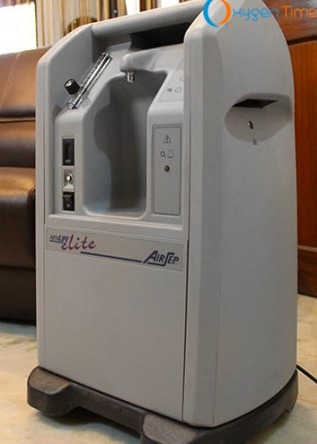
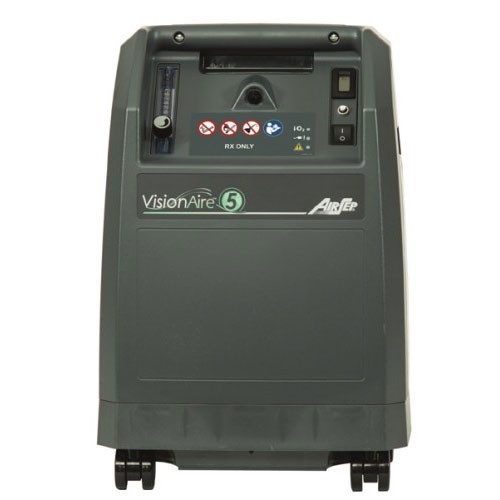
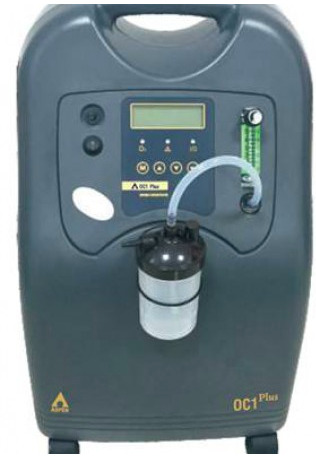
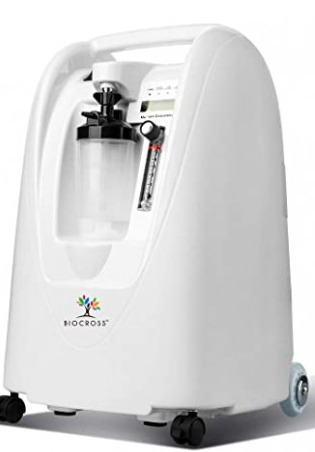
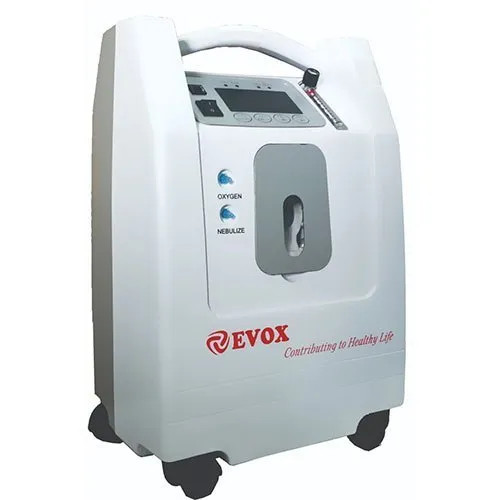
Evox 5 LPM
Key features
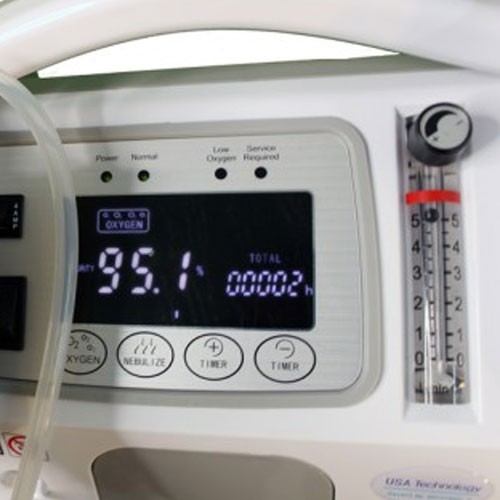
- Purity 90-96%
- Type Home Stationary
- Continuous Flow 1-5LPM
- Weight 15.6kg
- Oxygen Purity Indicator (OPI) Yes
- Power consumption 350watts
Specifications
| Purity | 90-96% |
|---|---|
| Type | Home Stationary |
| Continuous Flow | 1-5LPM |
| Weight | 15.6kg |
| Oxygen Purity Indicator (OPI) | Yes |
| Power consumption | 350watts |
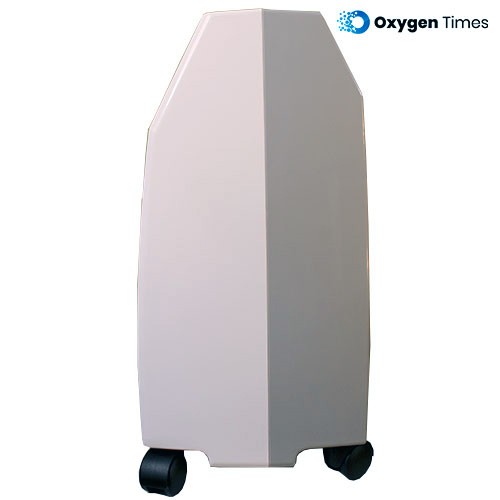
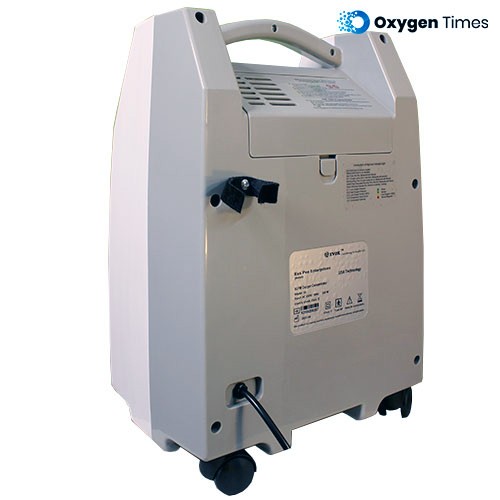
| Dimensions | 23.2H x 14.96W x 10.6Dinch |
| Outlet pressure | 10psi |
| Loss of Power Alarm | Yes |
|---|---|
| System Malfunction Alarm | Yes |
| No Flow Alarm | Yes |
| Indian Voltage Model | Yes |
| Company Headquarters | India |
| CE Certified | Yes |
Pros and cons
PROS
- 350 W power consumption is the lowest in its direct Indian-brand peer group
- 10 psi outlet pressure is generous for enrichment and long cannula runs
- OPI, no-flow alarm, system-malfunction alarm and CE certification all present
- 90–96% purity across 1–5 LPM with two-year warranty on current production
CONS
- 15.6 kg chassis is ~12% heavier than Oxymed Mini 5 LPM
- No operating altitude rating published — hill-station deployment uncertain
- Service network is narrower than Oxymed's nationwide footprint
The Evox 5 LPM is an Indian-made home-stationary oxygen concentrator specced for 1–5 LPM continuous flow at 90–96% oxygen purity, 15.6 kg chassis weight, 350 W power consumption and 10 psi outlet pressure. Indicative street pricing runs roughly ₹32,000 against a ₹66,240 MRP per manufacturer brochure and e-commerce product listings. The device is in active production, carries CE certification, OPI and a complete alarm package, ships with a two-year warranty and is listed with India as the company headquarters. Evox is a less brand-famous name than Oxymed or BPL but has quietly built one of the more technically-competent Indian 5 LPM offerings — at this price point it beats Oxymed Mini on power draw and beats BPL Oxy 5 Neo on weight, noise and outlet pressure. This review evaluates whether that combination makes it the right default pick for Indian 5 LPM budget buyers.
What the specs mean
Six spec lines define the Evox 5 LPM’s fit.
1–5 LPM continuous flow at 90–96% purity. Standard 5 LPM clinical category. The 96% purity ceiling matches the current Oxymed Mini 5 LPM and beats BPL Oxy 5 Neo’s 95%. The device description claims 93% purity (+/- 3%) at all flow rates, which is consistent with the spec sheet’s 90–96% range and is a clinically-useful stability commitment for continuous therapy (ISO 80601-2-69). OPI is confirmed on board, so purity-drift indication is available to the household.
15.6 kg chassis, 23.2 × 14.96 × 10.6 inches. Slightly heavier than Oxymed Mini (13.9 kg) and Nidek Nuvo Lite 2 (13.6 kg), substantially lighter than BPL Oxy 5 Neo (25 kg). At 15.6 kg the unit is comfortably moveable by one adult between rooms on a single floor, and manageable on stairs with a dolly. The form factor is taller than the Oxymed Mini but narrower than the BPL, so placement options are flexible.
350 W power consumption. This is the strongest spec on the Evox datasheet. At 350 W the unit is 40 W below Oxymed Mini (390 W), 50 W below BPL Oxy 5 Neo (400 W), and effectively tied with Philips EverFlo (~350 W). On 24/7 operation at typical Indian residential tariffs (₹7–9 per kWh), 350 W works out to ~₹1,800–2,300 per month — roughly ₹250 per month less than the Oxymed Mini. Over a three-year therapy, that is ₹9,000 in cumulative electricity savings, which partly offsets any capex premium if the Evox is priced slightly higher than Oxymed.
10 psi outlet pressure. Tied with the current Oxymed Mini and notably higher than the BPL Oxy 5 Neo’s 7.25 psi or Philips EverFlo’s ~5 psi. Generous for standard nasal cannula use, long cannula runs up to 15 feet, and most enrichment-circuit pairings. This is the right spec for a 5 LPM unit that might occasionally be pressed into edge-case duty.
Full alarm package. The manufacturer brochure’s additional-details table shows Loss of Power Alarm, System Malfunction Alarm and No Flow Alarm all ticked. Oxygen Purity % Analyzer field is blank (the OPI provides binary therapeutic indication), but the core alarm set matches Oxymed Mini and beats BPL Oxy 5 Neo (which lacks no-flow alarm on record). For long-duration therapy this matters — system-malfunction alarm catches compressor and electronic failure modes, no-flow alarm catches cannula blockage and tubing disconnection.
CE certification confirmed. This is a meaningful differentiator against BPL Oxy 5 Neo, where the CE Certified field was blank on the spec sheet we reviewed. For institutional buyers and conservative consumer buyers, CE presence reduces procurement friction.
No operating altitude rating published. This is the one real gap on the datasheet. Oxymed Mini publishes 7,500 ft, BPL Oxy 5 Neo publishes 6,000 ft, Nidek Nuvo Lite 2 publishes 8,000 ft — Evox does not commit to a number. For plain-lands deployment the omission is not a blocker, but for any Himachal, Uttarakhand or Sikkim deployment above ~5,000 feet the buyer should confirm altitude performance with the manufacturer in writing, or assume the unit is best used on plains.
Who should buy
Three strong fit profiles.
Budget-capped LTOT buyers wanting full certification paperwork. The Evox 5 LPM sits at ₹32,000 street price with CE certification, OPI, complete alarm package and two-year warranty — among the few sub-₹35,000 Indian-brand 5 LPM units with CE on its spec sheet (Oxymed Mini, for reference, is CDSCO registered but does not carry CE on record). For buyers who specifically check CE presence and want a fully-documented 5 LPM unit, this is the value pick.
Power-cost-sensitive households. On 24/7 operation the 350 W draw saves meaningful electricity over the Oxymed Mini and BPL Oxy 5 Neo. For households in states with sharply-tiered slab tariffs (Maharashtra, Karnataka, Tamil Nadu), that ₹250/month delta compounds into real money. This is the 5 LPM unit to buy if the prescription is multi-year and electricity costs matter.
Enrichment-circuit and long-cannula-run users. The 10 psi outlet pressure makes this suitable for CPAP enrichment pairing, trans-tracheal delivery accessories and cannula runs beyond 10 feet between machine and patient. For these configurations the Evox beats BPL and Philips EverFlo on pressure alone.
Who shouldn’t
Mobility-prioritised households. At 15.6 kg the Evox is two kilograms heavier than the Oxymed Mini. For households where daily relocation between rooms is part of the routine, Oxymed Mini is 12% lighter and the difference is noticeable in the hand. Not a large gap, but real.
Hill-station deployments. The absent altitude rating is a genuine unknown. For any Himachal, Uttarakhand, Sikkim or Jammu deployment above 5,000 feet, either buy Oxymed Mini (7,500 ft rated) or Nidek Nuvo Lite 2 (8,000 ft rated) instead.
Buyers who prioritise the widest possible dealer network. Oxymed’s 40-city authorised service footprint is still broader than Evox’s. For buyers in the most far-flung Tier-3 and Tier-4 locations, the Oxymed footprint may give faster first-response SLAs than Evox.
Buyers needing the longest warranty available. Evox offers a two-year warranty; the Oxymed Mini ships with three years on current production. For the most risk-averse buyers, that extra year is meaningful.
Head-to-head alternatives
Evox 5 LPM vs Oxymed Mini 5 LPM. The direct Indian-brand comparison that most buyers will run. Oxymed Mini specs: 13.9 kg (1.7 kg lighter), 45 dB sound claim (Evox not published but described as 46 dB in product text), 390 W (40 W higher power), 10 psi outlet (tied), 90–96% purity (tied), OPI (tied), full alarm package (tied), CDSCO registered but no CE on record (Evox carries CE), three-year warranty (one year longer), 7,500 ft altitude (Evox unrated). Street price around ₹35,000–45,000 vs Evox’s ₹32,000. Verdict: Oxymed Mini wins on weight, warranty length and altitude rating; Evox wins on power efficiency, CE paperwork and marginal price. Both are defensible; Oxymed Mini is the slightly stronger overall pick for buyers outside power-sensitive planning; Evox is the value choice for plains-deployment power-optimised buyers who also want CE on the spec sheet.
Evox 5 LPM vs BPL Oxy 5 Neo 5 LPM. Evox beats BPL on weight (15.6 kg vs 25 kg — 9.4 kg lighter!), outlet pressure (10 psi vs 7.25 psi — much better for accessories), alarm package (Evox has no-flow, BPL lacks it), CE certification (Evox present, BPL blank) and power draw (350 W vs 400 W). BPL beats Evox only on brand recognition and arguably on the breadth of BPL’s institutional service network. Street price is effectively tied at ~₹32,000. Verdict: Evox is the clearly better hardware choice. BPL makes sense only for brand-trust-led buyers.
Evox 5 LPM vs Philips EverFlo 5 LPM. Philips EverFlo specs: 14 kg, ~40 dB sound claim, ~350 W, ~5 psi outlet, US FDA and CE cleared, ~₹55,000–75,000 street price. Verdict: EverFlo wins on sound (clearly quieter), weight (marginally), and US FDA clearance. Evox wins on outlet pressure (10 psi vs 5 psi — real for enrichment use) and price (~40% cheaper). For a straight home-therapy prescription Philips is the upgrade pick if budget and authorised-service access support it; for anyone operating within a ₹40,000 budget or needing high-pressure output, Evox is the correct category.
Indian-market considerations
Evox’s distribution footprint in India is narrower than Oxymed’s but focused — the brand is most strongly represented in Maharashtra, Gujarat, parts of Karnataka and Tamil Nadu, with authorised service partners in most major cities. For buyers outside those regions, confirm the nearest authorised Evox service centre before buying. In cities where Evox has direct dealer presence the service experience is generally solid, with first-response SLAs comparable to Oxymed’s; in under-served regions the de facto service path may route through a multi-brand medical equipment dealer whose parts stocking is more limited.
Rental-market presence for Evox is moderate. Unlike Nareena, Evox does appear in rental fleets — particularly in western and southern India — which means secondary-market supply is reasonable and resale liquidity is fair. A used Evox 5 LPM with fresh service paperwork typically resells at 50–60% of original capex, comparable to Oxymed Mini used-market pricing.
Power planning is where this unit shines. 350 W on 220 V / 50 Hz is handled by a 1 kVA UPS with a 7–9 Ah battery for 20+ minutes of bridge; for voltage-unstable areas a modest 1 kVA stabiliser is adequate. The low draw also means simultaneous operation of the concentrator, room AC and fans on a standard residential circuit is unproblematic in most households.
Altitude and CDSCO: the absence of a published altitude rating is the honest flag. Buyers for plains deployment (most of urban India below ~2,000 feet elevation) can ignore this. Hill-station buyers should look elsewhere or demand written confirmation of altitude performance before committing. CDSCO registration should be expected given Evox’s Indian-listed headquarters; institutional buyers should request the number in writing.
Service-claim experience on Evox 5 LPM is reasonably consistent in well-dealer-covered markets. The two-year warranty is industry standard for this class, and warranty claims through authorised channels are generally honoured without the multi-week bureaucratic delays that some smaller brands impose. Out-of-warranty service economics are reasonable — sieve-bed replacement at year three typically runs ₹6,000–9,000 at authorised service points.
Verdict
The Evox 5 LPM is the strongest-value Indian-brand 5 LPM on the current market — full stop. At ₹32,000 with CE certification, OPI, full alarm package, 350 W power draw, 10 psi outlet pressure and a two-year warranty, it delivers what a plains-deployment home LTOT patient actually needs without paying the Oxymed brand premium or accepting the BPL weight and noise penalty. The two real caveats are the slightly heavier chassis compared to Oxymed Mini (15.6 vs 13.9 kg) and the absent altitude rating.
For plains-deployed LTOT prescriptions in Maharashtra, Gujarat, Karnataka, Tamil Nadu and similar Evox-strong markets, this is the default pick. For hill-station deployments, buyers who want three-year warranty coverage, or buyers who want the absolute broadest dealer network, step across to the Oxymed Mini 5 LPM — the price premium is small and the additional peace of mind is worth it. Score: 7.4.