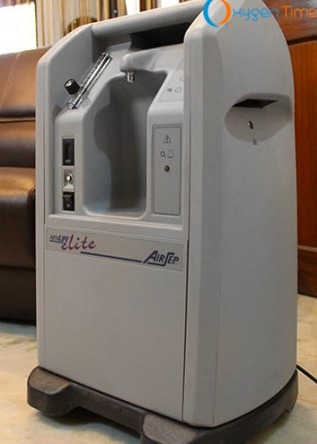
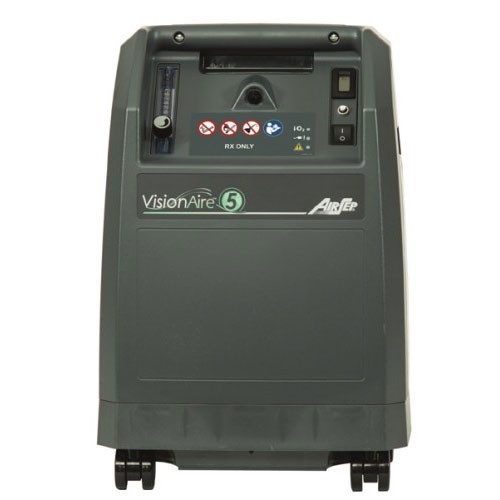
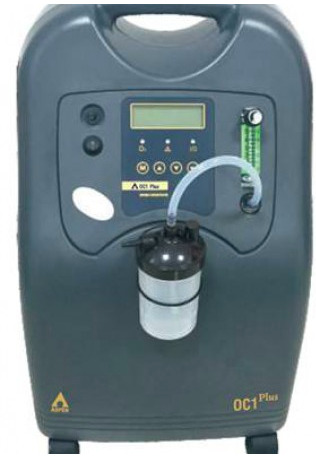
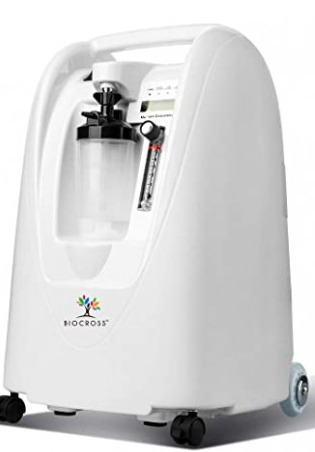
Equinox 5 LPM
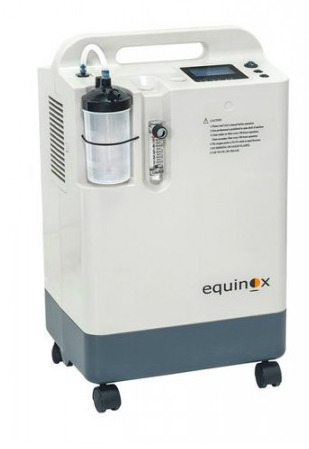
Key features
- Purity 90-95%
- Type Home Stationary
- Continuous Flow 1-5LPM
- Weight 19kg
- Oxygen Purity Indicator (OPI) No
- Power consumption 390watts
Specifications
| Purity | 90-95% |
|---|---|
| Type | Home Stationary |
| Continuous Flow | 1-5LPM |
| Weight | 19kg |
| Power consumption | 390watts |
| Sound level | 40db |
| Dimensions | 23.6H x 14.7W x 14.3Dinch |
| Outlet pressure | 10psi |
| Loss of Power Alarm | Yes |
|---|---|
| Indian Voltage Model | Yes |
| Company Headquarters | China |
Pros and cons
PROS
- Loss-of-power alarm is declared on the brochure, unlike many ₹40,000-class peers
- 40 dB noise spec sits at the low end of the 5 LPM stationary class
- 10 psi outlet pressure gives tubing-length headroom up to 50-ft runs
- Indian-voltage model per manufacturer declaration
CONS
- ₹45,120 price is ₹5,000-8,000 above equivalent-spec Chinese competitors
- No US FDA, no FAA, no CE on spec sheet — blank across all three
- System Malfunction and No Flow alarm rows blank on brochure
- 19 kg weight and 390 W draw match heavier-chassis older designs
- Flow floor of 1 LPM cuts out paediatric and low-dose adult prescriptions
The Equinox 5 LPM is one of those machines that tells you exactly what is wrong with the Indian oxygen concentrator market: it is priced at ₹45,120 per the manufacturer brochure and e-commerce product listings, which puts it squarely in the same bracket as the Yuwell 7F, the Nidek Nuvo Lite, and several other machines that come with multi-decade brand equity and structured Indian service networks. The Equinox brings none of those things — it is a Chinese-origin stationary unit with blank cells where regulatory certifications should be, and with alarm coverage that is partial rather than complete. A buyer paying ₹45,120 for this machine is paying branded prices for an unbranded product. In almost every scenario, there is a better ₹45,000-50,000 option available.
What the specs actually mean in Indian homes
The Equinox 5 LPM delivers 90-95% oxygen purity at a continuous flow range of 1 to 5 LPM. That 1 LPM floor is worth pausing on: a significant number of clinical prescriptions, particularly for stable COPD on domiciliary oxygen, sit at 0.5-1 LPM for nocturnal-only therapy. A flow floor of 1 LPM means the patient cannot be titrated down below 1 LPM without using a flow-meter bleed — a cosmetic fix that is not recommended clinically (British Thoracic Society). The Eloxy 5 LPM and the Fitmate 5 LPM both start at 0.5 LPM; so do most branded units. The Equinox’s 1 LPM floor is a minor but non-trivial limitation.
The 19 kg chassis is the same dimension and weight as the Eloxy — these may share OEM architecture, possibly with differences only in badging and minor firmware differences. That matters for two reasons. First, spare-parts interchangeability is sometimes possible between OEM-siblings, which is useful if either dealer has stock. Second, the identical weight and power numbers (390 W) mean identical operating-cost profiles and identical portability profiles. In a flat with a narrow staircase, 19 kg means two-person moves; in a single-floor house it is a non-issue. Dimensions at 23.6 × 14.7 × 14.3 inches fit standard hospital bedside trolleys and fit under most study tables.
Power consumption of 390 W at continuous 5 LPM means running cost of roughly ₹75-95 per 24-hour day at ₹8-10 per kWh domestic tariff. Over a three-year service life running 12 hours per day, the electricity bill is in the ₹42,000-54,000 range. That is more than the purchase price. This is true for any 390 W concentrator, and the Equinox is not uniquely bad — but the comparison with 300 W units (Oxybliss 5 LPM, Oxyflow 5 LPM) is sharp: those save roughly ₹12,000 over three years in running cost, which fully erases any price premium the Equinox could claim.
Noise at 40 dB is competitive, matching the Eloxy and Oxybliss 5 LPM specifications. Real-world noise rises over time as compressor bearings and isolation mounts age; expect 5-10 dB increase by year three. For bedroom placement at night this matters — 40 dB is below conversational volume; 50 dB starts to interfere with sleep for some patients. The Equinox noise number, if accurate, makes the machine viable for bedroom placement on a fabric mat to damp vibrations.
Outlet pressure of 10 psi is strong — higher than Philips EverFlo (5 psi) and most branded 5 LPM stationary units. This gives tubing-length headroom: a patient can run 25-50 feet of 1/4-inch oxygen tubing between the concentrator and the cannula without significant flow drop. In practical Indian home use that means the concentrator can live in a hallway or adjacent room, out of earshot but still feeding the patient in a bedroom. For users with limited room flexibility this is meaningful.
Compliance is the Equinox’s soft spot. Spec-sheet rows for US FDA, FAA, and CE are blank. Indian Voltage Model is declared Yes, but no CDSCO notification number is stated in the brochure (CDSCO). The Loss of Power Alarm is marked Yes — this is better than the Eloxy, which leaves even that row blank — but System Malfunction and No Flow alarm rows are empty. A machine without a no-flow alarm will not warn the patient or caregiver if the cannula kinks, disconnects, or falls out during sleep; a machine without a malfunction alarm does not indicate compressor trip, solenoid-valve failure, or purity-band degradation.
Who should buy the Equinox 5 LPM
The Equinox is defensible only for a buyer who specifically needs 40 dB bedroom-placement noise and 10 psi outlet pressure, who does not need 0.5 LPM low-flow titration, and who has direct dealer-relationship trust for service recourse. That is a narrow buyer. For most users, the price premium over Eloxy and Oxybliss is not justified by the partial alarm upgrade. The Equinox might suit a 40-50 year old post-COVID user with mild residual desaturation needing 2-3 LPM nocturnal support in a bedroom environment, who has a local dealer with demonstrable long-term presence and who sees service calls as a tolerable 1-week turnaround.
Who should not buy the Equinox 5 LPM
Patients on continuous 24/7 oxygen need complete alarm coverage. Anyone whose prescription includes 0.5 LPM nocturnal titration cannot use the Equinox’s 1 LPM floor. Patients in high-altitude locations (any station above 6,000 feet) should not use a concentrator without a declared altitude ceiling. Hospice users and elderly-alone users must have a no-flow alarm — cannula dislodgement is the single most common silent failure mode in domiciliary oxygen, and without the alarm the patient can silently desaturate for hours. Commercial or clinic use is not appropriate — a clinic needs regulatory compliance documentation, which the Equinox does not provide. Users in cities where service turnaround matters (tier-2 cities without a dealer network) should go with a machine whose brand has an established national service network: Philips, Nidek, Invacare, BPL, or Yuwell.
How it compares: Equinox vs Eloxy vs Oxybliss vs Yuwell 7F
Equinox vs Eloxy 5 LPM — Identical chassis dimensions and power consumption suggest shared OEM lineage. Equinox has the Loss of Power alarm declared while Eloxy leaves it blank. Equinox is ₹7,680 more expensive at ₹45,120 versus ₹37,440. Is the single declared alarm worth ₹7,680? Probably not — a standalone loss-of-power alarm ₹1,500 UPS solves the same problem and protects the machine itself from power-cut damage. Verdict: Eloxy plus a UPS is the better combination at lower total cost.
Equinox vs Oxybliss 5 LPM — Oxybliss is Taiwan-origin at ₹36,480 (₹8,640 cheaper). Oxybliss draws only 300 W versus Equinox’s 390 W — a 23% saving that compounds to ₹12,000-15,000 over three years in electricity cost alone. Both have blank compliance rows. Oxybliss has all-alarm rows blank; Equinox has Loss of Power declared. For a total-cost-of-ownership view, Oxybliss wins by ₹20,000-23,000 over three years even before considering purchase price. Verdict: Oxybliss is the better bet for cost-conscious buyers.
Equinox vs Yuwell 7F 5 LPM — At a similar ₹45,000-50,000 price point, the Yuwell 7F is a completely different tier of product. It has Yuwell’s multi-country regulatory sign-offs, an Indian service network with presence in 40+ cities, and a brand lineage that includes hospital-grade Yuwell 8F variants sold to government health programmes. The 7F weighs 14-15 kg (versus Equinox’s 19 kg), draws 300-350 W (versus 390 W), and has complete alarm coverage. At the same price the Yuwell is a better machine in every dimension except possibly the 40 dB noise claim — Yuwell 7F is typically specified at 43-45 dB. Verdict: Yuwell 7F beats Equinox decisively at equivalent price.
Indian-market considerations
The ₹45,000 price point in Indian oxygen concentrators is the critical inflection — below it, buyers are signing up for unknown-import risk; at and above it, branded units enter the market with Indian service networks. The Equinox sits exactly on the wrong side of that inflection: it is priced in the branded bracket but sold like an unbranded import. The Yuwell 7F, the Nidek Nuvo Lite (₹52,000-60,000), the Philips EverFlo in its gray-market reconditioned form (₹35,000-45,000), and the Home Medix HM-KV (₹45,000-55,000) are all reachable at this price level and all come with declared service networks.
Indian voltage conditions require an automatic voltage stabiliser (AVR) for any concentrator running 24/7 in typical urban-rural networks. Budget ₹4,000-6,000 for a V-Guard Crystal or Microtek EMT-2090. For a concentrator running intermittently or in a metro with stable supply, a UPS with 30-minute backup at 400 W load (₹8,000-12,000) is a better choice — it covers the frequent 2-5 minute power cuts common in Delhi NCR and Kolkata summers. CDSCO notification is not declared for the Equinox in the public listing; buyers should demand the notification number from the dealer before purchase.
Service network reality: the Equinox has no Indian service footprint comparable to branded competitors. Parts turnaround is typically 3-6 weeks from China via the importing dealer. Users in Pune, Jaipur, Lucknow, Bhubaneswar, and most tier-2 cities will find the importing dealer is based in Delhi, Mumbai, or Ahmedabad, and that service calls require a shipping cycle. For life-dependent users this is not acceptable.
Verdict
The Equinox 5 LPM is not a bad machine, but it is a badly priced machine. At ₹45,120 it asks for branded-unit money without offering branded-unit backing. At ₹35,000-38,000 it would be a defensible entry choice against Eloxy and Oxybliss. At its actual price, the Yuwell 7F and reconditioned branded units from Philips and Nidek are both better purchases. The single declared alarm (loss of power) is the only meaningful differentiator from cheaper Chinese imports, and it does not justify the premium. For buyers who have settled on an unverified import, Oxybliss at ₹36,480 delivers similar noise, better efficiency, and comparable compliance ambiguity at a significantly lower price. For buyers willing to stretch to the Equinox’s price, Yuwell 7F is the rational purchase. Score: 5.4 out of 10.