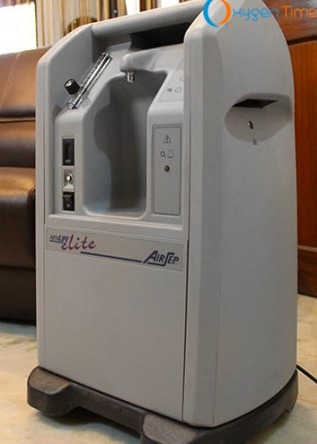
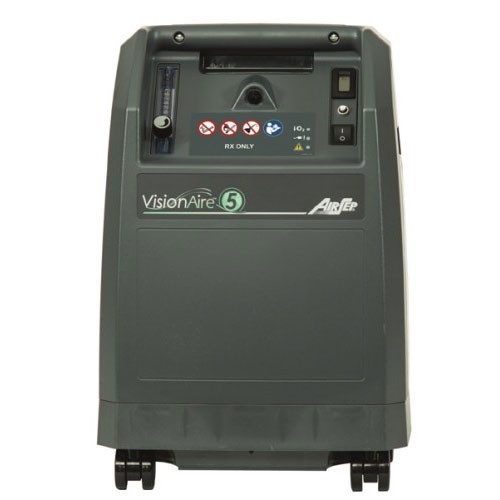
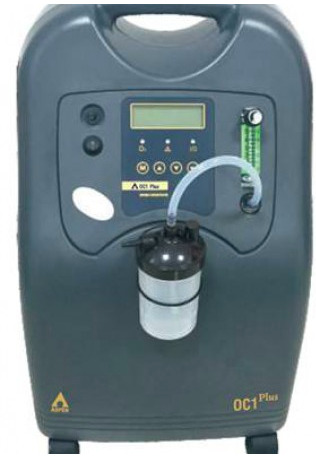
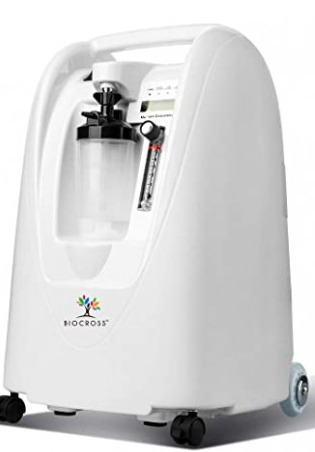
Eloxy 5 LPM
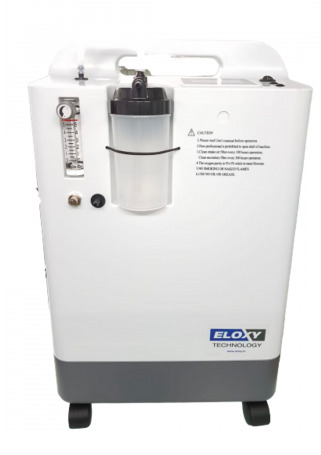
Key features
- Purity 90-95%
- Type Home Stationary
- Continuous Flow 0.5-5LPM
- Weight 19kg
- Oxygen Purity Indicator (OPI) No
- Power consumption 390watts
Specifications
| Purity | 90-95% |
|---|---|
| Type | Home Stationary |
| Continuous Flow | 0.5-5LPM |
| Weight | 19kg |
| Power consumption | 390watts |
| Sound level | 40db |
| Dimensions | 23.6H x 14.7W x 14.3Dinch |
| Outlet pressure | 10psi |
| Indian Voltage Model | Yes |
|---|---|
| Company Headquarters | China |
Pros and cons
PROS
- 40 dB noise spec is among the lowest in the 5 LPM stationary class
- ₹37,440 listed price sits below the ₹40,000 floor for branded 5 LPM units
- Indian voltage model per brochure — runs on 220 V without external conversion
- Full 0.5-5 LPM continuous flow range covers paediatric to adult prescriptions
CONS
- No US FDA, no FAA, no CE certification — blank cells across every compliance row
- 19 kg chassis with 390 W power draw is heavier and thirstier than 16 kg competitors
- Brochure leaves loss-of-power, malfunction, and no-flow alarms blank (not 'No', but unstated)
- No oxygen purity indicator and no purity analyzer on spec sheet
- Out-of-stock status on primary listing suggests discontinued or low-volume supply
The Eloxy 5 LPM occupies an awkward slot in the Indian concentrator market: priced at ₹37,440 per the manufacturer brochure and e-commerce product listings, it sits below the ₹40,000 line that most branded 5 LPM units hold, but above the ₹25,000–30,000 bracket where the deepest-discount OEMs live. It is a Chinese-origin home stationary concentrator with no US FDA, no FAA, and no CE certification on the published spec sheet, and with conspicuous blank cells where basic alarm statuses should be declared. For an Indian family searching for oxygen therapy at home, that combination sets up a specific question: is the saving worth the compliance vacuum? In most cases the answer is no, but there is a narrow set of buyers for whom this unit makes defensible sense.
What the specs actually mean in Indian homes
The Eloxy 5 LPM is specified at 90-95% oxygen purity across a continuous flow range of 0.5 to 5 LPM. That purity band is standard for the class. Anything less than 90% is below the clinical floor for supplemental oxygen therapy, and the 95% ceiling is what PSA (pressure swing adsorption) zeolite-bed architecture typically achieves before diminishing returns. The 0.5 LPM low end matters more than it sounds: paediatric prescriptions and very-low-flow adult prescriptions for nocturnal desaturation often sit at 0.5 or 1 LPM, and a machine whose floor is 1 LPM cannot serve those patients accurately. The Eloxy covers that range.
Weight is 19 kg. That is notably heavier than the 13-16 kg class of modern Chinese 5 LPM units and roughly in line with older Philips EverFlo-era designs from the mid-2010s. In a four-storey Mumbai walk-up or a Kolkata flat with a two-person elevator, 19 kg is the difference between one-person moves and two-person moves. For a stationary unit that will be shifted between rooms occasionally — say, bedroom at night and living room during the day — 19 kg is workable but tiring. Compare this to the 16 kg Keyhub 5 LPM or the 15.2 kg OxyPure 5 LPM and the Eloxy feels dated.
Power consumption is declared at 390 W. Indian electricity at ₹8-10 per kWh for domestic tariffs means 390 W of continuous use is roughly ₹75-95 per 24-hour day, or ₹2,300-2,900 per month if the machine runs 24/7. That is not trivial for a pensioner household. A 300 W unit like the Oxyflow or OxyPure from Sanrai costs roughly 25% less to run — the Eloxy’s higher draw directly translates into a larger electricity bill over the service life. Over a three-year period at 12 hours/day use, the difference is in the ₹10,000-12,000 range. That’s meaningful when the purchase price difference between Eloxy and better-specified competitors is under ₹5,000.
Noise is declared at 40 dB. If accurate, this is strong — 40 dB is the low end of the stationary-concentrator class and makes bedroom placement viable for light sleepers. The brochure number is declared at the unit’s side, not at the patient’s head, and compressor noise in any PSA concentrator rises with ambient temperature and over the life of the machine as bearings age. Buyers should treat 40 dB as a best-case first-year figure, likely 45-50 dB in year three of real use. Dimensions are 23.6 × 14.7 × 14.3 inches — not particularly compact, but fits most hospital-bedside trolleys and bedroom floor corners.
Outlet pressure of 10 psi is on the high end of the class. Most 5 LPM stationary units deliver 4-8 psi, so 10 psi gives more headroom for long-tubing runs (say, 50 feet) without flow drop. If the patient’s bed is across the room from the unit, or if tubing has to route around furniture, this is a quiet advantage. For standard 7-foot cannula setups, it’s irrelevant.
The compliance section is where the Eloxy falls apart. The spec sheet has blank cells for US FDA, FAA, and CE. It declares “Indian Voltage Model: Yes” but no Indian CDSCO registration information, no BIS certification, and no ISO 13485 manufacturer claim. The Loss of Power, System Malfunction, and No Flow alarm rows are blank — not stated as “No,” but left empty. In respiratory equipment brochures, blank compliance cells are not neutral. They are, in practice, negative claims by omission. A manufacturer that had any of these certifications would list them. The absence suggests the unit has not been through any independent certification process of consequence.
Who should buy the Eloxy 5 LPM
The Eloxy makes sense for a narrow buyer profile: a family that needs a 5 LPM stationary unit for non-critical intermittent use — post-COVID recovery breathing support, mild COPD in a patient who is not oxygen-dependent 24/7, or altitude adjustment for a visitor — and whose budget genuinely does not stretch past ₹40,000. The buyer must accept that this is a backup-grade machine, not a life-support-grade machine, and that service recourse is limited to whatever local dealer imported the unit. If the dealer disappears, so does the warranty. For short-term use (3-6 months post-hospitalisation) where the machine will be sold or returned after the prescription ends, the Eloxy’s lower up-front price amortises to a lower total cost than a branded unit, because depreciation and resale losses on the branded unit eat the saved running cost.
Who should not buy the Eloxy 5 LPM
Anyone prescribed oxygen for continuous long-term therapy should not buy the Eloxy. A patient on 24/7 oxygen needs alarm coverage that is declared and verified, not blank on the brochure. The absence of a no-flow alarm matters specifically when the patient is asleep or alone: a blocked cannula or kinked tube with no alarm means silent desaturation. Paediatric and high-altitude patients should also avoid — paediatric prescriptions demand certified accuracy, and the brochure declares no operating altitude ceiling, leaving Shimla, Leh, Darjeeling, and Ooty patients with no declared performance envelope. Hospice and palliative home-care setups should avoid — service network reliability is the single most important variable in that context, and Eloxy has no Indian service footprint to speak of.
How it compares: Eloxy vs Healthgenie vs Keyhub vs Oxybliss
The Eloxy’s natural comparison set is the cluster of no-name-brand Chinese 5 LPM stationaries in the ₹34,000-45,000 bracket.
Eloxy vs Healthgenie 5 LPM — Healthgenie is listed at ₹34,560, roughly ₹3,000 cheaper. It also has the CE certification row filled (“Yes”) where Eloxy is blank. Healthgenie is heavier at 21 kg and louder at 55 dB versus Eloxy’s 40 dB spec. For a user who plans to place the unit in a living room with ambient daytime noise, Healthgenie’s noise penalty is manageable and the CE mark plus lower price make it the rational pick. For bedroom use where 40 vs 55 dB is the difference between sleeping and not sleeping, Eloxy wins — but only if the 40 dB figure holds up in real use. Verdict: Healthgenie for living-room placement, Eloxy only if bedroom noise is the deciding factor.
Eloxy vs Keyhub 5LPM — Keyhub is listed at ₹42,240, roughly ₹4,800 more expensive. It is lighter at 16 kg, quieter-ish at 48 dB, and has CE certified on its spec sheet. It declares Loss of Power and No Flow alarms where Eloxy leaves those blank. Keyhub also has higher outlet pressure at 13 psi versus Eloxy’s 10 psi. Across almost every dimension Keyhub is a better-specified machine for ₹4,800 more. The only Eloxy advantage is lower quoted noise. Verdict: Keyhub wins unambiguously for buyers willing to pay ₹5,000 more for declared alarms and lower weight.
Eloxy vs Oxybliss 5 LPM — Oxybliss is listed at ₹36,480, actually slightly cheaper than Eloxy. Oxybliss is Taiwan-headquartered rather than China, with the same blank US FDA/FAA/CE row. Spec-sheet noise is identical at 40 dB and power is lower at 300 W versus Eloxy’s 390 W. Oxybliss has the same alarm-row blanks. On electricity running cost, Oxybliss wins — 90 W lower continuous draw compounds to roughly ₹2,500-3,000 per year in saved electricity for a 12 hour/day user. For buyers choosing between unverified imports, Oxybliss is the stronger pick. Verdict: Oxybliss beats Eloxy at lower price with better power efficiency.
Indian-market considerations
The Indian home-oxygen market is dominated by three realities that the Eloxy’s brochure ignores. First, voltage stability: urban Indian power supply swings between 180 V and 260 V in many pockets of Delhi NCR, Bengaluru peripheral areas, and tier-2 cities. A concentrator without a declared voltage tolerance range needs a 2 kVA automatic voltage stabiliser in front of it — budget ₹4,000-6,000 extra for a V-Guard or Microtek unit. The Eloxy brochure does not specify voltage tolerance, so assume a stabiliser is mandatory. Second, altitude: the brochure does not declare an operating altitude ceiling. Leh is at 11,500 feet, Manali at 6,700 feet, and patients in those locations need a unit with a declared performance envelope. The Eloxy cannot be recommended for hill-station use without manufacturer confirmation. Third, service network: there is no Eloxy service centre footprint in India comparable to Philips, Nidek, or Invacare. Spare parts (sieve bed, compressor, solenoid valves) will typically route through the importing dealer, with turnaround times of 2-6 weeks depending on whether parts are stocked locally. For a life-dependent user this is unacceptable. For intermittent use it is tolerable.
CDSCO (Central Drugs Standard Control Organisation) notification of the Eloxy in India is not declared on the product listing (CDSCO). Oxygen concentrators fall under Class B notified medical devices in India since the 2020 Medical Devices Rules amendment. An importer selling a non-notified device is technically non-compliant; for the end-user, this means that any warranty dispute has no regulatory escalation path. Buyers should ask the dealer specifically for the CDSCO notification number before purchase and treat its absence as a deal-breaker.
GST on oxygen concentrators in India is 12%. The ₹37,440 price is typically inclusive; confirm with the dealer. Extended warranty offers beyond the standard 1-year are usually traps — if the warranty period exceeds the typical dealer’s time-in-business for unknown imports, the warranty is unenforceable. Service visits in metros typically cost ₹800-1,500 per visit from the importing dealer; in tier-2 cities the cost can be 2-3x.
Verdict
The Eloxy 5 LPM is a machine that exists for a reason — it fills a price slot — but it is rarely the rational purchase at that slot. The Oxybliss 5 LPM sits at a lower price with better power efficiency. The Keyhub 5 LPM sits at ₹5,000 higher with declared alarms and lower weight. Healthgenie sits below Eloxy on price and above on certifications. The Eloxy’s only distinctive advantage is the 40 dB noise spec, and even that is a brochure number unverified in the field. For a buyer who has already decided that a Chinese unverified import is acceptable, the Oxybliss is the better version of the same bet. For a buyer who needs more certainty, any branded unit above ₹50,000 (Yuwell 7F, Philips EverFlo, Nidek Nuvo Lite) is a materially different tier of product. Home Medix, Dr Diaz, Nareena, and Oxymed units sit in the ₹45,000-65,000 bracket with declared Indian service networks. The Eloxy is a price-slot filler, not a considered choice. Score: 5.2 out of 10.