Dr Trust 5L
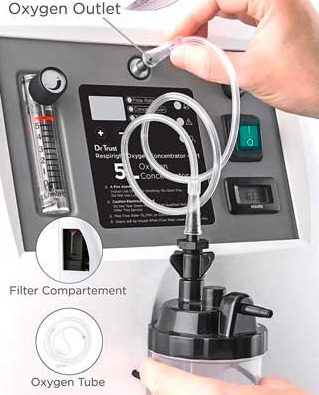
Key features
- Purity 90-95%
- Type Home Stationary
- Continuous Flow 0.5-5LPM
- Weight 15kg
- Oxygen Purity Indicator (OPI) No
- Power consumption 390watts
Specifications
| Purity | 90-95% |
|---|---|
| Type | Home Stationary |
| Continuous Flow | 0.5-5LPM |
| Weight | 15kg |
| Power consumption | 390watts |
| Sound level | 46db |
| Dimensions | 21.25H x 12.99W x 10.23Dinch |
| Indian Voltage Model | Yes |
|---|---|
| Company Headquarters | China |
Pros and cons
PROS
- Dr Trust has a recognisable brand name and nationwide consumer-device retail presence
- 15 kg chassis is lightweight for the category
- 46 dB sound is moderate, below Chinese-OEM class average
- Compact 21.25H x 12.99W x 10.23D inch dimensions fit smaller spaces
CONS
- No OPI, no alarms of any kind confirmed on the brochure
- No CE, FDA, or CDSCO certifications on the spec sheet
- 390 W power draw is mid-pack — not efficient
- Dr Trust's concentrator service network is undeveloped vs their BP monitor distribution
Dr Trust is a well-known Indian consumer health brand — blood-pressure monitors, digital thermometers, pulse oximeters, nebulizers — with broad retail distribution through chemist shops, e-commerce, and consumer-electronics channels. Its 5L oxygen concentrator, listed at ₹40,320, rides on the brand recognition but the underlying product is a Chinese-OEM rebadge with thin spec documentation. Spec sheet: 0.5–5 LPM continuous flow, 90–95% purity, 15 kg chassis, 390 W draw, 46 dB sound, no OPI, no alarms confirmed on the brochure. The brand-recognition advantage is real for buyers who trust the Dr Trust label. The product itself is middle-of-the-road.
What the specs mean
The 0.5–5 LPM flow range with 90–95% purity is the standard 5 LPM envelope. 0.5 LPM minimum supports paediatric and low-flow adult prescriptions.
The 15 kg chassis is genuinely light for a 5 LPM stationary. Matches Nareena and is lighter than Aspen (21 kg) or Healthgenie (21 kg). Similar-weight to Olex, Dynmed, and Biocross; heavier than the 13 kg Home Medix HM-KV. Lighter than the 16 kg Jumao/Veayva/Oxyflow cluster. For a buyer who needs to move the machine between rooms, 15 kg is manageable one-handed for most adults.
Dimensions at 21.25H x 12.99W x 10.23D inches are compact. The 10.23-inch depth is among the narrowest we see and makes this unit placeable against a wall in small spaces.
The 390 W power draw is mid-pack. Higher than Home Medix HM-KV (320 VA), GVS/Vandelay (300 W), or Dr Diaz (285 W), lower than Nareena (550 W). At 16 hours/day × ₹9/kWh, 390 W is roughly ₹1,700/month in electricity — acceptable but not efficient.
The 46 dB sound level is moderate — below the 48-52 dB Chinese-OEM class average, close to Philips EverFlo’s 45 dB. For a quiet-home environment this is acceptable.
No outlet pressure published.
The critical gaps: no OPI. No loss-of-power alarm, no system-malfunction alarm, no no-flow alarm — all blank. This is the same alarm-sheet-empty problem we see on Veayva, Jumao, Dynmed, and Healthgenie — and it is just as concerning on the Dr Trust unit as it is on them. The brand recognition does not change the product’s safety-feature absence.
No CE, no FDA, no FAA, no CDSCO. China HQ. Indian voltage confirmed.
No altitude rating.
Who should buy it
Buyers who trust the Dr Trust brand based on prior experience with the company’s consumer-grade products (BP monitors, thermometers, pulse oximeters) and want to stay within the brand. There is real commercial value in buying from a brand whose other products you already own and trust — support resolution is often easier when you’re already a customer.
Short-term use cases (3-6 months) where the machine sees moderate rather than 18-hour daily load and where the OPI/alarms gap is less consequential.
Buyers who value the compact form factor (narrow 10.23-inch depth) for placement in small Indian flats.
Who shouldn’t
Long-term LTOT patients — no OPI, no confirmed alarms, no certification paperwork is the wrong configuration for multi-year use.
Buyers who expect the Dr Trust consumer-brand retail support network to translate to oxygen-concentrator service. It does not; concentrator repair is a different capability than thermometer warranty.
Patients who need insurance-reimbursement documentation.
Head-to-head alternatives
Dr Diaz 5 LPM (₹29,759 current). Much better spec at lower price — OPI, three alarms, India HQ, 12,000 ft altitude, 13 psi outlet pressure. Against Dr Trust 5L at ₹40,320, Dr Diaz is ₹10,561 cheaper and materially better on every safety-relevant axis. The only thing Dr Trust offers that Dr Diaz does not is brand recognition in the Indian consumer-health market.
Home Medix 5 LPM (₹40,320). Same price. Home Medix has CE certification, a brochure-claimed 36 dB sound, and at least one confirmed alarm. Against Dr Trust, Home Medix is essentially a wash on most specs but better on certification and marginally on sound. Either is acceptable for the use case; neither is particularly recommended.
Oxymed Mini 5 LPM (₹32,000-38,000). Indian-manufactured, Chennai-based, usually OPI-equipped, stronger service network in South/West India. Against Dr Trust, Oxymed is ₹2,000-8,000 cheaper and better-supported for warranty claims.
Nidek Nuvo Lite 5 LPM (₹55,000-65,000). Japanese. 40 dB, 290 W, OPI, full alarms, 14 kg. Against Dr Trust, Nidek is 35-60% more expensive and dramatically better on every axis. For long-term LTOT, Nidek.
Indian-market considerations
Dr Trust has broad consumer-device retail distribution in India — you can buy a Dr Trust BP monitor at most chemist shops, Amazon, Flipkart, Croma, Reliance Digital, and similar outlets. This does not translate cleanly to oxygen-concentrator service. A concentrator is a much more complex device than a BP monitor, and compressor/sieve-bed repair requires specialised technicians and spare-parts inventory that consumer-device warranty processes do not support.
Realistically: if your Dr Trust 5L concentrator fails in month 14, the warranty claim will go through the specific dealer you bought it from. Dr Trust’s consumer-service infrastructure is not built to handle concentrator repairs. You may end up with a slow turnaround and dealer-dependent outcome, even though the brand name feels familiar.
Spare parts: no publicly documented Dr Trust concentrator-specific service centre network. The unit is a Chinese-OEM rebadge, so parts will need to come from the OEM supplier — which Dr Trust Indian support may or may not have efficient access to.
Warranty: not explicitly documented on source listing. Standard 1 year from dealer is expected.
Voltage: Indian voltage confirmed. 500 VA stabiliser adequate at 390 W.
Altitude: not listed.
CDSCO: not indicated.
Stock: out of stock on source listing. Dr Trust BP monitors and thermometers are consistently in stock; the concentrator is not. This tells you the product category is not a Dr Trust priority.
Brand recognition vs product fit: Dr Trust has earned customer trust on low-complexity consumer health devices (BP monitors, thermometers). Extrapolating that trust to a medical-grade concentrator is a mistake unless the specific unit’s spec sheet and service story justify it. This one does not.
Additional Dr Trust-specific considerations
The brand-recognition economics. Dr Trust has built meaningful consumer-health brand equity in India over the past decade through broad retail distribution of BP monitors, thermometers, weighing scales, and pulse oximeters. These products are technically simple, retail-channel-friendly, and warranty-claim-simple (replace-on-defect within warranty, no complex repair). A concentrator is fundamentally different: it is mechanically complex (compressor, sieves, valves), clinically critical (directly affects patient safety), and repair-dependent (compressor failures cost ₹6-12K to fix and require trained technicians).
Dr Trust’s infrastructure is built for the first category. The company’s warranty claim process for a BP monitor is: take the defective unit to the seller, exchange for a new one. This works because a BP monitor costs ₹1,500-3,000 and the inventory cost of a replacement is manageable. A concentrator at ₹40,320 cannot be handled on the same model. When a Dr Trust 5L fails in month 14, the dealer cannot simply exchange it for a new one — the economics don’t support that. They must repair it, which requires parts, technical skill, and turnaround time that Dr Trust’s consumer-retail support infrastructure is not optimised for.
This is not a Dr Trust-specific failure; it is a category mismatch. Any consumer-health brand expanding into oxygen concentrators faces the same gap between their existing support capabilities and what a concentrator buyer needs.
The 10.23-inch depth advantage. At 10.23 inches depth, Dr Trust 5L is among the narrowest 5 LPM units we review. Most 5 LPM stationary units run 11.8-15 inches deep. The narrow form factor allows placement against walls in Indian flats where floor space is at a premium — useful in bedrooms under 100 sq ft or in corridors. This is a genuine packaging advantage.
The Chinese OEM base. The Dr Trust 5L shares dimensional and weight characteristics with several other Chinese-OEM 5 LPM units but not a clean match with any single one — the 21.25 x 12.99 x 10.23 inch profile is unusual. This may reflect a Dr Trust-specific chassis customisation from the underlying OEM, or a less-common chassis family. Either way, the provenance is Chinese OEM per the brochure.
Retail price stability. Unlike many Chinese-OEM-in-India brands that move through large price swings based on dealer inventory, Dr Trust concentrators tend to hold list price more consistently because Dr Trust’s retail channel is structured around MRP maintenance. This has two implications: (a) do not expect discounts of more than 5-10% off ₹40,320 at most retail sellers, and (b) the price stability means cross-dealer shopping yields less benefit than with other emerging brands.
Warranty documentation gap. No warranty term is explicitly documented in the product description block. Dr Trust’s BP monitors and thermometers typically ship with 1-year warranties; whether the concentrator extends that period or matches it should be verified at purchase. Some medical-equipment dealers offer extended warranty packages on concentrators (₹3,000-5,000 for a second year); ask explicitly.
The repair-vs-replace question. For Dr Trust products in general, the default warranty-claim resolution has historically been replacement rather than repair. For a concentrator, the economics may push toward repair (new-unit replacement at ₹40K per incident is costly for the brand), which is the less-convenient outcome for the buyer. Confirm with the dealer in writing: “If this machine fails in month 10, will you replace it or repair it, and what is the turnaround time?” The answer informs the quality of the ownership experience materially.
Reading the Dr Trust retail channel
The Dr Trust 5L is sold through:
- Pharma-chain stores (Apollo, Guardian, Wellness Forever, 1mg Wellness) — limited stocking
- General e-commerce (Amazon, Flipkart) — primary channel, variable availability
- Medical-equipment specialists — less common
- Direct brand website — may or may not be available
Buying through a pharma-chain store gets you brand-aligned retail experience but may not get you a medical-equipment technician for service. Buying through a medical-equipment specialist gets you better service access but the Dr Trust brand is less frequently carried there.
For a buyer who values Dr Trust specifically for retail-channel familiarity, the Apollo Pharmacy or 1mg Wellness purchase path is the most aligned; understand that the service experience may route back through Dr Trust customer support (a call-centre-based process) rather than through an on-site medical-equipment technician.
Verdict
The Dr Trust 5L is a brand-recognition purchase masquerading as a medical-device purchase. The underlying product is a thinly-specified Chinese-OEM rebadge with no OPI, no confirmed alarms, and no certification markers at a ₹40,320 price where better-specced alternatives exist. The 15 kg chassis and 46 dB sound are reasonable. The brand name is familiar. Neither justifies buying this unit over Dr Diaz 5 LPM at ₹10,000 less, Oxymed Mini at ₹5,000 less, or any Tier 1 import at higher cost. If you are drawn to Dr Trust because you own their BP monitor and want to consolidate brand loyalty, understand that the concentrator is a different product category with different service requirements. Score: 5.8/10.