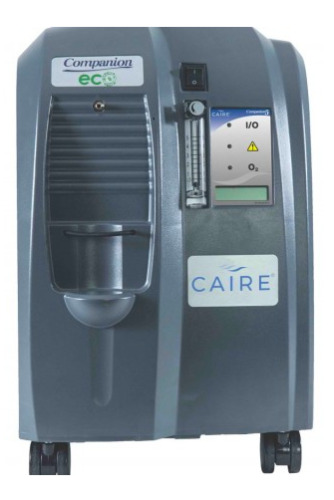
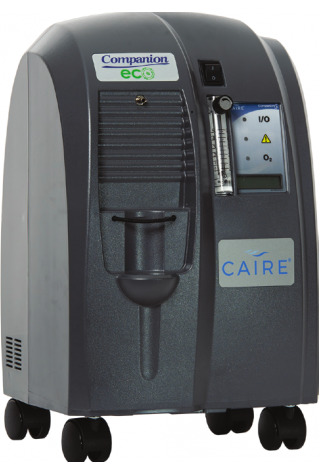
Companion 5 LPM
Key features
- Purity 90-95%
- Type Home Stationary
- Continuous Flow 0.5-5LPM
- Weight 16.3kg
- Oxygen Purity Indicator (OPI) No
- Power consumption 285watts
Specifications
| Purity | 90-95% |
|---|---|
| Type | Home Stationary |
| Continuous Flow | 0.5-5LPM |
| Weight | 16.3kg |
| Power consumption | 285watts |
| Sound level | 50db |
| Dimensions | 21.5H x 13.5W x 12.5Dinch |
| Operating altitude | 9879feet |
| Outlet pressure | 4.6psi |
| Loss of Power Alarm | Yes |
|---|---|
| System Malfunction Alarm | Yes |
| No Flow Alarm | Yes |
| Indian Voltage Model | Yes |
| Company Headquarters | USA |
| US FDA Approved | Yes |
| CE Certified | Yes |
Pros and cons
PROS
- 285 W published power draw ties the Airsep Visionaire 5 for the lowest in the 5 LPM class
- 9,879 ft operating altitude beats the Everflo (7,500 ft) and opens most Indian hill-station elevations
- Full alarm package (loss of power, system malfunction, no flow) for unattended 24x7 operation
- Indian Voltage Model per manufacturer brochure and e-commerce product listings
CONS
- Stock: Out of stock — no current supply in most Indian channels
- No Oxygen Purity Indicator (OPI) — cannot alarm on sieve-bed purity drop, a real gap for 24x7 use
- 16.3 kg weight is the heaviest in the major 5 LPM imported segment — hard for single-caregiver moves
The Caire Companion 5 LPM is a home stationary oxygen concentrator listed at indicative retail ₹66,240 (varies by region/dealer), currently Out of stock per manufacturer brochure and e-commerce product listings. At 16.3 kg published weight, 50 dB sound level, and with no Oxygen Purity Indicator (OPI), it is positioned in the premium-priced tier of the 5 LPM class but does not spec-sheet-compete with either the Philips Everflo (₹43,699) or the Airsep Visionaire 5 (₹54,999). It carries US FDA approval and CE certification per the published additional details and is shipped as an Indian Voltage Model.
What the specs actually mean
Published purity is 90–95%. The Companion does not have an OPI — the “Oxygen Purity Indicator (OPI)” field is empty in the technical details. For a 24x7 home concentrator intended for long-duration unattended use, the absence of OPI is a structural gap. Sieve-bed contamination — a normal degradation mode in Indian high-humidity environments like Mumbai, Chennai, Kolkata — can drop delivered purity from 93% to below 82% gradually over weeks, and without OPI the only feedback is the patient’s SpO2. That is a reactive rather than proactive safety posture, and it is the single biggest reason to avoid this machine for long-duration prescriptions.
Flow range is 0.5–5 LPM continuous, which matches the Visionaire 5 and edges the Everflo’s 1–5 LPM. The 0.5 LPM minimum is useful for paediatric prescriptions and for low-flow sleep titration.
The 16.3 kg weight is the heaviest in the major imported 5 LPM segment. Everflo: 14 kg; Visionaire 5: 13.6 kg; Nidek Nuvo Lite: similar or lighter; Invacare Platinum 5 and Philips Everflo 14 kg. A single caregiver can move 16.3 kg with wheels — but not easily, and not over raised thresholds or stairs common in Indian apartment layouts.
Published power consumption is 285 W — marginally better than the Visionaire’s 290 W and significantly better than the Everflo’s 350 W. On a 24x7 prescription, 285 W at 9 per kWh works out to about ₹1,848 a month, or ₹420 a month less than the Everflo. Over three years that is close to ₹15,000 in electricity savings, which partially offsets the ₹22,500 retail premium over the Everflo — but does not fully close the gap.
The 50 dB published sound level is meaningfully louder than the Everflo (45 dB) and Visionaire (45 dB). 50 dB is at the threshold where bedside placement in a small Indian bedroom becomes disruptive. For living-room or corridor placement with the patient in a separate room, 50 dB is fine — but that defeats the purpose of a 5 LPM concentrator as a bedside sleep machine.
Altitude and outlet pressure
9,879 ft operating altitude is close to 10,000 ft in practical terms — it covers the full Indian hill-station circuit below Leh. This is a legitimate strength of the Companion: patients at Shimla, Manali, Mussoorie, Gangtok, Auli (8,530 ft) all sit inside the envelope, and the Everflo’s 7,500 ft rating does not cover Auli.
The 4.6 psi outlet pressure is the lowest in this peer set — lower than the Everflo’s 5.5 psi, the Visionaire’s 8 psi, and much lower than the 10 LPM units at 30 psi. Below 5 psi, long cannula runs (30+ ft from machine to patient) start to show measurable pressure drop and delivered-flow reduction. The Companion is the wrong machine for any deployment where the patient and machine are in different rooms.
Who should buy it
Very few buyers. The narrow fit is an altitude-restricted Indian buyer between 7,500 and 9,879 ft whose budget is above ₹55,000 but below ₹66,000 and who is willing to accept the OPI gap — and who specifically has Caire/Chart Industries service support available in their city. That is a small population.
More practically, if the Companion comes back In Stock at a meaningfully lower price point (below the Visionaire’s ₹54,999 indicative retail), it becomes a defensible budget-altitude buy. At the current ₹66,240 listing, it is a more expensive machine than the Visionaire with weaker specs (no OPI, heavier, louder, lower outlet pressure) — there is no axis on which it currently wins.
A buyer with an existing Caire service relationship — some Indian hospitals standardise on Caire for in-room installations, and the local biomedical team is trained on the platform — may prefer the Companion for platform continuity. That is a real consideration in hospital-discharge-to-home handovers.
Who shouldn’t
Anyone buying a 5 LPM concentrator new in 2026 should probably not buy the Companion. The Everflo and Visionaire are simply better specified at the same or lower retail, and the Everflo has a deeper service network behind it. The math does not favour the Companion.
Anyone whose prescription calls for long-duration unattended operation — most home oxygen prescriptions — should not buy a concentrator without OPI. The Companion, Focus, Freestyle 3 and Freestyle 5 all fall in this category. For a home machine in India’s humid coastal cities especially, OPI is not optional.
Anyone doing a multi-room cannula deployment (machine in living room, patient in bedroom) should not buy the Companion — the 4.6 psi outlet is too low for a 40+ ft cannula run.
Anyone for whom sound level is load-bearing (light sleeper, small bedroom) should not buy the Companion. 50 dB vs 45 dB is a subjectively meaningful difference at bedside.
How it compares to real alternatives
Companion 5 vs Philips Everflo 5 LPM
Everflo: 14 kg, 350 W, 45 dB, 7,500 ft altitude, has OPI, 5.5 psi outlet, 3-year warranty, ₹43,699, deepest India service network. Companion 5: 16.3 kg, 285 W, 50 dB, 9,879 ft altitude, no OPI, 4.6 psi outlet, ₹66,240, thinner India service network. The Companion wins only on altitude (2,379 ft headroom) and power draw (65 W less). It loses on weight, sound, OPI, outlet pressure, warranty, retail price, and service depth. Pick the Everflo unless the buyer genuinely needs the 9,879 ft altitude envelope and has a Caire service contact in writing.
Companion 5 vs Airsep Visionaire 5
Visionaire 5: 13.6 kg, 290 W, 45 dB, 10,000 ft altitude, has OPI, 8 psi outlet, ₹54,999. Companion 5: 16.3 kg, 285 W, 50 dB, 9,879 ft altitude, no OPI, 4.6 psi outlet, ₹66,240. The Companion is 5 W more efficient on power. On every other axis the Visionaire wins, often decisively. At the published prices, the Visionaire is ₹11,241 cheaper and spec-sheet stronger — pick the Visionaire.
Companion 5 vs Nidek Nuvo Lite / Indian-voltage 5 LPM class
The Nidek Nuvo Lite and other Indian-voltage 5 LPM units typically sit in ₹40,000–55,000 range with 3-year warranties and Indian service. Versus the Companion: Indian-made units are cheaper, typically include OPI, and have faster service turnaround in-country. The Companion’s only remaining advantage is the Caire platform consistency for hospital-discharge handovers — which is a real consideration but not a common one.
Companion 5 vs Inogen at Home
Both imported US-manufactured. Inogen at Home: 8.16 kg, 100 W published, altitude not published, no OPI, ₹1,87,200, Out of stock. Companion: 16.3 kg, 285 W, 50 dB, 9,879 ft altitude, no OPI, ₹66,240, Out of stock. Both lack OPI. The Inogen at Home is 50% lighter and 64% more power-efficient on paper; the Companion is 65% cheaper. For a buyer whose only decision between the two is “no-OPI premium stationary,” the math depends entirely on how weight and power matter to the specific deployment — for most Indian buyers, the price gap is decisive in favour of the Companion, and for a budget that accepts either, the Everflo with its OPI and active stock is still the correct answer.
Clinical deployment considerations
The Companion’s 4.6 psi outlet pressure is the spec most Indian buyers misread. In a single-room deployment with the patient seated within 10–15 ft of the machine, the 4.6 psi is adequate. In a multi-room deployment — machine in the living room, patient in the bedroom with a 40 ft cannula run — the pressure drop along the tubing is meaningful, and the delivered flow at the cannula tip can be 10–15% below the setpoint. For buyers planning extended tubing runs, this is a real clinical consideration: the prescription flow is what you want at the patient’s nose, not what the machine is set to.
The 50 dB sound level similarly depends on deployment. In a small Indian bedroom with closed windows and no AC fan noise, 50 dB is audible and disruptive for light sleepers. In the same bedroom with an AC fan running at medium speed, the concentrator noise is masked by the fan. Most Indian summer-season bedrooms have some ambient machine noise (ceiling fan, AC unit, room cooler), and in those environments, 50 dB is functionally equivalent to 45 dB. In monsoon or winter months with windows closed and no fan, the 5 dB gap over the Everflo is more perceptible.
Indian-market considerations
The Companion is Indian Voltage Model per published additional details — tolerates 220V/50Hz directly. A 10-amp automatic voltage stabiliser for 24x7 use is standard practice: V-Guard, Microtek or Su-Kam class in the ₹2,500–4,500 range.
CDSCO approval status is not stated in the published key features or additional details for this SKU in the data we reviewed (CDSCO Medical Device Registry). Caire as a manufacturer rolled up under Chart Industries and the Indian regulatory footprint has shifted. Verify the specific SKU’s registration status with your dealer before hospital-channel purchase.
Caire India service network is thinner than Philips Respironics — fewer authorised service partners, longer dispatch times in tier-2 cities. For the Companion specifically, the Out of stock status compounds the problem: even a functional unit’s in-service longevity depends on a dealer who can source spare sieve cartridges, filters and pressure switches. Without a written service SLA, this is a risky long-duration buy.
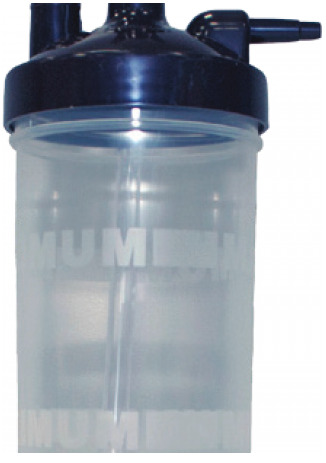
The online-vs-hospital channel gap is wide on Caire stationary units — hospital channels often price significantly higher, 15–25% above online, because hospital-channel Caire shipments are tied to a full installation-plus-service-contract bundle. For the online ₹66,240 price point, a buyer will get the machine and cannula; the hospital channel typically adds first-year PM and a humidifier bottle in a ₹78,000–85,000 bundle.
Verdict
The Caire Companion 5 LPM is a functionally competent 5 LPM stationary concentrator that is structurally uncompetitive in the Indian market: more expensive than the Everflo and Visionaire, heavier, louder, and missing OPI. The Out of stock status compounds the problem.
Score it 6.3 out of 10. Points off for the missing OPI, the heaviest weight in its class, the 50 dB sound, the 4.6 psi outlet, and the premium retail price against weaker specs. Points on for the 285 W power draw and the 9,879 ft altitude envelope. Unless a buyer is specifically on a Caire service platform for hospital-discharge continuity, there is no axis on which the Companion is the right 5 LPM buy in 2026 — the Philips Everflo or Airsep Visionaire 5 will be better in almost every respect.