BPL Oxy 5 Neo 5 LPM
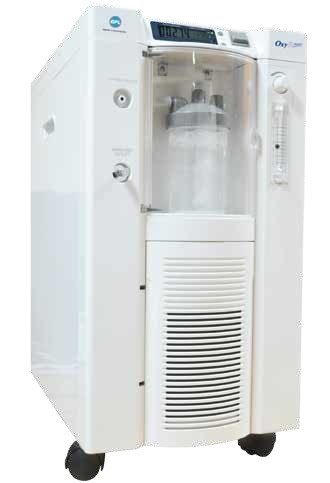
Key features
- Purity 90-96%
- Type Home Stationary
- Continuous Flow 1-5LPM
- Weight 25kg
- Oxygen Purity Indicator (OPI) Yes
- Power consumption 400watts
Specifications
| Purity | 90-96% |
|---|---|
| Type | Home Stationary |
| Continuous Flow | 1-5LPM |
| Weight | 25kg |
| Oxygen Purity Indicator (OPI) | Yes |
| Power consumption | 400watts |
| Sound level | 55db |
| Dimensions | 21.8H x 11.22W x 18.5Dinch |
| Operating altitude | 6000feet |
| Outlet pressure | 7.25psi |
| Loss of Power Alarm | Yes |
|---|---|
| System Malfunction Alarm | Yes |
| Indian Voltage Model | Yes |
| Company Headquarters | India |
Pros and cons
PROS
- 1–5 LPM continuous flow with 90–96% purity across range
- OPI on board plus loss-of-power and system-malfunction alarms
- BPL's nationwide medical-devices service footprint extends to this unit
- 400 W power draw manageable on standard household circuits
CONS
- 25 kg chassis is heavy for daily relocation — nearly 2x the Oxymed Mini
- 55 dB sound claim limits suitability for bedroom placement
- 7.25 psi outlet pressure is lower than most 5 LPM peers
The BPL Oxy 5 Neo 5 LPM is a home-stationary oxygen concentrator rated for 1–5 LPM continuous flow at 90–96% oxygen purity, 25 kg chassis weight, 55 dB sound claim, 400 W power consumption, 7.25 psi outlet pressure and a 6,000 ft operating altitude. Indicative street pricing runs around ₹32,000 against a ₹62,400 MRP per manufacturer brochure and e-commerce product listings. BPL is one of the oldest Indian electronics and medical-device brands, and that brand equity carries real weight in hospital procurement and middle-class household purchase decisions — this machine is the Oxy 5 Neo’s attempt to translate that equity into a respirable-gas home therapy category that has historically been dominated by specialist brands. The result is a serviceable, trust-leveraged 5 LPM unit that is specced below its closest Indian rivals on several axes and above them on none.
What the specs mean
Five spec lines define the BPL Oxy 5 Neo’s real-world fit.
1–5 LPM continuous flow at 90–96% purity. Standard 5 LPM clinical category. The 90% floor is ISO-window adequate (ISO 80601-2-69), the 96% ceiling is on par with better-specced peers, and the OPI on board means the household has a visual indicator if purity drifts. BPL does not publish per-LPM purity curves, which is the norm at this price — but the brand’s pedigree in electrocardiography, ventilators and patient monitors means the QC discipline on this unit is plausibly more robust than unbranded budget competitors.
25 kg chassis, 21.8 × 11.22 × 18.5 inches. This is the single biggest deficit against the 5 LPM competition. Twenty-five kilograms is nearly double the weight of the Oxymed Mini (13.9 kg), Evox 5 LPM (15.6 kg) and Philips EverFlo (14 kg). In daily household use this matters — the machine essentially cannot be relocated without two adults, and cross-floor staircase moves are genuinely hazardous. The form factor is also tall and narrow rather than compact, so placement options are constrained. For institutional use where the machine lives in one place, the weight is irrelevant; for a typical home oxygen therapy patient who wants the machine moved between bedroom and living room during different times of day, it is a real cost.
55 dB sound claim, 400 W power. At 55 dB the Oxy 5 Neo is 10 dB louder than the current Oxymed Mini’s 45 dB claim, which is a perceptual doubling in loudness (every 10 dB is roughly a doubling). This is a bedroom-unfriendly machine at full flow — households will need to either dedicate a separate room with a long cannula run, or accept continuous low-level fan noise as background. At 400 W the power budget is a touch higher than Oxymed Mini’s 390 W, but not meaningfully different in monthly electricity cost (₹2,100–2,600 per month at typical Indian residential rates on 24/7 operation).
7.25 psi outlet pressure. This is low for a 5 LPM unit. For standard nasal cannula use at short-to-medium cable runs (up to ~10 feet) it is adequate. For long cannula runs, trans-tracheal delivery accessories or any enrichment-circuit pairing with CPAP, 7.25 psi is marginal and may require downstream pressure compensation. Most 5 LPM peers (Oxymed Mini, Evox) run 10 psi; Philips EverFlo runs ~5 psi and manages clinically fine, so 7.25 is not a disqualifier, but it is on the low end.
6,000 ft altitude rating. Lower than most peers (Oxymed Mini 7,500 ft, Nidek Nuvo Lite 2 8,000 ft, Philips EverFlo 7,500 ft). For Shimla (~7,000 ft) the BPL is already out of spec; for Manali, Gangtok and any Himachal-Uttarakhand deployment above 6,000 feet, look elsewhere.
OPI, loss-of-power alarm, system-malfunction alarm on board; CE Certified field blank. The alarm package is respectable for the price bracket. The absence of a CE mark on the published spec sheet is a notable paperwork gap — BPL is Indian-headquartered and the device will be CDSCO-compliant for domestic sale, but CE is often expected by Indian institutional procurement even where not strictly required. Buyers for institutional use should confirm the unit’s certification paperwork before committing to a large order.
Who should buy
Three fit profiles.
Brand-trust-led households buying through retail channels. BPL is a recognised brand in Indian homes — buyers who walk into an electronics or medical-devices retailer and see “BPL” next to unfamiliar brand names will often choose BPL for the brand reassurance alone. That is a legitimate buying driver, and this machine will serve a stable home oxygen prescription adequately. The buyer should know they are paying a modest brand premium for that trust.
Institutional buyers with existing BPL procurement relationships. Small hospitals, nursing homes and diagnostic centres that already buy BPL ECG machines, patient monitors or defibrillators can add the Oxy 5 Neo 5 LPM to an existing procurement track, simplifying paperwork, consolidating vendor relationships and leveraging institutional service contracts. This is the cleanest use case for the SKU.
Fixed-placement home installations. Patients who will use the machine in one room for the duration of therapy, with no need for relocation — the 25 kg weight penalty disappears, and the 55 dB sound can be managed by placing the unit in an adjacent room with a long cannula. In that configuration the BPL Oxy 5 Neo delivers on its spec sheet without the chassis-weight penalty biting.
Who shouldn’t
Mobility-sensitive households. Anyone who wants to move the concentrator between rooms during the day (morning in one room, evening in another) should not buy a 25 kg machine. Oxymed Mini, Evox 5 LPM and Philips EverFlo are all close to half the weight for comparable clinical output.
Shared-bedroom placements with light sleepers. At 55 dB, continuous overnight operation is perceptually intrusive. For households where the patient and caregiver share a sleeping room and the caregiver is a light sleeper, this unit is not the right pick.
Altitude-deployed users. The 6,000 ft rating is a hard stop for any hill-station installation. Even Shimla breaks the spec; higher stations clearly do.
Buyers needing long cannula runs or enrichment-circuit pairing. 7.25 psi outlet pressure is not generous for downstream accessories. If the clinical plan involves anything beyond a standard nasal cannula, step up to a 10 psi-class peer.
Head-to-head alternatives
BPL Oxy 5 Neo vs Oxymed Mini 5 LPM. The direct comparison. Oxymed Mini specs: 13.9 kg (11 kg lighter!), 45 dB (10 dB quieter), 390 W (marginally less power), 10 psi outlet (higher), 90–96% purity (same), OPI on board, live purity analyser, CDSCO registered (no CE or US FDA on record), three-year warranty, 7,500 ft altitude. Street price around ₹35,000–45,000 vs BPL’s ₹32,000. Verdict: Oxymed Mini is the clearly better hardware — lighter, quieter, higher-pressure, full alarm suite plus live purity readout, longer warranty. BPL wins on brand recognition alone. If the buyer is choosing on specs, Oxymed Mini is the right pick.
BPL Oxy 5 Neo vs Evox 5 LPM. Evox 5 LPM is Indian-made, 15.6 kg, ~46 dB, 350 W, 10 psi outlet, 90–96% purity, OPI on board, CE certified, two-year warranty. Street price around ₹32,000 — effectively tied with BPL. Verdict: Evox beats BPL on weight (9 kg lighter), noise, power draw, outlet pressure and certification paperwork at essentially the same price. The only BPL advantage is brand recognition. Evox is the clearly better value.
BPL Oxy 5 Neo vs Philips EverFlo. Philips EverFlo is 14 kg, ~40 dB claim, ~350 W, 5 psi outlet, US FDA and CE cleared. Street price around ₹55,000–75,000 — a meaningful premium over BPL. Verdict: EverFlo is the spec-superior pick at higher cost, with the caveat that authorised Philips service access is limited outside top-8 metros. In metros with good Philips service, EverFlo is the upgrade; outside metros, BPL’s service network (through BPL’s broader medical-devices book) is more accessible.
Indian-market considerations
BPL’s competitive advantage in this category is institutional and retail distribution rather than oxygen-concentrator specialism. The brand runs a medical-devices service network through its hospital equipment business (ECGs, patient monitors, defibrillators), and the Oxy 5 Neo inherits that access. In cities with BPL-authorised medical-devices service partners — which includes most Tier-1 and Tier-2 cities — warranty and out-of-warranty service is reasonably reliable. Rural and Tier-3 access is weaker than Oxymed’s specialist oxygen dealer network.
Rental ecosystems for BPL units exist but are thinner than Oxymed. Most rental houses stock Oxymed, Philips and sometimes Nidek as their primary inventory; BPL tends to appear in institutional fleets rather than rental books. For consumer buyers this means secondary-market supply (used BPL units from rental returns) is less common, which can actually help resale value if the therapy ends early and the unit needs to be sold on.
Power, voltage and altitude: 400 W on 220 V / 50 Hz Indian mains is handled by a 1 kVA UPS for outage bridging, with stabiliser recommended in voltage-unstable areas. The 6,000 ft altitude rating is a hard constraint for any hill-station deployment. CDSCO registration is expected given BPL’s headquarters and institutional sales track — buyers should still request the CDSCO number in writing if the purchase is institutional or insurance-reimbursed.
The two-year warranty is industry-standard for this class; BPL’s warranty honour rate through authorised channels is reasonable, with service-claim experience generally better in metros and institutional contexts than in standalone retail-consumer households. First-response SLA from BPL authorised medical-devices partners typically runs three to seven working days, which is slower than Oxymed’s specialist oxygen network but faster than most Philips or Nidek non-metro responses.
Verdict
The BPL Oxy 5 Neo 5 LPM is a brand-trust play that delivers adequate clinical performance in an overweight, noisy chassis at a price that is not meaningfully better than more capable peers. For buyers who specifically want the BPL brand or who have existing BPL procurement relationships (institutional buyers especially), it is a defensible purchase. For spec-driven buyers the Oxymed Mini 5 LPM, Evox 5 LPM or Philips EverFlo are all stronger choices.
The specific buyer profile for this machine — “I want a branded Indian home oxygen concentrator from a brand I have trusted for decades with televisions and electrocardiographs, and I don’t care that it weighs 25 kg” — is real, and for that buyer this machine works. Others should shop on specs. Score: 6.6.