Resmed AirStart 10 Auto CPAP Machine
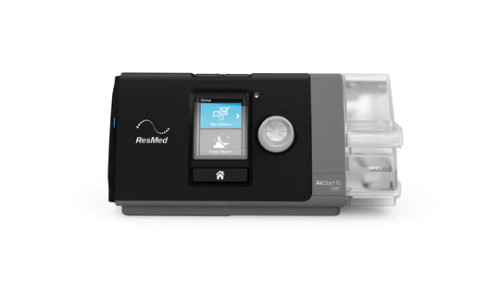
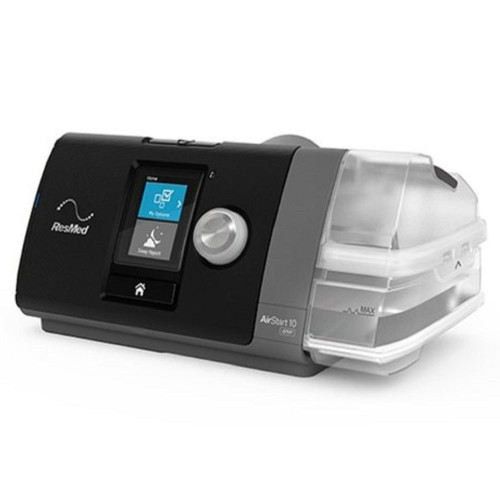
Key features
- Type Auto CPAP
- Modes APAP, CPAP
- Algorithm Standard
- Turbine Made in Australia
- Pressure Range 4-20cmH₂O
- Ergonomic Tilted Display Yes
Specifications
| Type | Auto CPAP |
|---|---|
| Modes | APAP, CPAP |
| Algorithm | Standard |
| Turbine | Made in Australia |
| Pressure Range | 4-20cmH₂O |
| Ergonomic Tilted Display | Yes |
| Sound level | 26.6dB |
| Weight | 1.1Kg |
| Dimensions | 116 x 205 x 150mm |
| Company Headquaters | California |
| Ramp Duration | 0-45min. |
| Ramp Down | No |
| EPR | Yes |
| Humidifier | Heated |
| Preheat | Yes |
| Leak Alert | Yes |
|---|---|
| Leakage Compensation | No |
| SD card | Yes |
| Cloud connectivity/Wifi | No |
| FAA | Yes |
| FDA | Yes |
| CE | Yes |
Pros and cons
PROS
- ₹24,430 retail is the lowest entry point into the ResMed APAP platform in India, roughly ₹21,000 below the AirSense 10
- Full 4-20 cmH2O pressure range matches the clinically useful adult-OSA envelope
- HumidAir heated humidifier is integrated on the base SKU, not a paid upgrade
- 1.1 kg chassis is the lightest in ResMed's home-APAP line and fits a small Indian bedside table
CONS
- Runs the older 'Standard' algorithm not the 'Advanced' AutoSet on AirSense, producing looser pressure control
- No AutoRamp, no Leakage Compensation, no Central Apnea Detection, no Climate Control on the base spec
- No cloud connectivity, no Bluetooth, no AirView — data stays on the SD card and requires clinic visit to read
The ResMed AirStart 10 Auto CPAP is the entry-tier APAP in ResMed’s Indian lineup, positioned below the AirSense 10 AutoSet at roughly half the price. It is a functional auto-adjusting CPAP — 4-20 cmH2O auto range, heated humidification, EPR, SD-card data logging, FAA approval, FDA and CE certification per the manufacturer brochure and e-commerce product listings. What it is not is a full-featured AutoSet platform. ResMed explicitly positions this as a clinic-friendly “simple operation” device: plug in, press Start, no menus to navigate. At an indicative retail of ₹24,430 (varies by region/dealer), 1.1 kg, and 26.6 dB published sound level, it targets the price-constrained first-time OSA buyer and the clinic-rental inventory market where durability and simplicity outweigh algorithm sophistication. It is In Stock on the Indian market.
What the specs actually mean
The 4-20 cmH2O pressure range is identical to the AirSense 10 and AirSense 11. On paper this is the full clinically useful adult-OSA envelope, and the device will deliver any prescribed fixed or auto pressure within that window. What matters is what the device does inside that envelope.
The AirStart 10 runs ResMed’s older “Standard” algorithm, not the “Advanced” AutoSet that ships on the AirSense line. The manufacturer spec-sheet labels them differently, and this is a genuine generational difference — the Standard algorithm responds to apnoeas and hypopnoeas but is less aggressive on flow-limitation pre-events, produces a noisier overnight pressure trace, and does not deliver the same residual-AHI reductions as the AutoSet. A patient running an AirStart 10 in auto mode will typically see a wider pressure swing and a higher 95th-percentile pressure than the same patient on an AirSense 10 AutoSet with the same min/max prescribed.
EPR — Expiratory Pressure Relief — is published as Yes. This is the comfort feature that drops delivered pressure by 1, 2, or 3 cmH2O on exhalation onset, and it is the single most important comfort feature for first-30-day adherence in CPAP patients (AASM Practice Guidelines). The AirStart 10 exposes EPR on the clinical menu. Basic CPAP therapy without EPR has meaningfully worse adherence in the Indian first-month drop-out data we have reviewed.
Ramp duration is published as 0-45 minutes. Crucially, AutoRamp — which is the sleep-onset-detection variant that waits for the patient to actually fall asleep before increasing pressure — is not on the AirStart 10 spec sheet. The device offers a fixed-duration ramp only. “Ramp Down” is explicitly listed as No. That means a patient who wants to set a 20-minute ramp will have the machine count down a timer regardless of whether they have fallen asleep or are still awake reading; if they fall asleep in 5 minutes, they are exposed to 15 minutes of rising pressure before the machine reaches therapy level. AutoRamp on the AirSense line solves this with a flow-pattern detector. The AirStart 10 does not.
Central Apnea Detection is explicitly not on the AirStart 10 spec sheet. The device will not flag a central apnoea in its data; it will log it as a generic apnoea and treat it the same way as an obstructive event — which is to raise pressure. In a patient with a significant central component, this is the wrong therapeutic response. Raising pressure against a central apnoea can destabilise breathing further. Any patient with a central-apnoea suspicion should not be on an AirStart 10 — they need at minimum an AirSense 10 (which flags centrals so the clinician can intervene) or more typically an AirCurve platform.
Leakage Compensation is published as No. That means the device’s pressure control loop does not actively compensate for mask leaks. A mask that leaks 30-40 L/min of intentional-plus-unintentional flow will produce degraded delivered pressure, and the AirStart 10 will not automatically raise fan output to compensate. This is a real-world adherence issue — masks loosen as the patient turns overnight, and the AirSense 10 and 11 hide this from the patient by compensating; the AirStart 10 does not.
Climate Control, Adaptive Humidification, Heated Tube Compatibility, and Mask Fit are all explicitly off the AirStart 10 spec sheet. The humidifier is a plain HumidAir with a 1-8 manual humidity level selector. No ClimateLineAir heated tube. No preflight mask-seal check. For a patient in a dry climate (Delhi winter, Rajasthan), rainout and nasal dryness management is entirely manual.
Published sound level is 26.6 dB. That is 1.6 dB above the AirSense 10’s 25 dB and 0.4 dB below the AirSense 11’s 27 dB. In practice all three are in the same perceptual tier — below bedside-disruption threshold in a standard Indian bedroom.
Connectivity is the starkest spec difference. Cloud connectivity is published as No. Bluetooth is published as No. The device has an SD card slot for therapy data, and that is it. AirView integration is not possible on this SKU. A clinician wanting to monitor the patient’s therapy data must have the patient bring the SD card to the clinic, download it through ResMed’s Scout or AirView clinical software, and re-insert. That workflow breaks down at the 6-month follow-up in most Indian practices, which is a real adherence problem.
Altitude compensation is not published on the AirStart 10 spec sheet. The spec-sheet field is empty, which we interpret as “not a published feature” rather than “works but undocumented.” Buyers taking this machine to Shimla, Nainital, Leh or Gangtok should expect delivered-pressure variance at altitude.
Weight at 1.1 kg matches the AirSense 11 and beats the AirSense 10’s 1.24 kg. Footprint at 116 × 205 × 150 mm is 50 mm shorter in depth than the AirSense 10. This is a genuine travel-friendly dimension for a home CPAP — it will fit into a smaller bedside-table footprint and into a standard cabin bag.
Who should buy it
The AirStart 10 is the correct buy for a clinic-titrated adult OSA patient where the clinic has already determined a fixed therapy pressure — say 10 cmH2O — and the patient just needs a machine that delivers that fixed pressure every night reliably. In that scenario, the auto-adjust is not doing meaningful work, the AutoSet algorithm is irrelevant, and the difference between a Standard and Advanced algorithm collapses. The AirStart 10 delivers fixed CPAP cleanly and reliably at a price roughly half the AirSense 10’s.
It is the correct buy for a price-constrained OSA patient whose clinical profile is straightforward — moderate AHI, no central component, no hypoventilation, no complex comorbidity — and whose clinic follow-up will be in-person with SD-card review. This is a genuine Indian use case in tier-2 and tier-3 cities where the clinic does not operate AirView and the patient visits quarterly for data download.
It is a defensible pick for a second-home or travel machine where the primary home unit is an AirSense 10 or 11 and the AirStart is backup inventory. At 1.1 kg and a small footprint, it is easy to keep at a parents’ home or a second residence for visits. For this use pattern the algorithm sophistication does not matter — the patient is already titrated on their primary device and the AirStart 10 just needs to deliver the same prescribed pressure.
And it is the right machine for clinic rental inventory where durability matters more than algorithm. ResMed’s chassis reliability is a known quantity across the AirStart and AirSense generations, and the simpler feature set means fewer failure modes and fewer tickets.
Who shouldn’t
Any treatment-naive OSA patient where the AHI is in the 15-50 range and auto-titration is expected to do real clinical work should not buy the AirStart 10 — the Standard algorithm is a measurably inferior titrator compared to AutoSet, and the ₹21,000 difference to the AirSense 10 AutoSet is the best-spent ₹21,000 in the entire ResMed catalogue.
Any patient whose prescription calls for AirView-based remote titration or monitoring cannot use the AirStart 10 — there is no cellular modem, no Bluetooth, no pathway to AirView at all. This is a hard technical limit, not a feature gap. Clinics running remote-titration workflows should not dispense this SKU.
Anyone with a sleep study showing central apnoeas, Cheyne-Stokes respiration, or complex sleep apnoea should not get an AirStart 10 — not just for the same reason these patients should avoid any APAP, but specifically because the AirStart 10 has no central-detection capability and will treat a central event exactly wrongly (by raising pressure).
Anyone with significant hypoventilation, OHS, neuromuscular disease, or COPD-OSA overlap is in the BiPAP-required category and should not be on any CPAP platform — AirStart, AirSense, or otherwise. The clinical indication there is pressure support delivery, which no CPAP provides.
Patients in dry high-altitude climates with a history of nasal congestion or epistaxis should not buy the AirStart 10 specifically — the lack of Climate Control and ClimateLineAir heated-tube support means rainout and humidity control are manual, and in a Shimla or Nainital winter this is a real nightly discomfort.
How it compares to real alternatives
ResMed AirSense 10 AutoSet (₹45,999). The AirSense 10 is the direct step-up. Same 4-20 cmH2O pressure range, same heated humidifier integration, same EPR, same mask ecosystem. What the AirSense 10 adds is the Advanced AutoSet algorithm, AutoRamp, Climate Control with ClimateLineAir heated tube, Adaptive Humidification, Central Apnea Detection, Leakage Compensation, Mask Fit verification, and optional cellular connectivity. That is a large, real, clinical feature delta — and it is what ₹21,000 buys. For any genuine auto-titration use case, the AirSense 10 is the correct buy over the AirStart 10. The AirStart 10 is a defensible buy only when the use case is explicitly fixed-pressure CPAP.
BMC G2S A20 APAP. The BMC G2S is the closest direct competitor in the sub-₹25,000 bracket. 4-20 cmH2O range, heated humidifier, EPR-equivalent (iPR on the BMC nomenclature), Bluetooth app connectivity, basic cloud integration through the BMC iCodeConnect app. On paper the BMC delivers a feature set closer to the AirSense 10 than to the AirStart 10 at a similar price to the AirStart 10. Where the BMC falls short is algorithm maturity and service-network reach in India. ResMed’s Indian dealer footprint and biomedical-technician training are deeper than BMC’s by a wide margin. Our call: BMC G2S for the tech-feature-comparison buyer, AirStart 10 for the service-network-reliability buyer. Both are defensible; neither is clearly better.
Philips DreamStation Go Auto. The DreamStation Go is the Philips entry APAP. It targets a similar price band, has similar feature coverage, and shares the post-Respironics-recall service-confidence issue in the Indian market. Most Indian dealers now steer toward ResMed over Philips at this price band specifically because of service-network resilience.
ResMed AirSense 11 AutoSet (₹63,390). The AirSense 11 is a different product class. Mentioned here only to frame where the AirStart sits: the AirStart 10 is 38% the price of the AirSense 11 and delivers roughly 40% of the clinical feature set. That is a rational price-to-feature ratio, but it is not a “ResMed flagship therapy at a discount” device — it is a deliberately stripped-down entry product.
Indian-market considerations
AirView integration is not available on this SKU at all. If a clinic is already on AirView and plans to run remote-titration workflows, the AirStart 10 is the wrong dispensing choice — the patient will need to physically return every quarter with the SD card, which creates a predictable adherence drop-off at the 6-12 month mark. Clinics should make the AirSense 10 AutoSet the minimum dispensed platform if AirView is part of the care plan.
Voltage handling on the external power brick is universal 100-240 V input per the ResMed power-supply spec, which handles Indian grid fluctuations in the 210-250 V range without derating. Surge protection at the wall outlet is still sensible in tier-2 cities but not a device risk in tier-1 metro deliveries.
Altitude compensation is not published. This is the operational limitation that matters for Indian buyers whose household travels regularly to hill stations. At 2,000-2,500 m (Shimla, Manali town, Darjeeling, Munnar) the patient should expect some delivered-pressure variance; at 3,000 m-plus (Leh, Spiti) this machine is out of its published operating envelope entirely.
Prescription portability is the same as any ResMed device in India — the machine requires a valid physician prescription through authorised channels. Grey-market units purchased overseas will not register for Indian warranty service.
The dealer-vs-online pricing split on the AirStart 10 is narrow. Online retail sits around ₹24,430; authorised dealers typically price within 5-8% of this, often bundling a one-year service visit. The hospital-channel price is typically 15-25% higher because the device is sold as part of a sleep-study-plus-device bundle. Patients doing independent home-sleep-study through a pulmonologist and then self-purchasing the device on the retail channel save meaningfully over the hospital bundle.
Humidity and dust considerations in Indian bedrooms matter especially for the AirStart 10 because the basic HumidAir humidifier does not have adaptive humidification. In peak monsoon Mumbai or Chennai with 80-85% ambient RH, patients should turn the humidifier to level 1 or off to prevent rainout in the non-heated tube. In Delhi or Rajasthan winter with 20-30% ambient RH, patients should run level 6-8. This is manual management — unlike the AirSense line which handles it automatically.
Warranty is 2 years manufacturer on the device per the published spec, and the Indian dealer network sometimes extends to 3 years per the manufacturer brochure and e-commerce product listings. Service turnaround through ResMed authorised centres is typically 7-10 working days in metros, longer in tier-2 cities.
Verdict
The AirStart 10 Auto CPAP is a rational entry-tier product that earns a 7.2 — meaningfully above pure-commodity Chinese-brand CPAPs but clearly below the AirSense line. The 4-20 cmH2O pressure range is clinically appropriate, EPR is on the machine, heated humidification is integrated, the ResMed service network supports it, and at ₹24,430 it is a credible “first CPAP” device for a patient on a tight budget.
Where it falls short is in the features that actually make a CPAP easier to wear nightly for a decade: no AutoRamp, no Climate Control, no Leakage Compensation, no Mask Fit, no AirView. Every one of those is a real adherence-influencing feature, and collectively they are why the AirSense 10 AutoSet exists at ₹21,000 more.
Buy the AirStart 10 only if the therapy pressure is already fixed by clinic titration, if the follow-up workflow is in-person SD-card download, and if the household is not planning to take the machine to altitude. For any other profile — treatment-naive titration, remote-monitored therapy, patients who travel to hill stations, patients sensitive to mask leaks — move up to the AirSense 10 AutoSet. The clinical feature delta is worth the price delta, and it is the difference between a device that encourages long-term adherence and one that merely meets minimum spec.
Frequently asked questions
What is the warranty for Resmed Airstart 10 Auto CPAP Machine?
The warranty of Resmed Airstart 10 Auto CPAP Machine is 3 years.
What are the top features of Resmed Airstart 10 Auto CPAP Machine?
Resmed Airstart 10 is an Auto CPAP machine that have the features like Expiratory Pressure Relief, Ramp time , SD card, easy to use display etc.