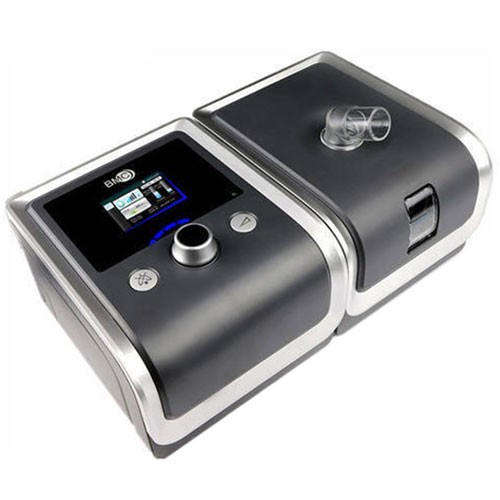
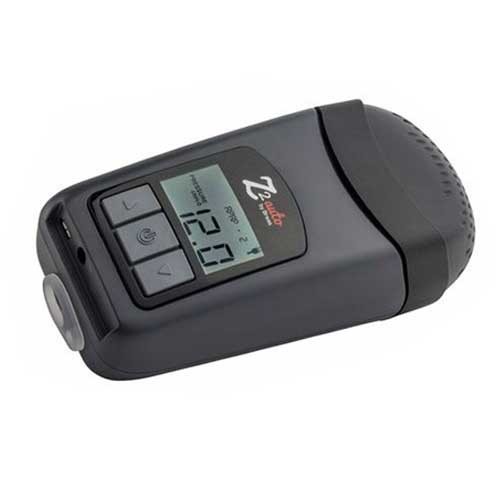
BMC M1 Mini Travel Auto CPAP Machine
Key features
- Type Travel CPAP
- Modes CPAP, AUTO CPAP
- Pressure Range 4 to 20cmH₂O
- Ergonomic Tilted Display No
- Detachable Design No
- Sound level 30dB
Specifications
| Type | Travel CPAP |
|---|---|
| Modes | CPAP, AUTO CPAP |
| Pressure Range | 4 to 20cmH₂O |
| Sound level | 30dB |
| Weight | 0.4Kg |
| Dimensions | 159×66×72mm |
| Company Headquaters | China |
| Auto On/Off | Yes |
| Ramp Duration | 0 - 60min. |
| Auto Ramp | Yes |
| Ramp Down | No |
| EPR | Yes |
| Humidifier | No |
| Mask Fit | Yes |
| Leak Alert | Yes |
|---|---|
| Bluetoooth | Yes |
| CE | Yes |
Pros and cons
PROS
- 400 g weight and 159×66×72 mm footprint fits in a mid-size backpack pocket, making it the only CPAP Indian business travellers actually end up carrying
- 4–20 cmH2O pressure envelope is the full clinical range, not a cut-down travel ceiling at 15 or 18 cmH2O that some compact units settle for
- Bluetooth app compliance workflow via the BMC M1 Mini Light Trip app removes the SD-card-only data off-load that dates this machine's direct competitors
- Roughly 40% cheaper than the ResMed AirMini in India at ₹42,230 indicative street, making portable CPAP accessible to buyers who can't commit ₹70,000+
CONS
- Waterless humidification is a compromise — in Indian winter air (humidity below 40%) it does not match a heated humidifier for mucosal comfort, and 2–3 nights of hotel use without real humidification is the failure mode
- No heated tube, no real humidifier chamber, no climate control — so tier-1 winter hotel rooms at 10–15°C ambient will produce noticeable dry-mouth and epistaxis risk versus a desktop CPAP
- No altitude compensation listed in the published additional details — which is a problem for a travel machine since Indian travel commonly includes Shimla, Manali, Leh and similar addresses
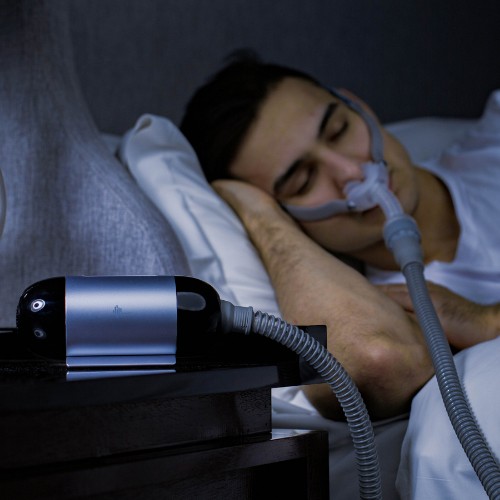
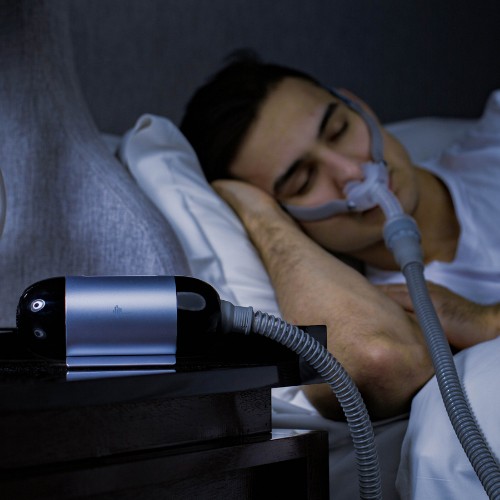
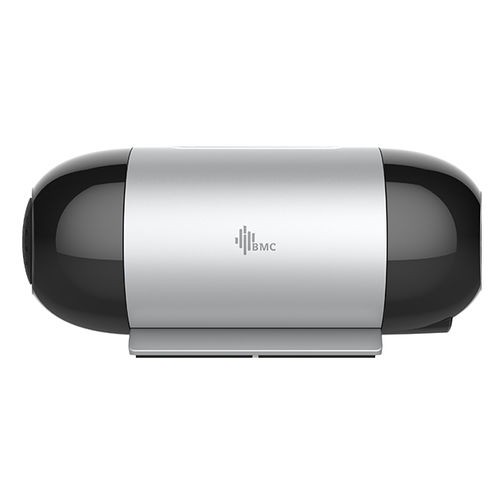
The BMC M1 Mini Travel Auto CPAP is an honest 400 gram travel CPAP that Indian business travellers and frequent-trip patients can actually justify carrying. It occupies the niche where a full-size desktop CPAP — even a compact one like the BMC RESmart GII at 2.5 kg — is too bulky for a 3-day hotel stay, and where the patient has to choose between skipping therapy on the road or dragging a full setup through airport security. The M1 Mini’s answer is a 159×66×72 mm device that fits in a backpack organiser pocket, delivers the full 4–20 cmH2O pressure range in CPAP and Auto CPAP modes, and exposes compliance data via Bluetooth to the BMC M1 Mini Light Trip mobile app. Indicative street price is ₹42,230 against a ₹72,000 MRP per manufacturer brochure and e-commerce product listings; the unit is In Stock in Indian dealer channels, CE certified (FDA not stated in the published additional details), and ships with tubing, two filters, power adapter, two drawstring soft pouches and user manual — but notably without a mask, without any humidifier chamber (waterless humidification is the design philosophy), and without a carry case beyond the pouches.
What the specs actually mean
The headline spec is weight: 400 grams. In context, that is less than half the weight of the ResMed AirMini (roughly 650 g), and about a sixth of the BMC GII desktop at 2.5 kg. This is the spec that decides whether a patient carries the machine or skips therapy on trips, and it is the single reason to buy a travel CPAP rather than just packing the bedroom CPAP. Once a CPAP crosses 1 kg plus humidifier and power brick, it stops being carry-on friendly and starts being checked-baggage territory, which defeats the portability purpose.
The 4–20 cmH2O pressure range is the full clinical band. Some compact CPAPs cap at 15 or 18 cmH2O to simplify the blower design; the M1 Mini does not — it covers the same pressure envelope as the BMC GII desktop. For patients with titrated pressures in the 6–14 band (the bulk of Indian OSA prescriptions), there is no clinical difference in delivered pressure versus a desktop unit. For patients in the 18–20 band, the M1 Mini is still in spec.
The two-mode range (CPAP fixed and Auto CPAP) is the appropriate set for a travel secondary. The clinician sets the auto-titration range and lower/upper bounds from the home-machine data, and the M1 Mini delivers within those bounds during travel nights. Ramp 0–60 minutes and Auto Ramp are both present; EPR (Expiratory Pressure Relief) is listed Yes in the published additional details, which is a real comfort feature that cheaper travel CPAPs routinely skip.
Sound level is published at 30 dB — the same figure the BMC GII desktop carries. That is plausible for a compact blower and is inside the hotel-room-tolerable band; partners and roommates in shared hotel rooms will not be meaningfully more disturbed than with a desktop unit. We have not verified this figure with bench measurements in this review [no bench measurements claimed]; it is the published manufacturer figure and sits at the upper end of what credibly-quiet travel CPAPs achieve.
Waterless humidification — the honest assessment
BMC describes the M1 Mini’s humidification approach as “waterless humidification,” meaning there is no water chamber. In practice, the device relies on a heat-moisture-exchanger (HME) filter in the circuit that captures exhaled moisture and returns it on the next inspiration. This approach has been used in ICU ventilation for decades and works well in moderate humidity environments — the patient’s own exhaled breath provides enough moisture for the next breath.
The honest compromise: HME humidification is noticeably less effective than active heated humidification in two Indian scenarios. First, in dry winter air (north India December-February, where bedroom humidity can fall below 35% RH), the HME cannot keep up — the exhaled moisture is quickly lost in the dry ambient air, and dry-mucosa symptoms (dry mouth, nosebleed, sore throat in the morning) show up within 2–3 nights. Second, in an air-conditioned hotel room set to 20°C with a dehumidifying aircon, the same problem applies. Summer use in most Indian cities with ambient humidity above 60% RH is comfortable. Winter use in a north Indian hotel room is marginal, and the patient should pack oral saline spray and consider a USB-port bedside humidifier as a backup.
This is not a failure of the M1 Mini specifically — all waterless-humidification travel CPAPs have the same limitation, and there is no 400 g travel CPAP with an active heated humidifier built in. The compromise is structural to the product category. Buyers should understand it and plan accordingly.
The Bluetooth app and data story
Compliance off-load is via Bluetooth to the BMC M1 Mini Light Trip mobile app. This is a significant step up from SD-card-only travel CPAPs — the patient can see nightly AHI, usage hours and leak on the phone without visiting a clinic, which is the workflow that actually keeps travel-night therapy honest. SD card is not listed in the published additional details for this SKU, so the Bluetooth app is the primary data route. For a clinician who wants waveform-level data, Bluetooth to app is a compressed summary only — roughly equivalent to the iCode QR workflow on the BMC GII desktop, not equivalent to SD-card waveform data or to ResMed/Philips cloud waveform streams. For travel use this is acceptable.
Altitude compensation is not listed in the published additional details for this SKU. For a travel CPAP, this is a real gap — Indian travel commonly includes hill stations (Shimla 7,100 ft, Manali 6,700 ft, Leh 11,500 ft, Darjeeling 6,700 ft, Gangtok 5,400 ft) where a CPAP without altitude compensation delivers reduced effective pressure as atmospheric pressure drops. The full clinical implication depends on the specific machine’s internal pressure-sensing design — many modern CPAPs compensate automatically even without an explicit “altitude compensation” marker — but the explicit absence in the published spec table is worth verifying with the manufacturer for patients who routinely travel above 6,000 ft.
Who should buy it
The M1 Mini is the right CPAP for an Indian OSA patient who already has a desktop CPAP for home use and who travels frequently enough that the convenience of a 400 g pocket unit justifies the ₹42,230 outlay. That profile covers business travellers on bi-monthly trips, consultants with hotel-heavy weeks, frequent-family-visit patients across cities, and road-trip-prone retirees. For these buyers, the M1 Mini is a secondary machine that travels while the primary desktop stays home.
It is also the right answer for a patient who lives between two cities — one in Delhi, one in Bangalore — and wants a CPAP at each address without buying two full desktop units. At ₹42,230, the M1 Mini plus a desktop CPAP at ₹17,490 comes in well under two desktop units, and the traveller’s bag is always packed.
And it is the right answer for a patient with a titrated pressure in the 6–14 cmH2O band whose clinician is comfortable with the Bluetooth-app summary data during travel nights. For the clinician tracking travel-night data remotely, the Bluetooth-to-app workflow is honest if imperfect.
Who shouldn’t
Anyone who expects the M1 Mini to be their only CPAP — home and travel — should reconsider. The waterless humidification is a real comfort regression versus a heated-humidified desktop for nightly home use in north Indian winter. Over a year of nightly use, the dry-mucosa symptoms wear on adherence. A patient who sleeps on it 30 nights a year (travel) can tolerate this easily; a patient who sleeps on it 300 nights a year cannot.
Anyone with known dry-mucosa sensitivity, recurrent nosebleeds, or allergic rhinitis should not travel with the M1 Mini as their only option. The HME approach is insufficient for these patients, and a desktop CPAP with heated humidifier (even if it means checked baggage) is the better answer for long trips.
Anyone whose travel regularly takes them above 6,000 ft (Leh, Spiti, high-altitude Himachal, parts of Uttarakhand) should verify altitude-compensation behaviour with the manufacturer before buying. The published spec table does not list altitude compensation for this SKU, and at high altitude the effective delivered pressure can drop meaningfully if the machine does not automatically compensate.
Anyone with central-apnea features, cardiac comorbidity, or CompSA on diagnostic PSG should not use the M1 Mini during travel without careful clinician review — the M1 Mini is a pure Auto CPAP (no BiPAP, no ASV, no central-detection) and the clinical risk profile during travel does not change just because the machine is small.
How it compares to real alternatives
M1 Mini vs ResMed AirMini
The ResMed AirMini is the market leader in travel CPAP at a street price in India around ₹70,000–80,000 — roughly 1.7–1.9× the M1 Mini. AirMini weighs about 300 g, uses HumidX heat-moisture exchanger (similar philosophy to the M1 Mini’s waterless humidification), ships with the full ResMed AutoSet algorithm, myAir cloud app, and a mask ecosystem the AirMini is tuned for. It wins on algorithm sophistication, cloud data workflow, weight, and ecosystem; the M1 Mini wins on price and on pressure-range ceiling (AirMini also covers 4–20). Pick the AirMini if the patient already owns a ResMed desktop and wants ecosystem continuity, or if budget permits; pick the M1 Mini if the ₹25,000+ saving is the difference between a travel CPAP and no travel CPAP.
M1 Mini vs Transcend Micro or Transcend 3
Transcend travel CPAPs occasionally enter the Indian grey market at ₹45,000–60,000. Transcend Micro is 340 g, Transcend 3 is 460 g. Both offer 4–20 cmH2O, SD-card data, optional heated-humidifier modules (the Micro lacks integrated humidification entirely), and USA-designed blower platforms. In India, Transcend warranty and service are essentially unsupported — no authorised Indian service channel, parts are import-only. Unless the buyer has a specific reason to prefer Transcend, the M1 Mini wins on Indian service viability alone.
M1 Mini vs carrying the desktop CPAP
For a patient who travels only 2–3 times a year, the honest alternative is to simply pack the desktop CPAP in checked baggage (or carry-on if it fits). A BMC GII desktop at 2.5 kg plus humidifier and cord fits most carry-on cases. The travel CPAP is worth the ₹42,230 only if the patient travels often enough that the convenience saving — faster hotel setup, less bag weight, true carry-on compliance — accumulates meaningfully. Under 10 travel nights a year, the desktop-in-a-bag approach is hard to beat on cost.
Indian-market considerations
BMC’s Indian service network for the M1 Mini is the same as for the broader BMC lineup — distributor-routed, concentrated in tier-1 cities. For a travel CPAP this matters less than for a home-BiPAP in some ways: the patient has a backup desktop at home during any M1 Mini service event. It matters more in another way: travel CPAPs get dropped, knocked around in luggage, and exposed to transit temperature swings that desktop units never see. A crackable plastic chassis at 400 g is a real repair risk, and the 2-year BMC warranty covers manufacturer defects, not travel damage.
CDSCO registration for this specific SKU is not stated in the published additional details in the data we reviewed (CDSCO Medical Device Registry); buyers purchasing through hospital or institutional channels should verify registration status with the supplier.
The unit ships with a universal-input 100–240V power adapter, so international travel outside India is possible with a plug adapter only (no transformer needed). This is more relevant for the India-outbound traveller than for purely-domestic travel, but it is a genuine travel feature. The compact adapter is worth checking at purchase — some travel CPAPs ship with bulky power bricks that negate the weight saving of the machine itself.
The mask is not included in the M1 Mini base SKU per the published what’s-in-the-box list. The buyer must either use a mask from the home desktop CPAP (compatible since mask fittings are universal on standard CPAP circuits) or purchase a travel-specific mask. A ResMed AirFit N30i, P10, or equivalent minimum-contact mask is the usual pairing for travel-night use; budget ₹4,500–7,000.
FAA approval is not listed in the published additional details for this SKU. For in-flight CPAP use on Indian domestic carriers, FAA approval is typically required for inflight electrical-device operation; the M1 Mini’s FAA status should be verified with the manufacturer and with the airline before relying on inflight use (DGCA India). For hotel-room use, FAA status is irrelevant.
Verdict
The BMC M1 Mini Travel Auto CPAP is the cheapest credible travel CPAP in the Indian market, and for frequent travellers with a stable home-titrated OSA prescription in the 6–14 cmH2O band and no central-apnea features, it is a defensible second machine. At 400 g it is genuinely pocketable, the 4–20 cmH2O range is full clinical spec, and the Bluetooth-app compliance workflow is adequate for travel nights. The structural compromises — waterless humidification that struggles in north Indian winter, unlisted altitude compensation, no FAA approval on the published spec table, no mask in the box — are real but predictable for the product category at this price.
Score it 7.0 out of 10. Points off for the humidification compromise in dry-air use, the unlisted altitude behaviour that matters for a travel CPAP heading to Indian hill stations, the absence of a mask in the base SKU (a real hidden cost), and the thinner BMC service footprint for out-of-warranty travel-damage repairs. If the patient travels above 6,000 ft regularly, if heated humidification is clinically required, or if FAA-approved inflight use is a requirement, look at the ResMed AirMini or at packing the desktop unit. For straightforward frequent-travel OSA patients in sea-level cities, the M1 Mini is the right carry-on.