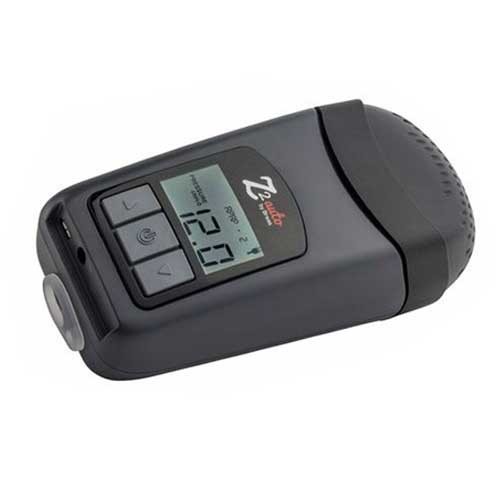
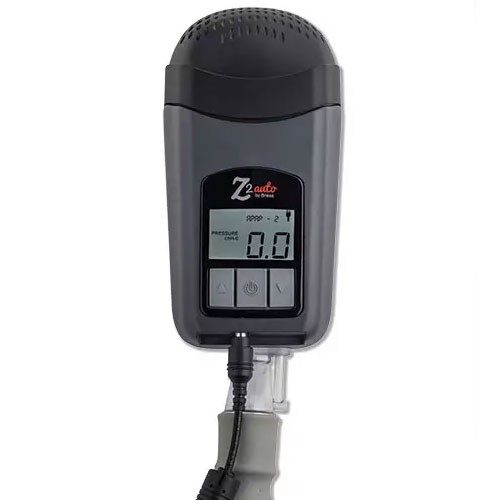
Breas Z2 Auto Travel CPAP
Key features
- Type Travel CPAP
- Modes CPAP , APAP
- Pressure Range 4-20cmH₂O
- Ergonomic Tilted Display No
- Detachable Design No
- Sound level 26dB
Specifications
| Type | Travel CPAP |
|---|---|
| Modes | CPAP , APAP |
| Pressure Range | 4-20cmH₂O |
| Sound level | 26dB |
| Weight | 0.299Kg |
| Dimensions | 164.6x 83.8 x 51.3mm |
| Company Headquaters | Sweden |
| Auto On/Off | Yes |
| Ramp Duration | 0-45min. |
| Ramp Down | No |
| EPR | Yes |
| Humidifier | No |
| Leak Alert | Yes |
|---|---|
| Altitude Compensation | Yes |
| Waterless Humidification | Yes |
| Bluetoooth | Yes |
| FAA | Yes |
| CE | Yes |
Pros and cons
PROS
- 299 gram weight is roughly one-seventh of the 2.0 kg home-APAP class — genuinely carry-on-pocket portable
- FAA-approved for airline-cabin use (explicit on the spec sheet) — the only non-ResMed travel CPAP marked with this on the Indian listing
- 26 dB published sound level with Q-Tube muffler is the quietest machine in the Indian CPAP listing we reviewed
- Waterless humidification using a HME-class heat-moisture-exchange element; no distilled-water supply required at destination
CONS
- ₹62,687 current price is roughly 2.2x the Oxymed SleepEasy and comparable to a full-size premium APAP — you are paying for portability, not for features
- No data infrastructure beyond Bluetooth/Nitelog app; no SD card and no cloud connectivity for clinician-side compliance monitoring
- No heated humidifier, no tilted display, no mask-fit feedback, no CSA detection — this is a stripped travel-only device
The Breas Z2 Auto Travel CPAP is the machine an Indian OSA patient buys when they need to fly regularly and cannot contemplate the idea of packing a 2 kg APAP and its humidifier into checked baggage. At 299 grams with a 26 dB published sound, 4–20 cmH2O pressure envelope, waterless humidification via a heat-moisture-exchanger, a Q-Tube CPAP muffler, Bluetooth data to the Nitelog mobile app, an optional Powershell battery for airline-cabin or off-grid use, and — critically — FAA approval for in-cabin operation, it is the travel CPAP the category defines itself by. The current street price is ₹62,687 against an MRP of ₹90,230. The machine is listed as In Stock and ships as a Sweden-headquartered Breas design (the parent company has strong European clinical-device heritage). It is one of only three travel-form-factor CPAPs available through the Indian dealer channel (the others being the ResMed AirMini at ~₹90,000 and the Transcend 3 MiniCPAP at ~₹65,000).
What the specs actually mean
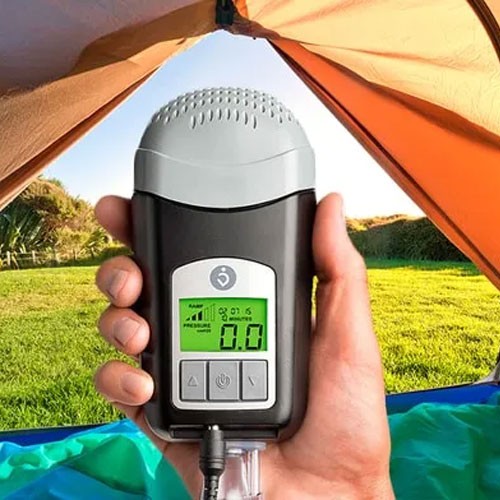
The 299 gram weight is the category-defining spec. A Breas Z2 fits into a toiletry pocket or a laptop-bag compartment; it does not need its own checked-baggage allocation. That changes the CPAP-travel calculus fundamentally. For an OSA patient who has previously avoided overnight travel because packing a home APAP was too onerous, the Z2 reopens that option. Domestic flights, train overnights, road trips and international long-hauls all become CPAP-compatible without negotiation with the airline or the luggage.
FAA approval is explicitly marked on the spec sheet. This is the single permission slip required for in-cabin operation on US-registered and most international airlines; an unmarked CPAP generally cannot be operated during flight, which means an 8-hour international flight is an 8-hour therapy-free night. For an OSA patient with serious AHI (>30) who flies monthly or more, a year of therapy-free travel nights is a meaningful adherence setback. FAA-approved flight operation matters.
The 26 dB published sound level with the Q-Tube CPAP muffler is genuinely quiet. The Q-Tube is Breas’s inline-muffler that sits between the machine and the hose; it damps the turbulent-air noise from the blower and reduces the audible sound to within 1 dB of the ResMed AirMini (which publishes 30 dB without the P10 mask-integrated muffler). In an airline cabin or a shared-room hotel, this matters more than in a home bedroom.
Waterless humidification using a HME (heat-moisture-exchanger) element is Breas’s answer to the “no distilled water at destination” problem that plagues traditional heated-humidifier CPAP travel. An HME element captures moisture from exhaled air and releases it on inhalation — no reservoir, no distilled water, no heated chamber, no risk of spilling water onto the pillow. The trade-off is that HME humidification is less complete than active heated humidification; patients with significant nasal dryness or who are sensitive to dry airway will notice the difference, particularly at pressures above 12 cmH2O. For most travellers on most pressures, the waterless HME is adequate; for patients who live on a heated humidifier at home, the Z2 is comfortable for 3–5 night trips but not for extended travel.
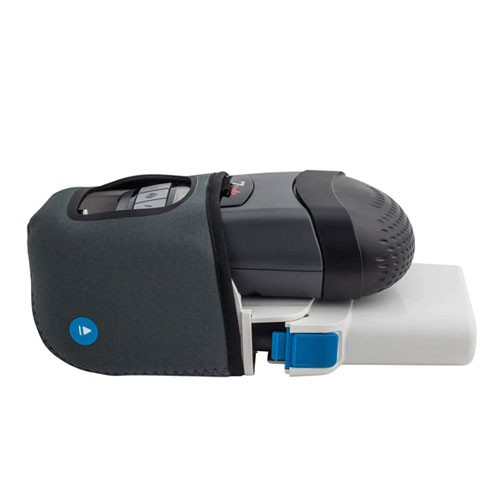
The Powershell battery is an optional accessory (not shipped with the base unit per the listing — confirm inclusion with your dealer). On a Powershell the Z2 can run untethered for approximately 1–2 full nights depending on pressure and battery size, which enables true off-grid or long-international-flight operation.
The 4–20 cmH2O pressure envelope is full adult APAP range. The Z2 Auto has two modes: fixed CPAP and APAP. EPR (exhalation pressure relief, labelled “Z breath” in Breas’s marketing) is marked. Altitude compensation (to 8,000 ft, per Breas’s published documentation) is marked. Leak alerts are marked. Bluetooth data export to the Nitelog iOS/Android app is marked.
What is NOT on the spec sheet: heated humidifier (correctly — this is a waterless machine), detachable design (the blower and HME are integrated), ergonomic tilted display, SD card, cloud connectivity/Wi-Fi, central-apnea detection, RERA reporting, SpO2 monitoring compatibility, trigger/cycle sensitivity (APAP-appropriate), ramp down, adaptive humidification, mask-fit feedback, climate control, preheat. FDA approval is not marked (though FAA is). CE is marked.
Who should buy it
The Z2 is the right machine for a frequent-flying OSA patient. That is the exclusively-correct use case. If the patient flies 10+ times a year for business, makes annual multi-week international trips, or is on a pilgrimage / heritage-tourism schedule that puts them in hotels, dharmshalas and mountain homestays, the Z2 is the machine that keeps CPAP therapy attached to that lifestyle. For the same patient, a 2 kg home APAP plus a travel case is a logistical burden they will not sustain.
It is the right machine as a second CPAP for a household where the primary machine is a heated-humidifier APAP at home. The cost of a second machine is real, but so is the cost of a six-month adherence gap caused by skipping therapy on travel nights. For patients who will log 30–50+ travel nights a year, two machines (home + travel) is the logistically-robust setup.
It is the right machine for a patient whose profession involves domestic on-site deployments — consultants, field engineers, disaster-response medical staff — where the machine needs to fit into a 40-litre backpack along with laptops and clothes and documents. The 299 g plus waterless operation make this scenario work.
It is the right machine for an international traveller carrying an Indian CPAP prescription who needs airline-cabin CPAP operation. FAA approval is the airline permission slip; the Z2 has it documented.
Who shouldn’t
Anyone who does not travel frequently with a CPAP should not buy the Z2. At ₹62,687 you are paying a ~₹35,000 premium over the Oxymed SleepEasy for features (weight, waterless humidifier, FAA approval) that are only valuable if travel is a large fraction of your use case. Home-primary users get better value from the SleepEasy, Harmony or AirSense.
Anyone who relies heavily on heated humidification at home should not use the Z2 as their only CPAP. The HME element is workable for short trips but not equivalent to active heated humidification for long-term daily use. A patient on nasal-steroid therapy, with recurrent nasal dryness, or who lives in very dry climate (Jaipur, Jodhpur, Bikaner in summer) will find the HME inadequate.
Anyone whose prescription includes documented CSA events should not buy the Z2 as the only CPAP. CSA detection is not marked.
Anyone who needs cloud-connected compliance monitoring by their pulmonologist should not rely on the Z2 alone. The data infrastructure is Bluetooth-to-phone-app only; no SD card, no cloud, no clinician-side data portal.
Anyone on a pressure prescription above 16 cmH2O should test the Z2 for sound tolerance before committing. The Q-Tube muffler works well at lower pressures; at the top of the envelope (18–20 cmH2O) the turbulent-air noise becomes more audible and the 26 dB spec is harder to hit.
How it compares to real alternatives
Breas Z2 Auto vs ResMed AirMini
The ResMed AirMini is the direct category competitor. AirMini is ~300 g (essentially identical), ~30 dB (slightly louder per published spec, though mask-integrated mufflers make cabin-noise comparisons context-dependent), APAP mode, waterless humidification (via HumidX inserts in the AirFit mask system rather than in the machine), requires a ResMed-specific mask for humidification (a system-design lock-in), FDA-approved, FAA-approved, myAir cloud data integration, street price ~₹90,000 in India. Z2 wins on machine-independent mask choice (use any standard CPAP mask and hose), on price by ~₹25,000, and on 4 dB of published quietness. AirMini wins on the ResMed service network, on myAir cloud data, and on deeper algorithm validation. For a traveller whose home CPAP is already a ResMed (so myAir continuity matters), AirMini is the integrated choice. For a traveller whose home CPAP is Indian-brand or whose mask preference is set, Z2 is cheaper and more flexible.
Breas Z2 Auto vs Transcend 3 MiniCPAP
Transcend 3 is a competing travel CPAP in the Indian market at roughly ₹55,000–₹65,000. It is slightly heavier (~500 g), similarly quiet, offers waterless humidification. Z2 wins on weight (299 g vs ~500 g), on sound (26 dB vs ~28 dB), and on the specific FAA-approved status. Transcend 3 wins on battery-run-time options in some configurations. Between the two, Z2 is the stronger buy unless the Transcend is priced meaningfully below the Z2 in a specific dealer deal.
Breas Z2 Auto vs a home APAP (Oxymed, BPL, ResMed AirSense)
This is the wrong comparison. A Z2 is not a replacement for a home APAP for daily bedroom use. It is a supplement for travel. For home-only use, every full-size APAP in the Indian market delivers better comfort (heated humidification, broader feature set, better data) at lower price.
Indian-market considerations
Breas is a Swedish-headquartered sleep-therapy and ventilation brand with a multi-decade European clinical heritage. The Z2 is engineered and validated against European regulatory standards. CE marking is explicit. FAA approval is explicit for airline use. FDA is not stated in the published key features or additional details for this SKU.
CDSCO registration for the Indian SKU is not stated in the published data (CDSCO Medical Device Registry). For insurance-reimbursed or institutional purchase, confirm with the dealer at point of sale. For direct-consumer retail, CE marking is the minimum European-equivalent standard.
Voltage handling: the Z2 uses a universal AC power supply with an IEC cord — plugs into any 100–240V supply worldwide, making international travel straightforward. Indian 220V/50Hz is within spec. For battery operation, the Powershell accessory runs on a regulated DC rail and is independent of mains voltage. This is one of the few CPAPs sold in India where you can plausibly skip the voltage stabiliser — the universal PSU has built-in voltage tolerance and the machine will be unplugged during flight operation anyway.
Distilled water and humidifier maintenance: not applicable. The HME element is replaceable (consumable every 3–4 weeks per Breas’s published guidance) and adds ~₹800–₹1,500 to annual running cost. Plan for this in total-cost-of-ownership.
Mask compatibility: the Z2 uses standard 22 mm hose and is compatible with any mask in the nasal, nasal-pillow, or full-face categories. There is no mask-platform lock-in as there is with the ResMed AirMini. This is a structural advantage for patients who have established mask preferences from a prior CPAP.
Service network: Breas Indian service is through the primary dealer channel; service depth is thinner than Oxymed or BPL, broadly comparable to Wellell or ResMed portable-segment. Warranty length is not stated in the listing data we reviewed — confirm with the dealer. Expect 2 years on the machine; the Powershell battery carries a separate, shorter warranty.
Airline-security use case: the Z2 is a documented medical device and travels through security without complication when declared. Carry the original dealer invoice or a prescription copy for international destinations that request evidence.
Verdict
For an Indian OSA patient who travels frequently — 10+ flights a year, regular multi-week trips, on-site professional deployments — the Breas Z2 Auto is the defensible travel CPAP. The 299 g weight, 26 dB sound, waterless HME humidification, Q-Tube muffler, FAA approval and universal power supply are genuinely purpose-built for the travelling user. It is not the machine to buy as your only CPAP; it is the machine to buy in addition to a home APAP, or as the CPAP for a patient whose use case is substantially travel-dominated.
Score it 7.8 out of 10. Points off for the lack of a home-equivalent heated humidifier, the absence of CSA detection, the Bluetooth-only data infrastructure (no SD card, no cloud), the unstated FDA status on the Indian SKU, and the unclear warranty length for the Indian dealer channel. For the carefully-scoped travel-CPAP use case, it is the right machine. For everything else, a full-size APAP at a lower price is the better buy.