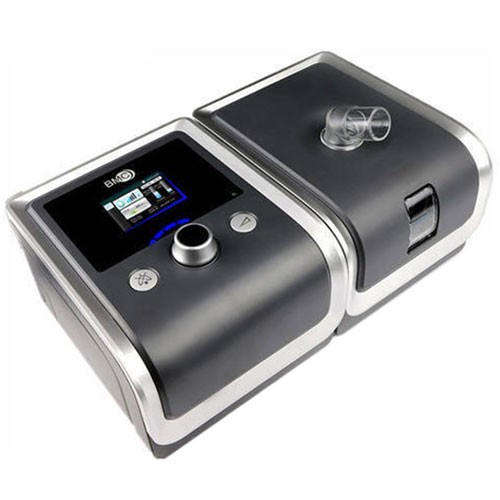
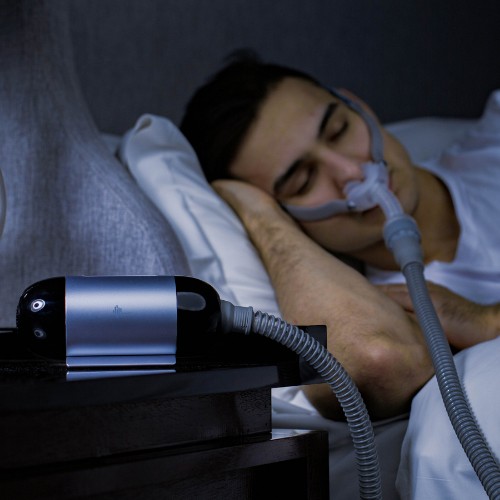
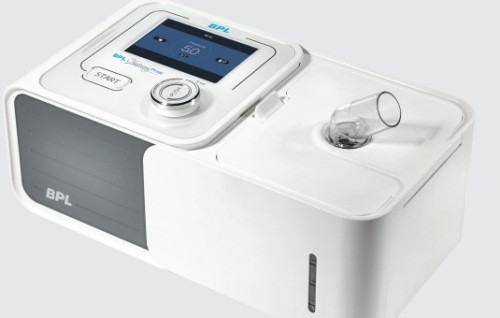
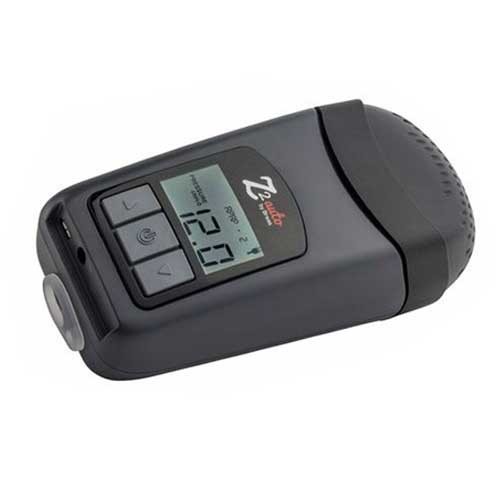
Deckmount VT50 D Harmony (AFlex) Auto CPAP Machine
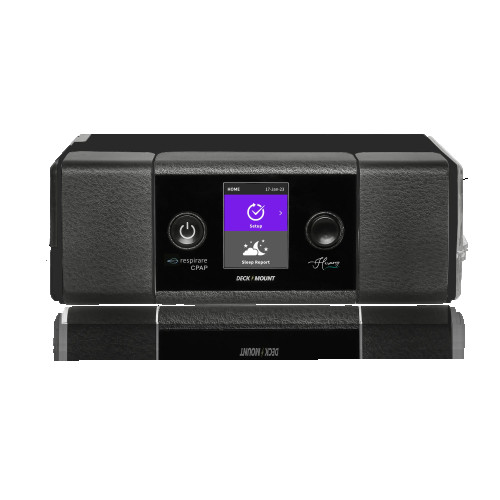
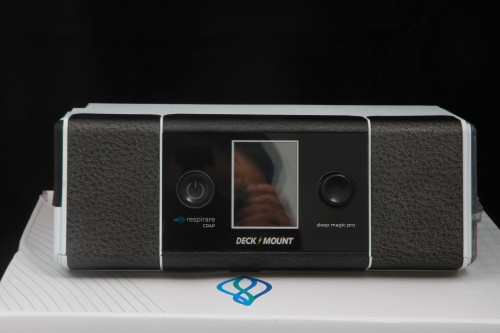
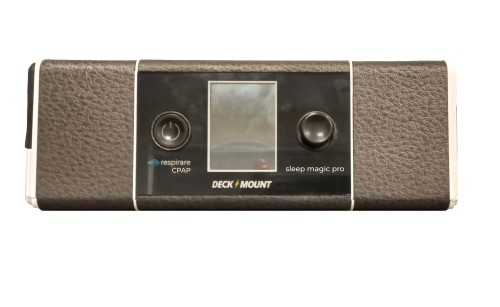
Key features
- Type Auto CPAP
- Modes Auto CPAP with A- flex, CPAP
- Algorithm Standard
- Turbine Made in India
- Pressure Range 4-20cmH₂O
- Ergonomic Tilted Display Yes
Specifications
| Type | Auto CPAP |
|---|---|
| Modes | Auto CPAP with A- flex, CPAP |
| Algorithm | Standard |
| Turbine | Made in India |
| Pressure Range | 4-20cmH₂O |
| Ergonomic Tilted Display | Yes |
| Sound level | 28dB |
| Weight | 1.8Kg |
| Dimensions | 290x160x110mm |
| Company Headquaters | India |
| Auto On/Off | Yes |
| Ramp Duration | 0-45min. |
| Auto Ramp | Yes |
| Ramp Down | No |
| EPR | Yes |
| Humidifier | Heated |
| Leak Alert | Yes |
|---|---|
| Trigger & Cycle sensitivity | Yes |
| SpO2 Monitoring Compatibility | Yes |
| Leakage Compensation | Yes |
| SD card | Yes |
| QR code | Yes |
Pros and cons
PROS
- ₹25,919 current price undercuts the Oxymed SleepEasy (₹28,499) and BPL Harmony (₹35,519) for a recognised-brand Indian APAP
- A-Flex-style exhalation pressure relief is published — the comfort feature most likely to determine adherence in the first 30 nights
- 28 dB published sound level is class-competitive and 2 dB quieter than the Oxymed SleepEasy
- Made-in-India turbine — the machine is domestically-assembled, which matters for spares availability and warranty economics
CONS
- Algorithm is labelled Standard, and central-apnea detection and altitude compensation are NOT marked on the spec sheet
- CE, FDA and cloud-connectivity are not stated in the published key features or additional details
- No mobile-app data infrastructure published; data pathway is SD card plus QR code export only
The Deckmount VT50 D Harmony Auto CPAP is the cheapest AutoCPAP in the Indian branded-dealer channel, currently listed at ₹25,919 against an MRP of ₹59,520. Deckmount is an Indian respiratory-equipment manufacturer with a primarily hospital-channel distribution footprint, and the VT50 is their consumer-accessible APAP SKU. At 1.8 kg with a 28 dB published sound level, 4–20 cmH2O pressure envelope, and an A-Flex-style exhalation pressure relief (marketed as “A-flex” in Deckmount’s mode list), it targets the price-sensitive buyer who wants a recognised hospital-channel brand without paying the BPL or ResMed premium. The machine is listed as In Stock, ships with an Indian turbine and QR-code data export, and is the right price point for a trial-and-adherence-test purchase where the household is unsure whether they will sustain CPAP therapy past the first 90 nights.
What the specs actually mean
The 4–20 cmH2O pressure envelope is standard adult APAP territory. The algorithm is marked “Standard” by Deckmount — an honest label that matches BPL’s Harmony Auto approach, and that tells the buyer the machine implements the basic APAP titration loop without the CSA-aware, RERA-aware or pressure-waveform-shaping features of the premium class. For an uncomplicated OSA prescription with no central-apnea component, Standard APAP is clinically sufficient.
The A-Flex mode (labelled “Auto CPAP with A-flex” in Deckmount’s mode list) is a Philips-style exhalation pressure relief implementation — the machine drops pressure by a set cmH2O amount at the start of exhalation, returning to the prescribed CPAP pressure before the next inspiration. A-Flex matters for first-week-of-therapy adherence: patients who cannot tolerate the feeling of exhaling against fixed positive pressure will often quit therapy in the first 30 nights, and A-Flex or an equivalent EPR implementation is the single feature most likely to retain those patients. Deckmount implementing it is the right call.
The 28 dB published sound level is genuinely class-competitive. It matches the BPL Harmony Auto (28 dB) and is 2 dB below the Oxymed SleepEasy (30 dB). In a typical Indian bedroom with a ceiling fan running, it is inaudible.
The 1.8 kg chassis is mid-pack — heavier than BPL Harmony (1.55 kg) and Wellel iX (1.49 kg), but lighter than the 2.0–2.2 kg range of some competing Indian APAPs. For bedside use this is fine; for frequent travel, the Harmony or Wellel is a better pack weight.
What is on the spec sheet: heated humidifier, trigger-and-cycle sensitivity configurable (unusual on an APAP — this is usually a Bi-Level feature, and Deckmount exposing it here suggests the VT50 uses a Bi-Level-capable motherboard in a CPAP configuration), SD card data, QR-code data export, SpO2-monitoring compatibility, EPR, leak compensation, leak alerts, auto on/off, auto-ramp, and heated-humidifier preheat.
What is NOT on the spec sheet but should be on a premium APAP: central-apnea detection is NOT marked, altitude compensation is NOT marked, adaptive humidification is NOT marked, mask-fit feedback is NOT marked, heated-tube compatibility is NOT marked, cloud connectivity / Wi-Fi / Bluetooth / mobile app are NOT marked. The omission of central-apnea detection and altitude compensation on a 2026 APAP at this price is a real spec gap — both the Oxymed SleepEasy and the Wellel iX mark both features on their equivalent-price SKUs.
CE, FDA, and RERA reporting are not stated in the published key features or additional details.
Who should buy it
The VT50 is the right machine for a price-sensitive first-time OSA patient whose budget ceiling is ₹28,000, who has uncomplicated OSA (no central-apnea component on the sleep study), who lives and sleeps below 7,000 ft elevation where altitude compensation does not matter clinically, and who is willing to take the spec-sheet-transparency trade-off for a ₹3,000–₹10,000 price saving against the Oxymed or BPL alternatives.
It is the right machine for a hospital-channel or bulk-purchase deployment where Deckmount’s procurement relationships apply. Deckmount is known to Indian hospital procurement officers for nebulisers, suction units and oxygen concentrators; the VT50 flows through the same channels as those products. For a dharmshala, sleep clinic, or public-hospital deployment where cost per machine is the dominant variable, Deckmount’s volume-channel pricing can be meaningfully better than the retail numbers we’re pricing against here.
It is the right machine for a household that is specifically unsure whether CPAP therapy will be sustained past 90 nights. At ₹25,919, if the patient abandons therapy after 2 months, the sunk cost is smaller than on a ₹35,519 BPL or a ₹45,000+ ResMed purchase. For genuinely uncertain-adherence cases, the lower-price floor matters.
It is the right machine for a patient whose clinician is comfortable with a Standard algorithm and whose data workflow is SD-card download plus QR-code export at clinic visits. For that clinical model, the VT50 does what is required.
Who shouldn’t
Anyone with a sleep study showing central-apnea events should not buy the VT50. Central-apnea detection is not marked. A Standard algorithm that responds to every apnea with pressure escalation can worsen treatment-emergent CSA. Step up to an APAP that marks CSA detection explicitly.
Anyone whose residence or prescription involves elevations above 2,000 m (Shimla, Manali, Darjeeling, Gangtok, and any above-2,500 m destination) should not buy the VT50. Altitude compensation is not marked. A CPAP that cannot compensate for altitude will under-deliver prescribed pressure at elevation.
Anyone whose pulmonologist runs a cloud-based compliance-monitoring programme should not buy this machine. There is no Bluetooth, no Wi-Fi, no mobile app marked. Data comes off the SD card.
Anyone who wants heated-tube compatibility for rainout-free north-Indian winter operation should not buy the VT50. That feature is not listed.
Anyone who is willing to pay ₹3,000 more for the Oxymed SleepEasy (₹28,499) should do so — the SleepEasy adds CSA detection, altitude compensation, adaptive humidification, mask-fit feedback, and mobile-app data, and adds 1 year of warranty with PAN-India home service. The Deckmount is ₹3,000 cheaper, but every spec difference favours Oxymed.
How it compares to real alternatives
VT50 vs Oxymed SleepEasy AutoCPAP
The closest direct comparison. SleepEasy is ₹28,499, 30 dB, 2.0 kg, German turbine, 3-year PAN-India home-service warranty, mobile-app data, CSA detection marked, altitude compensation marked, adaptive humidification marked, mask-fit feedback marked, FlowSens-labelled Advanced algorithm. VT50 is ₹25,919, 28 dB, 1.8 kg, Made-in-India turbine, warranty and home-service terms not clearly stated in the listing data we reviewed, SD-card plus QR-code data, CSA NOT marked, altitude compensation NOT marked, Standard algorithm. SleepEasy wins on almost every spec dimension for a ₹2,580 premium — the warranty and service coverage alone justify the delta. The VT50’s price advantage is real but narrow.
VT50 vs BPL Harmony Auto
BPL Harmony is ₹35,519, 28 dB, 1.55 kg, 2-year warranty, SD-card data, Standard algorithm, no CSA detection marked, altitude compensation marked. For a ₹9,600 premium over the VT50, BPL offers the lighter chassis, altitude compensation, and the BPL brand relationship. For a procurement-driven or brand-sensitive buyer, BPL wins; for pure price-per-function, VT50 is cheaper and the feature set is only modestly narrower.
VT50 vs ResMed AirStart 10 / AirSense 10 Auto
ResMed sits ₹25,000–₹45,000 above the VT50. For that premium you get Easy-Breathe waveform, ClimateLineAir heated-tube compatibility, myAir cloud data, peer-reviewed algorithm validation, and the best service network in India. For a patient expected to be on CPAP for 10+ years, ResMed is the long-horizon buy. For an uncertain-adherence 90-day trial, the VT50’s lower price floor is the better risk posture.
VT50 vs Wellel iX Auto
Wellel iX is ₹65,280 (when available — currently out of stock), 28 dB, 1.49 kg, Taiwan-made turbine, Advanced algorithm labelling, Wi-Fi cloud connectivity, adaptive humidification marked, CSA detection marked. On any feature-per-rupee basis Wellel is the better machine, but the price premium is ₹39,000 and availability has been inconsistent. For a budget-binding purchase, VT50 wins; for a feature-led purchase where Wellel is in stock, Wellel is well ahead.
Indian-market considerations
Deckmount assembles in India and uses a Made-in-India turbine. For a ₹25,919 machine, domestic assembly is the right answer on spares-availability grounds — a turbine, humidifier chamber or adapter that fails in year 3 is much easier and cheaper to replace on an Indian-manufactured machine than on an imported premium unit. This is the same structural advantage that Oxymed and BPL claim on their home-assembled SKUs.
Voltage: 220V/50Hz. Stabilise at the wall with a 1-kVA unit. Any CPAP blower running overnight needs voltage conditioning regardless of manufacturer.
CE and FDA approvals are not stated in the published key features or additional details for this SKU (CDSCO Medical Device Registry). For a purely-domestic-retail out-of-pocket purchase, this is not a showstopper. For any CGHS/ECHS/insurance-reimbursed purchase, confirm CDSCO registration with the dealer at point of sale.
Service network: Deckmount’s service network is weighted to metros and tier-2 cities where their hospital-channel customers sit. Tier-3 city support is thinner than Oxymed’s or BPL’s PAN-India networks. For a tier-3 buyer, the Oxymed SleepEasy with its documented PAN-India home-service commitment is a materially better warranty-service proposition than the VT50.
Data: SD card plus QR-code export. The QR-code pathway is a Deckmount-specific convenience for patients to export compliance summaries from the machine display via phone camera — it works, but it is a manual-capture workflow, not a cloud-integrated one. For a clinician who asks the patient to bring a phone screenshot of the previous month’s AHI and usage numbers to each visit, this is serviceable.
Warranty: length and terms are not clearly stated in the listing data we reviewed. Confirm with the specific authorised Deckmount dealer at point of sale. For a ₹25,919 machine, the warranty length is part of the total-cost-of-ownership calculation — a 2-year warranty against Oxymed’s 3-year plus home service is a real economic delta over the life of the machine.
Verdict
The Deckmount VT50 D Harmony Auto CPAP is the cheapest recognised-brand AutoCPAP in the Indian dealer channel and at ₹25,919 it is a legitimate entry-price APAP for an uncomplicated OSA prescription below 2,000 m elevation. The A-Flex implementation, the 28 dB sound, and the A-Flex-class comfort story are correct for a first-time CPAP patient. But the algorithm is Standard, central-apnea detection is not marked, altitude compensation is not marked, and the data infrastructure is SD-card-plus-QR-code rather than app-connected.
Score it 6.8 out of 10. Points off for the missing CSA detection (material spec gap at this price), missing altitude compensation (matters for Indian hill-station deployments), unstated CE/FDA status, and unclear warranty length and service coverage versus the Oxymed alternative. If the ₹2,580 price delta to the Oxymed SleepEasy is not the binding budget constraint, buy Oxymed — every spec dimension favours it. If ₹25,919 is the absolute ceiling, the VT50 is a competent Standard APAP that will do its job for a simple prescription.