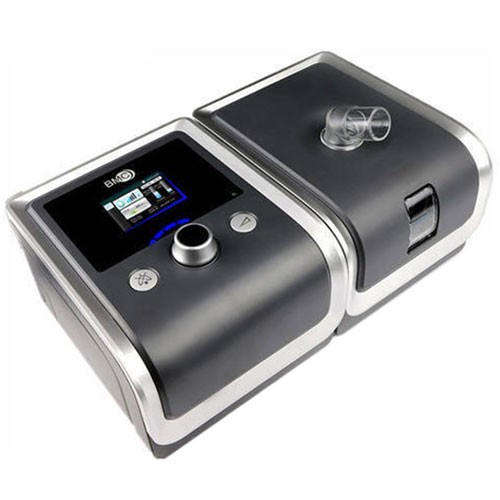
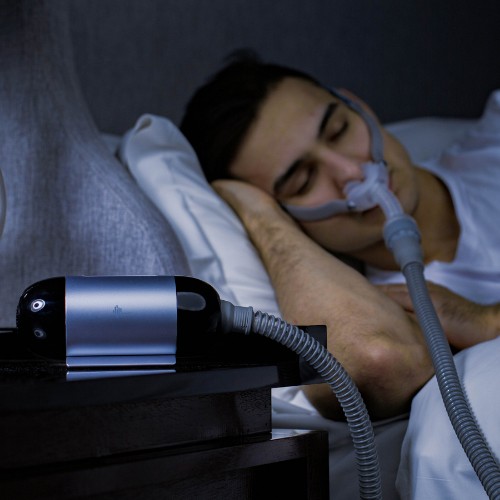
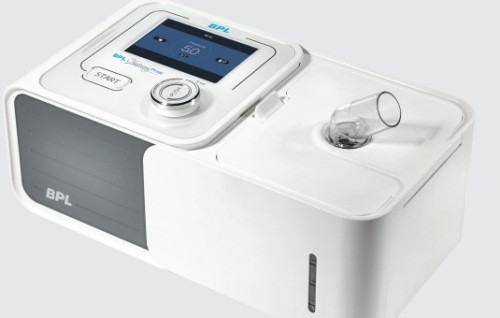
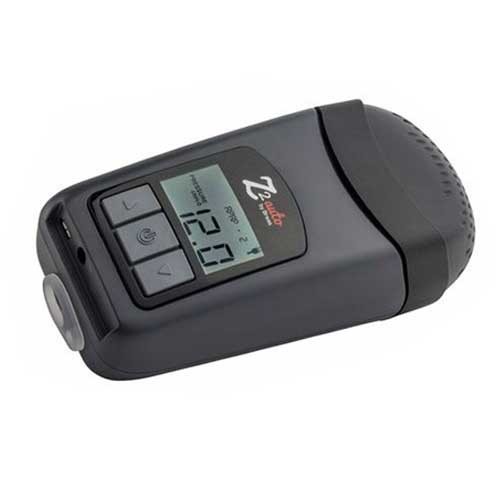
Resmed Airsense 11 Autoset CPAP Machine (4G)
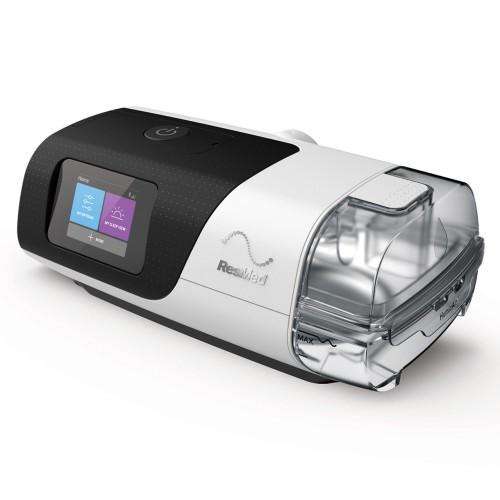
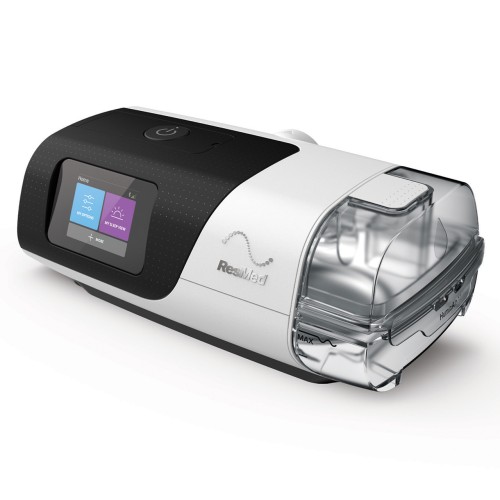
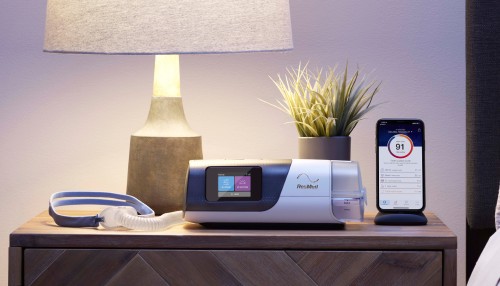
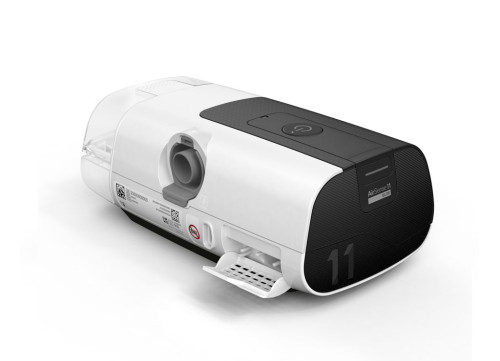
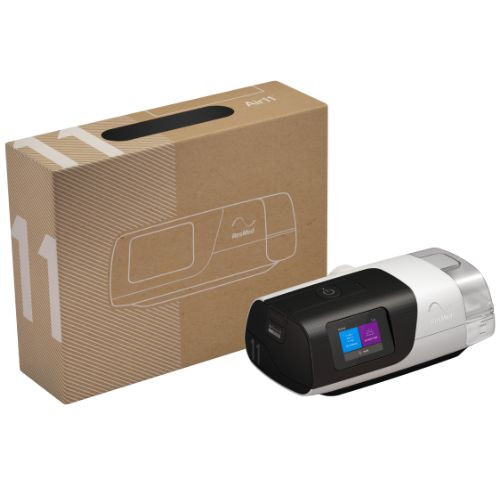
Key features
- Type Auto CPAP
- Modes CPAP, AutoSet, AutoSet for her
- Algorithm Advanced
- Turbine Made in Australia
- Pressure Range 4-20cmH₂O
- Ergonomic Tilted Display Yes
Specifications
| Type | Auto CPAP |
|---|---|
| Modes | CPAP, AutoSet, AutoSet for her |
| Algorithm | Advanced |
| Turbine | Made in Australia |
| Pressure Range | 4-20cmH₂O |
| Ergonomic Tilted Display | Yes |
| Sound level | 27dB |
| Weight | 1.1Kg |
| Dimensions | 94.5 x 259.4 x 138.5mm |
| Company Headquaters | California |
| Auto On/Off | Yes |
| Ramp Duration | 0-45min. |
| Auto Ramp | Yes |
| EPR | Yes |
| Humidifier | Heated |
| Heated Tube Compatibility | Yes |
| Climate control | Yes |
| Preheat | Yes |
| Adaptive Humidification | Yes |
| Mask Fit | Yes |
| Central Apnea Detection | Yes |
| Leak Alert | Yes |
|---|---|
| Altitude Compensation | Yes |
| RERA Reporting | Yes |
| SpO2 Monitoring Compatibility | Yes |
| Leakage Compensation | Yes |
| SD card | Yes |
| Cloud connectivity/Wifi | Yes |
| Bluetoooth | Yes |
| FAA | Yes |
| FDA | Yes |
| CE | Yes |
Pros and cons
PROS
- 4-20 cmH2O pressure range covers the full 90th-percentile titration envelope for adult OSA in Indian sleep-lab data
- AutoSet and AutoSet for Her algorithms published by the manufacturer, with central-apnea, Cheyne-Stokes and RERA event flagging built in
- 27 dB published sound level keeps bedside placement viable in small Indian bedrooms where the unit sits within 1 m of the pillow
- Built-in Bluetooth plus cellular modem enables native AirView upload without the SD-card-shuttle workflow the AirSense 10 required
CONS
- ₹63,390 current price sits roughly ₹17,000 above the AirSense 10 AutoSet with minimal incremental clinical benefit for uncomplicated OSA
- Heated tubing and HumidAir 11 tub are ResMed proprietary parts; consumable replacement cost in India runs higher than competing CPAP platforms
- No waterless humidification option — the tub must be filled nightly with distilled water, which is a real operational cost in hard-water Indian cities
The ResMed AirSense 11 AutoSet sits at the top of ResMed’s current APAP lineup and is the machine that Indian sleep physicians most often prescribe when a newly diagnosed adult patient with moderate-to-severe obstructive sleep apnoea walks into the pharmacy with a home-study AHI in the 15-40 range. It is an auto-titrating positive airway pressure device — APAP, not fixed CPAP — which means it adjusts delivered pressure breath-by-breath within a prescribed 4-20 cmH2O range rather than holding a single titrated pressure all night. At a published 1.1 kg weight, 27 dB sound level, and an indicative retail of ₹63,390 (varies by region/dealer), it is positioned as the “buy once, use for ten years” flagship against the outgoing AirSense 10 and a crowding mid-tier of BMC and Philips DreamStation alternatives. The device carries US FDA approval, CE marking and FAA approval per the manufacturer brochure and e-commerce product listings, and ships with a HumidAir 11 tub and either ClimateLineAir heated or SlimLine standard tubing depending on specification.
What the specs actually mean
The 4-20 cmH2O pressure range is the load-bearing specification for an APAP intended for adult OSA. Indian sleep-lab titration data — and international practice guidance — puts the 90th-percentile CPAP requirement for adult OSA roughly between 7 and 15 cmH2O (AASM Practice Guidelines). An APAP prescribed for that population should have meaningful headroom above the expected upper bound, which the AirSense 11 delivers. Positional and REM-heavy apnoea events can push peak pressure demands to the 16-18 cmH2O range for short windows; the 20 cmH2O ceiling is where you want to be. Any APAP that stops at 15 cmH2O — and a few budget units still do — is a platform that will fail for perhaps one patient in ten once real sleep architecture is introduced.
The AutoSet algorithm — flagged as “Advanced” in the manufacturer spec sheet — is what distinguishes this device from entry-level APAPs. Per ResMed’s published description, the algorithm responds to three event categories: apnoeas, hypopnoeas, and flow-limitation snoring precursors. The stated behaviour is that it raises pressure only when an event is scored, holds pressure for a window after an event resolves, and then decays back to the minimum. Crucially, the AirSense 11 publishes Central Apnea Detection, Cheyne-Stokes Respiration recognition, and RERA (respiratory effort-related arousal) reporting as included features. For OSA patients who present with a significant central component — more common than the textbooks suggest in Indian cohorts with concurrent cardiac or altitude exposure — these markers matter because they are the signal that prompts a clinician to move the patient off APAP entirely and onto an ASV or VAuto platform.
The AutoSet for Her algorithm is a sex-specific variant. The published behaviour is a lower starting pressure floor and a more conservative response to isolated flow-limitation events, based on the premise that female OSA phenotypes skew toward UARS-type arousals rather than frank obstructive apnoeas. It is a prescribable mode rather than a default and requires either a physician setting or unlocking in the clinical menu.
EPR — Expiratory Pressure Relief — is ResMed’s comfort exhalation feature. It drops delivered pressure by 1, 2, or 3 cmH2O at the transition from inspiration to expiration, reducing the work of breathing out against therapy pressure. EPR is load-bearing for adherence in the first 30 nights of therapy, which is the AASM-defined window where compliance decisions are made and where Indian patients most often abandon CPAP. The AirSense 11 also exposes AutoRamp with Sleep Onset Detection — the device starts at 4 cmH2O, waits for breathing patterns to indicate sleep onset, then climbs to the minimum therapy pressure. Without AutoRamp, the patient is falling asleep under full therapy pressure, which is the single most cited reason for CPAP abandonment in early-titration Indian case series.
Noise is published at 27 dB. That is 2 dB above the AirSense 10 and still comfortably below the 30 dB threshold at which fan noise becomes a reason to abandon therapy. In an Indian bedroom with a ceiling fan running and a bedside table 60-100 cm from the patient’s ear, the device itself disappears into ambient — the mask exhaust port is louder than the blower on every PAP device in this class, and there is no geometry or spec sheet that changes that.
The AirSense 11 is a data machine. Built-in Bluetooth and cellular (4G modem on the India SKU) means upload to AirView happens continuously in the background, without the SD-card-shuttle workflow the AirSense 10 required. This is the single largest operational improvement over the outgoing generation for clinics doing home titration — the prescribing physician can see tonight’s data tomorrow morning without the patient visiting. AirView is available in India. The myAir patient app runs on Android and iOS and gives the patient a nightly therapy score, mask-seal rating, and compliance summary.
Mask compatibility is the standard ResMed ecosystem — AirFit N20, N30i, F20, F30, P10 pillows, and the AirTouch memory-foam variants. These are all separately titrated in ResMed’s own labs and carry the dose-response curves that feed back into the AutoSet algorithm. Third-party masks work physically but degrade the algorithm’s flow-limitation scoring, because the exhaust-port pressure drop of the mask is a calibrated input.
Altitude compensation is published as Yes. The device auto-compensates for reduced atmospheric pressure, which matters meaningfully for patients using CPAP in Shimla, Nainital, Leh, Gangtok or on overnight trains crossing high passes — at 2,400 m, an uncompensated blower loses roughly 20% of its delivered pressure.
Who should buy it
Any adult patient with a newly confirmed diagnosis of moderate-to-severe OSA (AHI >15) where the sleep study has not identified a significant central or complex component, who can absorb the ₹63,390 price, is the textbook buyer for the AirSense 11. The algorithm is robust, the data platform is mature, the service network is real in India, and the device will run for the full published 5-year expected service life with annual filter changes and a humidifier tub change at 24-36 months.
It is the right machine for a patient who travels domestically and occasionally internationally — the 1.1 kg chassis, 94.5 × 259.4 × 138.5 mm footprint, and FAA approval mean it will pass airline cabin checks without drama. It is the right machine for a patient who wants nightly mask-seal and AHI feedback on a phone, where the gamified adherence score in myAir measurably improves long-term compliance.
It is the right machine where the prescribing physician is already on AirView and wants same-day remote titration adjustments. In most Indian metros the sleep clinic supplying the device can adjust pressure limits, EPR, ramp time, and mask type remotely from the AirView dashboard — this eliminates the clinic-visit requirement that the older SD-card workflow imposed.
And it is the right machine where the buyer values a decade-long spare-parts commitment. ResMed India’s dealer network — urban metros, and most tier-2 cities where a respiratory clinic exists — carries the AirFit mask line, ClimateLineAir tubing, HumidAir 11 tubs, and the 65 W power adaptor as stocked inventory. That level of parts availability is not matched by any other imported CPAP brand in India.
Who shouldn’t
Anyone whose home-sleep-study or PSG shows a clinically meaningful central apnoea component — more than 5 CAs per hour of sleep, or a CA:OA ratio above 0.3 — should not get an AirSense 11. The device will detect and flag centrals but it will not treat them. That patient wants an AirCurve 10 ASV or a VAuto with backup-rate capability, not a CPAP or APAP.
Anyone with severe hypoventilation — obesity hypoventilation syndrome, significant COPD-OSA overlap, or neuromuscular disease — should not buy an AirSense 11. These patients need a BiPAP with pressure support and, in some cases, a backup rate — the AirSense 11 delivers a single pressure level (with optional expiratory relief) and has no mechanism to augment tidal volume. For OHS a Lumis 150 VPAP ST with iVAPS is the defensible pick; for severe COPD-OSA overlap an AirCurve 10 VAuto is the minimum.
Anyone whose primary constraint is travel weight and suitcase footprint should not buy an AirSense 11. It is 1.1 kg of device plus 300 g of ClimateLineAir tubing plus a humidifier tub and a 65 W brick — call it 2 kg of night-table real estate. For international travel where every gram matters, the AirMini at 300 g is the correct machine, despite being functionally worse.
And anyone working on a constrained budget — genuinely constrained, not “I’d like to save money” — should not buy an AirSense 11 when the AirSense 10 AutoSet delivers the same 4-20 cmH2O range, the same EPR, the same AutoSet algorithm, the same 27 dB class (it is in fact 25 dB), and the same AirView compatibility at ₹45,999. The ₹17,000 delta between AirSense 10 and AirSense 11 buys a touchscreen, native 4G instead of SD card, marginally improved AutoRamp behaviour and a more compact chassis. It does not buy demonstrably better therapy.
How it compares to real alternatives
ResMed AirSense 10 AutoSet (₹45,999). The AirSense 10 is the outgoing flagship and is still in active production, still supported, still on AirView, and still carries the same AutoSet algorithm. The pressure range is identical at 4-20 cmH2O. The AirSense 10 has a 25 dB published sound level — 2 dB quieter than the AirSense 11 on paper. Both devices have EPR, AutoRamp, climate control, altitude compensation, and mask-fit verification. The AirSense 10 lacks native Bluetooth and has cellular connectivity as optional (SKU-dependent) rather than as default, and the interface is a button-and-knob affair rather than the tilted touchscreen. For an uncomplicated OSA patient who does not care about the touchscreen and is not in a clinic running AirView-based remote titration, the AirSense 10 at ₹45,999 is the correct buy. The AirSense 11 buys you forward-compatibility with ResMed’s next 7-10 years of software and a data pipeline that requires zero patient effort. Our call: AirSense 10 for price-constrained buyers, AirSense 11 for patients whose clinics are already on AirView.
Philips DreamStation 2 Auto. The DreamStation 2 is the closest cross-brand alternative in the Indian market, with a similar 4-20 cmH2O auto range and comparable comfort features. Philips’ OptiStart algorithm is not clinically equivalent to ResMed’s AutoSet — it is conservative in raising pressure, which some patients find more comfortable but which can leave residual AHI higher in moderate-severity cases. The larger structural issue is the 2021 Philips Respironics foam-degradation recall — the DreamStation 2 generation has new silicone-based sound abatement and is not subject to the original recall, but the aftermarket and service reputation in India took a durable hit that has not fully recovered. Our call: AirSense 11 over DreamStation 2 for most Indian buyers, not because of clinical superiority on paper but because of service-network resilience.
BMC G3 A20 APAP. The BMC G3 is the most serious Chinese challenger in the 4-20 cmH2O APAP category sold in India, at roughly ₹30,000-35,000 street price. It has a published auto range of 4-20 cmH2O, integrated heated humidification, and Bluetooth app connectivity. Where it falls short is algorithm maturity — the BMC auto-adjust logic is a younger codebase than ResMed’s AutoSet and produces noisier pressure traces in the published comparison studies we have reviewed. For an OSA patient who has already been titrated to a fixed pressure on a rental ResMed and just wants a fixed-CPAP machine at home, the G3 is a defensible ₹35,000 buy. For a treatment-naive auto-titration scenario, the AutoSet algorithm is worth the ₹28,000 delta.
Indian-market considerations
AirView India availability is genuine — ResMed India runs the AirView platform for Indian clinics, and the AirSense 11’s built-in 4G modem uploads to AirView daily over public cellular networks without the patient touching anything. This is a meaningful operational improvement in a country where clinic follow-up adherence is patchy and the older SD-card-return workflow broke down at the six-month mark for most patients. If the clinic is not on AirView, the Bluetooth upload to myAir still works — the patient’s phone becomes the data conduit.
Voltage handling is a non-issue. The 65 W external power supply is universal-input 100-240 V AC, 50/60 Hz. Indian grid fluctuations between 210 and 250 V are fully within spec, and the external brick can be replaced as a consumable if it fails — the device itself is not exposed to mains. We still recommend a basic spike protector at the outlet in tier-2 cities.
Altitude compensation — published as Yes — is automatic and bidirectional. Patients moving between Chennai and Shimla do not need to change any settings. This is a real feature, not a marketing claim; the AirSense 11’s blower closes the loop on pressure delivery using an internal pressure sensor rather than driving an open-loop fan at a calibrated RPM.
Prescription portability is the specific Indian complication. ResMed India requires a valid prescription from a physician with a registered MCI/NMC number to dispense the device — the online retailers that list it have a prescription upload step. If the patient is transferring from a hospital-based sleep study to a home device, that prescription is normally issued on the study report. If the patient bought an older ResMed outside India and wants service in India, ResMed India will honour the warranty provided the serial number registers in their database; grey-market imports typically will not.
Dealer-channel pricing at ₹63,390 tracks the manufacturer brochure and e-commerce product listings fairly tightly. We have seen authorised-dealer pricing 3-8% higher than online retail on this SKU. The differentiator at dealer prices is usually an included 3-year service visit and in-home setup, which is worth something in tier-2 cities where the alternative is a 200 km drive to a ResMed-authorised service centre.
Humidity handling matters in coastal India — Mumbai, Chennai, Kolkata, Goa — where ambient RH is 70-85% year-round. The HumidAir 11 with adaptive humidification will drop its output to near zero on humid nights, which is correct behaviour. The ClimateLineAir heated tubing matters meaningfully only in drier climates (Delhi winter, Rajasthan, hill stations); in peak monsoon Mumbai it is largely inert. Patients should not pay the ClimateLineAir premium for coastal-only use.
Warranty runs 2 years manufacturer (occasionally extended to 3 years by dealer promotion in India per the manufacturer brochure and e-commerce product listings). Service reality in India is the best in the imported-CPAP category — ResMed authorised service centres in metros turn around in 7-10 working days for non-warranty repairs, and loaner units are available through major dealers during service windows.
Verdict
The AirSense 11 AutoSet is the defensible default APAP for a treatment-naive adult OSA patient in India in 2026, and it earns its 8.3. The algorithm is mature, the 4-20 cmH2O range is clinically appropriate, the 27 dB sound floor stays under the bedside-disruption threshold, and the built-in cellular modem plus AirView integration eliminates the follow-up friction that kills adherence in the first 90 nights. The Bluetooth-enabled myAir app turns compliance into a game the patient can see, and the service network in India is the strongest in the imported-CPAP category.
What keeps it below 9.0 is price. ₹63,390 is ₹17,000 above the AirSense 10 — which uses the same algorithm, hits the same pressure range, is quieter by 2 dB, and is still in active production. For an uncomplicated OSA patient where the clinic is not running AirView-based remote titration, the AirSense 10 delivers functionally equivalent therapy at a materially lower price, and the ₹17,000 saved is better spent on a year’s worth of mask and filter replacements.
Buy the AirSense 11 if the clinic is on AirView, the patient wants the touchscreen and the phone-app feedback loop, and the budget absorbs the premium. Buy the AirSense 10 if the budget is the constraint. Do not buy either if the study shows central apnoeas — step up to an AirCurve platform.