Resmed AirMini Travel Auto CPAP
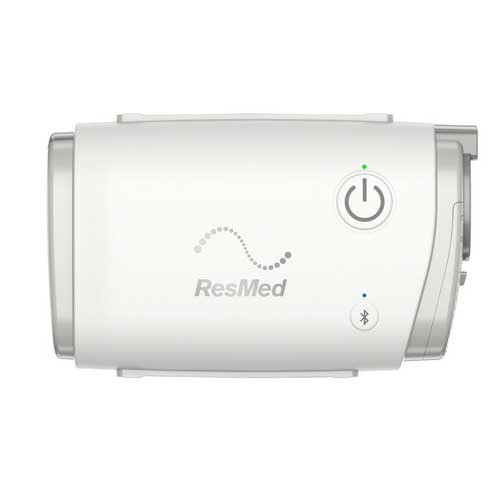
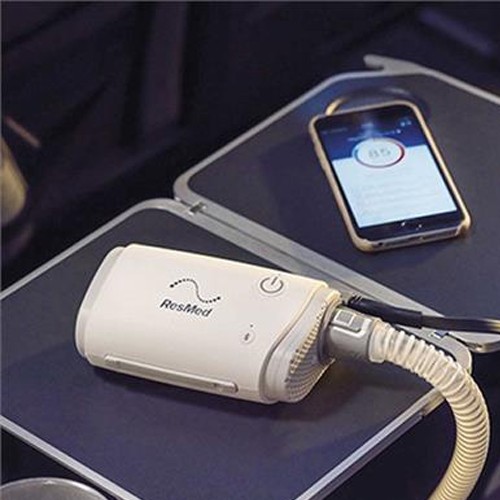
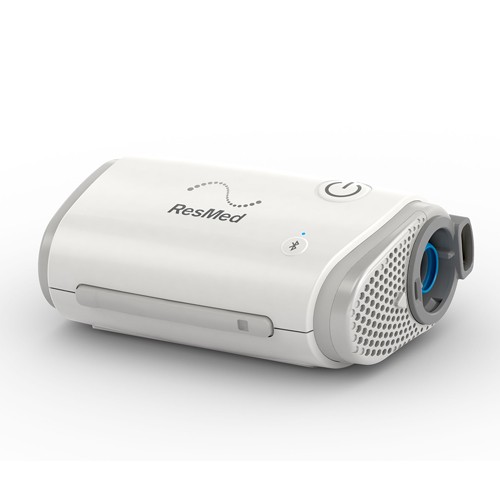
Key features
- Type Auto CPAP
- Modes CPAP, AutoSet(APAP), AutoSet for Her (APAP).
- Algorithm Advanced
- Pressure Range 4-20cmH₂O
- Ergonomic Tilted Display No
- Detachable Design No
Specifications
| Type | Auto CPAP |
|---|---|
| Modes | CPAP, AutoSet(APAP), AutoSet for Her (APAP). |
| Algorithm | Advanced |
| Pressure Range | 4-20cmH₂O |
| Sound level | 27dB |
| Weight | 0.3Kg |
| Dimensions | 136 x 84 x 52mm |
| Company Headquaters | California |
| Auto On/Off | Yes |
| Ramp Duration | 0-45min. |
| Ramp Down | No |
| EPR | Yes |
| Humidifier | No |
| Mask Fit | Yes |
| Leak Alert | Yes |
|---|---|
| Waterless Humidification | Yes |
| Bluetoooth | Yes |
| QR code | Yes |
| FAA | Yes |
| FDA | Yes |
| CE | Yes |
Pros and cons
PROS
- 300 g weight and 136 × 84 × 52 mm footprint fits inside a laptop bag, unmatched in any full-featured CPAP currently sold
- Waterless HumidX humidification eliminates distilled-water dependency for international travel where sourcing is unreliable
- AutoSet and AutoSet for Her algorithms identical to AirSense line, with full 4-20 cmH2O pressure range
- FAA approval on the device and the published 4G-free Bluetooth-only data path make airline carry-on use straightforward
CONS
- Proprietary mask ecosystem — only AirFit N30, P10, F20, F30 AirMini variants work, and the mask integrates the pressure-regulation valve
- No battery; requires mains power or a separately-sourced ResMed Power Station II, which adds 1 kg and meaningful cost
- No altitude compensation published, and operational noise is 27 dB with no humidifier buffering — audible in silent hotel rooms
The ResMed AirMini is the smallest auto-CPAP in production anywhere, and its existence is the reason that committed business travellers and pilgrimage-route patients with OSA can comply with therapy away from home. It is a 300 g, 136 × 84 × 52 mm puck of a device — smaller than a paperback novel — that delivers the same AutoSet and AutoSet for Her algorithms and the same 4-20 cmH2O auto pressure range as the full-sized AirSense 11. What it trades away is everything that makes a home CPAP comfortable: integrated water humidification, a heated tube, climate control, an adaptive HumidAir, a display, cloud-modem data upload, cross-brand mask compatibility, and a built-in battery. The indicative retail is ₹49,990 (varies by region/dealer), the device carries US FDA, CE, and FAA approval per the manufacturer brochure and e-commerce product listings, and it ships In Stock on the Indian market through ResMed-authorised channels.
What the specs actually mean
The 4-20 cmH2O published pressure range is the same as the AirSense 11 and AirSense 10. This is not a “travel-lite” device clinically — it delivers the full adult-OSA therapy envelope, and the AutoSet algorithm running inside it is the same algorithm that ships on the flagship. A patient titrated to 12 cmH2O on an AirSense 11 gets the same 12 cmH2O on an AirMini, and the auto-adjust logic responds to apnoeas, hypopnoeas, and flow limitation in the same way.
Published sound level is 27 dB — matching the AirSense 11 on paper. The real-world difference is that the AirMini has no water humidifier to absorb motor noise and no large-volume air path to damp the blower; in a silent hotel room at 3 am, the AirMini is audibly present where a full-size AirSense disappears into ambient. It is not disruptive for the patient wearing the mask, but a light-sleeper partner in the same hotel bed may notice.
Waterless humidification via HumidX is the AirMini’s signature engineering solution. HumidX is a small disc inserted in the short tube that captures moisture from the patient’s exhaled breath and recycles it into the therapy air stream. It is not a replacement for a HumidAir water humidifier — the achievable humidity output is lower — but it is genuinely useful for a 3-5 night travel trip where the alternative is to carry distilled water and a tub through airline security. Two variants ship: HumidX (standard) and HumidX Plus (more aggressive moisture capture, recommended for drier climates or longer trips). The HumidX disc has a 30-day published service life in regular use.
Therapy modes published are CPAP, AutoSet (APAP), and AutoSet for Her (fAPAP). The same clinical algorithms as the AirSense line. “Ergonomic Tilted Display” is explicitly No — the AirMini has no on-device display at all. All configuration, clinical-setting changes, and data review happen through the AirMini phone app, which connects to the device over Bluetooth.
EPR is published as Yes. Expiratory Pressure Relief works identically to the AirSense — 1, 2, or 3 cmH2O drop on exhalation. This is important because travel CPAP compliance has a well-documented first-night drop-off, and removing any comfort feature widens that drop. The AirMini retains EPR fully.
AutoRamp is published as blank (not included) in the spec sheet. The device offers Ramp Time (0-45 minutes) as a simple fixed-duration pressure ramp, but not the flow-pattern-based sleep-onset detection that the AirSense 10 and 11 implement. “Ramp Down” is explicitly No. For a traveller falling asleep on a new-time-zone schedule, the absence of AutoRamp is a mild adherence degradation from the home-device experience.
Central Apnea Detection is blank on the AirMini spec sheet — this feature is not flagged as published. This matters for a patient who is already known to have clean OSA (no central component) and simply wants to maintain therapy on travel. It does not matter clinically because the AirMini is not the patient’s diagnostic or primary therapy platform. But a patient whose central-apnoea picture has not been fully characterised should not rely on the AirMini exclusively.
The mask ecosystem is the single biggest real-world constraint on this device. The AirMini uses a proprietary short-tube with integrated vent, and it only works with the “for AirMini” variants of four ResMed masks: AirFit N30 for AirMini, AirFit P10 for AirMini, AirFit F30, and AirFit F20 / AirTouch F20 with the AirMini adapter. The N20 and AirTouch N20 full-face variants ship with an AirMini adapter. A patient cannot take an existing non-AirMini ResMed mask and plug it into the AirMini — the mask-vent geometry is different, and the device’s pressure control is calibrated to the AirMini-specific exhaust curve.
The F20 full-face mask is specifically not compatible with HumidX. The HumidX moisture-recycling mechanism requires a nasal or nasal-pillow path; a full-face mask breathes from mouth as well as nose and breaks the moisture-loop physics. F20 users get no humidification on the AirMini.
There is no cloud-connectivity modem. The AirMini uploads data via Bluetooth to the AirMini phone app (Android and iOS), and the app sync to AirView runs through the phone’s internet connection. This is a workable compliance pathway for most travelling patients but it is brittle — the phone must be present, paired, and connected to internet for the sync to complete. Travel patients who lose phone access for extended periods will see an AirView data gap.
There is no battery in the device. The AirMini needs mains power or a ResMed Power Station II external battery (sold separately). The ResMed Power Station II is 1 kg and adds ₹18,000-22,000 to the kit. Third-party batteries exist but compatibility is variable.
Altitude compensation is blank on the spec sheet. This is the single most important Indian-use consideration: patients travelling on pilgrimage routes that cross high passes (Amarnath, Kailash-Manasarovar, Yamunotri, Kedarnath above 3,000 m, Leh-Ladakh circuits) will find the AirMini delivering variable pressure at altitude because there is no published sensor-loop altitude compensation. The AirSense 11 does compensate. For a serious Himalayan-travel OSA patient, the AirMini is not the correct choice.
Who should buy it
The AirMini is the correct buy for an adult OSA patient already on CPAP therapy at home (typically on an AirSense 10 or 11) who travels for business or family regularly — 30-plus nights a year outside the home — and who currently abandons therapy on those travel nights. For that patient, the AirMini is the difference between 3-4 weeks of untreated OSA each year (with all the cardiovascular and daytime-sleepiness implications that carries) and near-perfect therapy compliance. The ₹49,990 spend is clinically justifiable against that outcome.
It is the correct buy for a patient whose travel profile is business-hotel urban — Delhi, Mumbai, Bangalore, Singapore, Dubai, London — where mains power is reliable, room AC keeps ambient humidity manageable, and the trips are 3-7 nights. The HumidX handles short-trip humidification adequately, the mains-power dependency is not a problem, and the 300 g size fits in hand luggage without taking roll-aboard space.
It is the correct buy for a patient flying domestically in India and internationally — the FAA approval and small form factor mean TSA-equivalent checks are faster, the device packs into a laptop bag, and it does not count against the carry-on weight allowance the way a full-size AirSense 11 does.
It is the correct buy as a second device for a patient who already owns a full-featured CPAP. In that configuration, the AirMini inherits the titrated therapy pressure from the primary device, the clinical feature gaps are irrelevant (because the home device has already characterised the patient’s OSA), and the AirMini’s role is purely maintenance-therapy-during-travel. That is where it excels.
And it is the correct buy for a patient with specific airline-cabin-use needs — overnight international flights where the patient is actually trying to sleep. The AirMini is the only CPAP small enough to make this realistic, and it is FAA approved for in-flight use.
Who shouldn’t
A treatment-naive OSA patient should not buy the AirMini as their first and only CPAP. The device is a maintenance platform, not a therapy-establishment platform. The compliance feedback features that matter in the first 90 nights — heated water humidification, AutoRamp, the on-device display, the larger footprint that lets the patient integrate the machine into a bedroom routine — are all absent on the AirMini. Patients starting therapy on an AirMini have worse 90-day adherence than patients starting on an AirSense by any reasonable metric.
A patient with significant rhinitis, chronic nasal congestion, or established sensitivity to dry therapy air should not use an AirMini as a primary device. HumidX is not the same as a HumidAir water humidifier — it provides meaningful but lower-humidity output, and it does not scale up on dry-climate nights. For a patient whose mucous membranes object to the therapy air on a standard humidified machine, the AirMini will be worse.
A patient on prescribed F20 full-face therapy should not buy the AirMini unless they are comfortable with zero humidification on every travel night. The F20-HumidX incompatibility is a hard physical limit, not a configuration option.
A patient whose travel profile includes remote, off-grid, or high-altitude destinations should not rely on the AirMini. No battery built-in plus no published altitude compensation plus no data redundancy if the phone-Bluetooth sync fails equals a fragile compliance chain in a difficult environment. A patient trekking the Everest Base Camp circuit, driving the Manali-Leh highway, or flying into Bhutan’s Paro should not stake OSA therapy on an AirMini.
A patient with significant central apnoea, hypoventilation, OHS, or complex comorbidity should not be on the AirMini at all — they should not be on any CPAP. This is an APAP, and the AirMini specifically strips features (no central detection) that matter for complex patients.
How it compares to real alternatives
Philips DreamStation Go Auto. The DreamStation Go is the closest direct competitor — a similarly sized, similarly priced travel CPAP from Philips. The DreamStation Go has a built-in battery (a real feature advantage over the AirMini), a water-based “overnight travel” humidifier option, and a screen on the device. What it lacks is the AirMini’s form-factor advantage — the DreamStation Go is meaningfully larger at roughly 860 g, closer to a mini-AirSense than a puck. The Philips brand-confidence hit in the Indian market after the 2021 recall applies here too. Our call: AirMini for pure portability, DreamStation Go for battery-and-humidifier travel resilience at the cost of pocketability.
Transcend Micro. The Transcend Micro is a niche US travel-CPAP brand, minimally present in the Indian market, that goes even smaller than the AirMini on form factor but has weaker algorithm sophistication and no meaningful Indian service network. Not a serious alternative for Indian buyers.
ResMed AirSense 11 AutoSet (₹63,390). The AirSense 11 is the home-device comparison. At 1.1 kg it is 3.5x the AirMini weight, has full humidification, has an on-device display, has AutoRamp, has Central Apnea Detection, has native 4G cellular. For home use it is a clearly better device. For travel use it is a roll-aboard anchor that most patients will leave at home. The AirMini is not competing with the AirSense 11 on features — it is competing on “is this thin enough to actually bring on a trip?” Our call: own both if travel is frequent, only the AirSense 11 if travel is rare, only the AirMini is a rational choice in essentially no scenario.
ResMed AirSense 10 AutoSet (₹45,999). The AirSense 10 at roughly the same price as the AirMini is clinically the correct primary-home-device choice for a cost-constrained OSA patient. The two devices are not substitutes — they serve different use cases. A patient paying ₹45,999-49,990 for a single device should buy the AirSense 10; a patient buying a travel supplement alongside an existing home CPAP should buy the AirMini.
Indian-market considerations
AirView integration is through the AirMini app running on the patient’s phone, and the phone relays to AirView through mobile internet. This works in India with the normal caveats — cellular data coverage, phone battery life, Bluetooth pairing stability. For clinics running remote titration through AirView, the AirMini is supported but the patient needs to actively maintain the phone-app pairing, which is a real compliance tax compared to the “just plug it in” cellular modem on the AirSense 11.
Voltage handling is through an external 24 V DC power supply (included) with universal 100-240 V AC input. Indian grid conditions are well within spec. The power-supply brick is small but the connector is proprietary — a patient who loses the adaptor at a hotel will need a ResMed-authorised replacement, not a generic third-party alternative.
Altitude compensation: not published. This is the operational limit most relevant for Indian travel use. Patients planning overnight stays above 2,500 m should not depend on the AirMini as sole therapy; the AirSense 11 with explicit altitude compensation is the better pick for altitude-mobile households.
Prescription portability is the same as every ResMed Indian-market device — valid physician prescription required for initial purchase through authorised channels. The AirMini app and device initial-configuration step requires the prescription details to be loaded.
Mask sourcing in India is the operational gotcha. The AirFit N30 for AirMini, P10 for AirMini, and F20/F30 AirMini-adapter kits are available through ResMed’s Indian dealer network but the “for AirMini” variants are stocked more sparingly than the standard masks — a patient whose AirFit N30 for AirMini wears out may wait 7-14 days for a replacement in tier-2 cities. We recommend keeping a spare cushion and a spare headgear in the travel kit.
HumidX consumable sourcing: 30-day service life per disc, and the replacement is sold by ResMed India through the same dealer channel. For a business traveller doing 6-8 nights per month, one HumidX per month is the correct consumable budget. For pack travellers, HumidX Plus is the right variant in drier trip destinations.
Dealer pricing tracks the published ₹49,990 closely with the online retailers typically within ₹500 of the authorised-dealer price. The “Setup Kit” (mask plus short tube plus HumidX) is an additional ₹4,000-6,000 and is genuinely required — the device does not ship with a mask in the standard Indian SKU.
Warranty is 2 years manufacturer, occasionally 3 years by dealer promotion per the manufacturer brochure and e-commerce product listings. Service reality is reasonable in metros (ResMed India’s service network is strong for full-size AirSense devices, marginally less experienced on AirMini-specific mask and short-tube issues). Turnaround for warranty issues is typically 10-14 working days.
Verdict
The AirMini earns a 7.8 — high for a specialised travel device, lower than the full-size AirSense line because it cannot be recommended as a primary home CPAP. The engineering is genuinely impressive: 300 g of device delivering the full AutoSet algorithm and 4-20 cmH2O pressure range, with waterless HumidX humidification eliminating the travel-water-sourcing problem. For the right patient, this is a transformative compliance device — the difference between 90%+ nightly CPAP use year-round and a recurring 30-night-per-year adherence gap.
What keeps it from the 8-plus tier is its dependency profile: no built-in battery, no altitude compensation, a closed and sparsely stocked mask ecosystem, and the HumidX-F20 incompatibility that leaves full-face users without any humidification on travel nights. These are real constraints, not nitpicks, and they define the AirMini’s correct buyer: an already-adherent CPAP user on nasal or nasal-pillow therapy, travelling on business to urban destinations with reliable mains power, who wants to maintain near-perfect therapy compliance on the road.
Buy the AirMini as a second device alongside an AirSense 10 or 11. Do not buy it as a primary home CPAP. Do not rely on it at altitude. And budget separately for the Setup Kit mask and the 30-day HumidX consumable cycle — the sticker price is not the total cost.
Frequently asked questions
Can you use ResMed AirMini daily?
Although Resmed Airmini can offer the same effective compressed air as a full-sized CPAP, the AirMini is made to be used as a travel CPAP.
What is the warranty of Resmed Airmini Travel CPAP Machine?
The warranty of Resmed Airmini travel CPAP is of 3 years.
Does Resmed Airmini travel CPAP have a battery?
No. Airmini does not have a battery, it needs to be plugged into power source to operate. One can purchase the battery separately.
Which CPAP masks are compatible with Resmed AirMini travel CPAP?
Resmed Airmini is compatible with AirFit N30 for AirMini, AirFit P10 for AirMini, AirFit F30, AirTouch™ F20, AirFit N20, AirFit F20 and AirTouch N20 mask.
Does Resmed AirMini travel CPAP use water?
No. Resmed Airmini uses waterless humidification technology via HumidX and HumidX plus which are compatible with nasal pillow and nasal masks.