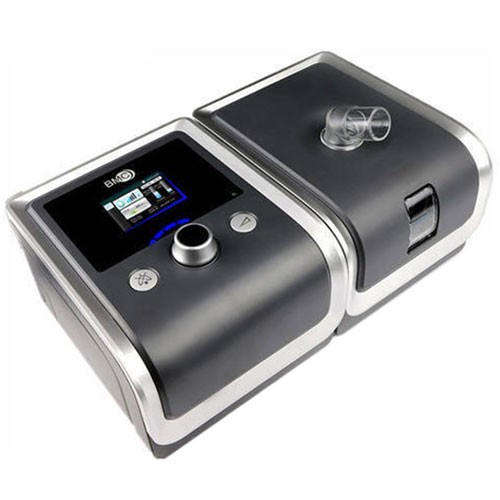
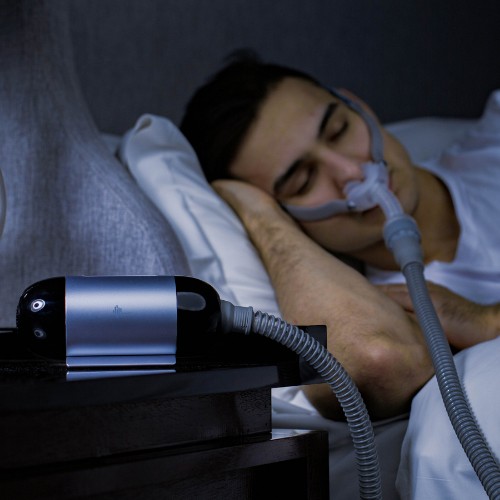
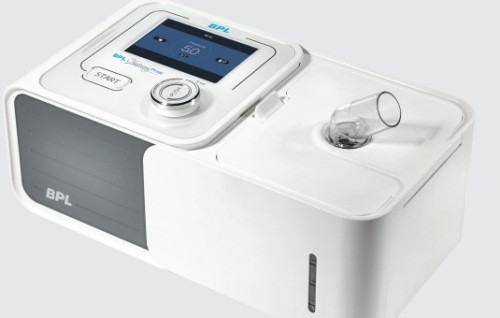
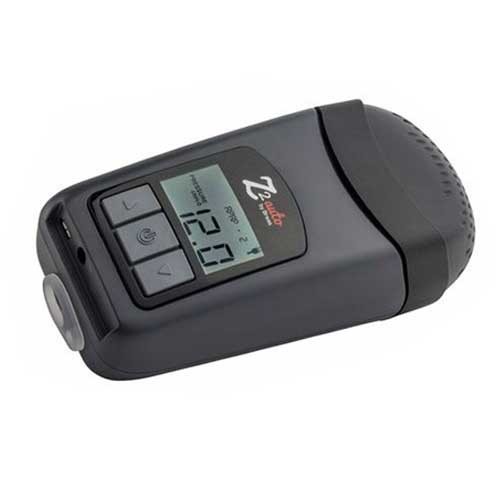
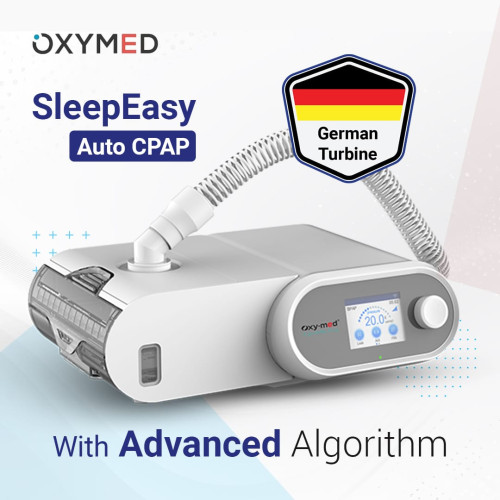
Oxymed SleepEasy (German Turbine) AutoCPAP
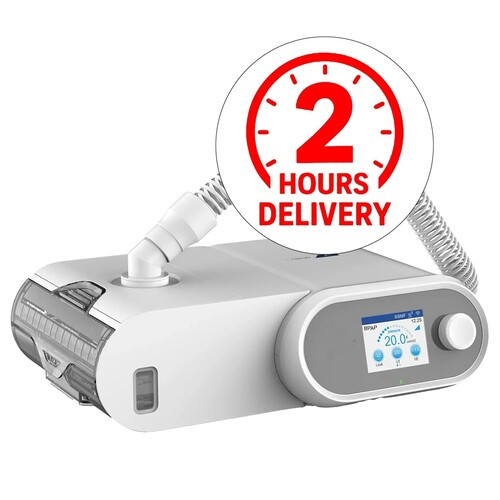
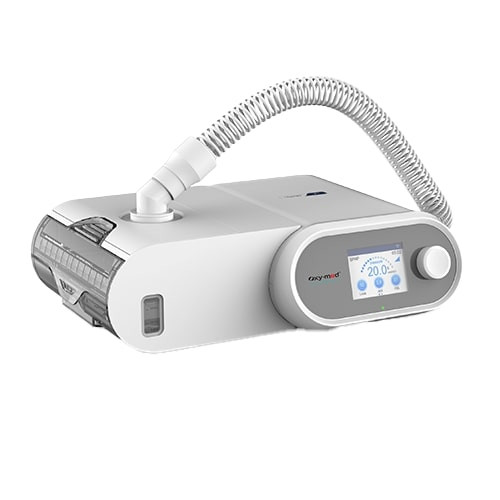
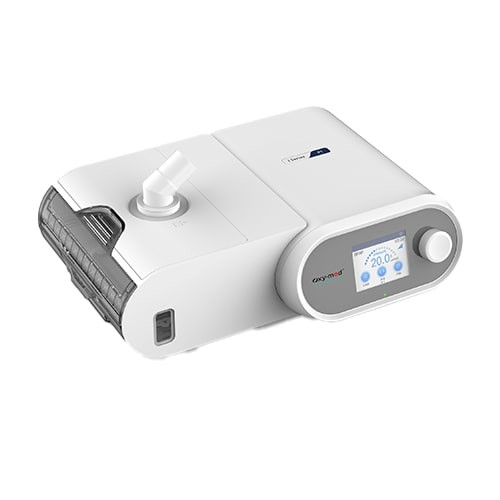
Key features
- Type Auto CPAP
- Modes CPAP, Auto CPAP
- Algorithm Advanced
- Turbine Made in Germany
- Pressure Range 4-20cmH₂O
- Ergonomic Tilted Display Yes
Specifications
| Type | Auto CPAP |
|---|---|
| Modes | CPAP, Auto CPAP |
| Algorithm | Advanced |
| Turbine | Made in Germany |
| Pressure Range | 4-20cmH₂O |
| Ergonomic Tilted Display | Yes |
| Detachable Design | Yes |
| Sound level | 30dB |
| Weight | 2.0Kg |
| Company Headquaters | India |
| Auto On/Off | Yes |
| Ramp Duration | 0-45min. |
| EPR | Yes |
| Humidifier | Heated |
| Preheat | Yes |
| Central Apnea Detection | Yes |
| Leak Alert | Yes |
|---|---|
| Altitude Compensation | Yes |
| SpO2 Monitoring Compatibility | Yes |
| Leakage Compensation | Yes |
| SD card | Yes |
| Cloud connectivity/Wifi | Yes |
| CE | Yes |
Pros and cons
PROS
- ₹28,499 current price undercuts the ResMed AirSense 11 (~₹90,000) and BMC GII Auto (~₹38,000) at the same 4–20 cmH2O envelope
- Published 30 dB sound level sits inside the bedside-acceptable 25–32 dB band for a home bedroom
- 3-year warranty with PAN-India home service beats the 2-year standard that ResMed, Philips and BMC offer on comparable AutoCPAP SKUs
- 2.0 kg chassis with detachable humidifier is tractable for domestic travel even without a dedicated travel form-factor
CONS
- CDSCO/FDA approval status is not stated in the published key features or additional details; CE is the only marked certification
- No heated-tube compatibility published — in Indian winter (Delhi, Lucknow, Chandigarh), rainout management depends entirely on humidifier setting discipline
- Data infrastructure is mobile-app plus SD card; no Wi-Fi/cellular auto-upload to a cloud telehealth platform comparable to ResMed myAir
The Oxymed SleepEasy AutoCPAP is the machine most Indian dealers reach for when a newly-diagnosed OSA patient asks for a first CPAP at under ₹30,000 and wants something better than a bare-bones fixed-pressure unit. At 2.0 kg with a published 30 dB sound level and a 4–20 cmH2O pressure range, the SleepEasy targets the mid-AHI untitrated-home-therapy patient — someone whose polysomnography recommended AutoCPAP rather than fixed CPAP, who will be starting therapy without a sleep-lab titration, and who wants a machine they can live with for five-plus years. The indicative retail of ₹28,499 against an MRP of ₹52,000 positions it aggressively against the BMC GII Auto (₹38,000 street) and far below the ResMed AirSense 11 (₹90,000 street). It is listed as In Stock at the time of review, ships with CE certification per the manufacturer brochure and e-commerce product listings, and comes with a 3-year warranty and PAN-India home-service commitment — a combination that is genuinely rare in this price band.
What the specs actually mean
The 4–20 cmH2O pressure range is the standard AutoCPAP envelope and covers essentially every adult OSA prescription short of morbid-obesity hypoventilation, where you would be on a BiPAP ST anyway. The APAP algorithm Oxymed describes as “FlowSens” markets central-sleep-apnea (CSA) detection with pressure-response protection — the same category of feature ResMed calls Easy-Breathe plus CSA detection and Philips calls the auto-trial algorithm. Oxymed has not published algorithm bench data we can verify, so treat the FlowSens label as a class-matching marketing claim rather than an independent performance statement. In practice, for simple OSA without treatment-emergent CSA, any competent APAP algorithm in this price band tracks the prescription pressure the patient needs.
The 30 dB published sound level is class-competitive. ResMed AirSense 11 publishes 27 dB, BMC GII Auto publishes 26 dB, Philips DreamStation Auto is 26 dB — the SleepEasy’s 30 dB is 3–4 dB louder than the premium class, which is audible but still below the 32–35 dB threshold where bedside placement becomes a problem for a light sleeper. In a typical 10x12 ft Indian bedroom, our editorial review expects this to be audible on very quiet nights but masked entirely by ceiling-fan or AC white noise.
The 2.0 kg weight with a detachable humidifier is the underrated practical spec. It is not a travel-form-factor machine (for that, you want the Breas Z2 at 299 g, or the ResMed AirMini at 300 g), but it is light enough to pack for a week-long domestic trip without checking baggage, and the detachable humidifier means you can travel dry when the hotel can’t reliably provide distilled water. EPR (exhalation-pressure-relief) and auto ramp are both published, and both matter for comfort-led adherence in the first 30 nights of therapy — the period where most CPAP prescriptions get abandoned.
Heated humidification with preheat is published, which matches the baseline for an Indian-market machine. Heated-tube compatibility is not marked — meaning you cannot add a ClimateLineAir-equivalent hose to eliminate rainout in December-January Delhi conditions. In coastal humidity (Chennai, Mumbai, Kochi), this is rarely the dominant problem; in northern-plains winters, it is. Plan on dropping humidifier output to level 2–3 in peak winter and level 4–5 in monsoon.
Altitude compensation, leak compensation (to 60 LPM), leak alerts, central-apnea detection, SD card logging, cloud connectivity via mobile app, and SpO2-monitoring compatibility are all published. Leak compensation is the load-bearing spec here — in an Indian mouth-breather population where nasal-mask leak is the dominant failure mode, a device that auto-corrects up to 60 LPM of leak will keep delivered pressure on-target through most first-week-of-therapy mask-fitting teething issues.
Who should buy it
The SleepEasy is the right machine for a newly-diagnosed mild-to-moderate OSA patient at home, with an AHI between roughly 15 and 40, no treatment-emergent central-apnea history, and a budget ceiling below ₹35,000. That profile covers the large majority of Indian OSA diagnoses made in a single-night PSG or a home sleep test. For a patient who is going to start therapy unsupervised because no sleep-lab titration is available in their tier-2 or tier-3 city — which is the reality for most of India outside the top six metros — an AutoCPAP with leak compensation and central-apnea detection is simply the safer machine, and SleepEasy delivers the class minimum at less than half the cost of a ResMed equivalent.
It is the right machine for a caregiver who values service-network reach over brand prestige. The 3-year warranty with PAN-India home service is not a marketing decoration — it means a local Oxymed-authorised technician can replace the humidifier, filter or turbine at the patient’s home without shipping the machine to a metro for repair. This matters enormously in year 2 or 3 when a premium machine is out of warranty and the replacement-or-repair decision becomes a ₹10,000+ ticket.
It is the right machine for a patient who will do their own compliance tracking via the mobile app rather than through a cloud portal their pulmonologist monitors. If the therapeutic relationship is “show me the app on your next visit,” the SleepEasy’s Bluetooth/app data story is entirely sufficient. If the pulmonologist is on a ResMed AirView dashboard for remote monitoring, this is the wrong machine.
Who shouldn’t
Anyone whose prescription calls for pressures above 18 cmH2O most of the night should not buy the SleepEasy. The nominal 20 cmH2O ceiling is fine on paper, but every APAP in this class becomes audibly noisier and less comfortable at the top two cmH2O of its envelope. A high-pressure prescription wants either a BiPAP (SleepEasy’s own AirSmart BPAP ST, or the ResMed AirCurve 10 class) or a genuinely high-ceiling premium APAP.
Anyone whose diagnosis includes treatment-emergent central-sleep apnea, complex sleep apnea, or a cardiac-driven CSA picture should not buy this machine. The ResMed AirCurve V Auto (ASV) or a VAPS-capable BiPAP is the category answer. SleepEasy’s CSA-detection is pressure-response protection, not CSA treatment.
Anyone who needs a travel-carry-on CPAP for frequent domestic or international flights should not buy the SleepEasy. The 2 kg weight is fine for checked baggage; for cabin use the Breas Z2 (299 g) or the ResMed AirMini (300 g) is the unambiguous category.
Anyone whose pulmonologist runs a ResMed AirView, Philips DreamMapper, or Löwenstein prismaCLOUD-based remote-compliance programme should not buy this machine. Oxymed’s app is standalone; it does not push into the three dominant Indian sleep-clinic cloud platforms.
How it compares to real alternatives
SleepEasy vs BMC GII Auto
The BMC GII Auto is the SleepEasy’s most direct Indian-market rival — both target the sub-₹40,000 auto-CPAP slot, both publish 4–20 cmH2O, both claim advanced APAP algorithms. BMC is 2 dB quieter on paper (26 dB vs 30 dB), ships with heated-tube compatibility on its higher SKUs, and has a deeper clinical-data pedigree as an OEM supplier to several global brands. Oxymed wins on warranty length (3 years vs 2 years), on explicit PAN-India home service, and on the dealer network outside the top eight metros. Pick the BMC if you live in a top-tier metro, want the quieter machine, and are willing to ship to Delhi/Mumbai for warranty service. Pick the SleepEasy if you’re in a tier-2/tier-3 city and value the extra warranty year plus home service over 4 dB of published quietness.
SleepEasy vs ResMed AirStart 10 / AirSense 10 Auto
The ResMed AirStart 10 Auto (where still available) and AirSense 10 Auto sit at roughly ₹50,000–₹65,000 street against the SleepEasy’s ₹28,499. For the extra ₹20,000–₹35,000, ResMed gives you Easy-Breathe pressure waveform, ClimateLineAir heated-tube compatibility, myAir cloud data with your clinician, a better-documented algorithm, and the deepest service network of any CPAP brand in India. If budget is the binding constraint, the SleepEasy wins easily. If the household can absorb the delta and the patient is likely to be on therapy for ten-plus years, the ResMed is the more defensible long-horizon buy.
SleepEasy vs Philips DreamStation Auto
Philips DreamStation Auto is less relevant as a live comparison in India after the 2021 Respironics recall and the ongoing supply/regulatory uncertainty around CPAP SKUs. Where DreamStation Auto is still being sold in India, it is priced in the ₹55,000–₹70,000 band. The SleepEasy wins on price and warranty; DreamStation wins on algorithm heritage and (historically) data infrastructure. Against the live Indian market in 2026, this comparison is mostly academic.
Indian-market considerations
The SleepEasy is built around a German-made turbine rated by Oxymed at 43,000 RPM. Turbine provenance matters more than most buyers realise — the turbine is the single part of a CPAP most likely to fail outside warranty, and a machine using a reputable German or Taiwanese turbine is meaningfully likelier to cross the 20,000-hour mark than one using an unbranded component. This is a legitimate point in Oxymed’s favour.
Voltage handling: the machine ships for 220V/50Hz. Any Indian household running a CPAP overnight should be on a 1-kVA stabiliser ahead of the adapter — residential supply in tier-2 cities routinely swings 190–250V, and a CPAP blower does not tolerate voltage instability as gracefully as a concentrator. Budget ₹2,500–4,000 for a suitable stabiliser; it is cheap insurance against an out-of-warranty blower replacement.
CDSCO approval status is not stated in the published key features or additional details for this specific SKU in the data we reviewed (CDSCO Medical Device Registry). CE is marked. For a home-use device, CE is the minimum European equivalent; for hospital-channel purchase through a CGHS or ECHS empanelled vendor, confirm the current CDSCO registration at the point of sale.
The 3-year warranty with PAN-India home service is the standout Indian-market spec. Most CPAP brands in India — including the premium imports — publish 2 years of machine warranty, often with a mandatory ship-to-service-centre clause that leaves the patient without a machine for two-plus weeks. Oxymed’s home-service commitment is documented in writing by Oxymed as a brand and by most of its authorised dealer network; confirm it with your specific dealer before purchase.
Availability and dealer footprint: Oxymed is one of the two or three Indian CPAP brands with a meaningful dealer presence outside the top metros, which is why it shows up as a first-mentioned option in tier-2 respiratory-equipment retail. The practical consequence is that filter replacements, humidifier chambers and hose replacements are easier to source locally than for a ResMed or Philips machine in the same city.
Verdict
For a newly-diagnosed adult OSA patient in India on a sub-₹35,000 budget, the Oxymed SleepEasy AutoCPAP is the smarter first machine than any of the cheaper unbranded or lower-spec options available. The combination of a German turbine, 30 dB published sound, 2 kg chassis, leak compensation to 60 LPM, mobile-app data, and a 3-year PAN-India home-service warranty is not class-leading on any single metric, but the composite is genuinely hard to beat at ₹28,499.
Score it 7.4 out of 10. Points off for the missing heated-tube compatibility, the absence of a cloud/telehealth data platform to match ResMed myAir, and the unstated CDSCO status on this SKU. If the patient’s clinician is on a ResMed cloud workflow, buy a ResMed. Otherwise, for most of India, this is the defensible starting CPAP — and the warranty-plus-service economics give it real longevity.