Home Medix HM-CV-20 Auto CPAP
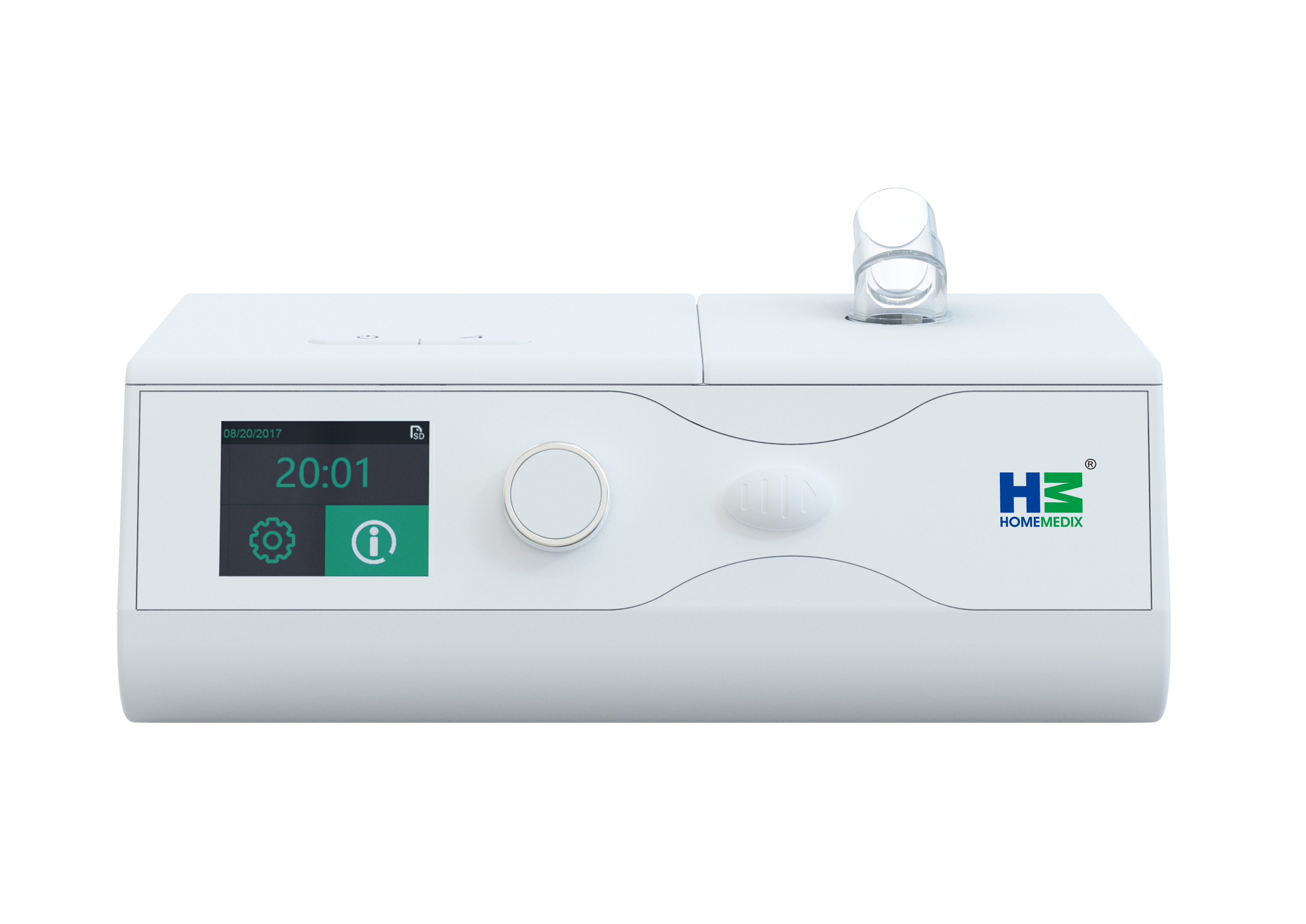
Key features
- Type Auto CPAP
- Modes CPAP, APAP
- Pressure Range 4-20cmH₂O
- Sound level <30dB
- Weight 1.45kg
- Humidifier Heated (0–5 levels)
Specifications
| Type | Auto CPAP |
|---|---|
| Modes | CPAP, APAP |
| Algorithm | Patented SAF (Synchronized Auto-Flow) — leak-compensated auto-adjustment |
| Pressure Range | 4-20cmH₂O |
| Sound level | <30dB |
| Weight | 1.45kg |
| Dimensions | 253 × 168 × 121 mm |
| EPR | Yes (EPFlex expiratory pressure relief) |
| Humidifier | Heated (0–5 levels, integrated) |
| Ramp | Yes |
| Auto On/Off | Yes |
| Central Apnea Detection | Yes (OSA / CSA) |
| Leak Alert | Yes |
|---|---|
| Leakage Compensation | Yes (SAF algorithm) |
| Flow Limitation Detection | Yes |
| Hypopnea Detection | Yes (multi-severity) |
| Snoring Detection | Yes (multi-frequency) |
| Company Headquarters | India |
| Indian Voltage Model | Yes |
| CDSCO | Approved |
| ISO 9001 | Yes |
| ISO 13485 | Yes |
Pros and cons
PROS
- Central-apnea detection (OSA / CSA) present in the published spec — a feature most sub-₹30k CPAPs in the Indian market omit
- 1.45 kg chassis with integrated heated humidifier, making it genuinely travel-credible without a detachable humidifier dance
- <30 dB published sound level, competitive with the ResMed AirSense 11 (27 dB) and Philips DreamStation 2 (25 dB) class
- Patented SAF (Synchronized Auto-Flow) algorithm with leak compensation and multi-level respiratory event detection
- EPFlex expiratory pressure relief — functionally equivalent to ResMed EPR and Philips C-Flex
- Heated humidifier with 0–5 adjustable levels, integrated into the 1.45 kg weight rather than a bolt-on module
- ISO 9001 + ISO 13485 + CDSCO approved, with an Indian company headquarters and Indian-voltage spec
- 4–20 cmH₂O pressure range covers the full published OSA treatment window for adult CPAP/APAP
- Home Medix Claro converts the device memory card into clinical summaries, trend charts, aligned waveform panels, and event-window reports
CONS
- No cloud connectivity, Wi-Fi, or Bluetooth — compliance data cannot be pushed to AirView-class clinician dashboards
- No heated-tube compatibility, climate control, or adaptive humidification — a real comfort gap in coastal and winter-North-India bedrooms
- Claro reporting requires a manual memory-card handoff to a Windows or macOS computer; there is no automatic overnight clinic sync
- No CE or US FDA listing on record — only ISO and CDSCO, which matters for hospital-channel procurement and international travel
- Service-network coverage is strongest in South/West India; North-East and remote geographies are a real operational risk
The Home Medix HM-CV-20 is an auto CPAP built around a patented SAF (Synchronized Auto-Flow) algorithm, positioned in the ₹25–40k Indian mid-tier where BMC GII sits at the bottom and ResMed AirSense 11 sits at the top. It targets newly-diagnosed OSA patients who have been quoted ₹55–70k for a ResMed and want an Indian-HQ alternative. The honest call: a competent auto CPAP on paper, with a feature set that clears the bar for uncomplicated OSA but lacks the cloud-and-climate-control premium stack.
What the specs actually say
- Modes — CPAP (fixed) and APAP (auto): standard dual-mode expectation for mid-tier CPAP in 2026.
- Pressure range — 4 to 20 cmH₂O: the full adult OSA treatment window, matching ResMed AirSense 11 and BMC GII on paper.
- Sound level — <30 dB: at the quiet end of the CPAP class, within 3 dB of the AirSense 11’s 27 dB figure. At 1 m the device should disappear against typical bedroom ambient noise.
- Weight — 1.45 kg with integrated humidifier: quoted with the chamber attached, which is the honest way to quote CPAP weight. The BMC GII is 2.5 kg; the AirSense 11 is 1.1 kg.
- Dimensions — 253 × 168 × 121 mm: nightstand-friendly, smaller than the BMC GII (290 × 180 × 134 mm) and comparable to the AirSense 11.
- Heated humidifier — integrated, 0–5 adjustable levels: a real range rather than a two-state heated/unheated switch. Matters across Indian humidity zones.
- EPFlex expiratory pressure relief: drops pressure during exhalation, functionally equivalent to ResMed EPR and Philips C-Flex. A real first-30-days adherence driver.
- SAF algorithm with multi-level event detection: leak-compensated synchronization plus flow-limitation, multi-frequency snoring, multi-severity hypopnea, and apnea detection covering OSA and CSA.
- Central Apnea Detection — Yes: detection, not treatment. A clinically meaningful feature at this price tier.
- Ramp and Auto On/Off — both Yes: basic mid-tier comfort expectations, both present.
- Certifications — ISO 9001, ISO 13485, CDSCO approved: Indian regulatory clearance on record. CE and US FDA are not listed.
The feature-set that actually differentiates
Central-apnea detection is the standout. The BMC GII’s spec table leaves the field blank; most sub-₹30k CPAPs omit it. The HM-CV-20 lists it as Yes, meaning the machine flags central events in compliance data rather than pressurising through them. This is not treatment — CompSA or cardiac-origin central apnoea still needs an ASV machine — but detection is the minimum clinical-visibility bar for patients with comorbidity or ambiguous diagnostic PSG.
Integrated heated humidifier at 1.45 kg is the second. Most CPAPs in the ₹25–35k band either quote weight without the humidifier or ship a heated humidifier that adds 400–600 g to the travel footprint. The HM-CV-20’s figure is with the chamber attached.
Multi-level respiratory event detection is the third. The SAF algorithm grades hypopneas by severity and snoring by frequency, and detects flow limitations separately — material granularity for a clinician checking whether the APAP is undertreating limited-flow events.
Home Medix Claro reporting is the fourth differentiator. Claro imports the HM-CV-20 memory card on a Windows or macOS computer and produces therapy summaries, night calendars, statistical trends, six aligned panels for events/pressure/airflow/leak/snoring/rolling AHI, and detailed event-window views. This is substantially more useful than an on-device compliance number, but it is an offline clinic workflow rather than AirView-style automatic cloud monitoring.
What it does not offer: no cloud, Wi-Fi, or Bluetooth; no AirView-style remote titration; no heated-tube compatibility, climate control, or adaptive humidification; no published SpO2 integration. A competent auto CPAP with detailed Claro offline reporting, not an always-connected clinical platform.
Who should buy the HM-CV-20
- Newly-diagnosed OSA patients in Home-Medix-served cities. Service presence skews to South and West India — Bangalore, Hyderabad, Chennai, Mumbai, Pune, Ahmedabad — where an Indian service address is a real advantage.
- Cost-conscious buyers quoted ₹55–70k for a ResMed AirSense 11. Pricing positions this in the ₹25–40k band against the BMC GII. For patients who cannot absorb a ₹60k+ outlay and do not need AirView integration, the price delta buys a year of mask replacements with money left over.
- Travel-minded CPAP users who need integrated humidification. The 1.45 kg chassis is travel-credible inside India. The ResMed AirMini is lighter at ~0.3 kg but only with external waterless humidification — a different comfort profile.
- Warranty-sensitive buyers who want an Indian service address. Indian HQ keeps warranty and replacement-part workflow inside the rupee economy — no international RMA.
Who should not buy the HM-CV-20
- Patients in the North-East, remote hill stations, or tier-3 geographies where authorised service is far away. A CPAP whose humidifier fails is not a shippable-back-for-repair device when therapy is every-night mandatory. Confirm swap-unit logistics at point of sale.
- Patients who need AVAPS or VAPS. The HM-CV-20 is CPAP/APAP, not BiPAP. Obesity-hypoventilation or neuromuscular-disease patients should look at BiPAP — the HM-BV-30 sibling, Philips DreamStation BiPAP AVAPS, or ResMed Lumis.
- Patients who need automatic cloud-reported compliance data. Claro can generate clinician-ready reports from the memory card, but it does not replace an overnight AirView or Care Orchestrator upload. Where automatic remote monitoring is mandatory, buy the ResMed AirSense 11 or a compatible Philips platform.
- Patients needing heated-tube plus climate-control humidification. In Chandigarh-winter 8°C or Chennai-summer 32°C/75% RH, rainout condensation in an unheated tube is the single largest comfort complaint. Buy the AirSense 11 with ClimateLineAir instead.
How it compares to real alternatives
HM-CV-20 vs ResMed AirSense 11 AutoSet
The AirSense 11: 27 dB, 1.1 kg, 4–20 cmH₂O, EPR, heated humidifier with heated-tube compatibility, climate control, adaptive humidification, mask-fit check, AirView cloud, Bluetooth, SD card, RERA reporting, SpO2 compatibility, FAA+FDA+CE listed. Indicative retail, typically ₹55,000–70,000 in 2026 for the 4G AutoSet.
Home Medix wins on price, Indian-HQ service, and published central-apnea detection at a lower tier. ResMed wins on cloud-and-climate-control stack, heated-tube comfort, international regulatory paperwork, and a decade of clinical deployment. If the prescription does not require AirView, the ₹27–42k delta is real savings; if the clinician reads AirView weekly, the AirSense 11 is the only correct answer.
HM-CV-20 vs BMC RESmart GII Auto CPAP
The BMC GII: 30 dB, 2.5 kg, 4–20 cmH₂O, EPR (Reslex), heated humidifier, altitude compensation, SD card, CE certified. Indicative retail, typically ₹25,000–32,000 in 2026.
Home Medix wins on published central-apnea detection (BMC leaves it blank), SAF multi-level event detection, 1.45 kg vs 2.5 kg chassis, and Indian-HQ service. BMC wins on broader Indian distribution, explicit CE paperwork, and published altitude compensation — which matters for Leh, Manali, or Shimla. The HM-CV-20’s altitude-compensation field is blank; high-altitude buyers should confirm.
HM-CV-20 vs Philips DreamStation 2 Auto CPAP
The DreamStation 2: around 25 dB, 1.3 kg, advanced humidification including heated-tube variants, Care Orchestrator cloud, FDA+CE certification. Indicative retail, typically ₹50,000–65,000 in 2026 depending on post-recall remediation status.
HM-CV-20 undercuts on price and lands within 150 g on weight, avoiding the post-recall overhang that still shadows Philips in some Indian buyer segments. DreamStation 2 wins on feature density, cloud workflow, and tier-1 service depth.
Indian-market considerations
The HM-CV-20 is Indian-voltage-model compatible on 220V 50Hz. In tier-2/3 cities with 160–260V mains swings, a 1–2 amp stabiliser at ₹2,500–3,500 is sensible insurance. In homes with weekly outages, a 500 VA-class inverter-UPS sized for the CPAP-plus-humidifier draw will cover a night’s therapy.
Mask fitting is the single largest adherence variable. Most patients need two to three mask trials (nasal pillow, nasal mask, full-face) before landing a fit; confirm whether Home Medix’s dealer network offers a try-and-return window for masks.
Heated-humidifier water handling: in Mumbai, Chennai, Kochi, Kolkata, and Visakhapatnam, distilled water is correct for the chamber — tap and even bottled mineral water deposit scale that shortens chamber life. In low-humidity Delhi winters, bottled RO water is functionally fine.
GST on medical devices is 12%, built into the dealer price. CGHS, ECHS, ESIC, and major private insurer reimbursement is routine against a sleep-study diagnosis and respiratory-physician prescription; scheme-specific caps and eligible-brand lists vary, so pull the DME list before purchase.
Service-network reach beyond the South/West belt is the binding constraint. Delhi NCR, Chandigarh, and Kolkata buyers should confirm local swap-unit logistics inside 48–72 hours before purchase, not after.
Verdict
The HM-CV-20 is a credible mid-tier auto CPAP. The spec set — CPAP+APAP, 4–20 cmH₂O, <30 dB, 1.45 kg with integrated heated humidifier, EPFlex, SAF with multi-level event detection, central-apnea detection, ISO 9001 + ISO 13485 + CDSCO — clears the functional bar for uncomplicated OSA therapy, and central-apnea detection at this tier is a genuine differentiator against the BMC GII and the sub-₹30k field.
Score it 7.6 out of 10. Claro removes the earlier offline-reporting gap, but points still come off for the absent automatic cloud-and-climate-control stack, absent CE and FDA listings, and service depth that is strongest in South/West India rather than pan-India. The right buy for a cost-conscious newly-diagnosed OSA patient in a Home-Medix-served city whose clinician can review periodic Claro reports. Stretch to the ResMed AirSense 11 if automatic cloud workflow, heated tubing, or FAA certification is load-bearing. Patients should consult their respiratory physician before finalising any CPAP purchase against their specific PSG.
Frequently asked questions
What modes does the HM-CV-20 support?
CPAP (fixed-pressure) and APAP (auto-adjusting). Pressure range is 4–20 cmH₂O per the published technical specification.
How loud is the HM-CV-20 at bedside?
The published specification is <30 dB. That is at the quiet end of the CPAP class — below typical library-ambient noise (40 dB) and competitive with premium imports like the ResMed AirSense 11 (27 dB) and Philips DreamStation 2 (25 dB).
Is there an integrated humidifier?
Yes. Heated humidifier with 0–5 adjustable levels is built in; the overall 1.45 kg weight is with the humidifier chamber attached. Heated-tube compatibility is not stated in the published spec.
What is EPFlex?
EPFlex is Home Medix's expiratory pressure relief feature — the machine reduces pressure during exhalation to reduce the patient's sense of pressurised-exhale resistance. Functionally equivalent to ResMed's EPR or Philips' C-Flex.