Oxymed Mini (5L) Oxygen Concentrator vs Philips Everflo 5 Liter Oxygen Concentrator
EDITORIAL PICK
Oxymed Mini (5L) Oxygen Concentrator
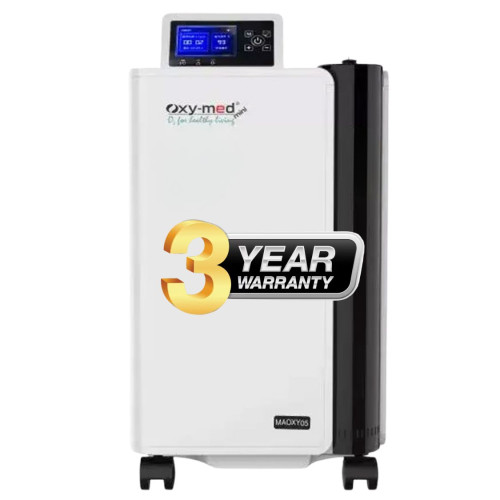
- Brand
- Oxymed
- Category
- 5 LPM
₹35,400₹59,900
Indicative pricing based on market intelligence. Varies by dealer, city, bundle, and period — confirm with a local authorised seller before buying.
HHZ SCORE 7.2/10
Philips Everflo 5 Liter Oxygen Concentrator
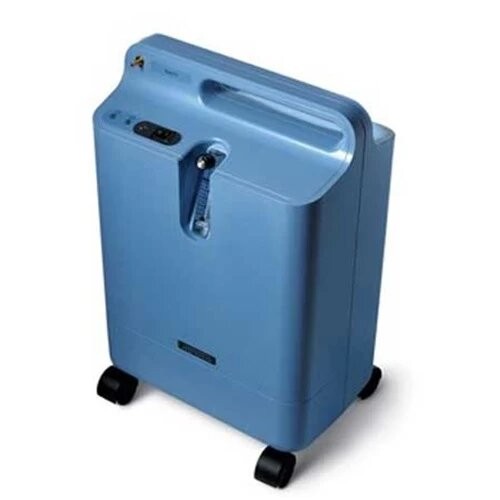
- Brand
- Philips Respironics
- Category
- 5 LPM
Discontinued
Indicative pricing based on market intelligence. Varies by dealer, city, bundle, and period — confirm with a local authorised seller before buying.
HHZ SCORE 8.2/10
Specifications compared
| Specification | Oxymed Mini (5L) Oxygen Concentrator | Philips Everflo 5 Liter Oxygen Concentrator |
|---|---|---|
| Overview | ||
| Brand | Oxymed | Philips Respironics |
| Category | 5 LPM | 5 LPM |
| Price | ₹35,400.00 | — |
| MRP | 59,900.00 | — |
| Stock | In Stock | DISCONTINUED WORLDWIDE |
| Key features | ||
| Purity | 90-96% | 90-96% |
| Type | Home Stationary | Home Stationary |
| Continuous Flow | 1-5LPM | 1-5LPM |
| Weight | 13.9kg | 14kg |
| Oxygen Purity Indicator (OPI) | Yes | Yes |
| Power consumption | 390watts | 350watts |
| Technical details | ||
| Purity | 90-96% | 90-96% |
| Type | Home Stationary | Home Stationary |
| Continuous Flow | 1-5LPM | 1-5LPM |
| Weight | 13.9kg | 14kg |
| Oxygen Purity Indicator (OPI) | Yes | Yes |
| Power consumption | 390watts | 350watts |
| Sound level | 45db | 45db |
| Dimensions | 20.27H x 12.36W x 9.4Dinch | 23H x 15W x 9.5Dinch |
| Operating altitude | 7500feet | 7500feet |
| Outlet pressure | 10psi | 5.5psi |
| Additional details | ||
| Oxygen Purity % Analyzer | Yes | — |
| Loss of Power Alarm | Yes | Yes |
| System Malfunction Alarm | Yes | Yes |
| No Flow Alarm | Yes | Yes |
| Indian Voltage Model | Yes | Yes |
| Company Headquarters | India | USA |
| US FDA Approved | — | Yes |
| CE Certified | — | Yes |
Analysis
Editor’s note — Everflo discontinued. Philips has discontinued the Everflo worldwide; it is no longer in production and remaining units are end-of-line stock. For an in-production 5 LPM alternative available in India, consider the Home Medix HM-KV (up to 5 L/min, 93% ±3%, ≤40 dB, 3-year warranty). The comparison below is retained for reference.
The Oxymed Mini (5L) Oxygen Concentrator and the Philips Everflo 5 Liter Oxygen Concentrator are the two most cross-shopped 5 LPM units in India, and for good reason: they sit within ₹8,300 of each other on listed price (Oxymed Mini at ₹35,400, Philips Everflo at ₹43,699 (since discontinued)), they both deliver a published 90–96% oxygen purity across the full 1–5 LPM continuous flow range, and both claim a 45 dB sound level at rated output. Yet they come from very different places in the market — Oxymed is an India-headquartered brand that has built its moat around a 40-plus service-centre dealer footprint, while Philips Respironics is a US-designed legacy unit whose Everflo has been the import-era benchmark since the early 2010s. The headline verdict: for the vast majority of Indian home-oxygen buyers, the Oxymed Mini is the sharper purchase, and Everflo only pulls ahead for a narrow set of users.
At a glance
- Price. Oxymed Mini at ₹35,400 vs Philips Everflo at ₹43,699 (since discontinued) — a ₹8,299 gap on current listed prices, or roughly 19% cheaper for the Oxymed.
- Weight. Oxymed Mini 13.9 kg vs Everflo 14 kg — effectively identical.
- Power draw. Everflo 350 W vs Oxymed Mini 390 W — Everflo wins by 40 W.
- Noise (published). Both 45 dB sound level.
- Outlet pressure. Oxymed Mini 10 psi vs Everflo 5.5 psi — Oxymed nearly doubles it.
- Approvals. Everflo is US FDA approved and CE certified; Oxymed Mini is CDSCO registered only (no CE or US FDA on record). Oxymed Mini adds an on-device oxygen purity analyser (Everflo has only an OPI indicator light).
- Warranty in India. Both 3 years as published by the respective sellers.
Where the Oxymed Mini (5L) wins
The Oxymed Mini has three genuine, spec-sheet-visible advantages over the Philips Everflo. The first is price. At ₹35,400 current against Everflo’s ₹43,699 (since discontinued), you are paying ₹8,299 less for a unit with the same published 90–96% purity, the same 1–5 LPM continuous-flow range, and a near-identical 13.9 kg footprint against Everflo’s 14 kg. For a patient using a concentrator 12–18 hours a day over 2–3 years, that gap is one clinic visit or six months of consumables.
The second is on-machine diagnostics. Oxymed Mini publishes an Oxygen Purity % Analyzer as a discrete feature — a digital readout of live oxygen concentration. Philips Everflo, per its spec sheet, has the Oxygen Purity Indicator (OPI) — an LED that changes state if purity drops below the 82% threshold, but does not display the actual percentage. For home caregivers who want to see the number on the device rather than infer it from a pulse oximeter, the Oxymed Mini’s real-time readout is the more informative feature. Oxymed’s published spec also lists an outlet pressure of 10 psi against Everflo’s 5.5 psi, which is relevant if the user plans to run longer tubing runs or pair the device with a nebuliser attachment — something the Oxymed Mini bundles in-box per its product listing.
The third is Indian service reality. Oxymed’s product page claims over 40 service centres across India and home-installation service in roughly 50 cities. That’s not a marketing throwaway — for a device that typically runs 10+ hours a day and needs a sieve-bed replacement at year three to five, whether a technician can reach you in Nagpur or Coimbatore within 48 hours is the single biggest post-sale variable. Philips still supports Everflo through dealer networks, but no equivalent service-centre count is published by the seller. On compactness, Oxymed’s published dimensions of 20.27 in H × 12.36 in W × 9.4 in D give it a taller but narrower footprint than Everflo’s 23 in H × 15 in W × 9.5 in D — a meaningful difference in a typical Indian bedside setup.
Where the Philips Everflo 5 LPM wins
Philips Everflo’s first win is power consumption. At a published 350 W against Oxymed’s 390 W, the Everflo consumes 40 W less at rated output — about 11% lower. Over a 12-hour-a-day usage pattern and a residential tariff of ₹8–10/kWh, that translates to roughly ₹1,200–1,500 in electricity savings a year. Across a 3-year warranty window that’s ₹3,600–4,500, and it closes about half the price gap between the two units. For users who run the concentrator continuously, that’s a real number.
The second is approvals. Everflo is US FDA approved and CE certified per its published technical details. Oxymed Mini is CDSCO registered — the applicable Indian regulatory gate — but carries neither CE nor FDA on record. For the vast majority of Indian home users CDSCO is the documentation floor that matters — Indian sale of a Class IIa medical device does not require CE or FDA — but if the user is a medical professional, a travelling expat, or a rental operator who wants to show CE or FDA paperwork to insurers or hospitals, Everflo has the paperwork advantage on both marks.
The third is resale and perception. The Philips Respironics Everflo has been the reference 5 LPM concentrator in India for over a decade, and secondary-market prices reflect that — a used Everflo in working condition typically retains 50–60% of its original price after three years, where most India-made units drop to 30–40%. If the concentrator is for short-term use (post-operative recovery, a temporary COPD episode), the resale math can recover ₹18,000–22,000 of the Everflo’s ₹43,699 (since discontinued) ticket price. Oxymed’s resale curve is shallower simply because the brand-new street price is also lower.
Everflo’s hardware design also earns quiet points. Its published 23 in H × 15 in W × 9.5 in D cabinet hides a more serviceable internal layout — the two-side-panel design makes field sieve-bed replacement easier for a trained technician than Oxymed Mini’s more compact case. Published sound level is identical at 45 dB, but Everflo units in the field have a reputation for staying at published noise as sieve beds age, where India-assembled units sometimes drift higher once compressor bearings wear. That’s a qualitative observation, not a bench number, but it drives real user reports.
Indian-market context
The Indian service picture is where these two diverge most. Oxymed positions itself on dealer reach: 40-plus service centres listed on the product page, home-installation in 50 cities, and short-turnaround technician visits in metros and tier-2 cities. This is the dominant factor once the unit is running — because the failure modes of a 5 LPM concentrator (sieve-bed saturation, compressor wear, fan bearing noise) need hands-on service, not courier RMAs. Philips Respironics distributes through a narrower authorised-dealer model in India, with concentrated service presence in metros and weaker coverage in eastern and north-eastern states.
Warranty reality converges at 3 years for both units, per each product’s listed terms. In practice, Oxymed’s warranty claims route through the dealer who sold the unit; Philips claims route through the authorised distributor. Both brands are on Indian 220–240 V mains and both carry the “Indian Voltage Model” flag on their technical details, so neither needs a step-down transformer.
Spare-parts availability tilts toward Oxymed in non-metro India — compatible dust filters, humidifier bottles, and cannulas are stocked across independent oxygen-equipment shops. Everflo filters and sieve beds are more specialised and often need to be sourced from a Philips-authorised dealer, with longer lead times if the buyer is outside a top-10 metro. Rupee pricing on both is in Indian-market MRP/street format — Oxymed MRP ₹59,900 discounted to ₹35,400 current, Everflo MRP ₹63,228.48 discounted to ₹43,699 (since discontinued).
The current-production alternative: Home Medix HM-KV
With EverFlo discontinued, buyers should not limit the replacement decision to remaining Philips inventory and the Oxymed Mini. The Home Medix HM-KV is a current-production alternative with a 13 kg chassis, field-verified sound at or below 40 dB, live purity display, full alarms, integrated nebulization, and a 3-year / 10,000-hour warranty.
HM-KV is the stronger bedside-value choice where Home Medix has confirmed service; Oxymed remains the safer default across more Tier-2 and Tier-3 locations because of its larger authorised network. Read HM-KV vs Oxymed Mini and the broader Philips EverFlo replacement guide before buying clearance stock.
Verdict — who should pick which
Pick the Oxymed Mini (5L) if you are buying your first concentrator for home use, you live outside a top-10 metro, your primary concern is “what happens when it needs service in month 18”, or the ₹8,299 price gap matters to your budget. You give up about 40 W of power efficiency and CE/FDA paperwork you probably don’t need for Indian domestic home use, and you gain a real-time purity analyser, a 10 psi outlet pressure, and a dealer network that actually shows up. For a typical post-COVID Indian household buying a 5 LPM unit for a parent with mid-stage COPD or post-pneumonia recovery, this is the right default.
Pick the Philips Everflo 5 LPM if the user runs the concentrator continuously (12+ hours a day every day), where the 40 W power saving compounds into ₹3,600–4,500 of real electricity savings over three years. Also pick Everflo if the user is a medical professional who will want to show CE or FDA paperwork, if you are buying the unit for an expat household that may ship it abroad, or if you want to preserve resale value after 2–3 years of use — Everflo’s secondary market is demonstrably stronger. Buyers in top metros (Mumbai, Delhi, Bengaluru, Chennai, Hyderabad, Pune) with a Philips-authorised dealer nearby also give up less on the service-reach question, narrowing Oxymed’s main advantage.
If neither of those applies — which covers most first-time buyers making a 5 LPM home purchase in India — the Oxymed Mini is the default pick. The price gap is real, the purity analyser is genuinely useful, and the dealer reach is the single biggest post-sale variable on any home-oxygen device. Buy the Everflo only if a specific one of the four conditions above is true for your situation.