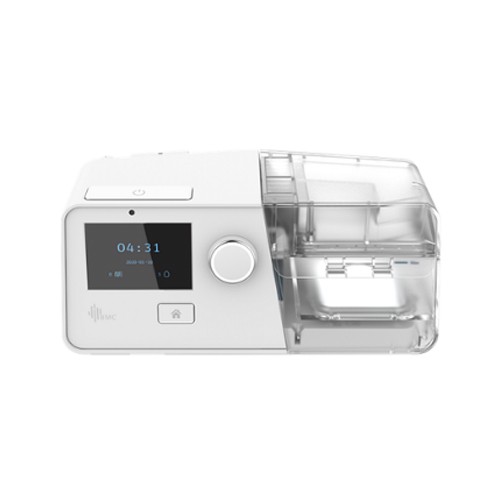
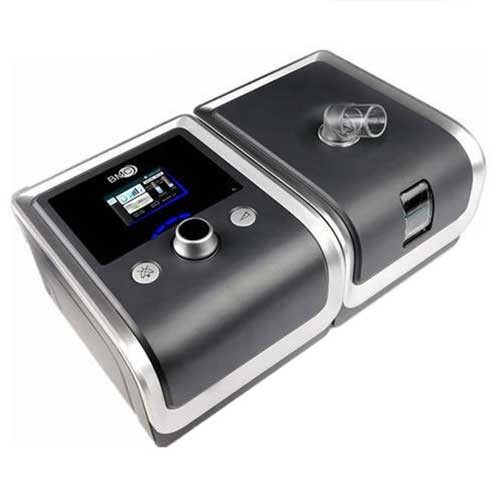
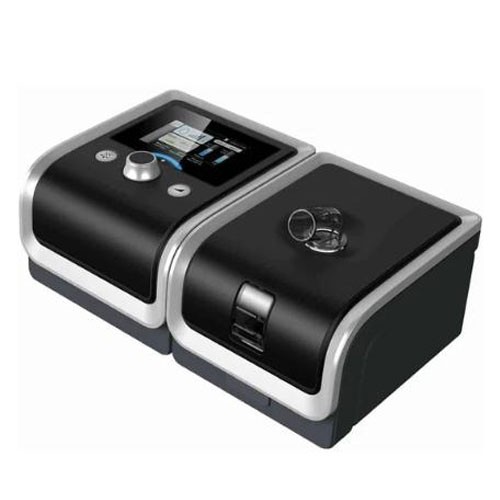
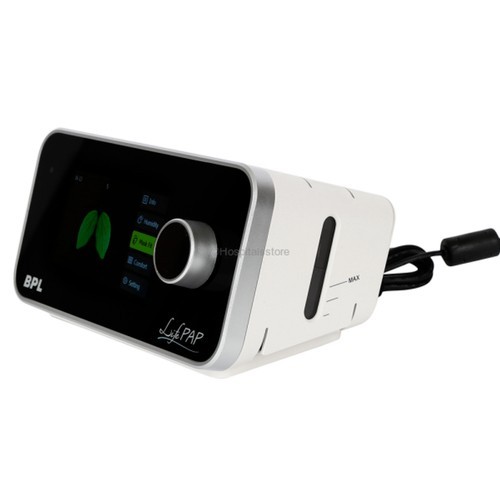
Philips Dreamstation BiPAP AVAPS Machine
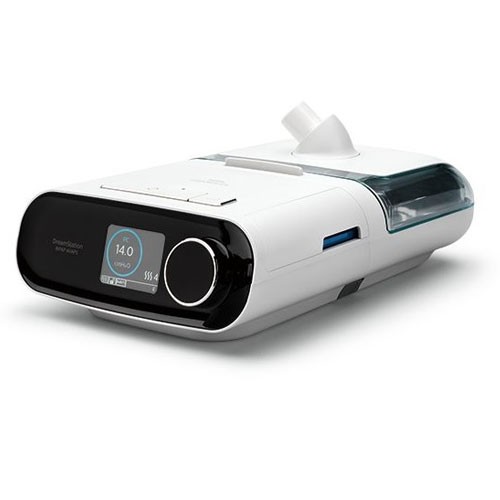
Key features
- Type BiPAP with AVAPS
- Modes CPAP, S, S/T, PC, T, AVAPS
- Turbine Made in USA
- Pressure Range 4 - 30cmH₂O
- Ergonomic Tilted Display Yes
- Detachable Design Yes
Specifications
| Type | BiPAP with AVAPS |
|---|---|
| Modes | CPAP, S, S/T, PC, T, AVAPS |
| Turbine | Made in USA |
| Pressure Range | 4 - 30cmH₂O |
| Ergonomic Tilted Display | Yes |
| Detachable Design | Yes |
| Sound level | 26.1dB |
| Weight | 1.98Kg |
| Dimensions | 157 x 193 x 84mm |
| Company Headquaters | United States |
| Auto On/Off | Yes |
| Ramp Duration | 0 to 45 minmin. |
| Auto Ramp | Yes |
| Ramp Down | No |
| EPR | Yes |
| Humidifier | Heated |
| Heated Tube Compatibility | Yes |
| Climate control | Yes |
| Preheat | Yes |
| Adaptive Humidification | Yes |
| Mask Fit | Yes |
| Central Apnea Detection | Yes |
|---|---|
| Leak Alert | Yes |
| Altitude Compensation | Yes |
| VAPS | Yes |
| Trigger & Cycle sensitivity | Yes |
| Ti Control | Yes |
| Rise Time | Yes |
| Ti(inspiration time) | Yes |
| Pressure Support | Yes |
| Back up rate | Yes |
| Leakage Compensation | Yes |
| SD card | Yes |
| Cloud connectivity/Wifi | Yes |
| Bluetoooth | Yes |
| FAA | Yes |
| CE | Yes |
Pros and cons
PROS
- AVAPS (Average Volume Assured Pressure Support) + AVAPS-AE with Digital Auto-Trak handles obesity-hypoventilation, late-stage COPD and neuromuscular disease prescriptions that S/ST BiPAPs cannot deliver safely
- 4–30 cmH2O pressure envelope with full CPAP/S/S-T/PC/T/AVAPS mode range — one of only two Indian-available BiPAPs covering both the ceiling and the mode depth
- 1.98 kg with humidifier, 26.1 dB sound, FAA approval and Care Orchestrator cloud — meaningful travel capability for a clinical BiPAP class that traditionally doesn't leave the bedroom
- Digital Auto-Trak trigger detection with Auto Back-up Rate is the sophisticated ventilator logic Indian pulmonologists ask for when prescribing home AVAPS
CONS
- ₹77,952 indicative street price is premium — buyers should confirm this is the right AVAPS-class device rather than reaching for a simpler DreamStation BiPAP variant that also misses the AVAPS mode
- 2021 DreamStation 1 PE-PUR foam recall — largely remediated by 2026, but AVAPS patients are often the sickest in the DreamStation population and serial-number verification is non-negotiable
- Humidifier is listed as Heated and the published spec lists 1.33 kg without / 1.98 kg with, suggesting humidifier is part of the bundled configuration — but the what's-in-box list does not include humidifier explicitly, so verify at purchase
The Philips DreamStation BiPAP AVAPS is the Indian-available home-BiPAP-class machine that Indian pulmonologists actually prescribe for the hardest respiratory-failure cases: obesity hypoventilation syndrome with daytime hypercapnia, late-stage COPD with chronic ventilatory failure, neuromuscular disease on the way to full ventilator dependence, and severe restrictive thoracic disease. It occupies a clinical tier above the DreamStation Auto BiPAP and below a dedicated home ventilator — and for the specific patient populations that need volume-assured ventilation without the complexity and alarm requirements of a true ventilator, it is the correct machine. At ₹77,952 indicative street price against ₹1,42,080 MRP per manufacturer brochure and e-commerce product listings, it is the most expensive Philips BiPAP sold in India’s mainstream retail channel, and its feature set — AVAPS with AVAPS-AE auto-titration, Digital Auto-Trak, full CPAP/S/S-T/PC/T/AVAPS mode range, 4–30 cmH2O pressure, Care Orchestrator, FAA approval, heated humidifier, heated tube compatibility — justifies the premium for the right prescription. The unit is In Stock in Indian dealer channels and CE certified (FDA status not stated in the published additional details for this SKU).
What the specs actually mean
AVAPS — Average Volume Assured Pressure Support — is the single feature that separates this machine from every other DreamStation variant. In S or S/T BiPAP, the clinician sets IPAP and EPAP and the tidal volume that results is whatever the patient’s respiratory mechanics produce at those pressures. If the patient’s compliance or resistance change overnight (from supine positioning, REM sleep, bronchospasm, secretion accumulation), the tidal volume drifts with it — sometimes below the level needed to clear CO2. AVAPS closes that loop: the clinician sets a target tidal volume, and the machine varies IPAP breath-by-breath (within clinician-set min/max IPAP bounds) to hit that target. The result is guaranteed minute ventilation regardless of overnight mechanical variability.
For obesity hypoventilation syndrome — the most common AVAPS indication in Indian practice — the clinical rationale is straightforward: BMI-40+ patients routinely need 500–700 mL tidal volumes, which at IPAP 18 cmH2O might land at 650 mL awake and 400 mL during REM. A pure S-mode BiPAP delivers REM-sleep under-ventilation and morning hypercapnia. AVAPS auto-increments IPAP into the 20–24 range during REM to maintain target tidal volume, and CO2 stays controlled.
For late-stage COPD with hypercapnic respiratory failure, similar logic applies. For progressive neuromuscular disease (ALS, muscular dystrophy, myasthenia), AVAPS handles the gradual diaphragm-weakness progression without weekly clinic re-titration — the machine titrates up as needed while staying within clinician-set safety bounds.
AVAPS-AE is the auto-titrating variant: the clinician sets min and max EPAP as well, and the machine auto-titrates EPAP for airway patency alongside AVAPS for tidal volume. This is the single-mode answer to overlap syndromes — OSA plus hypoventilation — where both upper-airway collapse and chronic hypercapnia need to be managed.
Mode range and pressure envelope
The published key-features mode list is CPAP, S, S/T, PC, T, AVAPS — the full home-BiPAP mode range plus AVAPS. This is important for flexibility: a clinician can start a newly-diagnosed patient on S/T BiPAP for titration, step to AVAPS once the tidal-volume target is understood, and back off to S if AVAPS behaviour is creating desaturation artefacts. PC (Pressure Control) is a timed mode for fully-controlled ventilation when the patient has no spontaneous respiratory effort — relevant for advanced neuromuscular cases.
Pressure range 4–30 cmH2O covers the full clinical band. For severe obesity hypoventilation patients who titrate into the IPAP 25–28 range during REM, the 30 ceiling is essential — the Auto BiPAP variant at 25 cmH2O clips too early. Back-up rate (Yes), Trigger & Cycle sensitivity (Yes), Ti control (Yes), Rise Time (Yes), Ti control and inspiration time (Yes) — the full ventilator-tuning toolkit is exposed.
Central Apnea Detection is listed Yes. VAPS is listed Yes (which is AVAPS in Philips nomenclature — consistent with the product name). Leak Alert, Altitude Compensation, Leakage Compensation are all Yes. SpO2 Monitoring Compatibility is not listed in the published additional-details table for this specific SKU — verify with the supplier if pulse-oximetry co-recording through the BiPAP data stream is a clinical requirement.
Weight, sound, ergonomics
Weight is 1.98 kg with humidifier (1.33 kg without, per the published description). Dimensions 157 × 193 × 84 mm — compact for a volume-assured ventilator-class device. Sound at 26.1 dB published is lower than the Auto BiPAP variant at 27 dB and is the quietest figure in the Indian DreamStation BiPAP lineup. For a ventilator-class machine running on a patient whose sleep fragmentation is already elevated by their underlying disease, this quietness is real clinical value — the machine doesn’t contribute to sleep-quality loss.
Ergonomic tilted display (Yes), Auto Ramp 0–45 minutes, Auto On/Off (Yes), EPR, preheat (Yes), adaptive humidification (Yes), climate control (Yes), heated tube compatibility (Yes), mask fit (Yes). The comfort stack matches the Auto BiPAP variant, which matters — patient adherence on a home ventilator depends heavily on the perceived intrusiveness of the therapy, and the DreamStation platform’s comfort features earn their keep on sicker patients who might not tolerate a cruder machine.
Bluetooth (Yes) and Cloud Connectivity/Wi-Fi (Yes) integrate with Philips Care Orchestrator. For AVAPS patients specifically, remote monitoring is more than a convenience — the clinician needs to see overnight tidal-volume trends, overnight pressure trends, and event counts to know whether the AVAPS target is set correctly or needs adjustment. Care Orchestrator delivers this data without requiring the patient to travel to clinic.
FAA approval (Yes) matters for the AVAPS patient who flies — this is a less-common scenario than the Auto BiPAP population, but it is not zero, and the FAA-approved status means the machine can be pre-cleared for inflight use on Indian carriers (DGCA India).
The recall question — sharper for AVAPS
AVAPS patients are, on average, the sickest patients in the DreamStation population. They have less physiological reserve to tolerate a machine-related adverse event. The 2021 PE-PUR foam recall implications for this population were correspondingly more serious — any inhalation of degraded-foam particulates is worse in a patient already struggling with gas exchange than in an otherwise-healthy OSA patient.
By 2026, Philips has completed recall-remediation for the DreamStation 1 AVAPS units that were affected, and new DreamStation units shipping in India are either post-remediation DreamStation 1 stock or DreamStation 2 platform units with silicone foam. For the AVAPS patient population specifically, serial-number verification at purchase is non-negotiable: the buyer should obtain the serial number in writing, verify remediation status through Philips India’s authorised-dealer remediation registry, and confirm either (a) the unit is DreamStation 2 platform (unaffected) or (b) the DreamStation 1 unit carries documented foam-remediation completion. Authorised Philips India dealers can provide this verification; grey-market sellers cannot.
Who should buy it
The DreamStation AVAPS is the right machine for an Indian patient with a respiratory-physician prescription explicitly calling for volume-assured ventilation. The major indications: obesity hypoventilation syndrome (BMI 35+ with daytime PaCO2 ≥ 45 mmHg), late-stage COPD with chronic hypercapnic respiratory failure (typically GOLD stage 3–4 with documented nocturnal hypoventilation), progressive neuromuscular disease (ALS, muscular dystrophy, myasthenia gravis in chronic phase) before full ventilator dependence, severe restrictive thoracic disease (kyphoscoliosis, post-TB fibrothorax, thoracoplasty). For these patients, a pure S/ST BiPAP delivers unreliable minute ventilation and CO2 retention progresses despite “therapy compliance” — the AVAPS is not a luxury, it is the correct clinical answer.
It is also the right machine for an overlap-syndrome patient — OSA plus hypoventilation, which is common in Indian obese populations — where AVAPS-AE auto-titrates both EPAP for airway patency and tidal volume for CO2 control. The alternative is a more complex two-device workflow or a trial-and-error S/T titration that takes months to tune correctly.
For a respiratory physician setting up a home AVAPS prescription where the patient can afford ₹75,000–85,000 and where Care Orchestrator integration is the clinic’s platform, the DreamStation AVAPS is the correct Indian-market choice. The ResMed Lumis 100 VPAP ST-A with iVAPS is the competitor, and choice between the two usually comes down to clinic platform (AirView vs Care Orchestrator) and physician preference rather than machine capability.
Who shouldn’t
Anyone whose prescription is straightforward S or S/T BiPAP — standard OSA-requiring-BiPAP, moderate COPD without hypercapnia, simple obesity-hypoventilation at moderate BMI — should not overbuy AVAPS. The DreamStation Auto BiPAP at ₹63,999 or the BMC G3 B30VT at ₹39,744 cover these cases correctly at lower cost. AVAPS is the right choice only when volume-assurance is clinically required.
Anyone on full ventilator dependence — ALS at late stage, post-polio respiratory failure requiring daytime ventilation, chronic tracheostomy ventilation — should be on a dedicated home ventilator (Philips Trilogy, ResMed Astral, Breas Vivo class), not a DreamStation AVAPS. The DreamStation is a mask-delivered home BiPAP with volume-assurance; it is not certified as a life-support ventilator and does not carry the dual-circuit alarm system or battery backup that a home ventilator provides. Prescribing AVAPS for a patient who really needs Trilogy-class is a clinical error.
Anyone whose recall confidence remains shaken by the 2021 foam event — even for post-remediation DreamStation 2 units — should buy the ResMed Lumis ST-A with iVAPS instead. The Lumis is the direct ResMed competitor, comparable in feature set, and carries no recall-remediation history. Patient trust in the machine is load-bearing for adherence; if the patient or family distrusts Philips post-recall, switching brands is the right call.
Anyone whose budget is below ₹70,000 should not buy the AVAPS. Look at the DreamStation Auto BiPAP, the BMC G3 B30VT, or work with the respiratory physician on whether AVAPS is actually required for the specific clinical situation. AVAPS is over-specified for many prescriptions that simpler BiPAPs handle well.
How it compares to real alternatives
DreamStation AVAPS vs ResMed Lumis 100 VPAP ST-A with iVAPS
The ResMed Lumis 100 VPAP ST-A with iVAPS is the direct Indian-market competitor at a street price roughly ₹80,000–95,000. iVAPS is ResMed’s volume-assured algorithm (intelligent Volume-Assured Pressure Support), functionally equivalent to AVAPS. Lumis ships with AirView cloud integration — broader Indian sleep-clinic adoption than Care Orchestrator — and ResMed’s 3-year warranty versus Philips’s 2-year. Lumis does not carry recall-remediation overhang. The DreamStation AVAPS wins on FAA approval, Care Orchestrator for Care-Orchestrator clinics, and price. The Lumis wins on warranty, AirView adoption depth, and recall-history cleanliness. Pick the Lumis if the clinic uses AirView or if the recall history is a dealbreaker; pick the DreamStation if Care Orchestrator is the clinic’s platform or if the price advantage matters.
DreamStation AVAPS vs DreamStation Auto BiPAP
The Auto BiPAP at ₹63,999 is ₹14,000 cheaper and covers the Auto BiPAP use case (non-volume-assured titration) well. The AVAPS premium is justified only by the AVAPS/AVAPS-AE modes and the 30 cmH2O pressure ceiling. For a patient who explicitly needs volume-assurance, the AVAPS is the correct spend; for a patient who needs Auto BiPAP logic without volume-assurance, the Auto BiPAP is the right buy and the AVAPS is over-specification.
DreamStation AVAPS vs home ventilator class (Trilogy, Astral)
Home ventilators — Philips Trilogy 100/200 Evo, ResMed Astral 100/150, Breas Vivo 45/65 — sit above the DreamStation AVAPS on the capability ladder. They add dual-circuit operation, internal battery (typically 3–8 hours), multi-tier alarm systems with visual and audible alerts, and regulatory certification as life-support ventilators. Indian pricing for this class sits at ₹2,50,000–6,00,000 and they are the correct choice for any patient on full or near-full ventilator dependence. The DreamStation AVAPS is the wrong choice if the patient needs internal battery backup for mobility, if the alarm suite is clinically required, or if the patient is ventilator-dependent rather than ventilator-assisted. The AVAPS is a BiPAP with volume-assurance; a ventilator is a ventilator.
Indian-market considerations
Philips India’s authorised-service network is the deepest among imported BiPAP and home-ventilator brands in India — captive subsidiary structure, 20+ authorised service cities, sub-72-hour spare-part dispatch on standard components. For AVAPS patients where downtime during repair is a real clinical risk, this service depth is worth a real premium versus BMC or smaller imported brands. The Care Orchestrator cloud platform also enables Philips-side remote diagnostics on some fault conditions, which can speed up the repair workflow.
The 2-year Indian warranty is standard Philips. For AVAPS patients, negotiating an extended warranty (paid, typically 2+2 years) is sensible — the machine is expensive and the patient’s therapy continuity matters more than for a simpler OSA-BiPAP case.
Universal-input 100–240V; no step-down transformer needed. Voltage stabiliser is essential for any home with unstable mains — a ₹3,500–5,000 stabiliser appropriate for continuous high-draw loads (the AVAPS with heated tube and humidifier draws more than a standard BiPAP) is right-sized. Inverter-UPS backup is more important for AVAPS patients than for OSA-BiPAP patients because the patient population is sicker and unplanned therapy cessation during a blackout has higher clinical consequence — a 1.5 kVA inverter-UPS sized for the AVAPS plus humidifier plus heated tube is a reasonable investment at ₹20,000–30,000. The AVAPS does not ship with integrated battery; this is a genuine gap for patients who need mobility beyond the bedside.
CDSCO registration should be verified with the Philips India authorised dealer for any hospital-channel purchase (CDSCO Medical Device Registry). Philips Respironics maintains CDSCO registration on its core BiPAP product lines, but AVAPS-specific registration status should be confirmed at purchase.
Online versus hospital-channel pricing runs 8–15% on the AVAPS, and for this SKU specifically the hospital channel is almost always worth the premium: the AVAPS titration is more complex than a standard BiPAP titration, and the respiratory technician’s setup time at first commissioning directly affects therapy outcome. An online-purchased AVAPS without professional titration support is a waste of the machine’s capability.
Recall-remediation verification is non-negotiable. For an AVAPS patient — higher clinical risk than the Auto BiPAP population — the buyer must obtain the serial number in writing, verify it against Philips India’s remediation registry, and confirm either DreamStation 2 platform or documented DreamStation 1 foam-remediation completion. Authorised Philips India dealers provide this verification; any seller who cannot is not a legitimate channel for this SKU.
Verdict
For an Indian home-BiPAP prescription explicitly requiring volume-assured ventilation — obesity hypoventilation syndrome, chronic hypercapnic COPD, progressive neuromuscular disease, severe restrictive thoracic disease — the Philips DreamStation BiPAP AVAPS is the strongest Indian-available machine in the home-BiPAP category. At ₹77,952 street, it delivers AVAPS with AVAPS-AE auto-titration, Digital Auto-Trak trigger detection, full 4–30 cmH2O range, and Care Orchestrator cloud integration in a 1.98 kg (with humidifier) chassis at 26.1 dB. The feature set is appropriate to the clinical need, and the price is within range of the competing ResMed Lumis.
Score it 8.0 out of 10. Points off for the 2021 recall overhang that requires serial-number verification at purchase (a real but closable buying-process step), the 2-year warranty trailing ResMed’s 3-year Lumis warranty by a year, the absence of integrated battery that would make the machine genuinely portable for AVAPS patients, and the unlisted SpO2 monitoring compatibility in the published spec for this specific SKU. Points on for AVAPS/AVAPS-AE mode sophistication, 30 cmH2O ceiling, FAA approval, Care Orchestrator cloud data workflow, the deepest imported-brand Indian service network, and the comfort stack that matters more on this sick-patient population than on any other BiPAP user base. If the clinic is ResMed-standardised on AirView, consider the Lumis 100 ST-A iVAPS instead. If the patient is on full ventilator dependence, buy a Trilogy-class or Astral-class home ventilator. For everyone else with a clinically indicated AVAPS prescription, the DreamStation AVAPS is the right machine — with verified foam-remediation status on the specific unit.