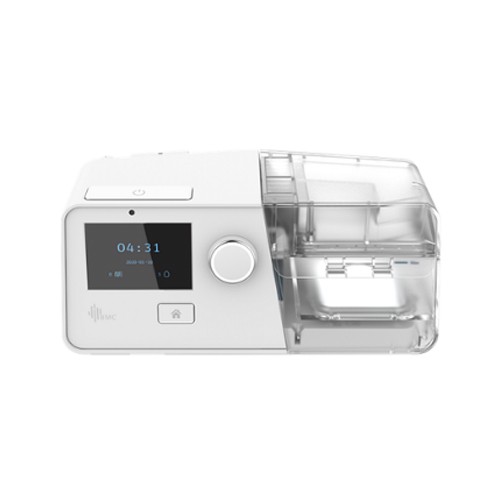
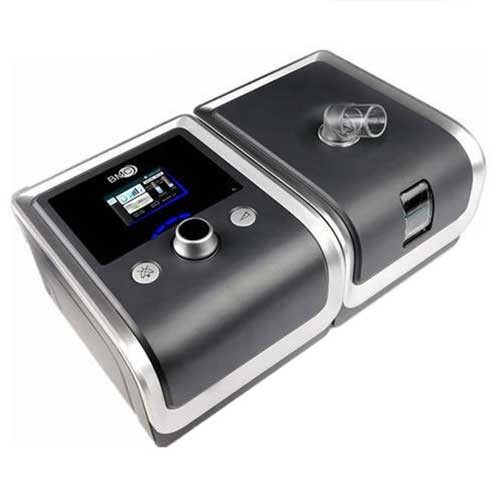
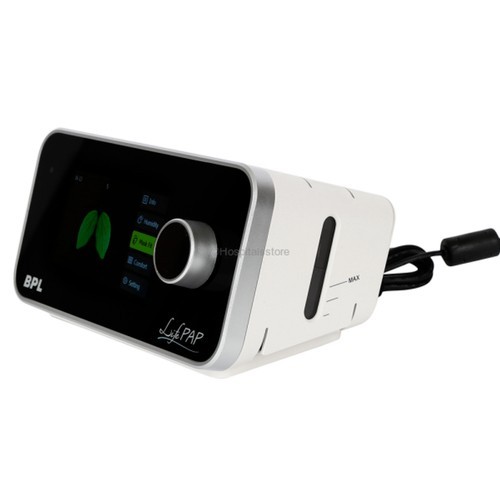
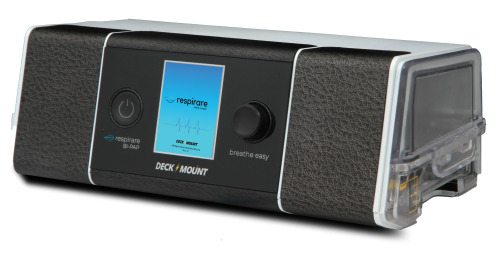
BMC RESmart GII Y30T BiPAP Machine (G2)
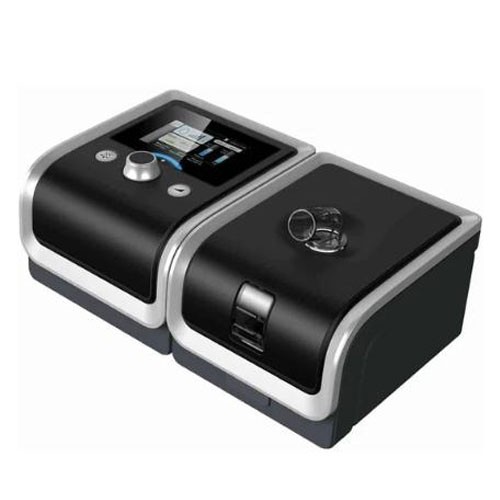
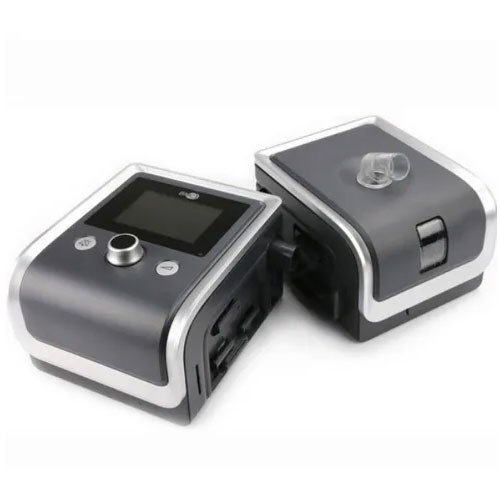
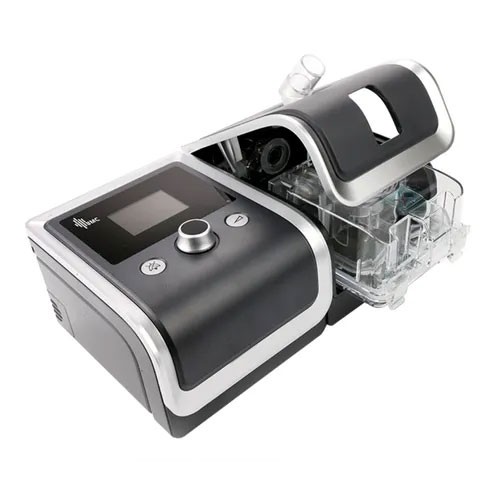
Key features
- Type BIPAP
- Modes CPAP, S, S / T, T
- Turbine Made in China
- Pressure Range 4-30cmH₂O
- Ergonomic Tilted Display No
- Detachable Design Yes
Specifications
| Type | BIPAP |
|---|---|
| Modes | CPAP, S, S / T, T |
| Turbine | Made in China |
| Pressure Range | 4-30cmH₂O |
| Detachable Design | Yes |
| Sound level | 30dB |
| Weight | 2.5Kg |
| Dimensions | 313 × 194 × 112mm |
| Company Headquaters | China |
| Auto On/Off | Yes |
| Ramp Duration | 0 to 60min. |
| Ramp Down | No |
| Humidifier | Heated |
| Leak Alert | Yes |
|---|---|
| Altitude Compensation | Yes |
| Trigger & Cycle sensitivity | Yes |
| Ti Control | Yes |
| Rise Time | Yes |
| Ti(inspiration time) | Yes |
| Pressure Support | Yes |
| Leakage Compensation | No |
| SD card | Yes |
| QR code | Yes |
| CE | Yes |
Pros and cons
PROS
- 4–30 cmH2O pressure envelope handles obesity-hypoventilation, COPD-overlap and high-BMI OSA-requiring-BiPAP without hitting a ceiling the Y25T reaches
- Pressure Support explicitly adjustable alongside trigger/cycle/rise-time/Ti — the full synchrony toolkit is available, not firmware-locked
- ₹23,440 indicative street price undercuts the narrower-range Y25T and sits 60–65% below a ResMed AirCurve 10 with humidifier
- 3.5-inch colour LCD is genuinely readable at 2 am without glasses — a practical ergonomic win for elderly patients the Y25T display marginally lags on
CONS
- No Wi-Fi, no cloud connectivity, no Care-Orchestrator-style remote titration workflow — iCode QR plus SD card is the ceiling
- No central-apnea detection, no back-up-rate on central event, no RERA reporting — complex-apnoea patients need a different machine
- BMC service-network depth in India is thinner than Philips or ResMed below tier-1 cities; rural warranty claims mean longer downtime
The BMC RESmart GII Y30T is the fuller sibling of the Y25T — same chassis footprint, same 30 dB sound floor, same 2.5 kg weight, but with the pressure ceiling lifted to 30 cmH2O and explicit Pressure Support control added per the published spec table. Indicative street price is ₹23,440 against a ₹33,600 MRP per manufacturer brochure and e-commerce product listings. The unit is currently In Stock in Indian dealer channels. It delivers CPAP, S, S/T and T modes across the full 4–30 cmH2O range, bundles a heated humidifier, ships CE-certified (FDA status not stated in the published additional details for this SKU), and uses iCode QR-code plus SD card for compliance off-load. For most Indian home-BiPAP prescriptions this is the Y-series BMC to buy; the Y25T remains interesting only for specific inventory-price reasons.
What the specs actually mean
The headline spec difference against the Y25T is the pressure envelope: 4–30 cmH2O against 4–25. That five-cmH2O headroom matters for three real Indian home-BiPAP populations. Patients with obesity hypoventilation syndrome (BMI above 40 with daytime hypercapnia) routinely titrate to IPAP 22–28 cmH2O, which lives comfortably inside the Y30T envelope and starts clipping on a 25-ceiling machine. COPD-overlap patients with high-pressure requirements can push into the 22–25 range on bad nights. And patients stepping up from failed CPAP therapy at 18+ cmH2O often end up with IPAP in the 20–25 range and EPAP 8–12 — again, more comfortably handled by a machine with headroom than one at the ceiling.
Pressure Support is explicitly listed in the Y30T spec table (in a row the Y25T leaves blank). This is the IPAP-minus-EPAP delta that drives tidal volume, and the Y30T lets the clinician set it as a first-class parameter rather than as a consequence of setting IPAP and EPAP separately. In practice, any competent BiPAP prescription already specifies this either directly or by IPAP/EPAP, but having Pressure Support exposed as a tunable makes firmware-level titration cleaner during in-clinic setup.
The four-mode range (CPAP, S, S/T, T) is unchanged from the Y25T. S/T is the mode that covers the widest Indian home-BiPAP population: it uses the patient’s own effort when available and fires a back-up rate if they stop breathing. Back-up rate itself is not listed in the published additional-details table for the Y30T (a slight documentation gap), but the S/T mode assumes one.
Trigger and cycle sensitivity, rise time, and Ti control are all adjustable — the full synchrony toolkit exposed to the clinician, matching what the Y25T offers. This is what separates real clinical BiPAPs from dressed-up CPAPs, and both the Y25T and Y30T get it right at this price point. Cheaper Chinese-import BiPAPs at sub-₹20,000 often ship these parameters locked in firmware, and the result is patient-ventilator dysynchrony that kills adherence in the first two weeks.
Altitude compensation is Yes; leak alert is Yes; leakage compensation is listed No (mask leak is not automatically compensated at the pressure-delivery level, which is a real gap against ResMed’s Vsync and Philips’s Digital Auto-Trak). In Indian humid-season use where mask seal degrades as the silicone softens, this means the patient may feel drops in effective pressure when the mask starts leaking — the clinician’s only remedy is to re-fit the mask, not to let the machine compensate.
Weight is 2.5 kg and dimensions 313 × 194 × 112 mm — identical to the Y25T chassis. Sound at 30 dB; same bedside-tolerable band.
Humidifier and the “eco smart heating” note
Heated humidifier is bundled in the base SKU. The published description mentions “eco smart heating technology” for district heating efficiency — marketing translation: the humidifier uses a thermostatically controlled heater plate with variable duty cycle rather than a constant-on plate, which reduces average power draw. In practical terms, it means the humidifier doesn’t over-heat the water chamber during Indian summers, where over-humidification can lead to rainout (condensation in the hose) — a real annoyance for patients waking up to water in the mask at 3 am. Whether this works well in the Y30T specifically is not verified with bench data in this review [no bench measurements claimed].
Ramp duration 0–60 minutes matches industry norms; Ramp Down is not supported, which is a minor comfort gap but not clinically material.
iCode, SD card, and the cloud gap — again
Compliance off-load workflow is identical to the Y25T: iCode QR-code summary on the device screen, SD card for waveform-level data, no Wi-Fi or Bluetooth, no cloud sync. This is the structural gap in the BMC lineup at this price tier. For Indian sleep and respiratory clinics running cloud-based follow-up (ResMed AirView, Philips Care Orchestrator), the Y30T requires the patient or caregiver to physically visit for data handoff. In tier-1 cities with established cloud workflows this is a real friction point; in tier-2 and tier-3 cities where in-person follow-up is still the norm, the gap is moot.
Who should buy it
The Y30T is the right BiPAP for the core Indian home-BiPAP population: OSA-requiring-BiPAP at any IPAP 10–30 cmH2O, COPD with nocturnal hypercapnia on S or S/T, obesity hypoventilation syndrome at IPAP up to 30, neuromuscular disease at stable pressure requirements, post-hospital-discharge BiPAP where the family is paying out of pocket. In all of these, the pressure headroom matters more than the cloud workflow does, the bundled humidifier reduces accessory spend, and the ₹23,440 street price keeps the machine within range of the household budget that a ResMed AirCurve 10 clears out.
It is also the right choice for a patient likely to upgrade in year one or two. The Y30T’s 2-year warranty and BMC’s moderate service footprint are honestly modest against ResMed’s 3 years and much deeper field force — but at the price, a Y30T plus an AirCurve-in-year-three still nets out below a single AirCurve purchase upfront, especially if the first year of therapy ends up being trial-and-error on mask fit and prescription tuning.
For a respiratory physician setting up a new home-BiPAP prescription where the patient has a clean diagnostic polysomnography (no central events, no complex apnoea, no CompSA pattern), the Y30T is an honest default recommendation in the BMC-price tier. It exposes the right clinical parameters, covers the right pressure band, and does not get in the way.
Who shouldn’t
Anyone with central apnoea on diagnostic PSG should not buy the Y30T. Period. No central-apnea detection means the machine is delivering S or S/T therapy blind to the failure mode that matters in these patients — they need a ResMed AirCurve ASV, a Philips DreamStation ASV, or an AVAPS/iVAPS-class device.
Anyone on home ventilation for ALS, muscular dystrophy, late-stage restrictive thoracic disease, or any chronic ventilator-dependence should not buy the Y30T. This is home-ventilator territory — AVAPS, iVAPS, battery backup, dual-circuit with disconnect alarms, internal-lamp-and-buzzer alarm systems. The Y30T is a BiPAP, not a life-support ventilator, and using it outside its indicated band is clinically risky.
Anyone whose clinic is structured around cloud titration — AirView, Care Orchestrator, proprietary Indian clinic portals — should buy a ResMed or Philips rather than the Y30T. The workflow friction will eventually override any cost saving.
And anyone needing IPAP above 30 cmH2O — rare but real in extreme obesity hypoventilation — should look at an AVAPS-class machine. The Y30T does not clip gracefully at 30; it clips absolutely.
How it compares to real alternatives
Y30T vs ResMed AirCurve 10 S (or VAuto)
Street price differential runs roughly ₹45,000–65,000 — the AirCurve 10 in India sits around ₹65,000–75,000 with humidifier. The AirCurve wins on Wi-Fi + AirView, 3-year warranty, AutoSet response speed, mask-fit library, service-network depth, and Vsync leak compensation. The Y30T wins on price and on not having any of the distributor-level Indian-service headaches that occasionally slow AirCurve warranty claims. Pick the AirCurve if the clinic runs AirView or if budget permits; pick the Y30T if the ₹50,000 delta is the difference between therapy and no therapy.
Y30T vs Philips DreamStation BiPAP S/T Auto
Philips DreamStation BiPAP S/T Auto with humidifier sits around ₹55,000–75,000 in India in 2026 depending on dealer and post-recall remediation status. It offers Care Orchestrator cloud workflow, FAA approval (useful for travel), and a more feature-rich clinical platform. The 2021 DreamStation 1 foam recall overhang is largely resolved — Philips has moved to DreamStation 2 hardware for new units and completed foam remediation on recalled DreamStation 1 stock — but buyers should confirm the specific unit’s serial number and remediation status at purchase. Pick the DreamStation if Care Orchestrator integration or the post-recall confidence is available; pick the Y30T if the recall history remains a sticking point or if budget is tighter.
Y30T vs Y25T
Same chassis, wider pressure range, Pressure Support exposed, and at the current Indian retail listing the Y30T is actually slightly cheaper — ₹23,440 vs ₹25,823. Buy the Y30T. The Y25T has a defensible case only at an anomalous price discount; at list, the Y30T is strictly better.
Indian-market considerations
BMC’s Indian service reality is the Y30T’s biggest operational risk. Authorised service in India routes through distributor-partners concentrated in Delhi NCR, Mumbai, Pune, Bangalore, Hyderabad, Chennai, Ahmedabad, Kolkata and Chandigarh. Outside these, service means courier-to-partner-city and wait. For a BiPAP patient where the therapy is not skippable, this is more concerning than for a CPAP patient; a swap-unit loan program is not standard. If the buyer is in a tier-2 or tier-3 city, contacting BMC’s India distributor before purchase to confirm the named service partner and spare-part stock is a non-optional step.
The unit is universal-input 100–240V, so no step-down transformer. Indian voltage stability still argues for a ₹2,500 stabiliser ahead of the BiPAP in tier-2 and tier-3 residences. For any household where power reliability is marginal, a small inverter-UPS (700 VA class) on the BiPAP and the humidifier is a reasonable precaution — a night of unsupported BiPAP during a blackout is a real therapy-adherence hit. The Y30T does not ship with integrated battery.
CDSCO registration for this specific SKU is not stated in the published additional details in the data we reviewed (CDSCO Medical Device Registry); hospital-channel buyers should verify registration with the supplier before issuing a PO. BMC generally carries CE as the primary regulatory marker; Indian regulatory is distributor-side.
Online retail versus hospital channel runs a 10–20% price delta. Hospital channel bundles setup, mask fitting, and trigger/cycle/Ti tuning — for a first-time BiPAP patient this tuning is more valuable than the price premium. Online is the right channel only for returning buyers or for buyers with independent access to a respiratory technician.
Verdict
For the majority of Indian home-BiPAP prescriptions, the BMC RESmart GII Y30T is the best-value machine still shipping in India. At ₹23,440 street it exposes the clinical parameters a respiratory physician needs, covers the 4–30 cmH2O band that actually matters, and bundles the humidifier the patient will use from day one. The Y25T is redundant at current pricing; the AirCurve 10 is 2.8–3.2× the price and mostly justifies it only when cloud workflow or deeper service network are load-bearing.
Score it 7.5 out of 10 — a step up from the Y25T’s 7.3 because the wider pressure range and Pressure Support control remove the two most significant clinical ceilings on the Y25T without adding any meaningful cost. Points off for the missing cloud workflow, the absence of central-apnea detection, the leak compensation gap, and BMC’s tier-2 service footprint. If central apnoea is on the differential, if the clinic runs AirView, or if home-ventilator capability is really what’s needed, this is the wrong class of device. For everyone else in the Indian home-BiPAP budget tier, the Y30T is the honest default.
Frequently asked questions
What is the warranty of BMC RESmart GII Y30T BiPAP Machine?
The warranty of BMC RESmart GII Y30T BiPAP Machine is 2 years.
What are the top features of BMC RESmart GII Y30T BiPAP?
BMC RESmart GII Y30T is a BiPAP machine and following are the few top features of this device are - Auto on/off Trigger sensitivity Rise time Reslex Pressure Relief Altitude Compensation Leak Compensation iCode for sleep data