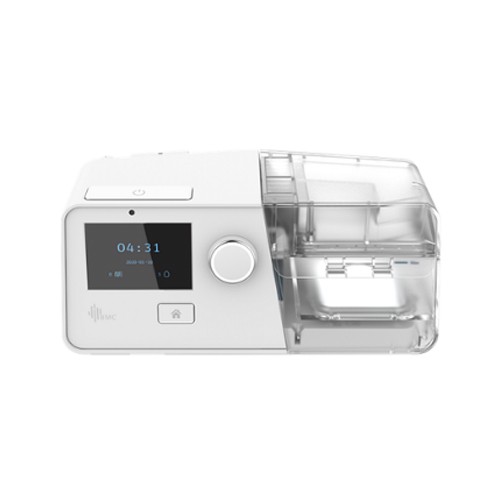
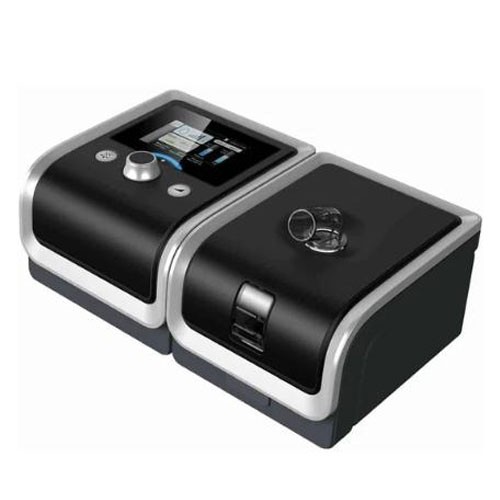
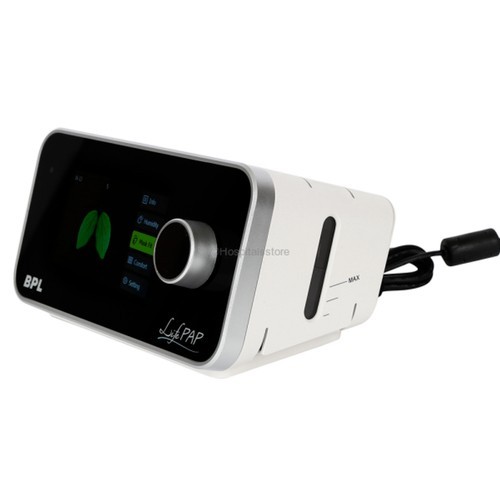
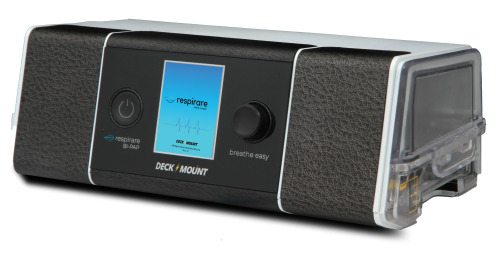
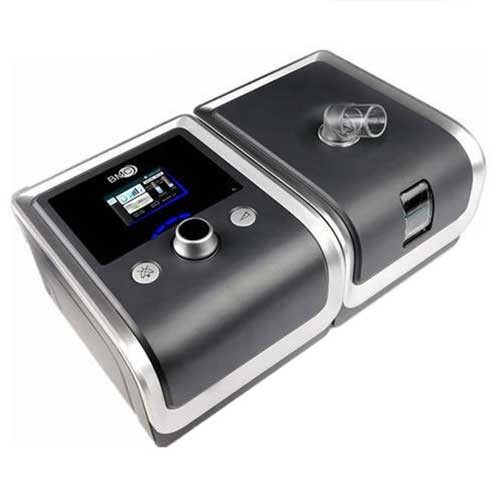
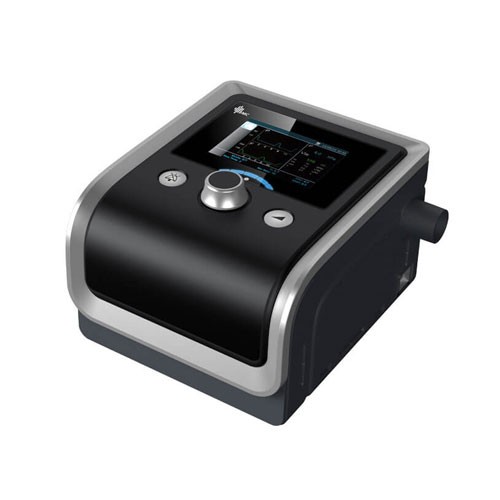
BMC RESMART GII BiPAP Y25T Machine (G2)
Key features
- Type BIPAP
- Modes CPAP, S, S/T, T
- Turbine Made in China
- Pressure Range 4 - 25cmH₂O
- Ergonomic Tilted Display No
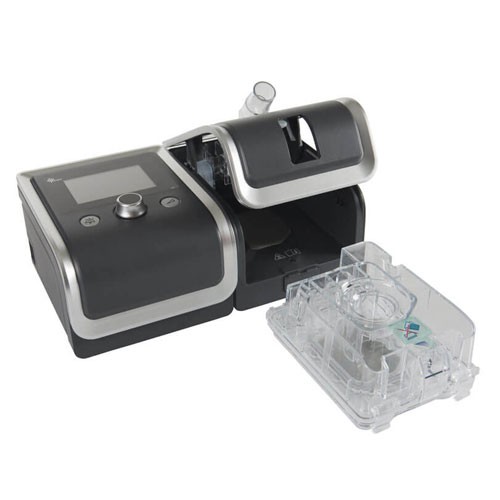
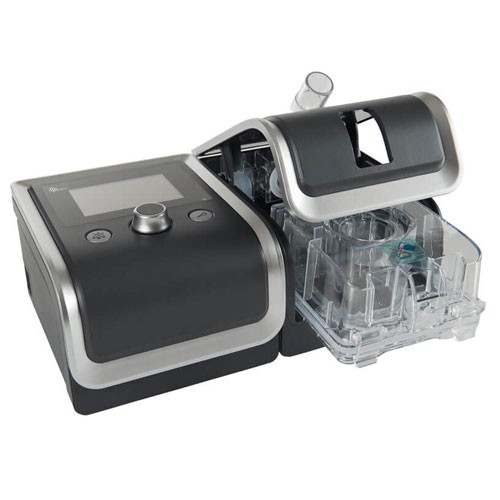
- Detachable Design Yes
Specifications
| Type | BIPAP |
|---|---|
| Modes | CPAP, S, S/T, T |
| Turbine | Made in China |
| Pressure Range | 4 - 25cmH₂O |
| Detachable Design | Yes |
| Sound level | 30dB |
| Weight | 2.5Kg |
| Dimensions | 313 × 194 ×112mm |
| Company Headquaters | China |
| Auto On/Off | Yes |
| Ramp Duration | 0 - 60min. |
| Ramp Down | No |
| Humidifier | Heated |
| Leak Alert | Yes |
|---|---|
| Altitude Compensation | Yes |
| Trigger & Cycle sensitivity | Yes |
| Ti Control | Yes |
| Rise Time | Yes |
| Ti(inspiration time) | Yes |
| Leakage Compensation | No |
| SD card | Yes |
| Cloud connectivity/Wifi | No |
| QR code | Yes |
| CE | Yes |
Pros and cons
PROS
- 4–25 cmH2O pressure envelope with CPAP/S/S-T/T modes covers standard home BiPAP indications including COPD overlap and OSA-requiring-BiPAP at under half the ResMed AirCurve 10 price
- 30 dB published sound level matches the quieter imported BiPAPs and stays below the 40 dB partner-complaint threshold in a small Indian bedroom
- Bundled heated humidifier plus adapter, mask, hose and carry bag in the base SKU remove ₹6,000–10,000 of typical BiPAP accessory spend
- Trigger & cycle sensitivity, rise time and Ti control are adjustable — the clinician can actually tune synchrony, which budget BiPAPs routinely fix in firmware
CONS
- No Wi-Fi or cloud connectivity — compliance off-loads via SD card or iCode QR only, which is a structural gap for clinics managing titration remotely
- No central-apnea detection, no back-up-rate-on-central-event flag, no RERA reporting — the Y25T is a workhorse S/ST BiPAP, not a complex-apnoea machine
- 2-year warranty and BMC's thinner tier-2/tier-3 service footprint versus Philips or ResMed means rural buyers face real support friction
The BMC RESmart GII Y25T BiPAP Machine is the budget-end home BiPAP still shipping in India in 2026, and it occupies a genuinely awkward but important niche — cheap enough to be the right answer when a patient is stepping up from CPAP to BiPAP but can’t commit ₹60,000+ to a ResMed AirCurve 10, feature-rich enough to actually deliver the S/ST/T modes a respiratory physician prescribes, and light enough at 2.5 kg to live on an Indian bedside table. Indicative street price is ₹25,823 against a ₹62,400 MRP per manufacturer brochure and e-commerce product listings — that 58% discount off MRP is real in the Indian online channel and should not be mistaken for a fake sticker discount. The unit ships in CPAP, S, S/T and T modes with a 4–25 cmH2O pressure range, heated humidifier in the box, and iCode-based compliance readout via QR code or SD card. CE certified; FDA status not stated in the published spec tables for this SKU.
What the specs actually mean
The four-mode range (CPAP, S, S/T, T) is the load-bearing capability on any BiPAP — and the Y25T delivers all four. CPAP mode turns the machine into a fixed-pressure therapy device for straightforward OSA (rare use case — you’d normally just buy a CPAP). S mode (Spontaneous) gives independent IPAP and EPAP pressures and waits for the patient’s own breathing effort, which is the mode most Indian COPD-overlap and high-BMI OSA patients actually use. S/T (Spontaneous/Timed) adds a back-up respiratory rate that fires if the patient stops initiating breaths — critical for COPD patients, neuromuscular disease, or any condition with central-apnoea risk. T (Timed) hands breath initiation fully to the machine.
The 4–25 cmH2O pressure envelope is adequate but not generous. Most Indian BiPAP prescriptions for COPD and OSA-requiring-BiPAP land in the 10–20 cmH2O IPAP range with EPAP 4–8 cmH2O, comfortably inside the Y25T’s band. Patients who need IPAP above 25 — severe obesity hypoventilation, advanced restrictive lung disease — need the Y30T or an AVAPS-class machine; the Y25T is the wrong buy for them.
Trigger and cycle sensitivity, rise time, and Ti (inspiration time) control are all adjustable per the published spec table — this is the feature set that lets a respiratory technician or physician tune patient-machine synchrony, and it separates a real clinical BiPAP from a dressed-up CPAP. Cheaper BiPAPs ship with these parameters locked in firmware, which forces the patient to adapt to the machine rather than vice versa. The Y25T getting this right is the single strongest argument for it at the price.
Weight is 2.5 kg with dimensions 313 × 194 × 112 mm. That is larger and heavier than the ResMed AirCurve 10 class (around 1.3 kg without humidifier) — the BMC chassis is a bedside unit rather than a travel unit, and that is fine for a prescription that will not leave home.
Sound level published at 30 dB matches the Y30T sibling and the lower-cost ResMed and Philips BiPAPs within a few decibels. In an Indian bedroom under typical insulation, 30 dB translates to audible-but-not-disruptive for the patient, and partner complaints at this level are almost always mask-leak noise rather than blower noise.
Humidifier is heated, bundled in the base SKU. For any BiPAP patient on extended nightly therapy, humidification is non-negotiable — unhumidified BiPAP at pressures above 10 cmH2O dries the nasal mucosa fast enough to cause epistaxis within weeks. Ramp 0–60 minutes gives the patient a gradual pressure onset; Ramp Down is not supported.
Altitude compensation is listed Yes — relevant for hill-station travel or higher-altitude Indian deployments (Shimla, Gangtok, Nainital). Leak alert is present. Central apnea detection is not listed, and this is a meaningful gap: on a patient with cardiac comorbidity or any REM-centred apnoea signal, the Y25T will deliver S or S/T therapy without flagging that the events it is not preventing are central in origin. That is not a safety failure — the clinician reads this off the diagnostic polysomnography — but it does mean the Y25T is the wrong choice for any patient where complex apnoea is on the differential.
The iCode, SD-card compliance story
Compliance off-load is via iCode (a QR-code summary readable at the device screen) and an SD card for full waveform data. There is no Wi-Fi, no Bluetooth, no cloud sync. iCode is a pragmatic workaround — the patient photographs the QR code and the clinician retrieves a summary — but it is not a substitute for remote cloud titration workflows that ResMed myAir or Philips Care Orchestrator provide. For Indian sleep and respiratory clinics that have moved to cloud-based follow-up (increasingly common in tier-1 metros post-2022), this is a real friction point.
Who should buy it
The Y25T is the right BiPAP for an Indian patient with a prescription for S or S/T mode BiPAP — OSA-requiring-BiPAP, COPD with nocturnal hypercapnia, obesity hypoventilation at IPAP under 25 cmH2O — where budget is the binding constraint and the clinician is comfortable managing the patient on monthly in-clinic downloads rather than cloud feeds. That covers a meaningful fraction of Indian home-BiPAP buyers, especially in tier-2 cities and post-discharge COPD patients who cannot afford a ₹60,000+ imported unit.
It is also the right choice for a patient stepping up from CPAP to BiPAP where the CPAP attempt failed on pressure intolerance rather than on central events — the classic “CPAP is too aggressive on exhale” patient where S-mode BiPAP solves the comfort issue without needing the therapy-logic sophistication of an AirCurve. And it is defensible as a home-discharge machine for a patient leaving the hospital on BiPAP where the family is paying out-of-pocket and the hospital tech is available to tune trigger/cycle/rise-time during the first in-clinic follow-up.
The bundled humidifier-plus-mask-plus-hose accessory kit also matters more than it sounds. A new BiPAP buyer in India typically spends another ₹8,000–12,000 on mask, cushion, humidifier chamber and spare tubing; having most of this in the base SKU blunts the true first-purchase cost gap with higher-end BiPAPs.
Who shouldn’t
Anyone whose diagnostic sleep study shows central apnoea, complex sleep-disordered breathing, CompSA pattern, or cardiac-origin central events should not buy the Y25T. They need a ResMed AirCurve ASV, a Philips DreamStation ASV, or an AVAPS-class device that actively detects and responds to central events. The Y25T has no central-apnea detection or treatment logic.
Anyone on home ventilation for neuromuscular disease (ALS, muscular dystrophy, late-stage restrictive thoracic disease) should not buy the Y25T. They need a true home ventilator with AVAPS or iVAPS, battery backup, and alarm capability the Y25T does not provide — this is the Philips DreamStation AVAPS or ResMed Lumis territory.
Anyone whose clinic requires cloud compliance data for insurance or CDSCO-regulated therapy programmes should confirm with the clinic before buying — the Y25T’s iCode workflow works for paper-record practices but not for automated cloud-reporting workflows.
And anyone needing IPAP above 25 cmH2O routinely — severe obesity hypoventilation, restrictive chest-wall disease — should buy the Y30T (4–30 cmH2O) instead. The Y25T hits its ceiling too early for these patients.
How it compares to real alternatives
Y25T vs ResMed AirCurve 10 S (or VAuto)
The ResMed AirCurve 10 line is the premium Indian import reference for home BiPAP. Street prices in India run roughly 2.5–3× the Y25T, with a 3-year warranty, integrated Wi-Fi with AirView for clinician-side remote data, AutoSet/AutoBiLevel algorithms that track the 90th-percentile pressure requirement, and the broadest imported-brand service network in India. It wins decisively on data workflow, warranty, and service. The Y25T wins on price and bundled humidifier. Pick the AirCurve if the clinic runs AirView-based follow-up or if the patient has any complexity beyond straightforward S/ST BiPAP; pick the Y25T if the budget gap is binding and the prescription is clean.
Y25T vs Philips DreamStation BiPAP S/T (post-recall)
Philips is back in the Indian BiPAP market with recall-remediated DreamStation stock and the DreamStation 2 platform. The DreamStation BiPAP offers Care Orchestrator cloud workflow and a more feature-rich platform than the Y25T but at a street price 1.6–2.0× higher. The 2021 recall on DreamStation 1 foam is largely resolved in India by 2026, but buyers should confirm the specific unit’s serial range and foam remediation status at purchase. The Y25T has no recall overhang and no associated inspection anxiety; that is a genuine value. Pick the DreamStation if Care Orchestrator workflow matters or if the recall confidence is there; pick the Y25T if the recall history is a dealbreaker.
Y25T vs BMC Y30T
The Y30T is the same chassis with the pressure ceiling lifted to 30 cmH2O and Pressure Support added. It sits at roughly ₹23,440 — actually slightly lower in the current Indian retail listing than the Y25T, which reflects inventory rather than capability. If the clinician’s prescription includes explicit pressure-support settings or sees any probability of IPAP creeping above 25 cmH2O, the Y30T is the better buy for the same money. The Y25T retains a case only when the exact prescription is locked at IPAP ≤ 25 and the buyer finds a Y25T at a meaningful discount — an increasingly rare scenario in the Indian channel.
Indian-market considerations
BMC’s Indian presence is distributor-based — no captive Indian subsidiary, service routed through tier-1-city partners. For a BiPAP buyer this matters more than for a CPAP buyer: BiPAPs get used on sicker patients, downtime during repair is costlier, and the absence of a captive field force means swap-unit logistics during a warranty repair are not guaranteed. A Y25T bought in Ahmedabad or Pune with a named BMC partner has a workable warranty experience; a Y25T bought online and shipped to Dehradun or Varanasi can mean a week of therapy downtime during any service event. This is the single biggest operational consideration for BMC in India.
The Y25T ships as a universal-input 100–240V unit; no step-down transformer needed. Voltage stabiliser is still recommended for tier-2 and tier-3 residences with swinging mains — a ₹2,500 stabiliser is cheap insurance against a ₹25,823 machine. For any BiPAP patient whose therapy is essential (cannot be skipped for a night), a UPS or battery-backed inverter is a reasonable add-on; the Y25T does not ship with integrated battery.
CDSCO registration for this specific SKU is not stated in the published additional details in the data we reviewed (CDSCO Medical Device Registry); hospital-channel buyers should confirm registration status before issuing a purchase order.
Online versus hospital-channel price gap runs 10–18%. Hospital purchase typically includes the initial setup visit, mask fitting and trigger/cycle tuning by the respiratory technician — for a first-time BiPAP patient this tuning is worth more than the price premium, since mistuned trigger sensitivity on a BiPAP translates directly into poor patient-ventilator synchrony and therapy abandonment. Online is the right channel only for a returning buyer who already knows their parameters.
Verdict
For an Indian home BiPAP prescription in the standard S or S/T mode, IPAP ceiling ≤ 25 cmH2O, with no central-apnoea complexity and a budget ceiling around ₹30,000, the BMC RESmart GII Y25T is a defensible choice — the cheapest BiPAP shipping in India that actually exposes the clinical parameters a respiratory physician wants to tune. It is not the best home BiPAP sold in India; that is the ResMed AirCurve 10 by a wide margin. But it is a workable machine for the patient the AirCurve prices out.
Score it 7.3 out of 10. Points off for the missing cloud workflow, the absence of central-apnea detection, the thinner-than-Philips-or-ResMed tier-2 service footprint, and the price-ceiling awkwardness versus its own Y30T sibling. If IPAP might drift above 25 cmH2O, if the clinic works on cloud follow-up, or if any central-apnoea complexity is on the differential, spend up. For the straightforward budget S/ST home BiPAP case, this is still the Indian market’s price floor for a real clinical-grade machine.