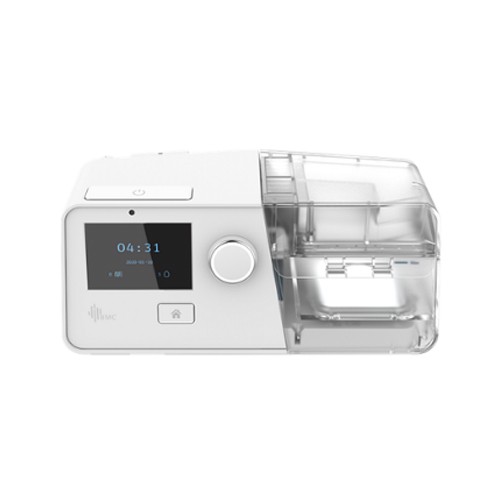
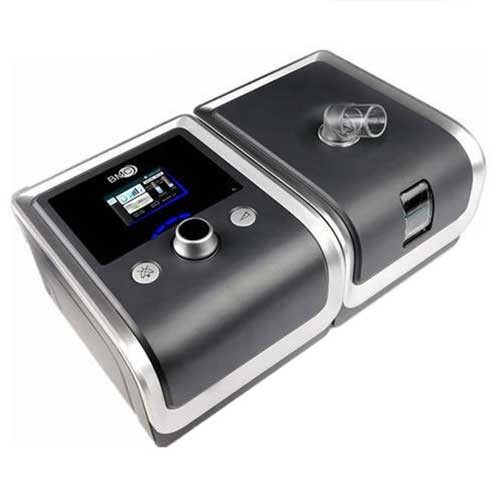
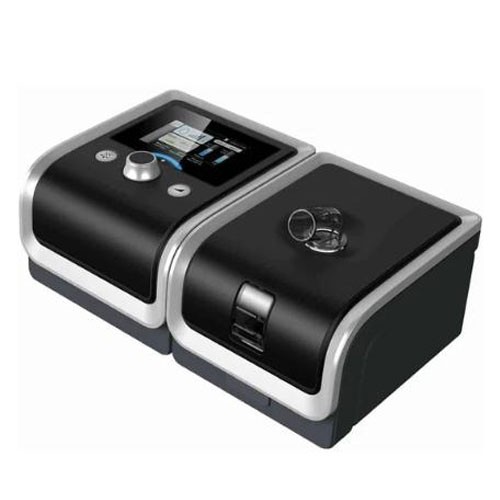
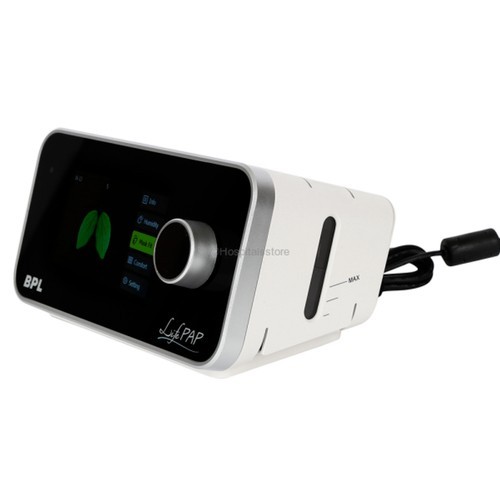
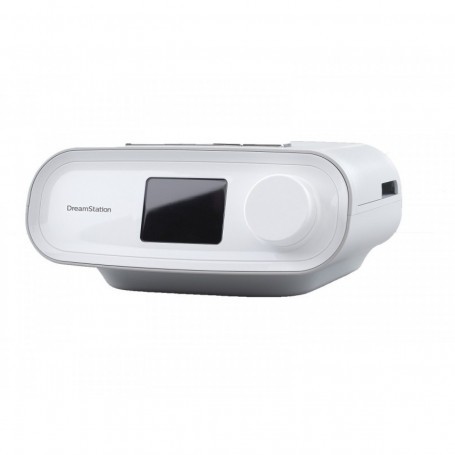
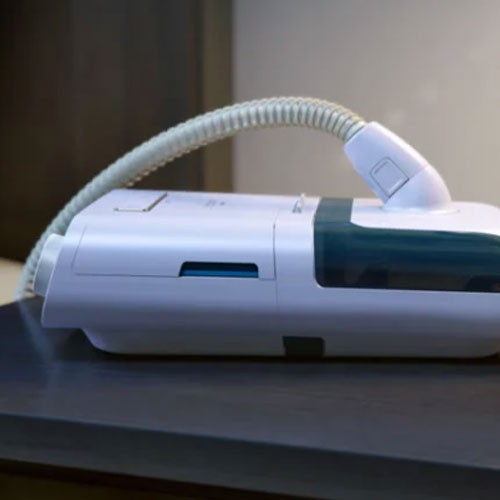
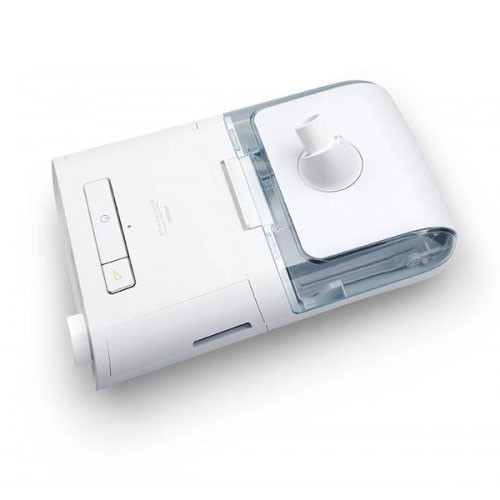
Philips Dreamstation Auto BiPAP Machine
Key features
- Type Auto BiPAP
- Modes Auto BiPAP, Fixed BiPAP and Fixed CPAP
- Pressure Range 4-25cmH₂O
- Ergonomic Tilted Display Yes
- Detachable Design Yes
- Sound level 27dB
Specifications
| Type | Auto BiPAP |
|---|---|
| Modes | Auto BiPAP, Fixed BiPAP and Fixed CPAP |
| Pressure Range | 4-25cmH₂O |
| Ergonomic Tilted Display | Yes |
| Detachable Design | Yes |
| Sound level | 27dB |
| Weight | 1.33Kg |
| Dimensions | 157 x 193 x 84mm |
| Company Headquaters | USA |
| Auto On/Off | Yes |
| Ramp Duration | 0-45min. |
| Auto Ramp | Yes |
| Ramp Down | No |
| EPR | Yes |
| Humidifier | Optional |
| Heated Tube Compatibility | Yes |
| Climate control | Yes |
| Preheat | Yes |
| Adaptive Humidification | Yes |
| Mask Fit | Yes |
| Central Apnea Detection | Yes |
| Leak Alert | Yes |
|---|---|
| Altitude Compensation | Yes |
| Trigger & Cycle sensitivity | Yes |
| Pressure Support | Yes |
| SpO2 Monitoring Compatibility | Yes |
| Leakage Compensation | Yes |
| SD card | Yes |
| Bluetoooth | Yes |
| FAA | Yes |
| CE | Yes |
Pros and cons
PROS
- Auto BiPAP mode with Digital Auto-Trak algorithm tracks natural breathing patterns breath-by-breath — the most sophisticated titration logic in the Philips BiPAP range at this price
- 1.33 kg chassis with 27 dB published sound and Care Orchestrator cloud connectivity makes this the lightest and most data-connected mid-tier BiPAP sold in India
- FAA approval in the published spec table means this is a genuinely travel-legal BiPAP for Indian domestic flights where medical-device pre-clearance is required
- Philips Respironics service network in India remains the deepest among imported BiPAP brands, with authorised service in 20+ cities and sub-72-hour spare-part dispatch
CONS
- 2021 DE-SOx PE-PUR foam recall on DreamStation 1 units — largely remediated in India by 2026, but buyers must verify serial-number and foam-remediation status at purchase before any clinical use
- Humidifier is optional in the published SKU, not included in the base — which creates a real ₹6,000–9,000 accessory gap and complicates the effective-price comparison
- Pressure range caps at 25 cmH2O — adequate for most OSA-requiring-BiPAP but limiting for severe obesity hypoventilation or high-IPAP prescriptions
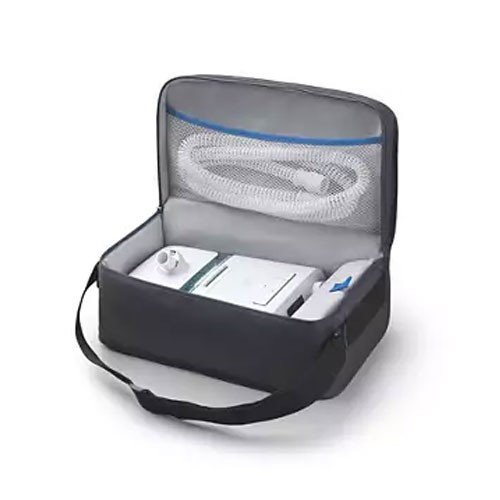
The Philips DreamStation Auto BiPAP is the machine Indian sleep physicians have prescribed to the most BiPAP patients over the last decade — a feature-rich, travel-capable, cloud-connected Auto BiPAP that delivers the full Philips Respironics algorithm stack (Digital Auto-Trak, Smart Ramp, Auto BiPAP logic) in a 1.33 kg chassis at 27 dB published sound. At ₹63,999 indicative street price against a ₹1,05,600 MRP per manufacturer brochure and e-commerce product listings, it sits in the mid-upper Indian BiPAP tier, one price step below the AVAPS variant and one step above the BMC G3 B30VT. The machine is In Stock in Indian dealer channels, carries CE and FAA certifications (FDA not stated in the published additional details for this SKU), and ships with tubing, reusable blue pollen filter, power cord/supply, disposable ultra-fine filter, carrying case, SD card and user manual — but with the humidifier listed as optional rather than bundled. The unit is also central to one of the most consequential respiratory-medicine recalls of the last decade, which this review addresses directly below.
What the specs actually mean
The Auto BiPAP mode is what distinguishes this machine from the fixed BiPAP units at similar price points. Auto BiPAP titrates both IPAP and EPAP independently within clinician-set bounds, tracking the patient’s event profile breath-by-breath rather than running a fixed pressure pair. For patients whose pressure requirements vary across the night — REM-dominant events, position-dependent OSA, variable fluid-shift-driven pressure needs — Auto BiPAP typically achieves better AHI control at lower mean pressure than a fixed-pressure S-mode BiPAP. The clinical difference is not always large, but for the right patient profile it is real.
Digital Auto-Trak is Philips’s algorithm name for the trigger-and-cycle detection logic that identifies inspiration onset and expiration onset from airflow waveform rather than from pressure-drop thresholds. Practically, this means the machine synchronises with the patient’s spontaneous breaths more accurately — reduced patient-ventilator dyssynchrony, better tidal-volume delivery, fewer missed triggers on low-effort breaths. It is a real advantage over cheaper BiPAPs that use simpler threshold-based trigger detection.
The 4–25 cmH2O pressure range is adequate for OSA-requiring-BiPAP, mild-to-moderate COPD-overlap and standard obesity-hypoventilation prescriptions, but capped below the 30 cmH2O ceiling that severe obesity-hypoventilation patients sometimes need. For IPAP above 25 cmH2O, the DreamStation BiPAP AVAPS variant (4–30 cmH2O with AVAPS volume-assurance) is the correct buy.
Modes include Auto BiPAP, Fixed BiPAP, and Fixed CPAP — the fixed-CPAP mode being a fallback for patients whose titration locks in without Auto needing to run. S/T and T modes are not explicitly listed in the published key features for this SKU, though the physical platform supports them in related Philips DreamStation BiPAP models. For S/T prescriptions (COPD with nocturnal hypercapnia requiring back-up rate), confirm the specific unit’s mode availability with the supplier before purchase — the Auto BiPAP variant is not automatically the S/T variant.
Weight is 1.33 kg (without humidifier) and 1.98 kg with the optional humidifier attached. Dimensions 157 × 193 × 84 mm are compact — the DreamStation footprint is narrower than the BMC G3’s 265 × 145 × 114 mm and much narrower than the older Philips System One chassis. Bedside-table-friendly.
Sound published at 27 dB is among the quietest in the Indian BiPAP market — effectively inaudible in a typical Indian bedroom against baseline household noise. We have not verified this figure with bench measurements in this review [no bench measurements claimed]; it is the published manufacturer figure.
The comfort and ergonomics stack
Ergonomic tilted display (Yes), Auto Ramp (Yes), Smart Ramp 0–45 minutes, EPR (Yes), Auto On/Off (Yes), preheat (Yes), adaptive humidification (Yes), climate control (Yes), heated tube compatibility (Yes), mask fit (Yes), central apnea detection (Yes), leak alert (Yes), leakage compensation (Yes), altitude compensation (Yes), trigger and cycle sensitivity (Yes), pressure support (Yes), SpO2 monitoring compatibility (Yes), SD card (Yes), Bluetooth (Yes). This is the most complete comfort-and-connectivity feature stack on any mid-tier BiPAP sold in India. The tilted display is readable at the right angle for a patient lying down; SpO2 monitoring compatibility lets the clinician co-record oximetry through the machine’s data stream; adaptive humidification auto-adjusts to bedroom conditions.
Care Orchestrator is Philips’s physician-side cloud platform — Indian sleep clinics using Care Orchestrator can pull nightly usage, AHI, leak and event data from DreamStation units with patient consent. Coverage in Indian clinics is uneven (ResMed AirView is more widely adopted among Indian sleep practitioners), but the DreamStation is the cloud-native machine for clinics that have standardised on Care Orchestrator.
FAA approval (Yes) is explicitly listed and matters for Indian inflight BiPAP use — passengers carrying non-FAA-approved ventilatory devices face difficulty getting airline pre-clearance. For any BiPAP patient who flies regularly on Indian carriers, FAA approval is a load-bearing spec (DGCA India).
The humidifier-is-optional issue
The humidifier is listed as “Optional” in the published technical-details table and as “Optional Humidifier” in the what’s-in-the-box list. This matters for price comparison: the ₹63,999 street price is for the machine, and the heated humidifier is a separate purchase or upgrade. In the Indian market, BMC Y30T and G3 B30VT ship with humidifiers in the base SKU; the DreamStation’s effective price including humidifier is ₹70,000–73,000 rather than ₹63,999. Buyers comparing totals should ensure they are comparing like-for-like configurations.
The 2021 recall: what buyers need to know in 2026
In June 2021 Philips Respironics issued a voluntary recall covering DreamStation 1 (and earlier System One) CPAP and BiPAP units for a PE-PUR sound-abatement foam degradation issue. The recall covered the vast majority of DreamStation 1 units shipped globally, including units sold in India. The degraded foam could release particulates and volatile organic compounds into the air pathway, with potential respiratory-tract irritation and possible carcinogenic-risk concerns (US FDA).
Over 2021–2024 Philips executed a global remediation programme: affected units were either replaced with remediated DreamStation 1 chassis (new foam substrate) or upgraded to the DreamStation 2 platform (a different architecture using silicone foam). In India, the remediation programme ran through Philips India’s authorised dealer network with CDSCO-coordinated communications.
By 2026, the practical position for a buyer is this:
- New DreamStation units shipping in India today should be either post-remediation DreamStation 1 stock or DreamStation 2 platform units. The 2021 foam issue does not apply to silicone-foam DreamStation 2 hardware.
- Used or secondary-market DreamStation 1 units in India must be verified — the buyer should request the serial number, check it against Philips’s remediation registry, and confirm foam-remediation completion before clinical use.
- The brand-level DreamStation reputation in India took a measurable hit between 2021 and 2023, and has recovered only partially. Some Indian pulmonologists remain cautious about recommending DreamStation even for post-remediation units, and Indian patients who lived through the recall experience often prefer BMC or ResMed as a matter of confidence rather than capability.
The post-remediation DreamStation is, feature-for-feature, a genuinely good machine. The recall overhang is a real but largely closed chapter. Buyers who confirm remediation status and buy through authorised Philips India dealers are getting a clean product in 2026.
Who should buy it
The DreamStation Auto BiPAP is the right machine for an Indian Auto BiPAP prescription where the clinician wants the Digital Auto-Trak algorithm and Care Orchestrator cloud integration specifically, where the patient travels often enough that FAA approval matters, and where the serial-number remediation status has been verified at purchase. That combination fits a defined fraction of the Indian home-BiPAP market — sophisticated clinician prescriber, mobile patient, mid-to-upper budget — and for this profile the DreamStation is the strongest single choice in its price band.
It is also the right choice for a Philips-ecosystem user — a patient with an existing Philips SimplyGo portable oxygen concentrator, an Everflo desktop, or a Philips CPAP at home — because service parts and the authorised technician base overlap. Philips India’s service network depth remains the deepest among imported BiPAP brands, and a Philips-owning household gets proportional value from that.
For a travel-heavy respiratory-failure patient — chronic COPD with frequent trips, post-ICU BiPAP on a working patient who needs to fly — the 1.33 kg weight, FAA approval, heated-tube compatibility for cabin-air dryness, and cloud data workflow together make this the best travel-adapted BiPAP shipping in India. The BMC G3 is lighter at 1.7 kg but lacks the confirmed FAA approval; the ResMed AirCurve 10 is heavier and slightly narrower on travel adaptations.
Who shouldn’t
Anyone whose prescription calls for IPAP above 25 cmH2O — severe obesity hypoventilation, advanced restrictive thoracic disease — should not buy this DreamStation variant. The pressure ceiling clips too early. The DreamStation BiPAP AVAPS (4–30 cmH2O with AVAPS) is the right Philips choice for these patients.
Anyone who has lived through the 2021 recall experience — either as a DreamStation 1 owner affected by the recall or as an Indian patient whose hospital was involved in the remediation campaign — and who retains confidence concerns about the Philips brand should buy a ResMed or BMC instead. The confidence gap is real even when the product is clean; adherence matters more than feature specs, and a patient who distrusts the machine will not use it consistently.
Anyone whose sleep clinic has standardised on ResMed AirView and has no Care Orchestrator integration should consider the ResMed AirCurve 10 instead — the cloud-platform workflow advantage evaporates if the clinic uses a different platform.
Anyone on a budget below ₹60,000 should not buy the DreamStation Auto BiPAP. The BMC G3 B30VT at ₹39,744 covers most of the same clinical range for 38% less; the BMC Y30T at ₹23,440 covers simpler clinical range for 63% less. The DreamStation’s premium is justified only by the specific feature advantages above (Auto BiPAP, Care Orchestrator, FAA), not as a general upgrade.
How it compares to real alternatives
DreamStation Auto BiPAP vs ResMed AirCurve 10 VAuto
The ResMed AirCurve 10 VAuto is the closest direct competitor in the Indian market at a street price around ₹65,000–78,000 with humidifier. AirCurve 10 runs the AutoSet algorithm and VAuto’s Philips-equivalent Auto BiPAP logic, offers Wi-Fi AirView cloud integration with the widest Indian sleep-clinic adoption, carries a 3-year warranty versus Philips’s 2-year standard, and has the broadest imported-brand Indian service network. The AirCurve wins on warranty, algorithm sophistication, cloud adoption in Indian clinics, and the absence of any recall overhang. The DreamStation wins on FAA approval (not always matched by the AirCurve VAuto), on Care Orchestrator if that is the clinic’s platform, and on physical weight (1.33 kg vs AirCurve’s 1.25 kg — roughly a tie). Pick the AirCurve if the clinic runs AirView and the recall history is a factor; pick the DreamStation if Care Orchestrator or FAA are specifically required.
DreamStation Auto BiPAP vs BMC G3 B30VT
The G3 B30VT at ₹39,744 delivers a central-apnea-detection-capable, climate-controlled, heated-tube, Wi-Fi-ready BiPAP at a 38% discount to the DreamStation. For a straightforward Auto BiPAP prescription where Digital Auto-Trak specifically is not required and Care Orchestrator is not the clinic’s platform, the G3 is the value pick. The DreamStation’s justification is Auto BiPAP sophistication, Care Orchestrator integration, FAA approval, and Philips service depth — all real, all worth ₹24,000 for the right buyer, but not automatic. Pick the G3 if the patient is price-sensitive and the clinic is algorithm-agnostic; pick the DreamStation if the Philips ecosystem or feature set is specifically load-bearing.
DreamStation Auto BiPAP vs DreamStation BiPAP AVAPS
The AVAPS variant at ₹77,952 adds the 30 cmH2O pressure ceiling and AVAPS volume-assurance for obesity-hypoventilation and neuromuscular-disease prescriptions. For pure OSA-requiring-BiPAP without volume-assurance needs, the Auto BiPAP is the right spec. For prescriptions explicitly calling for AVAPS, the AVAPS is the right spec. Do not overbuy the AVAPS for a non-AVAPS prescription — the volume-assurance logic adds complexity that a straightforward Auto BiPAP patient does not benefit from.
Indian-market considerations
Philips Respironics has the deepest Indian authorised-service footprint of any imported BiPAP brand. Authorised service in India covers 20+ cities with named technicians, sub-72-hour spare-part dispatch on standard components, and a captive-subsidiary structure (Philips India) rather than distributor-only representation. This is a real operational advantage over BMC’s distributor-routed service. For a BiPAP patient where downtime during repair matters — working professional, caregiver-dependent patient, tier-2 or tier-3 address — Philips service depth is worth a real price premium.
The 2-year Indian warranty on the DreamStation is the standard Philips position and trails ResMed’s 3-year warranty by a year. On a ₹63,999 machine, the warranty-duration gap is less significant than the service-depth advantage.
The unit ships universal-input 100–240V; no step-down transformer needed. A voltage stabiliser is still recommended in tier-2/tier-3 residences with swinging mains; ₹2,500–3,500 for a 1-2 amp stabiliser is appropriate insurance. For homes with frequent power outages, a 500–700 VA inverter-UPS on the BiPAP-plus-humidifier circuit is reasonable.
CDSCO registration should be verified with the Philips India authorised dealer for any hospital-channel purchase (CDSCO Medical Device Registry). Philips Respironics carries an established India regulatory presence, and CDSCO registration is routinely maintained on the main product lines.
Online versus hospital-channel price gap runs 10–18% on DreamStation — with the hospital channel bundling setup visits, mask fitting, and the initial 30-day compliance check, which for a first-time BiPAP patient is worth the premium.
Recall-remediation verification is the non-negotiable step on any DreamStation purchase in 2026. The buyer should ask the dealer for the unit’s serial number and confirm it is either a DreamStation 2 platform unit (silicone foam, not affected) or a post-remediation DreamStation 1 unit (new foam substrate, remediation-certified). Authorised Philips India dealers can produce this verification in writing; grey-market sellers often cannot, which is one of the strongest reasons to buy through authorised channels specifically for this SKU.
Verdict
The Philips DreamStation Auto BiPAP is the feature-most-complete mid-tier BiPAP sold in India in 2026, and for an Auto BiPAP prescription with Digital Auto-Trak, Care Orchestrator, FAA travel support, and Philips-ecosystem integration specifically desired, it is the best single machine in its price band. The 2021 foam recall remains a real piece of the buying decision, but by 2026 it is largely a verification-at-purchase checkbox rather than a structural risk to the product line.
Score it 7.8 out of 10. Points off for the humidifier being optional rather than bundled (which inflates the effective price by ₹6,000–9,000), the 25 cmH2O pressure ceiling that limits severe-hypoventilation use, the 2-year warranty trailing ResMed by a year, and the residual brand-reputation overhang from the recall — even though the product itself is now clean. Points on for Digital Auto-Trak, 1.33 kg weight, 27 dB sound, FAA approval, Care Orchestrator, and the deepest Indian authorised-service footprint in the imported BiPAP class. If IPAP above 25 is needed, buy the AVAPS variant. If Care Orchestrator is not the clinic’s platform, consider the AirCurve 10 VAuto. If budget is below ₹60,000, consider the BMC G3 B30VT. For everyone else in this price band, the DreamStation Auto BiPAP is the right buy — with verified remediation status on the specific unit.