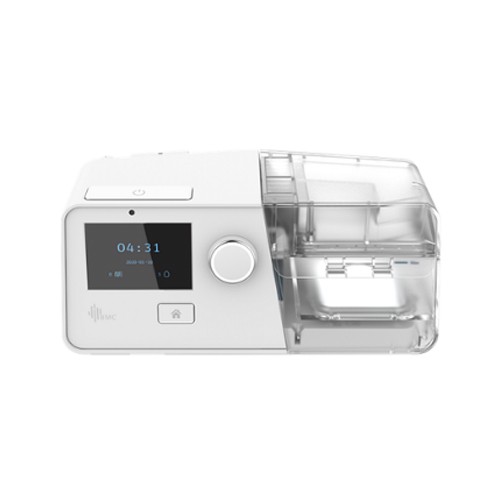
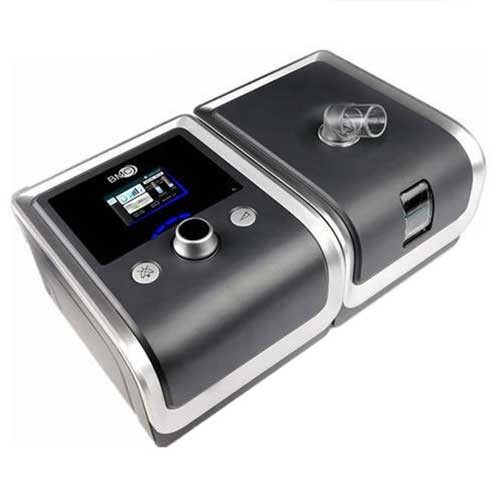
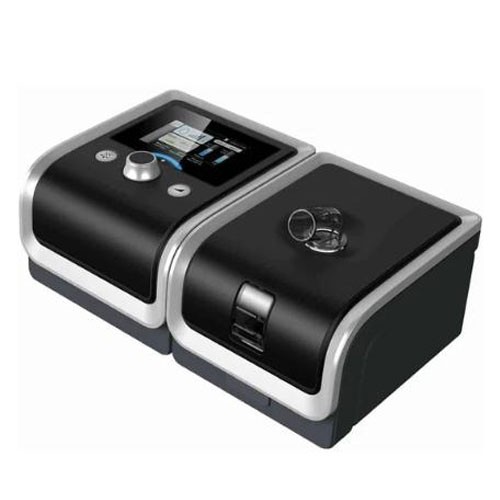
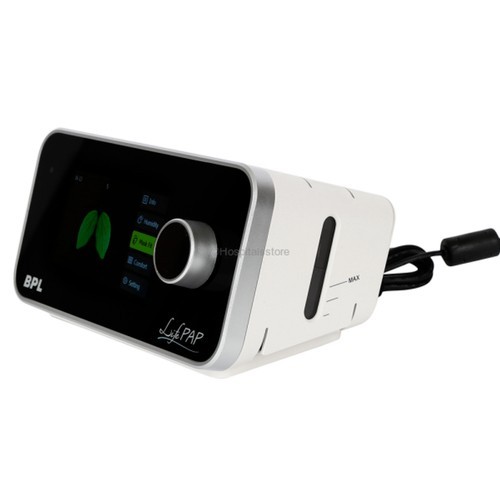
Oxymed AirSmart Bi-Level Auto
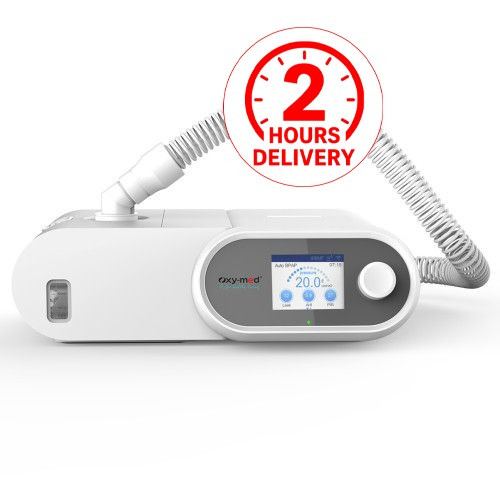
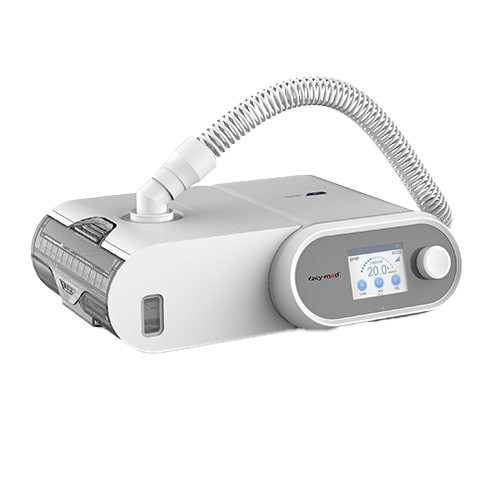
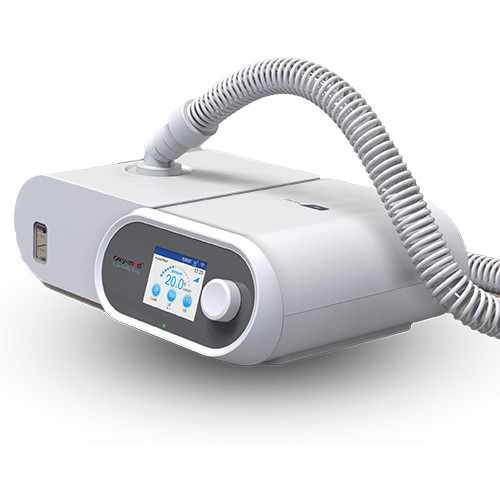
Key features
- Type BiPAP
- Modes CPAP, Auto CPAP, S , Auto BPAP
- Algorithm Advanced
- Turbine Made in Germany
- Pressure Range 4 -30cmH₂O
- Ergonomic Tilted Display Yes
Specifications
| Type | BiPAP |
|---|---|
| Modes | CPAP, Auto CPAP, S , Auto BPAP |
| Algorithm | Advanced |
| Turbine | Made in Germany |
| Pressure Range | 4 -30cmH₂O |
| Ergonomic Tilted Display | Yes |
| Detachable Design | Yes |
| Sound level | 30dB |
| Weight | 2.0Kg |
| Company Headquaters | India |
| Auto On/Off | Yes |
| Ramp Duration | 0 -45min. |
| EPR | Yes |
| Humidifier | Heated |
| Preheat | Yes |
| Central Apnea Detection | Yes |
| Leak Alert | Yes |
|---|---|
| Altitude Compensation | Yes |
| Trigger & Cycle sensitivity | Yes |
| Rise Time | Yes |
| Ti(inspiration time) | Yes |
| Leakage Compensation | Yes |
| SD card | Yes |
| Cloud connectivity/Wifi | Yes |
| CE | Yes |
Pros and cons
PROS
- ₹33,990 current price is roughly one-third of the ResMed AirCurve 10 VAuto (~₹1.05L) and half the BMC G3 B25A Auto BiPAP (~₹65k)
- 4–30 cmH2O pressure envelope covers the full adult Auto BiPAP prescription range including high-IPAP obesity hypoventilation candidates
- Four operating modes (CPAP, Auto CPAP, S, Auto BPAP) mean one machine covers titration from CPAP-intolerance through Auto Bi-Level therapy
- Trigger and cycle sensitivity are configurable per the spec sheet — a patient-synchrony feature that most sub-₹50k Indian BiPAPs omit entirely
CONS
- No VAPS, no back-up rate, no central-apnea treatment — this is not an ST BiPAP, do not buy it for treatment-emergent CSA or CompSA
- FDA approval is not stated in the published key features or additional details; CE is the only marked certification
- No heated-tube compatibility published; rainout management in north-Indian winter relies on humidifier-setting discipline
The Oxymed AirSmart Bi-Level Auto is the cheapest Auto BiPAP sold through a legitimate Indian dealer channel in 2026. At ₹33,990 against an MRP of ₹65,000, with a 4–30 cmH2O pressure envelope, four operating modes (CPAP, Auto CPAP, S, Auto BPAP), and a 3-year PAN-India warranty, it fills a gap that the imported brands have historically ignored — the CPAP-intolerant patient who needs Auto Bi-Level pressure support but cannot justify a ₹1-lakh premium machine. The machine is listed as In Stock, ships with CE certification per the manufacturer brochure and e-commerce product listings, and uses the same 2.0 kg chassis, 30 dB turbine and German motor as the SleepEasy AutoCPAP. This is the clinically-meaningful upgrade path for a household that bought in at SleepEasy price and the prescription has since moved to Bi-Level.
What the specs actually mean
The 4–30 cmH2O pressure envelope is the full adult Auto BiPAP range. Where a CPAP tops out at 20 cmH2O, a Bi-Level machine needs to deliver IPAP values above 20 for obesity hypoventilation, severe OSA with high therapeutic pressures, and many end-stage-COPD overlap cases. The AirSmart’s 30 cmH2O ceiling matches the ResMed AirCurve 10 S and the BMC G3 B25A series, and exceeds what most sub-₹50,000 Indian BiPAPs offer.
Four modes are on the spec sheet: CPAP (fixed pressure), Auto CPAP (APAP), S (fixed Bi-Level, spontaneous trigger), and Auto BPAP (Bi-Level with auto-titrating IPAP and EPAP). That covers the practical titration path for an adult OSA patient who has been failing CPAP — your sleep physician can move through CPAP → APAP → fixed S → Auto BPAP on the same machine as adherence patterns and comfort data accumulate. This multi-mode flexibility in a sub-₹35k device is the AirSmart’s real selling point.
What the spec sheet explicitly does not list: VAPS (volume-assured pressure support), back-up rate, central-apnea treatment, or any ST-mode option. This is not a bilevel-ST machine. If the prescription includes “BiPAP ST” or “ST with back-up rate 12” on the sleep-lab summary, this is the wrong device — you want the Oxymed AirSmart BPAP ST (the VAT/VAPS SKU) or a ResMed AirCurve 10 ST. Do not buy the AirSmart Auto for chronic respiratory failure, neuromuscular disease, or treatment-emergent CSA.
The 30 dB published sound is 3–5 dB louder than the ResMed and BMC premium Bi-Level class (typically 26–28 dB), but comfortably inside the bedside-acceptable band for an Indian bedroom. In a room with a ceiling fan or AC running, the difference is inaudible.
Trigger and cycle sensitivity are marked as configurable — Oxymed documents a 1-to-3 setting range for each. For patient-device synchrony, especially in a patient with a shallow breathing pattern or neuromuscular weakness who is being titrated on Bi-Level, adjustable trigger sensitivity is load-bearing. Most sub-₹50,000 Indian BiPAPs fix trigger and cycle sensitivity internally and do not expose the control to the clinician.
Rise time is adjustable. Ti (inspiratory time) is adjustable. Those two parameters determine how the IPAP is delivered — a brisk rise-time and a clamped Ti are right for COPD patients, a slower rise-time is more comfortable for OSA. Again, sub-₹50,000 Indian BiPAPs routinely omit these adjustments; the AirSmart Auto exposes them.
Leak compensation to 60 LPM, leak alerts, altitude compensation, heated humidifier with preheat, Bluetooth/app data, SD-card data, SpO2-monitoring compatibility are all published. Heated-tube compatibility is not marked.
Who should buy it
The AirSmart Auto is the right machine for an adult OSA patient who has failed a trial of CPAP on the basis of expiratory pressure intolerance, has an AHI in the 20–60 range, does not have a treatment-emergent CSA picture, and whose clinician has prescribed Auto Bi-Level rather than APAP or BiPAP ST. That specific clinical profile is common in Indian pulmonology practice, particularly for moderately-obese patients (BMI 32–40) where IPAP values above 18 are expected and the patient needs the EPAP-drop comfort to tolerate therapy overnight.
It is the right machine for a patient who has been on an Oxymed SleepEasy AutoCPAP for 6–18 months and whose compliance data shows that CPAP pressures above 14 cmH2O are producing arousals, mask leaks, or mouth-breathing. Moving to Auto BPAP on the same brand’s data-app continuity is operationally easier than switching platforms.
It is the right machine for a caregiver budget in the ₹30,000–₹50,000 band where a ResMed AirCurve is genuinely out of reach. At ₹33,990, this is roughly one-third of the AirCurve 10 VAuto and half the BMC G3 B25A Auto — those are real price gaps that change what is clinically accessible.
It is the right machine for a tier-2/tier-3 city buyer who wants a 3-year PAN-India warranty with home service. Oxymed’s dealer network is meaningfully broader than ResMed’s outside the top metros.
Who shouldn’t
Anyone prescribed BiPAP ST — anyone with a sleep-study summary that mentions back-up rate, central-sleep apnea, treatment-emergent CSA, or Cheyne-Stokes — should not buy the AirSmart Auto. The ST mode and back-up rate are absent. The correct Oxymed SKU is the AirSmart BPAP ST (VAT/VAPS). The correct ResMed SKU is the AirCurve 10 ST. Buying the wrong Bi-Level here is a clinical error, not a configuration issue — the machine will not deliver back-up breaths.
Anyone prescribed VAPS for obesity hypoventilation, neuromuscular respiratory failure, or overlap syndrome should not buy the AirSmart Auto. VAPS is the headline absent feature — the SKU immediately above it in Oxymed’s own lineup (the AirSmart BPAP ST) adds VAT/VAPS and is the right buy at ₹37,490.
Anyone whose pulmonologist needs cloud-pushed compliance data into ResMed AirView or Philips DreamMapper should not buy this machine. Oxymed’s data story is app-and-SD-card, standalone.
Anyone looking for a travel-Auto-BiPAP that will fly FAA-approved in airline cabins should not buy it — FAA is not marked. The travel Auto-BiPAP category is genuinely thin; in India, frequent travellers are often better off with a travel Auto CPAP (Breas Z2, ResMed AirMini) plus a home BiPAP at the main address.
How it compares to real alternatives
AirSmart Auto vs BMC G3 B25A Auto BiPAP
The BMC G3 B25A is the closest sub-₹70,000 Auto BiPAP in the Indian market. It is priced around ₹55,000–₹65,000 street, publishes a 25 cmH2O ceiling against the AirSmart’s 30, and is broadly comparable on noise (28 dB vs 30 dB) and data (SD card plus limited Wi-Fi). The BMC has the better clinical-OEM pedigree. The AirSmart Auto wins on price by ₹25,000–₹30,000, on pressure ceiling (30 vs 25 cmH2O), and on warranty length (3 vs 2 years). Pick BMC if you’re in a top metro, want the established OEM heritage, and can find a ₹15,000 price concession on street. Pick AirSmart Auto if budget is binding and you need the 30 cmH2O ceiling or the home-service warranty.
AirSmart Auto vs ResMed AirCurve 10 VAuto
ResMed AirCurve 10 VAuto sits at ₹95,000–₹1,10,000 street. For the extra ₹60,000–₹75,000 you get Easy-Breathe waveform, ClimateLineAir heated tubing, myAir cloud data into the clinician’s workflow, a documented Auto Bi-Level algorithm with meaningful published literature, and the deepest service network in India. If you live in a top-six metro, your pulmonologist is on myAir, and the prescription is expected to be long-term, the ResMed is the defensible buy. If budget is the constraint or you are outside a metro, AirSmart Auto is the pragmatic alternative — not as well-documented, but clinically sufficient for most uncomplicated Auto Bi-Level prescriptions.
AirSmart Auto vs Philips DreamStation Auto BiPAP
DreamStation Auto BiPAP in India is now a niche post-recall SKU with uncertain long-term parts availability. Where it is still being sold, it is priced in the ₹1,00,000+ band. The AirSmart Auto’s price advantage is decisive; the DreamStation’s clinical heritage is stronger but supply risk is real. For a new 2026 purchase, we would not recommend DreamStation Auto BiPAP over the AirSmart Auto unless the pulmonologist has a specific DreamStation-data workflow.
Indian-market considerations
The AirSmart Auto inherits the SleepEasy’s German turbine, 43,000-RPM rating and 2.0 kg chassis. Turbine provenance is the single strongest component-level argument for Oxymed in this price tier — an Indian Bi-Level at this price running an unbranded turbine would be a different risk profile entirely.
Voltage handling is the same 220V/50Hz story as any home-bedroom CPAP/BiPAP. A 1-kVA automatic voltage stabiliser ahead of the adapter is not optional for a device that will run 6–10 hours a night for multiple years. Budget ₹2,500–4,000.
CDSCO status is not stated in the published key features or additional details (CDSCO Medical Device Registry). CE is marked. For CGHS/ECHS/insurance-supported purchases, confirm CDSCO registration at point of sale with the dealer. For private out-of-pocket retail, CE suffices.
Service network: Oxymed’s 3-year PAN-India home-service warranty is documented and its dealer footprint outside the top metros is a real structural advantage. On a Bi-Level machine running 3,000+ hours a year, a humidifier chamber or filter that a local technician can replace at the patient’s home — rather than shipping the machine to Delhi for two weeks — is a meaningful total-cost-of-ownership advantage over a premium imported brand with a narrow service footprint.
Data infrastructure: the AirSmart Auto logs to SD card and pushes to an Oxymed mobile app via Bluetooth. There is no Wi-Fi/cellular auto-upload comparable to ResMed’s myAir or Philips DreamMapper. For an Indian sleep physician who is already working with downloaded SD-card reports on OSCAR-style analysis tools, this is sufficient. For a clinic expecting to push auto-compliance data into an EMR or remote-monitoring platform, it is not.
Verdict
The Oxymed AirSmart Bi-Level Auto is the only legitimate sub-₹35,000 Auto BiPAP in the Indian market in 2026. For a CPAP-intolerant OSA patient whose prescription has moved to Auto Bi-Level, whose clinician does not need VAPS or ST back-up rate, and whose budget is squeezed, this machine is the clinically-defensible buy. It is not as well-instrumented, not as quiet, and not as cloud-integrated as the ResMed AirCurve 10 VAuto that sits at three times the price — but the 4–30 cmH2O envelope, configurable trigger/cycle sensitivity, adjustable rise time and Ti, 60-LPM leak compensation, and 3-year PAN-India home-service warranty are a defensible combination for a first Auto Bi-Level at this price.
Score it 7.3 out of 10. Points off for the missing VAPS/ST modes, the missing heated-tube compatibility, the unstated FDA/CDSCO status on this SKU, and the absence of a cloud data platform that matches ResMed or Philips. For a patient who needs a VAPS/ST feature set, step up to the AirSmart BPAP ST at ₹37,490 or stretch to the ResMed AirCurve 10 ST. For a patient who genuinely only needs Auto Bi-Level, this is the pragmatic Indian-market buy.