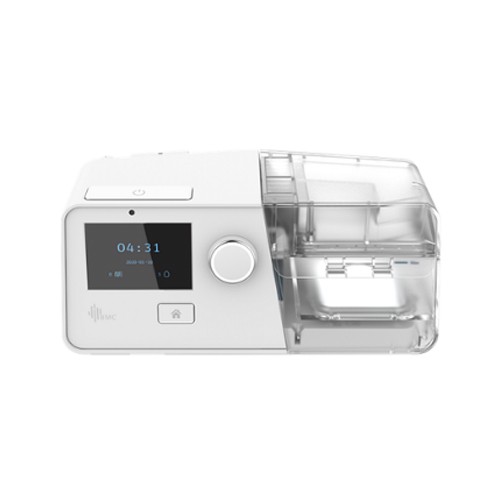
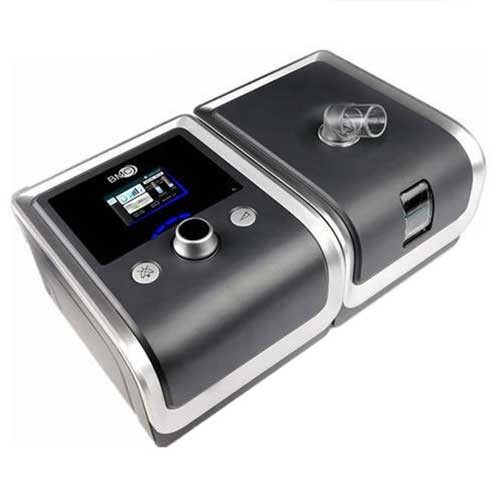
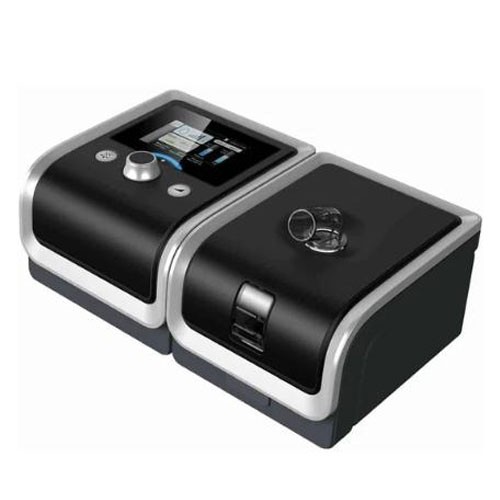
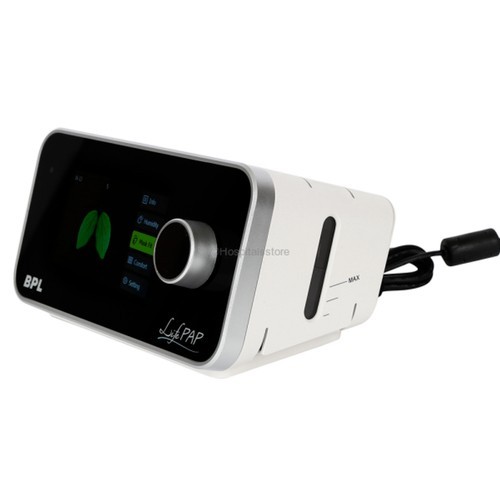
Home Medix HM-BV-30 BiPAP
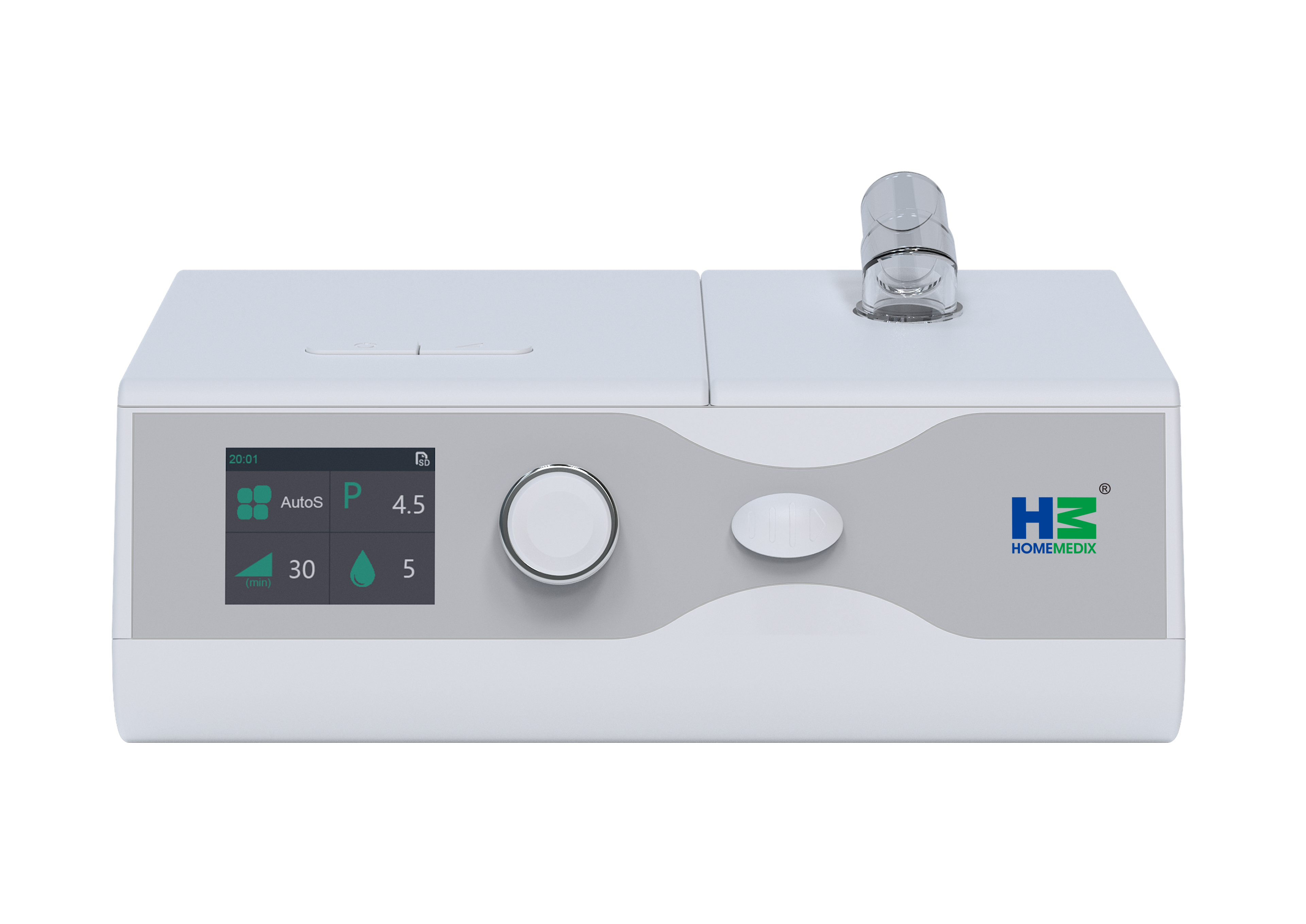
Key features
- Type BiPAP with TVAPS
- Modes CPAP, APAP, S, Auto S, S/T, T, TVAPS
- Pressure Range 4-30cmH₂O
- Sound level <30dB
- Weight 1.45kg
- Humidifier Heated (0–5 levels)
Specifications
| Type | BiPAP with TVAPS (target-volume assured pressure support) |
|---|---|
| Modes | CPAP, APAP, S, Auto S, S/T, T, TVAPS |
| Algorithm | Patented SAF (Synchronized Auto-Flow) — leak-compensated synchronization |
| Pressure Range | 4-30cmH₂O |
| Sound level | <30dB |
| Weight | 1.45kg |
| Dimensions | 253 × 168 × 121 mm |
| Humidifier | Heated (0–5 levels, integrated) |
| Back up rate | Yes (T and S/T modes) |
| Ramp | Yes |
| Auto On/Off | Yes |
| Central Apnea Detection | Yes (OSA / CSA) |
| VAPS | Yes (TVAPS — target-volume assured) |
|---|---|
| Pressure Support | Yes (S, Auto S, S/T modes) |
| Trigger & Cycle sensitivity | Yes (SAF synchronization) |
| Leak Alert | Yes |
| Leakage Compensation | Yes (SAF algorithm) |
| Flow Limitation Detection | Yes |
| Hypopnea Detection | Yes (multi-severity) |
| Snoring Detection | Yes (multi-frequency) |
| Company Headquarters | India |
| Indian Voltage Model | Yes |
| CDSCO | Approved |
| ISO 9001 | Yes |
| ISO 13485 | Yes |
Pros and cons
PROS
- Full seven-mode clinical stack — CPAP, APAP, S, Auto S, S/T, T, TVAPS — covering straightforward OSA through volume-assured NIV in a single chassis
- TVAPS at a sub-premium tier — functionally equivalent to ResMed iVAPS and Philips AVAPS, and not listed by the closest Indian competitor BMC G3 B30VT
- 4–30 cmH₂O envelope covers high-IPAP obesity-hypoventilation and elevated-pressure severe OSA, not just the mid-range
- 1.45 kg with integrated heated humidifier — lighter than the BMC G3 B30VT (1.7 kg) and competitive with the Philips DreamStation class
- Patented SAF algorithm with leak-compensated synchronization, multi-level hypopnea/snoring/flow-limitation detection, OSA/CSA central-apnea detection
- Back-up rate in T and S/T modes — covers the feature gap that forces complex-apnoea patients off the budget Y-series BiPAPs
- CDSCO approved, ISO 9001 + ISO 13485 paperwork, Indian voltage model, 253 × 168 × 121 mm bedside footprint
- Home Medix Claro memory-card reporting adds therapy summaries, trends, six aligned waveform panels, and event-window analysis
CONS
- No CE and no FDA listed on the published spec table — weaker for hospital-channel procurement and international travel than ResMed or Philips
- No heated-tube compatibility, no climate control, no adaptive humidification — four-season comfort trails the BMC G3 B30VT and the imported premium class
- No Wi-Fi, cloud, or Bluetooth — Claro requires manual memory-card import and cannot feed an AirView-style live clinic dashboard
- Central-apnea DETECTION only, not ASV-class treatment — CompSA and cardiac-origin central events still escalate to a ResMed or Philips ASV
- HM-BV-30 pricing not yet published in the data we reviewed; price-per-feature case is provisional until the number lands
The Home Medix HM-BV-30 is an Indian-market BiPAP that ships with a feature most sub-premium BiPAPs at this tier quietly omit: TVAPS, target-volume assured pressure support. The closest Indian competitor — the BMC G3 B30VT at roughly ₹39,744 indicative retail — does not list volume-assured ventilation. The HM-BV-30 covers the full clinical mode set (CPAP, APAP, S, Auto S, S/T, T, TVAPS) across a 4–30 cmH₂O envelope in a 1.45 kg chassis with integrated heated humidifier and <30 dB published sound. For a buyer quoted ₹80,000-plus for a ResMed AirCurve 10 ST-A because their physician has prescribed volume-assured NIV, this is the one sub-premium Indian BiPAP worth a shortlist slot. Honest call: a strong clinical mode set with real regulatory and ecosystem gaps — the most defensible TVAPS-capable BiPAP in its price class, not a ResMed-killer.
What the specs actually mean
The spec sheet is denser than the Home Medix catalogue position suggests. Eight capabilities matter.
Modes — the full clinical stack. CPAP, APAP, S, Auto S, S/T, T, and TVAPS is the complete BiPAP and home-NIV set short of ASV. S/T and T add a back-up rate — the minimum for central events, CompSA during CPAP trial, or neuromuscular weakness that fails to reliably trigger the machine. TVAPS adds volume-assured ventilation on top. The BMC G3 B30VT lists CPAP, S, T, ST — four modes to the HM-BV-30’s seven, with no volume-assured option.
Pressure range — 4–30 cmH₂O. The full BiPAP envelope. The top end matters for severe obesity-hypoventilation where IPAP sits at 22–26 cmH₂O, and for elevated-pressure severe OSA. The HM-CV-20 CPAP sibling caps at 20 cmH₂O.
Sound — <30 dB. Competitive but not class-leading (BMC G3 B30VT 26 dB, ResMed AirCurve V Auto 25 dB). At one metre in an Indian bedroom the blower should not drive a compliance problem. Published manufacturer figure; no bench measurement claimed.
Weight and dimensions — 1.45 kg, 253 × 168 × 121 mm. Lighter than the BMC G3 B30VT (1.7 kg) and competitive with the Philips DreamStation class. Bedside-credible.
Humidifier — heated, integrated, 0–5 levels. Built into the chassis, which is why the 1.45 kg figure is achievable. Without climate control or heated-tube compatibility, shoulder seasons will see more rainout.
SAF algorithm. The manufacturer-patented Synchronized Auto-Flow handles trigger, cycle, and leak compensation. Multi-level event detection covers flow limitations, multi-frequency snoring, multi-severity hypopnea, and OSA/CSA apnea.
Back-up rate — yes, in T and S/T. Required for neuromuscular patients and for treatment-emergent central events. Budget BiPAPs that skip this are not clinically safe for these prescriptions.
Central Apnea Detection — yes. OSA and CSA flagged separately in the data. Detection, not ASV-class treatment.
Claro clinical reporting — yes, via memory card. Home Medix Claro imports the HM-BV-30 data on a Windows or macOS computer and presents therapy summaries, multi-night trends, six aligned nightly panels (events, pressure, airflow, leak, snoring, rolling AHI), and event-window analysis. This closes the earlier offline-reporting gap, but it is not automatic cloud telemetry or remote titration.
Regulatory — ISO 9001 + ISO 13485 + CDSCO approved; no CE, no FDA listed. CDSCO is sufficient for Indian retail and home channels. The CE and FDA gaps matter for hospital-channel procurement and international travel clearance (CDSCO Medical Device Registry).
TVAPS and why it matters
TVAPS is the reason the HM-BV-30 is on this shortlist at all. Most sub-₹60,000 Indian BiPAPs ship pressure-support modes without any volume-assured option; the BMC G3 B30VT does not list VAPS. The next rung up is the ResMed AirCurve 10 ST-A with iVAPS or the Philips DreamStation BiPAP AVAPS — both at a meaningful premium.
In TVAPS the clinician sets a target tidal volume and a pressure-support range; the machine adjusts inspiratory pressure to hold delivered tidal volume near target across changes in airway resistance, leak, patient effort, and lung compliance. Functionally equivalent to ResMed iVAPS and Philips AVAPS — guaranteed minute ventilation despite variable inputs.
The prescriptions that need TVAPS are narrow but clinically important. Obesity-hypoventilation syndrome (OHS) at BMI 40-plus with daytime hypercapnia is the biggest indication; volume-assured home NIV is standard of care for severe OHS where fixed-pressure BiPAP leaves residual hypercapnia (British Thoracic Society). Progressive neuromuscular disease — Duchenne, ALS, post-polio — is the second; as muscle strength declines the pressure needed to deliver stable tidal volume rises over months and volume-assured modes adjust automatically. Severe COPD with chronic CO₂ retention after hospitalisation is the third (Murphy PB et al, JAMA 2017). For these prescriptions the HM-BV-30 is not a nice-to-have — it is the mode selection.
Who should buy the HM-BV-30
Home NIV patients with OHS or neuromuscular disease who cannot justify the ResMed ST-A premium. The ST-A typically clears ₹85,000-plus indicative retail in 2026. Where the physician has prescribed volume-assured NIV and the budget caps well below the ST-A line, the HM-BV-30 covers the mode selection. Core use case.
BiPAP-complexity patients with mixed apnoea plus central events, CompSA that emerged during CPAP trial, or cardiac comorbidity with central pattern on PSG. Detection-level visibility plus S/T and T coverage manages these patients on BiPAP where safe; if the pattern escalates to true CompSA, the data supports the escalation.
Pulmonologists prescribing home NIV in Home-Medix-served cities where service turnaround and clinician handover matter. Shorter service loop than chasing BMC or imported-brand partners. Verify coverage at purchase.
Cost-conscious BiPAP buyers quoted ₹80k-plus for an ST-A. The HM-BV-30 makes TVAPS reachable for households otherwise pushed into a non-volume-assured BiPAP purely on budget. Real clinical gain.
Who should not buy the HM-BV-30
Simple OSA patients on fixed CPAP. The HM-CV-20 covers that at lower cost. The full mode set here is overkill.
ASV patients requiring Central Apnea Treatment. Detection only, no ASV-class active response. Escalate to ResMed AirCurve V Auto, AirCurve ASV, or Philips DreamStation ASV. TVAPS is not a substitute for ASV.
Patients whose clinic requires automatic cloud-reported compliance. Claro provides detailed memory-card reports, but there is no published Wi-Fi, Bluetooth, automatic cloud upload, or AirView/Care Orchestrator integration. The card must reach a Claro workstation for review.
Patients in remote or North-East regions without authorised Home Medix service. A week of downtime for a home-NIV patient is not acceptable. Verify coverage and swap-unit availability first.
How it compares to real alternatives
vs BMC G3 B30VT. The closest Indian competitor at ₹39,744 indicative retail (₹48,000 listed MRP), 4–30 cmH₂O, 1.7 kg, 26 dB, CPAP/S/T/ST, central-apnea detection, heated tube, climate control, Wi-Fi-ready, CE. HM-BV-30 adds TVAPS, three extra modes, and a lighter chassis. BMC wins on sound, heated tube, climate control, Wi-Fi/SD, and CE paperwork. Clean rule: needs TVAPS — HM-BV-30; doesn’t need TVAPS but values cloud and four-season comfort — G3 B30VT.
vs ResMed AirCurve V Auto (and ST-A). V Auto at ₹66,800 indicative retail (₹81,600 listed MRP); ST-A with iVAPS typically clears ₹85,000 in 2026. Premium benchmark — 25 dB, 1.24 kg, myAir/AirView, climate control, heated tube, FAA + FDA + CE. HM-BV-30 undercuts substantially; ResMed wins on algorithm sophistication, Vsync leak management, service-network depth, and ecosystem. Where AirView is load-bearing, buy ResMed; where TVAPS is needed and the budget gap can’t close, buy the HM-BV-30.
vs Philips DreamStation BiPAP ST (and AVAPS). Mid-to-premium. Higher feature density — heated tube, climate control, SD card, Bluetooth, Care Orchestrator, ergonomic tilted display, FAA. Post-2021 foam-recall remediation status should be verified on any specific Indian unit before purchase. HM-BV-30 wins on TVAPS at a lower Indian price and no recall overhang; Philips wins on ecosystem and international travel clearance.
Indian-market considerations
Indian-voltage model (220V ±10%), so no step-down transformer. A 1–2 amp stabiliser at ₹2,500–₹3,500 is sensible in tier-2/tier-3 residences; a 500–700 VA inverter-UPS on the BiPAP-plus-humidifier circuit is reasonable insurance where outages are weekly.
Humidifier water: distilled in coastal cities (Mumbai, Chennai, Kochi, Kolkata, Visakhapatnam) to protect the heating element; RO-filtered with periodic descaling inland. Altitude derating matters for patients in Shimla (~2200 m), Manali (~2050 m), Leh (~3500 m), Gangtok (~1600 m), Darjeeling (~2000 m), Srinagar (~1600 m), Mussoorie (~2000 m), Ooty (~2200 m), Munnar (~1500 m) — the additional-details table does not list altitude compensation, so expect some derating of delivered pressure above 2,000 m; discuss with the prescribing physician before a long-term move.
Mask selection typically splits nasal + full-face across the week, especially on TVAPS where mouth leak is load-bearing; most home-NIV households budget for both. Fit matters more than machine choice for first-30-day adherence.
GST on medical devices is 12%; insurance reimbursement via CGHS / ECHS / ESIC / private home-NIV pathways requires the pulmonologist’s prescription, diagnostic PSG, and device invoice. CGHS/ECHS patients should confirm Home Medix is on the empanelled supplier list in their region.
Consult your prescribing physician before starting therapy.
Verdict
The Home Medix HM-BV-30 is the most clinically complete sub-premium BiPAP currently on the Indian-market shortlist, on the strength of TVAPS inclusion and the full seven-mode stack with back-up rate and central-apnea detection. For OHS, progressive neuromuscular disease, and complex-apnoea prescriptions that need volume-assured NIV at home and cannot reach the ResMed ST-A or Philips AVAPS tier, it is the single most defensible Indian-market answer.
Score it 8.0 out of 10. Points for TVAPS, the full mode set, the 1.45 kg chassis with integrated heated humidifier, Claro memory-card reporting, and the CDSCO plus ISO 9001 plus ISO 13485 paperwork. Points off for the missing CE and FDA listings, absent automatic cloud/Bluetooth workflow, missing heated-tube and climate-control comfort stack, and absence of ASV-class central-apnea treatment. For simple fixed-CPAP OSA, buy the HM-CV-20. For ASV-needing patients, escalate to ResMed or Philips. For TVAPS-needing home-NIV patients at a sub-premium budget, this is the right Indian-market BiPAP.
Frequently asked questions
What modes does the HM-BV-30 support?
CPAP, APAP, S, Auto S, S/T, T, and TVAPS. That is the full clinical mode set for BiPAP and home non-invasive ventilation — covers obstructive sleep apnea (CPAP / APAP), mixed apnea with central events (S/T, T with back-up rate), and volume-targeted therapy for obesity-hypoventilation and neuromuscular disease (TVAPS).
What is TVAPS?
Target-Volume Assured Pressure Support — the machine auto-adjusts inspiratory pressure to deliver a clinician-set tidal volume despite changes in airway resistance or patient effort. Equivalent to ResMed's iVAPS and Philips' AVAPS. Clinically important for obesity-hypoventilation syndrome, progressive neuromuscular disease (Duchenne, ALS), and other conditions where volume delivery must be guaranteed.
How loud is the HM-BV-30?
The published specification is <30 dB — matching the HM-CV-20 CPAP sibling and competitive with the BMC G3 B30VT (26 dB) and ResMed AirCurve class.
What is the pressure range?
4–30 cmH₂O — the full BiPAP range, supporting high-pressure-need patients (severe OSA, obesity-hypoventilation on elevated IPAP). The CPAP sibling HM-CV-20 caps at 20 cmH₂O.