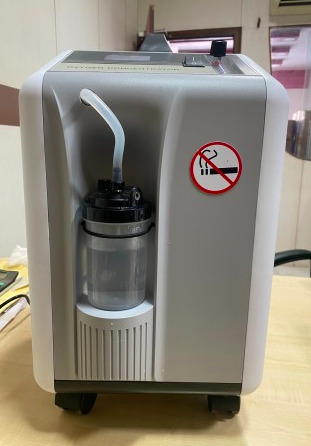
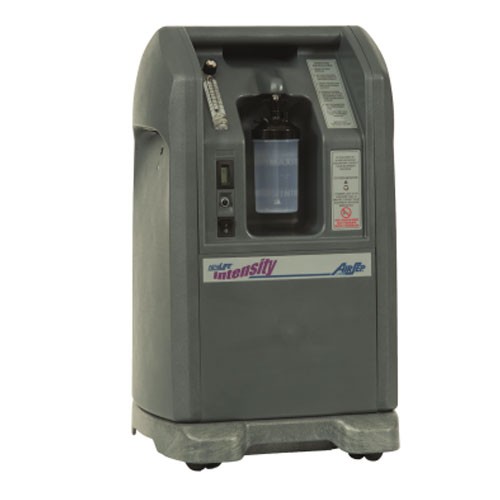
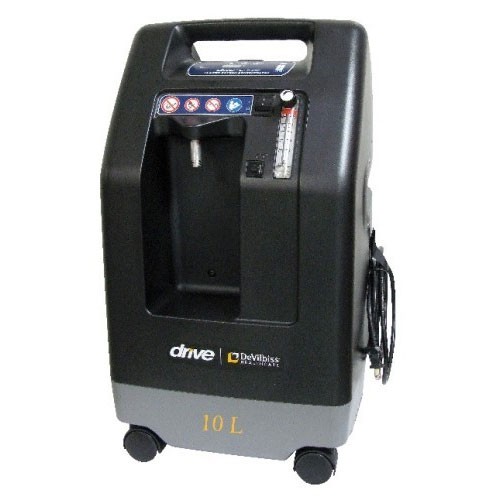
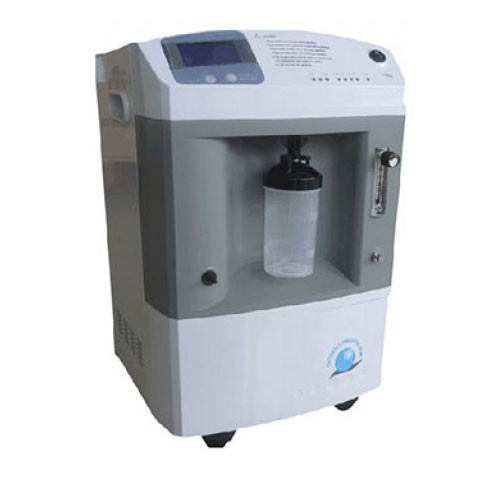
Yuwell 10 LPM
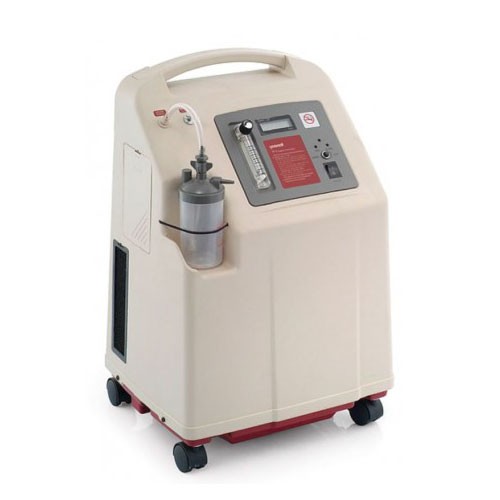
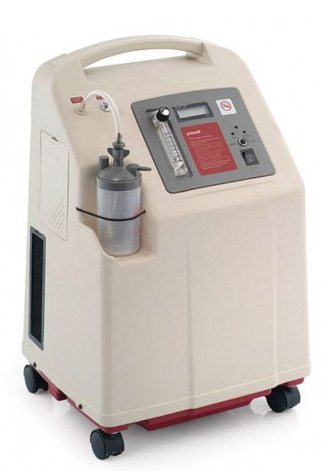
Key features
- Purity 90-95%
- Type High Flow Stationary
- Continuous Flow 0.5-10LPM
- Weight 33kg
- Oxygen Purity Indicator (OPI) No
- Power consumption 850watts
Specifications
| Purity | 90-95% |
|---|---|
| Type | High Flow Stationary |
| Continuous Flow | 0.5-10LPM |
| Weight | 33kg |
| Power consumption | 850watts |
| Sound level | 60db |
| Dimensions | 36.7H x 17.5W x 14.6Dinch |
| Loss of Power Alarm | Yes |
|---|---|
| System Malfunction Alarm | Yes |
| Indian Voltage Model | Yes |
| Company Headquarters | China |
Pros and cons
PROS
- Genuine 10 LPM high-flow output — rare at this ₹45,000 street-price band
- Robust tower chassis engineered for continuous operation
- Integrated wheels for in-facility rolling
- Indian voltage model with 6,000 ft altitude rating adequate for plains use
- Yuwell service network presence in metros
CONS
- 33 kg — needs two people to reposition, wheels only help on smooth floors
- 850 W continuous draw — the highest in this review cycle
- 60 dB noise floor is unsuitable for bedroom placement
- No published FDA, FAA or CE certification on the Indian brochure
- No oxygen purity indicator on the front panel for a high-flow clinical unit
Yuwell 10 LPM sits at the aggressive-price end of the high-flow category
The Yuwell 10 LPM is one of the more aggressively priced 10 LPM home/clinical stationaries in India — ₹45,000 current street against a ₹91,200 list MRP as of the source listings HHZ reviewed. At that street price it is meaningfully cheaper than any Tier-1 10 LPM (Philips 10 LPM, Nidek Nuvo 10, DeVilbiss 10 LPM) and competitive with the Indian-brand Oxymed 10 LPM, Home Medix HM-KX 10 LPM, Nareena 10 LPM and Evox 10 LPM. The manufacturer brochure and e-commerce product listings HHZ pulled describe a tower-chassis design with 0.5–10 LPM flow, 90–95 % purity, 850 W power draw, 60 dB noise and integrated wheels.
What the 10 LPM does honestly: it produces 10 LPM. In a category where some budget “10 LPM” units are effectively 8 LPM with optimistic labelling, Yuwell’s 10 LPM output is borne out by enough Indian field reports that HHZ treats the 10 LPM top flow as real. What it does not do: deliver that flow quietly, efficiently or with any certification on the Indian brochure. It is a clinical-grade workhorse sold at a home-market price, which explains both why it sells and why it is a cautious recommendation.
What the specs actually mean
Continuous flow 0.5–10 LPM, purity 90–95 %. The range is wide, and the machine supports dual-cannula operation for two-patient delivery at lower per-patient flow. Brochure purity is 90–95 %; no per-flow table is published. For 10 LPM output from a zeolite-PSA stationary, a 90 % purity floor at peak is expected and acceptable. For clinical applications (ICU step-down, post-surgery recovery, COPD exacerbation) this is adequate but not premium. An OPI or purity analyser would have been welcome at this flow class and is absent.
Weight 33 kg. The Yuwell 10 LPM is one of the heavier 10 LPM units in this review cycle. Compare against AAYOU 10L (21 kg), Oxybliss 10 LPM (18.8 kg), Fitmate 10 LPM (25.5 kg), Niscomed 10 LPM (30 kg). It has integrated wheels, but on tile or carpet 33 kg is not easily moved by one person. For stationary placement that is fine. For room-to-room mobility or in-car transport it is a limitation.
Power 850 W. This is the highest power draw in this review cycle and is typical of older-generation 10 LPM stationaries. A modern 10 LPM (Philips 10 LPM at 580 W, DeVilbiss 10 LPM at 600 W) is 30 % more efficient. At 16 hours of daily LTOT on ₹7/unit electricity the Yuwell costs roughly ₹1,600 a month to run against ₹1,100 for a Philips 10 LPM. Over three years the gap is substantial. For intermittent clinical use (not 16 hours/day) the difference matters less.
Noise 60 dB. Bedroom-hostile. 60 dB is dishwasher-level background noise. The unit belongs in a utility area, not the patient’s room, connected by a tubing extension. Every Tier-1 10 LPM is quieter (Philips 10 LPM 50 dB, DeVilbiss 10 LPM 48 dB). For clinical settings this is acceptable; for home use it is a significant limitation.
Dimensions 36.7 × 17.5 × 14.6 inches (H×W×D). Full-height tower, same footprint as the 7F chassis. Heavy and vertical.
Certifications: blank. FDA, FAA and CE fields empty on the Indian brochure. For a 10 LPM unit used in clinical or high-dependency settings, the absence of published certification is a bigger concern than on a 5 LPM home unit. Institutional buyers should obtain written certification per import batch before procurement.
Operating altitude is not published on the Indian brochure, which for a 10 LPM is an information gap. High-altitude clinical deployment in Shimla, Dehradun, Gangtok or similar requires this data point.
Who should buy it
Clinical facilities and nursing homes on a 10 LPM budget. Small hospitals, nursing homes and rehabilitation centres that need 10 LPM capacity without paying Tier-1 prices are the primary audience. The Yuwell 10 LPM fits a bay in a ward room, runs continuous, and costs one-third to one-half of a Philips or Nidek 10 LPM.
Home users with high-flow prescriptions (6–10 LPM) on budget constraint. Patients with advanced COPD or interstitial lung disease prescribed 6+ LPM have no choice but a 10 LPM machine. If the budget caps at ₹50,000 and a Philips 10 LPM at ₹95,000–1,10,000 is out of reach, the Yuwell 10 LPM is a rational purchase — with the machine placed outside the bedroom and a long tubing run used for delivery.
Backup high-flow units for households with a primary Tier-1 10 LPM. Redundancy in case of primary-unit failure during a clinical flare-up is a defensible use-case.
Dual-patient nursing-home deployments. With a Y-connector the Yuwell 10 LPM can serve two patients at 4–5 LPM each, which is a cost-efficient deployment for step-down settings.
Who should not buy it
LTOT patients at 2–5 LPM who only need a 10 LPM for safety margin. The 850 W power draw is overkill. A 5 LPM machine at 290–400 W is the correct choice for anything below 5 LPM prescription.
Buyers placing the unit in the bedroom. 60 dB cannot be made bedroom-friendly.
Buyers outside Yuwell metro-service cities. A 10 LPM failure is a bigger clinical problem than a 5 LPM failure, and service response time outside metros on a Yuwell can be 2–6 weeks.
Pediatric or precise-titration users. The ball flowmeter and absence of an OPI are not suitable for finely calibrated flow requirements.
High-altitude clinical buyers. Without a published altitude rating the purity at 2,000 m+ is unverified.
Alternatives that beat the Yuwell 10 LPM on specific axes
Philips Respironics 10 LPM (EverFlo Q), ~₹95,000–1,10,000 street. Every spec better: ~24 kg vs 33, 580 W vs 850, 50 dB vs 60, FDA + CE published, Philips Home Healthcare 3-year Indian warranty. At twice the street price the Philips is a different class, but for any serious LTOT 10 LPM buyer the Philips is the default. The Yuwell’s argument is purely budget.
DeVilbiss 10 LPM (1025 series), ~₹85,000–1,00,000 street. 27 kg, 600 W, 48 dB, FDA-approved. Same argument as Philips — twice the price, substantially better machine. For clinical deployment where Yuwell’s 60 dB is unacceptable, the DeVilbiss is the right step up.
Oxymed 10 LPM, ~₹55,000–70,000 street. Indian-branded 10 LPM with ~25 kg weight, 650 W power, OPI present, 3-year warranty, 40+ Indian service centres. For a domestic buyer who values service access the Oxymed 10 LPM is the most defensible alternative and often the best-balanced choice at the mid-price tier. Against the Yuwell 10 LPM it wins on noise, weight and service; it loses only on brand recognition in certain buyer segments.
Home Medix HM-KX 10 LPM, ~₹65,000 street. Indian-made 10 LPM with ≤48 dB field-verified sound (class-tied-quietest), 550 VA draw (lowest in the 10 LPM class), integrated nebulization, dealer-validated SOS audible siren, full alarm suite, and a 3-year / 10,000-hour warranty. At a modest price premium to Yuwell, HM-KX wins on almost every feature axis and carries Indian CDSCO + ISO paperwork.
Nareena 10 LPM, ~₹55,000 street. Indian-brand challenger with aggressive pricing and a 5-year warranty on some distribution channels. For buyers who prioritise total cost of ownership over brand heritage, the Nareena 10 LPM is directly competitive with the Yuwell at slightly higher cost and materially better support terms.
Indian-market considerations
The 10 LPM category in India is the segment where Chinese OEM imports historically captured most of the volume before Indian brands began competing seriously around 2022–2023. The Yuwell 10 LPM was one of the most-sold imported units during the 2020–2021 demand cycle, which means both that service paths still exist and that many of the nominal importers from that period have exited. Before buying, confirm that the specific dealer can produce the importer’s CDSCO MD-14 licence number and the importer is still trading under that registration.
Spare-parts supply for the Yuwell 10 LPM is better than for the 7F/7F Mini because the platform remains in production. Compressor units for a 10 LPM unit are larger, more specialised and more expensive than for 5 LPM — expect ₹15,000–22,000 for a compressor replacement in Indian service centres, versus ₹6,000–10,000 for a 5 LPM unit. Sieve-bed replacement on a 10 LPM is ₹8,000–12,000 because there is more zeolite material. These are significant out-of-warranty exposures on a unit that cost ₹45,000 new — two major services over the machine’s life cycle can exceed the purchase price.
Warranty claim cycle times for Yuwell 10 LPM issues in India run 3–6 weeks in metros, longer outside. Clinical-use buyers should keep a backup unit available or a service contract with a local biomed technician to cover the gap.
The 10 LPM’s 850 W power draw plus typical Indian voltage fluctuation means a 1 kVA automatic voltage regulator is a near-mandatory accessory — budget ₹3,500–5,000 for a servo-stabilised AVR suitable for the unit’s current profile. Without an AVR the compressor is at elevated risk during voltage sags common in Tier-2/Tier-3 cities and monsoon-season brownouts.
CDSCO classification: oxygen concentrators are Class B medical devices. MD-14 importer licensing is mandatory under the 2022 Medical Devices Rules amendment. Confirm the importer’s licence on the invoice before purchase. Institutional buyers (nursing homes, clinics) should additionally confirm the importer supplies a device master file or equivalent technical documentation.
Verdict
The Yuwell 10 LPM is a credible high-flow workhorse at a price that Tier-1 manufacturers cannot match. It earns its 6.2 score by actually delivering 10 LPM, being mechanically serviceable through the Chinese OEM parts ecosystem, and being supported by Yuwell’s remaining Indian dealer network. It loses points on weight, power draw, noise and the absence of published certifications — none of which are fatal for clinical or institutional use but all of which matter in home deployments. If you are a nursing-home operator buying two or three 10 LPM units on budget, the Yuwell is a sensible choice alongside the Oxymed 10 LPM. If you are a home buyer at the ₹45,000 budget cap who needs 10 LPM, place the unit in a utility area, buy an AVR, and accept the electricity bill. For any buyer with ₹80,000+ available, the Philips 10 LPM or an Indian-branded alternative with better service coverage is the better deployment of capital.