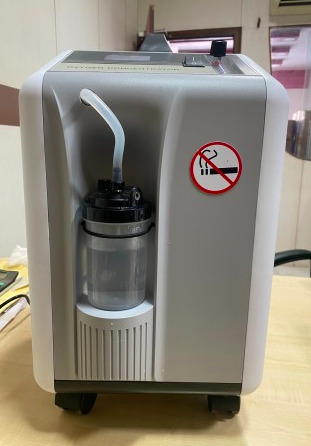
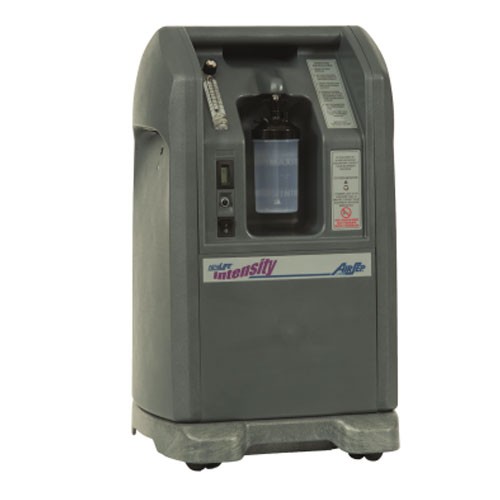
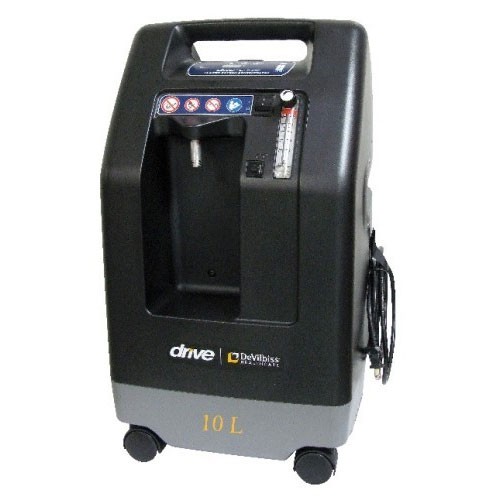
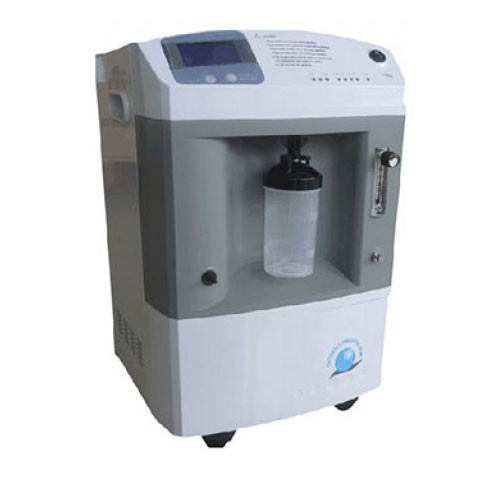
Philips 10 LPM
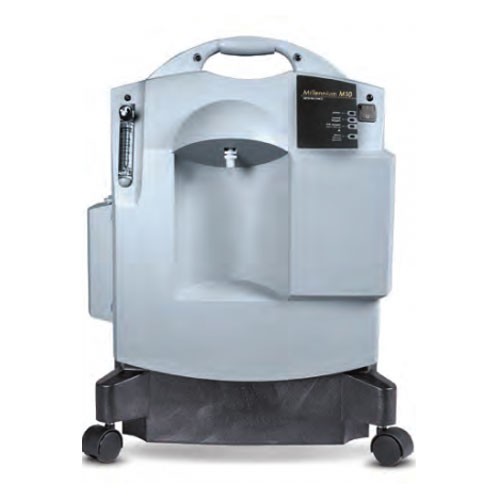
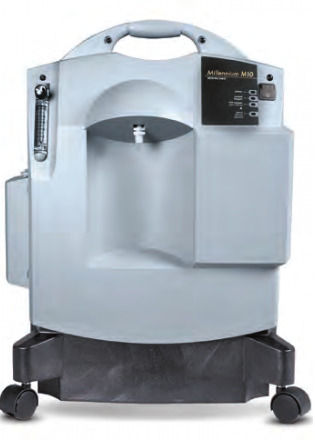
Key features
- Purity 90-95%
- Type High Flow Stationary
- Continuous Flow 1-10LPM
- Weight 24kg
- Oxygen Purity Indicator (OPI) Yes
- Power consumption 600watts
Specifications
| Purity | 90-95% |
|---|---|
| Type | High Flow Stationary |
| Continuous Flow | 1-10LPM |
| Weight | 24kg |
| Oxygen Purity Indicator (OPI) | Yes |
| Power consumption | 600watts |
| Sound level | 50db |
| Dimensions | 27H x 19W x 13Dinch |
| Operating altitude | 1368feet |
| Outlet pressure | 30psi |
| Loss of Power Alarm | Yes |
|---|---|
| No Flow Alarm | Yes |
| Company Headquarters | USA |
| US FDA Approved | Yes |
| CE Certified | Yes |
Pros and cons
PROS
- 10 LPM continuous flow covers severe ILD, pulmonary hypertension and post-acute COVID prescriptions that saturate 5 LPM units
- Published 30 psi outlet pressure is the highest in its class, driving high-flow nasal cannulas and split manifolds without pressure drop
- Philips Respironics service network is the deepest in India for the portion of the failure modes that do not require OEM parts
- Published 50 dB sound level is usable for day-time living-room deployment, if not for bedside placement
CONS
- Stock: Discontinued as a new-sale SKU per manufacturer brochure and e-commerce product listings — spares availability is deteriorating
- US voltage (110V) import — runs off a bundled step-down transformer, which is an extra failure point and a 3–5% power penalty
- Warranty for this model is not available in India per manufacturer brochure and e-commerce product listings — a serious buy-risk on a ₹1,29,600 machine
The Philips 10 LPM (catalogued as the Respironics Millennium M10 in service documentation) is a high-flow stationary concentrator, indicatively ₹1,29,600 (varies by region/dealer), that has quietly moved to Discontinued status in the Indian market per manufacturer brochure and e-commerce product listings. It is a 24 kg unit delivering 1–10 LPM continuous flow at 90–95% purity with a 600 W power draw, aimed at the segment where a 5 LPM unit isn’t enough — severe ILD, refractory pulmonary hypertension, and the roughly 10–15% of post-acute COVID patients whose prescriptions were written at 6–10 LPM continuous. The critical caveat, spelled out in the listing’s own notes: it ships as a US-voltage (110V) unit with a bundled step-down transformer, and the in-India warranty does not apply.
What the specs actually mean
The 90–95% published purity range is the standard PSA-based envelope for a high-flow concentrator. At 10 LPM, maintaining >90% purity is harder than at 5 LPM because the sieve beds are cycled faster — small amounts of sieve-bed contamination show up as purity drop sooner on a 10 LPM unit than on a 5 LPM unit. The OPI alarm (noted “Yes” in published specs) is therefore more load-bearing here than on a 5 LPM machine — this is a device you do not want to run unattended without it.
The 1–10 LPM continuous-flow range is the defining spec. It covers the entire prescribing range for home-oxygen severity, including the 6 and 8 LPM prescriptions that saturate a 5 LPM unit. In practice, most patients prescribed 10 LPM are titrated down to 6–8 LPM once stable, and at 8 LPM the 10 LPM headroom protects against purity and flow sag that a 10 LPM machine running at 100% of its capacity would show.
The 24 kg weight is not trivial. This is not a “move between rooms” machine — it is a “install once, fix the position” machine. With dimensions of 27H x 19W x 13D inches, it needs a ventilated corner with at least 6 inches of clearance on all sides so the intake and exhaust airflow is not throttled.
Power consumption at a published 600 W is almost double the 5 LPM Everflo’s 350 W. For 24x7 use, that works out to 600 × 24 × 30 / 1000 × 9 = ₹3,888 a month at a 9 per kWh tariff, or closer to ₹2,500 a month on subsidised residential slabs. Over a 12-month prescription, the electricity difference alone between a 10 LPM and a 5 LPM machine is ₹15,000–20,000 — meaningful, but trivial against the clinical need.
The 50 dB published sound level is at the edge of “liveable in the same room as the patient, but not at bedside.” This is a ~5 dB step up from the Everflo’s 45 dB — which, because decibels are logarithmic, is roughly a 3x perceived loudness increase. Practically, you install this in a living room or a corridor, never at the head of the bed.
The 1,368 ft altitude rating
The 1,368 ft (417 m) operating altitude ceiling is the most restrictive altitude rating among all the concentrators in this review. 1,368 ft is Delhi plus a few metres, and it rules out any regular use above that elevation — Bangalore (~920 m / 3,020 ft) is outside spec, and Pune (~560 m / 1,840 ft) is borderline. Above the rated altitude, a PSA concentrator derates in both purity and delivered flow simultaneously. For a 10 LPM prescription in Bangalore, this alone is a reason to look at the Devilbiss 10 LPM or Nidek Nuvo 10 litre instead.
The 110V / step-down transformer issue
The listing is explicit: “Imported unit (US Voltage Model). Step down transformer (Indian Voltage: 220V to US Voltage: 110V) included in this price.” A step-down transformer ahead of a 600 W continuous load is not a casual accessory — it needs to be sized at 1.5–2x nameplate (so at least 1,000 VA), dissipates heat continuously, and adds a 3–5% power loss. It is also a failure point: the transformer can fail independent of the concentrator, and a transformer trip takes the oxygen supply offline.
Who should buy it
The honest answer is almost nobody, now that it is Discontinued as a new-sale SKU in India. The narrow fit is a patient whose prescription mandates 6–10 LPM continuous flow, whose home address is below 1,368 ft and inside a power-stable region, whose physician has specifically asked for the Philips Millennium platform, and who has a biomedical technician who is trained on 110V Philips concentrators. That combination is rare.
The slightly wider fit is a buyer who is buying through an authorised channel that is providing its own extended warranty on top of the absent manufacturer warranty. A few Indian channels do this — they add a 12- or 24-month service warranty priced into the retail — and that can turn a risky buy into a defensible one. Ask for the warranty paperwork in writing before you commit the ₹1,29,600.
For a patient at a fixed low-altitude urban address with a reliable stabiliser and a local service contract in writing, the Philips 10 LPM remains a clinically capable machine. Its 30 psi outlet pressure is genuinely useful for high-flow nasal cannula or split manifolds feeding two cannulas, and the 1–10 LPM range covers prescriptions that a Devilbiss 5 LPM cannot.
Who shouldn’t
Everyone else. If the prescription is below 6 LPM, the 5 LPM Everflo is the right buy. If the prescription is 6–10 LPM but the address is above 1,368 ft, the Devilbiss 10 LPM (rated higher) or the Nidek Nuvo 10 litre are the right buys. If the buyer cannot confirm a written in-country warranty for this specific unit, this is simply a ₹1,29,600 device with no contractual service backing — a bad buy at any altitude.
Anyone in Bangalore, Pune, Nashik, Hyderabad, or any other tier-1 city above 1,368 ft elevation should not buy this machine — the altitude derating is enough to compromise the 10 LPM headroom that is the only reason to choose it. Anyone in a region with regular voltage sags below 200V should also avoid it, because the step-down transformer dropout compounds the problem: a 200V wall becomes a borderline 100V at the concentrator’s AC input.
And anyone who is considering this simply because a Philips-branded 10 LPM “feels” like a safer choice than an Indian-made one should reconsider. The Discontinued status and the absence of in-country warranty inverts that reasoning: a currently-shipping Indian-voltage 10 LPM with an active in-country warranty is the safer buy.
How it compares to real alternatives
Philips 10 LPM vs Devilbiss 10 LPM
The Devilbiss 10 LPM is the direct competitor in the imported 10 LPM segment. The Devilbiss runs on Indian voltage (no transformer required), ships with an active in-country warranty, and has a rated operating altitude that tolerates tier-1 city elevations that the Philips does not. The Philips has the edge on outlet pressure (30 psi is high for its class), and Philips Respironics has a deeper India service network for the parts that are not model-specific. Pick the Devilbiss 10 LPM over this if altitude, voltage compatibility, or warranty are load-bearing — they almost always are. Pick the Philips 10 LPM if a clinician has specifically asked for it and you have a channel-level warranty in writing.
Philips 10 LPM vs Philips Everflo 5 LPM
Same manufacturer, entirely different machine. The Everflo is Indian-voltage, carries a 3-year in-country warranty, 350 W draw, 45 dB sound, 7,500 ft altitude rating, and ₹43,699 indicative retail. The 10 LPM is US-voltage, no in-country warranty, 600 W draw, 50 dB sound, 1,368 ft altitude, ₹1,29,600. Pick the 10 LPM over the Everflo only when the prescription explicitly calls for flows above 5 LPM continuous. Below that, the Everflo is the vastly better buy on every non-flow axis.
Philips 10 LPM vs Nidek Nuvo 10 Litre
The Nidek Nuvo 10 Litre is the second-tier imported 10 LPM option in India. Nidek has a smaller service footprint than Philips Respironics but ships with in-country warranty and Indian voltage as standard. Pick the Nidek over the Philips if budget or warranty is load-bearing; pick the Philips only in the very specific scenario where a clinician has pre-specified the Millennium M10 platform, and a channel is offering its own warranty on the unit.
Indian-market considerations
The step-down transformer dependency is the Indian-specific issue that overrides everything else. Indian residential supply is typically 220V at 50Hz, swinging 190–250V in peak hours. A step-down transformer sized at 1.5 kVA is the minimum; under-sized transformers will sag the concentrator AC input under load peaks, which on a 110V target means the concentrator sees sub-100V and will start triggering low-voltage alarms. Expect to pay ₹4,500–7,500 for a good-quality Indian-assembled step-down of appropriate rating.
CDSCO registration status is not stated in the published key features for this specific SKU in the data we reviewed; given the Discontinued marker and the 110V import pathway, most currently-in-market stock is likely residual inventory — CDSCO paperwork should be checked with the dealer before purchase (CDSCO Medical Device Registry). The absence of in-country warranty per the listing’s own note also means that any repair outside the dealer’s goodwill is a spot-market parts exercise — and parts for an M10 platform are increasingly hard to source in India.
The typical online-vs-hospital channel gap is wider here than for the Everflo, because hospital channels generally won’t stock a Discontinued SKU. Most new-sale inventory is online-dealer only.
Verdict
The Philips 10 LPM is a clinically capable high-flow concentrator that has been discontinued as a new-sale SKU in India, and the economics and serviceability now tilt against it for almost every buyer. At ₹1,29,600 with no in-country warranty, a 1,368 ft altitude ceiling, and a step-down transformer dependency, it is a defensible buy only for a low-altitude urban patient with a 6–10 LPM prescription and a written channel warranty.
Score it 6.2 out of 10. Points off for the discontinued status, the absent in-country warranty, the US-voltage import pathway, and the restrictive altitude rating. The clinical capability is there, but the commercial package surrounding it in the Indian market is not competitive with an Indian-voltage 10 LPM such as the Devilbiss 10 LPM or Nidek Nuvo 10 litre. If your prescription needs a 10 LPM machine, this is not the 10 LPM you should buy in 2026.