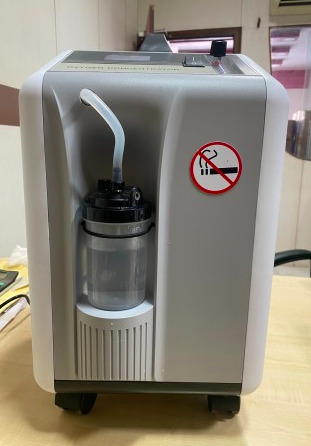
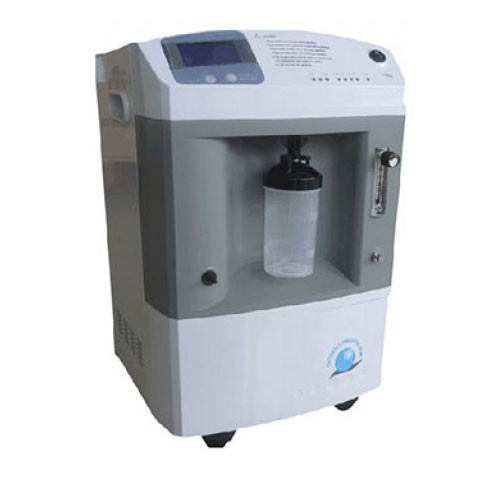
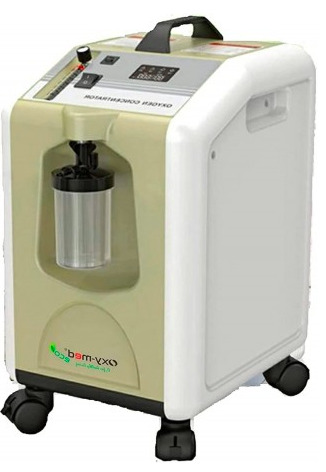
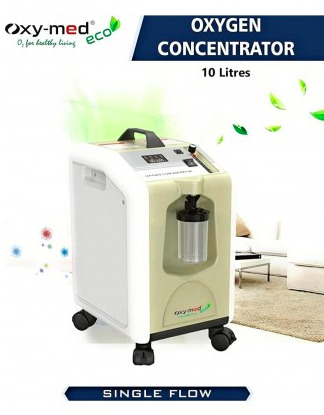
Oxymed Eco 10 LPM
Key features
- Purity 90-95%
- Type High Flow Stationary
- Continuous Flow 1-10LPM
- Weight 20kg
- Oxygen Purity Indicator (OPI) No
- Power consumption 770watts
Specifications
| Purity | 90-95% |
|---|---|
| Type | High Flow Stationary |
| Continuous Flow | 1-10LPM |
| Weight | 20kg |
| Power consumption | 770watts |
| Sound level | 55db |
| Dimensions | 26.7H x 17.5W x 15.7Dinch |
| Outlet pressure | 11.6psi |
| Loss of Power Alarm | Yes |
|---|---|
| Indian Voltage Model | Yes |
| Company Headquarters | China |
Pros and cons
PROS
- 1–10 LPM continuous flow suits two-patient or single-patient high-flow use
- 20 kg is relatively light for a 10 LPM high-flow unit
- 55 dB sound claim is reasonable for this output class
- 11.6 psi outlet pressure supports long cannula runs and enrichment circuits
CONS
- Discontinued SKU — no fresh warranty, parts sourcing harder
- 770 W power draw demands a 2 kVA UPS and stabiliser
- No OPI, no system-malfunction alarm, CE Certified field blank
The Oxymed Eco 10 LPM is a high-flow stationary oxygen concentrator rated for 1–10 LPM continuous flow at 90–95% purity, 20 kg chassis weight, 55 dB sound claim, 770 W power consumption and 11.6 psi outlet pressure. The SKU is listed as discontinued in manufacturer brochure and e-commerce product listings, with indicative pricing at capture of roughly ₹52,499 current against a ₹120,000 MRP — a gap large enough that the “current price” number functioned as clearance rather than steady-state retail. In 2026 this is a used-market machine only, with a specific use case that is worth spelling out: short-duration high-flow therapy where a 5 LPM unit is not enough, and where the household can tolerate the certification and alarm gaps that come with discontinued budget stock.
What the specs mean
Six spec lines dictate whether this unit is worth considering.
1–10 LPM continuous flow at 90–95% purity. The 10 LPM category is typically used for three situations: a single patient requiring high-flow support (severe COPD exacerbation, late-stage interstitial lung disease, post-surgical recovery on high FiO₂); a dual-patient feed with a Y-splitter for two concurrent low-flow patients sharing one machine (rare, but a real use case in some small nursing homes); and enrichment of a CPAP or ventilator circuit. The Eco 10 LPM’s 90–95% purity claim is ISO-window adequate (ISO 80601-2-69); per-LPM purity curves are not published, which is the norm in this price bracket but a real gap compared to Philips Respironics or Nidek 10 LPM high-flow units.
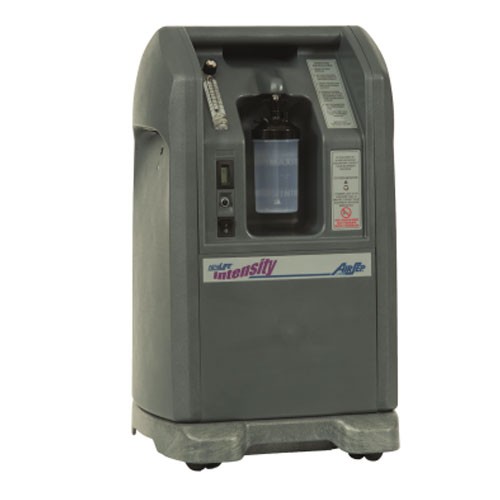
20 kg chassis, 26.7 × 17.5 × 15.7 inches. Twenty kilograms is actually respectable for a 10 LPM unit — the premium Philips SimplyFlo and AirSep Intensity class machines typically run 25–30 kg. This means the Eco is movable by one adult with dollies or wheels, even if two people are preferable on staircases. The footprint is larger than any 5 LPM unit — it needs its own corner, not a bedside slot.
55 dB sound claim. A 10 LPM compressor running at high flow will generate more noise than a 5 LPM compressor at the same flow, simply because of the larger airflow through the sieve beds and cooling fan. 55 dB is in the “will not be comfortable in a bedroom” band — conversational speech is ~60 dB for reference. This machine wants its own room, or at least a wall between it and where the patient sleeps, with a long cannula run.
770 W power consumption. Significantly higher than the 5 LPM line, and real for household planning. At ₹7–9 per kWh Indian residential tariffs, 24/7 operation at full flow runs roughly ₹4,000–5,000 per month in electricity, before slab-rate punishments kick in. A 2 kVA UPS is needed to bridge even short grid blips — 1 kVA will not carry this load for more than seconds. Stabiliser is mandatory in voltage-unstable areas.
11.6 psi outlet pressure. Good — high outlet pressure helps with long cannula runs and is the right specification for a machine that might feed a CPAP or ventilator enrichment circuit. Most home 5 LPM units run 7–10 psi; 11.6 psi gives real headroom.
No OPI, no system-malfunction alarm, no CE certification on record. The manufacturer brochure’s additional-details table shows blank entries for Oxygen Purity % Analyzer, System Malfunction Alarm, No Flow Alarm and CE Certified. Only Loss of Power Alarm is ticked. For a 10 LPM unit used in acute clinical settings this is a serious gap — purity drift at high flow is harder to detect clinically than at low flow (saturation can stay normal on patient side while actual delivered oxygen falls), and an OPI is the single most useful device-level monitor. The certification gap matters for institutional purchasing; many small nursing homes and hospice operators have CE or US FDA requirements as a minimum.
Who should buy
Rental fleet operators replacing end-of-life units. High-flow concentrators have a different rental economics than 5 LPM units — rental rates typically run ₹10,000–15,000 per month because the target patients are more acute and the therapy duration is usually shorter (days to weeks rather than months to years). A used Eco 10 LPM at ₹25,000–35,000 can pay back in three to four rental cycles if downtime is managed well.
Small nursing homes and hospice operators running existing Oxymed fleets. If a facility already has Oxymed Mini 5 LPM units and an established service relationship with a local Oxymed partner, adding a discontinued 10 LPM sibling to the fleet for occasional high-flow need is a defensible use of ₹25,000–40,000 capex, provided the facility can backstop with bottled oxygen cylinders for the failure case.
Households in acute-phase support for late-stage respiratory disease. Weeks-to-months duration, high-flow prescription (6–10 LPM), where the patient’s prognosis or clinical plan does not justify a ₹1.5–2 lakh investment in a premium Philips or Nidek 10 LPM. A used Eco 10 LPM with cylinder backup covers the clinical need without the capex.
Who shouldn’t
New-unit buyers at anything like MRP. The ₹120,000 MRP on this SKU is a legacy number. No 2026 buyer should pay anywhere near that — the money instead buys a current-production Oxymed 10 Litres Dual Flow, a Home Medix HM-KX 10 LPM, or a Nareena 10 LPM Dual Flow, all of which have active warranty and current certification paperwork.
Long-duration high-flow therapy (>6 months). The missing OPI and incomplete alarm coverage are a real risk over extended high-flow use. If a patient is projected to need 6+ LPM for more than a few months, step up to a current-production 10 LPM unit with OPI and preferably CE.
Any household without a backup plan for downtime. A 770 W machine running 24/7 in India will eventually face a grid outage longer than UPS capacity, a compressor service call, or a sieve-bed failure. High-flow patients cannot tolerate an hour off oxygen. If the household cannot maintain at least one D-size oxygen cylinder as backup, the Eco 10 LPM is not the right plan.
Altitude users. No altitude rating published. High-flow units degrade faster at altitude than low-flow units — sieve efficiency falls with reduced ambient partial pressure of oxygen. Above ~5,000 feet, plan differently.
Head-to-head alternatives
Oxymed Eco 10 LPM vs current Oxymed 10 Litres Dual Flow. The direct Oxymed comparison. Current unit is 24 kg (heavier), 50 dB sound (quieter than Eco’s 55 dB claim), 610 W power (meaningful saving vs Eco’s 770 W — 160 W over 24/7 is about ₹1,000/month), 14.5 psi outlet (higher), 90–96% purity (one percentage point higher ceiling), with OPI, no-flow alarm, and system-malfunction alarm all present; no CE or US FDA on record for either unit — CDSCO registration applies as the domestic regulatory gate. Current street price is around ₹50,000–65,000. Verdict: the current Oxymed 10 Litres wins on every dimension that matters clinically. The Eco is only defensible on absolute used price.
Oxymed Eco 10 LPM vs Home Medix HM-KX 10 LPM. HM-KX is a current-production 10 LPM at roughly ₹65,000 street price, 25.6 kg, ≤48 dB field-verified, 550 VA (lowest in the 10 LPM class), 0.04–0.06 MPa outlet, full alarm suite, integrated nebulization, dealer-validated SOS audible siren, 3-year / 10,000-hour warranty, CDSCO + ISO 9001 + ISO 13485 paperwork. Verdict: HM-KX is the current-production upgrade pick for any household in a Home-Medix-served city; Eco 10 LPM is the deep-discount used alternative only.
Oxymed Eco 10 LPM vs Nareena 10 LPM Dual Flow. Nareena 10 LPM Dual Flow is a current-production Indian 10 LPM unit at ~₹59,000 street price, 22.6 kg, 50 dB, 720 W, 8 psi outlet, 90–96% purity, OPI on board, one-year warranty. Nareena’s certification is similar to Eco (CE blank), but it has OPI and an active distribution and warranty. Verdict: Nareena is the new-unit budget pick for 10 LPM in India; Eco is only the cheaper used alternative.
Indian-market considerations
Oxymed’s service network applies to this SKU on an out-of-warranty basis, which is the one meaningful positive for a used buyer. Sieve-bed replacement, compressor service and filter changes are all within the capability of most Oxymed authorised partners in major cities. The compressor class used at 770 W is a standard Chinese-manufactured 10 LPM module also used in other Indian-brand machines, so third-party sieve replacement cartridges are findable if dealer stock lapses.
Power planning is the big household-level question. 770 W is real; on an Indian residential connection with a 5 kVA sanctioned load, the concentrator alone takes 15% of available load, and simultaneous operation of AC, geyser or kettle will trigger breaker trips or voltage sag on weak neighbourhood grids. A dedicated circuit is prudent. UPS sizing needs to be at least 2 kVA for 15+ minutes of bridge; for longer bridging, 3 kVA with deep-cycle batteries is typical in small-town setups where two-hour outages are not unusual.
Rental-market presence is specifically where this SKU still has life — used Eco 10 LPM stock circulates through rental fleets and dealer consignments at prices that work the unit economics of short-duration high-flow therapy. In Indore, Kanpur, Patna, Visakhapatnam and similar Tier-2 cities, families taking delivery of an oxygen rental for an acute-phase parent frequently see this exact machine show up. That is fine — it does the job for 30–90 days of rental use, and the operator handles the maintenance tail.
Altitude and CDSCO notes: no altitude rating published, so assume plain-lands use only; CDSCO registration status on a discontinued SKU should be confirmed in writing by the dealer if the purchase is for institutional or insurance use.
Verdict
The Oxymed Eco 10 LPM is a legacy budget 10 LPM concentrator that has aged out of the current-production catalogue. It is too lean on alarms and purity indication to recommend to any new buyer at anything resembling MRP, and too heavy on power draw to recommend for long-duration high-flow therapy even at used pricing. But for the narrow slice of buyers who actually need 10 LPM output, have a ₹25,000–40,000 used-market budget cap, and run cylinder backup for the failure case, it is a serviceable tool — the chassis mechanics are sound, the Oxymed service network applies, and the compressor class is a known quantity.
Most readers looking at a 10 LPM machine in 2026 should be comparing the current Oxymed 10 Litres Dual Flow and the Home Medix HM-KX 10 LPM instead. If you specifically encounter an Eco 10 LPM at a used price below ₹30,000 with fresh service paperwork and you have a bounded high-flow need, it will do the job. Score: 4.7.