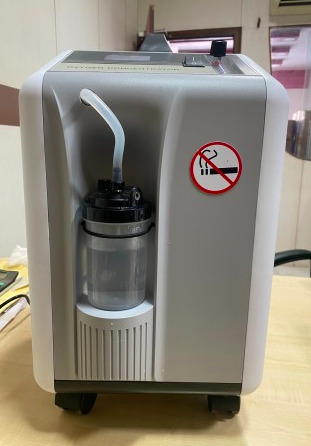
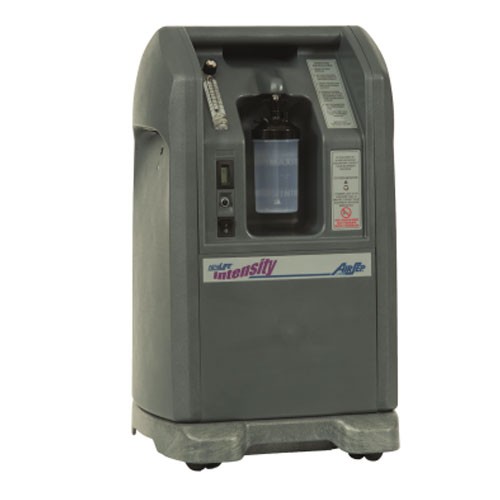
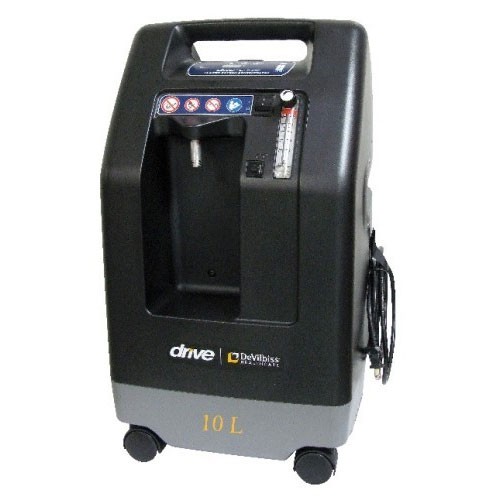
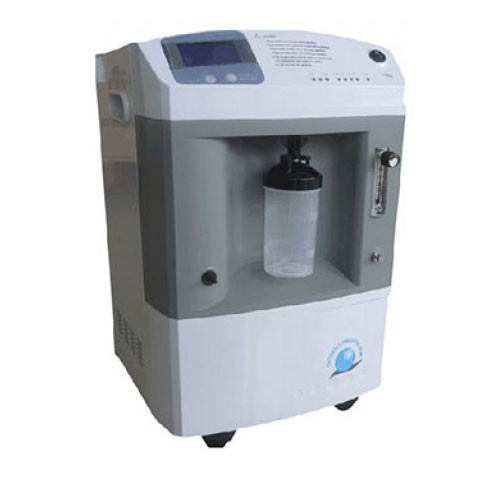
Nareena 10 LPM Dual Flow
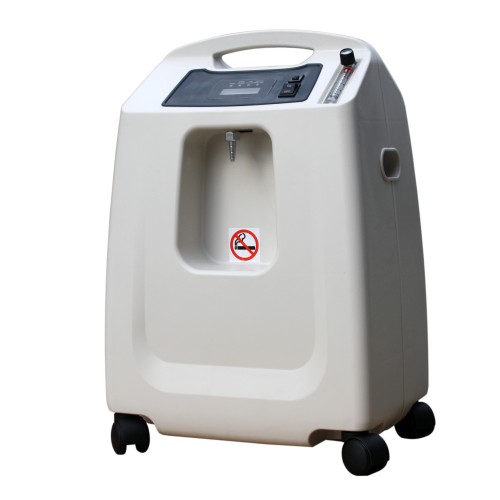
Key features
- Purity 90-96%
- Type High Flow Stationary
- Continuous Flow 1-10LPM
- Weight 22.6kg
- Oxygen Purity Indicator (OPI) Yes
- Power consumption 720watts
Specifications
| Purity | 90-96% |
|---|---|
| Type | High Flow Stationary |
| Continuous Flow | 1-10LPM |
| Weight | 22.6kg |
| Oxygen Purity Indicator (OPI) | Yes |
| Power consumption | 720watts |
| Sound level | 50db |
| Dimensions | 24.4H x 16.9W x 12.6Dinch |
| Outlet pressure | 8psi |
| Loss of Power Alarm | Yes |
|---|---|
| Indian Voltage Model | Yes |
| Company Headquarters | India |
Pros and cons
PROS
- 1–10 LPM continuous flow with 90–96% purity across range
- 22.6 kg chassis is slightly lighter than Oxymed 10 Litres
- OPI on board — critical for extended high-flow therapy
- ₹59,000 indicative street price is competitive in the segment
CONS
- 720 W power draw is higher than most 10 LPM peers
- Only loss-of-power alarm on spec sheet — no system-malfunction or no-flow alarms
- CE Certified field blank and one-year warranty is shortest in class
The Nareena 10 LPM Dual Flow is a high-flow home stationary oxygen concentrator from Nareena Lifesciences, rated for 1–10 LPM continuous flow at 90–96% oxygen purity, 22.6 kg chassis weight, 50 dB sound claim, 720 W power consumption and 8 psi outlet pressure. Indicative street price runs ₹59,040 against a ₹76,800 MRP per manufacturer brochure and e-commerce product listings. The SKU is in stock, carries OPI on board, and ships with a one-year warranty — shorter than any of its direct peers. Nareena Lifesciences is a second-tier Indian medical-devices company with a thinner distribution footprint than Oxymed or BPL; the 10 LPM Dual Flow is positioned as a price-aggressive entry into the high-flow segment. This review evaluates whether the ₹59,000 asking price buys enough machine to justify the weaker service and paperwork profile.
What the specs mean
Five spec lines dictate the Nareena 10 LPM’s real-world fit.
1–10 LPM continuous flow at 90–96% purity. Standard high-flow category, ISO-window adequate (ISO 80601-2-69). The 96% ceiling matches the current Oxymed 10 Litres Dual Flow and the Home Medix HM-KX 10 LPM. Purity-across-range is claimed but not curve-documented, which is normal for this price bracket. Dual-flow capability (two simultaneous outlets) is real and functional — suitable for Y-splitter two-patient use in small nursing-home settings.
22.6 kg chassis, 24.4 × 16.9 × 12.6 inches. Slightly lighter than Oxymed 10 Litres (24 kg) but heavier than the Oxymed Eco 10 LPM (20 kg). Definitely not mobile — this is a placement machine, and the form factor is broad and squat rather than tall and narrow. For fixed-placement home or institutional use the weight is acceptable; for any relocation-dependent therapy it is too heavy.
50 dB sound claim. Middle-of-pack for 10 LPM. Adequate for placement in a separate room with a long cannula run; marginal for shared-bedroom use. Compared to the Home Medix HM-KX 10 LPM’s ≤48 dB field-verified (roughly 2 dB quieter, the class-tied-quietest figure), Nareena is noticeably less bedroom-friendly; compared to Oxymed 10 Litres’ 50 dB claim, it is tied.
720 W power consumption. This is the single worst spec on the datasheet relative to peers. At 720 W the Nareena 10 LPM is 110 W higher than the Oxymed 10 Litres Dual Flow (610 W) and 170 W higher than the Home Medix HM-KX 10 LPM (550 VA — the lowest draw in the 10 LPM class). On 24/7 operation at typical Indian residential tariffs, 720 W costs ₹3,600–4,700 per month in electricity — roughly ₹600/month more than Oxymed and ₹1,000/month more than HM-KX. Over a two-year high-flow therapy, that cumulative electricity differential is real. Power draw matters at this output class.
8 psi outlet pressure. Middle of the pack — roughly on par with the Home Medix HM-KX 10 LPM’s 0.04–0.06 MPa (~5.8–8.7 psi) range, and significantly lower than the Oxymed 10 Litres Dual Flow’s 14.5 psi. Adequate for standard nasal cannula use; marginal for Y-splitter dual-patient configurations or enrichment circuits. For a unit whose selling point is “dual flow”, this outlet pressure is not generous.
Alarms minimal, CE blank, one-year warranty. The manufacturer brochure’s additional-details table shows only Loss of Power Alarm ticked. System Malfunction Alarm, No Flow Alarm, Oxygen Purity % Analyzer and CE Certified fields are all blank. This is the thinnest safety package in the current-production 10 LPM category on the Indian market. The OPI is on board — which is the single most critical item — so purity-drift indication is available. But the absence of a system-malfunction alarm means certain compressor or sieve failure modes will go un-signalled to the household, which is a meaningful gap on a high-flow therapy unit.
The one-year warranty is half the industry standard (Oxymed 10 Litres ships with two-year warranty; Home Medix HM-KX with three years or 10,000 hours; Philips and Nidek typically two-to-three-year). For a unit that will run 24/7 and is subject to compressor wear, one year of warranty coverage is materially less valuable than two or three. Buyers should budget for post-warranty service from year two.
Who should buy
Three narrow fit profiles.
Buyers with an existing Nareena dealer relationship. Some Tier-2 and Tier-3 cities have Nareena authorised dealers with strong local service track records, particularly in parts of Andhra Pradesh, Telangana, and some northern Karnataka regions. For buyers in those markets, a Nareena unit with a trusted local dealer is more valuable than a nominally-better-specced Oxymed or BPL unit with a distant authorised partner. This is a real consideration and the main legitimate case for choosing Nareena.
Bounded short-duration high-flow therapy (3–12 months). If the clinical plan projects 12 months or less of high-flow therapy — typical for some post-surgical recovery or acute-phase COPD step-down — the one-year warranty covers the therapy duration entirely, and the post-warranty service risk never materialises. For this use case the capex-only comparison with Oxymed 10 Litres Dual Flow is closer, and a buyer with a specific Nareena dealer can pick Nareena without meaningful risk.
Rental-fleet buyers at consignment discounts. Rental operators sometimes acquire Nareena stock at institutional pricing well below the single-unit street price. At ₹45,000–50,000 per unit in institutional quantity, the economics work for a rental book serving short-duration high-flow patients in Tier-2 cities.
Who shouldn’t
Long-duration therapy households. Two-year-plus high-flow therapy requires warranty coverage that extends beyond the Nareena’s one-year term. Post-warranty compressor service on a high-flow unit typically runs ₹8,000–15,000 per incident; the probability of at least one such incident in year two is material. Buy a two-year-warranty peer instead.
Power-cost-sensitive households. The 720 W draw costs roughly ₹600–2,000/month more in electricity than peers. Over any multi-year therapy, that differential dwarfs the capex savings. Power-efficiency matters specifically in 10 LPM — this is the wrong unit if that matters.
Shared-bedroom and multi-room-relocation users. Same constraints as any 20+ kg 10 LPM unit — this is not a mobile machine, and the noise is not bedroom-grade.
Institutional buyers with strict certification requirements. The CE blank and thin alarm package will fail some hospital procurement specifications. Confirm specification compliance before committing to institutional orders.
Head-to-head alternatives
Nareena 10 LPM Dual Flow vs Oxymed 10 Litre Oxygen Concentrator (Dual Flow). The direct Indian-brand comparison. Oxymed specs: 24 kg (1.4 kg heavier), 50 dB (tied), 610 W (110 W lower power), 14.5 psi outlet (significantly higher), 90–96% purity (tied), full alarm package (Nareena has only loss-of-power), CDSCO registered (Nareena blank on published regulatory paperwork; neither carries CE or US FDA on record), two-year warranty (double Nareena’s), Indian headquarters, ~₹50,000–65,000 street price. Verdict: Oxymed 10 Litres wins on alarm completeness, domestic regulatory paperwork, power efficiency, outlet pressure and warranty, at a price that is effectively the same or slightly lower. Nareena is the weaker option on specs and paperwork; there is no meaningful category in which it beats the Oxymed. Buy Oxymed unless you have a specific Nareena dealer reason.
Nareena 10 LPM Dual Flow vs Home Medix HM-KX 10 LPM. Feature-density comparison. HM-KX specs: 25.6 kg (3 kg heavier), ≤48 dB field-verified (2 dB quieter, class-tied-quietest), 550 VA (170 W lower power — the lowest draw in the 10 LPM class), 0.04–0.06 MPa outlet, 90–96% purity (tied on ceiling), full alarm suite (Low Oxygen / Power / High Temp / Low-No Flow), integrated nebulization, dealer-validated SOS audible siren, three-year / 10,000-hour warranty, CDSCO + ISO 9001 + ISO 13485 paperwork, ~₹65,000 street price. Verdict: HM-KX wins on sound, power, alarm completeness, feature density (integrated nebulizer and SOS), and warranty. Nareena wins only on weight and dual-flow routing. For single-patient LTOT, HM-KX is the clear pick; for genuine dual-patient households where Y-splitter routing matters, Nareena keeps one narrow defensible use case.
Nareena 10 LPM Dual Flow vs discontinued Oxymed Eco 10 LPM. For used-market buyers considering either. Eco specs: 20 kg, 55 dB, 770 W, 11.6 psi, 90–95% purity, only loss-of-power alarm, CE blank, discontinued, used-market pricing ₹25,000–40,000. Verdict: Eco is the cheaper option on used market and has better outlet pressure; Nareena is the current-production option with fresh warranty (however short) and OPI on board. For a new buyer the Nareena is the right choice between the two. For a used-market buyer at deep discount the Eco is defensible.
Indian-market considerations
Nareena Lifesciences operates a smaller distribution footprint than Oxymed or BPL. The brand’s dealer network is strongest in parts of South India (Andhra Pradesh, Telangana) and selected northern cities, with weaker coverage in the Northeast, Odisha and hill stations. Before buying, confirm the nearest authorised Nareena service centre and its hours — in many cities the de facto service path is through a single distributor who also handles post-warranty work, which is fine when it works but risky when that specific dealer relationship breaks down.
Rental-market presence is thin. Most rental fleets standardise on Oxymed, Philips and BPL; Nareena appears in fleets less frequently, which means secondary-market supply is limited and resale liquidity is weaker. A used Nareena 10 LPM often sells for 40–50% of original price at resale, vs 55–65% for a comparable Oxymed.
Power planning needs particular attention. 720 W on 220 V / 50 Hz requires a 2 kVA UPS minimum for short outage bridging, and in voltage-unstable areas a stabiliser is essential — the compressor class used in 10 LPM Chinese-origin modules is sensitive to under-voltage and will trip or degrade faster under poor-quality supply. Dedicated 5 amp circuit is prudent; shared circuits with AC or kettle will trip breakers.
Altitude and CDSCO: no altitude rating published, so plains deployment only. CDSCO registration status should be confirmed from Nareena in writing for institutional or insurance-reimbursed use — Nareena is Indian-headquartered and compliance is expected, but paperwork delivery is sometimes slow and buyers should get documentation up front.
Service-claim experience on Nareena 10 LPM units is meaningfully variable. In strong-dealer markets the brand delivers first-response SLAs in the three-to-five working day range; in weaker markets that stretches to two weeks or longer, particularly for sieve-bed replacement parts that typically ship from a central stock point. For a high-flow therapy patient, a two-week downtime window is not acceptable; bridging requires cylinder backup. Factor cylinder logistics into the buying decision.
Verdict
The Nareena 10 LPM Dual Flow is a budget-positioned 10 LPM that does enough to not be a bad purchase but not enough to be a good purchase when the current Oxymed 10 Litre (Dual Flow) is available at the same or lower price with better specs across every meaningful axis. The OPI on board is the one item that rescues it from being unbuyable — without purity indication a high-flow unit at this price would be indefensible — but the thin alarm set, one-year warranty, missing CDSCO marker on the surveyed listing and 720 W power draw collectively describe a machine that was priced to match Oxymed without delivering Oxymed’s hardware quality.
Buy this unit only if you have a specific Nareena dealer relationship that gives you better local service than your nearest Oxymed authorised partner — that is the only real case for it. Every other buyer should pick Oxymed 10 Litre (Dual Flow) instead. Score: 5.8.